

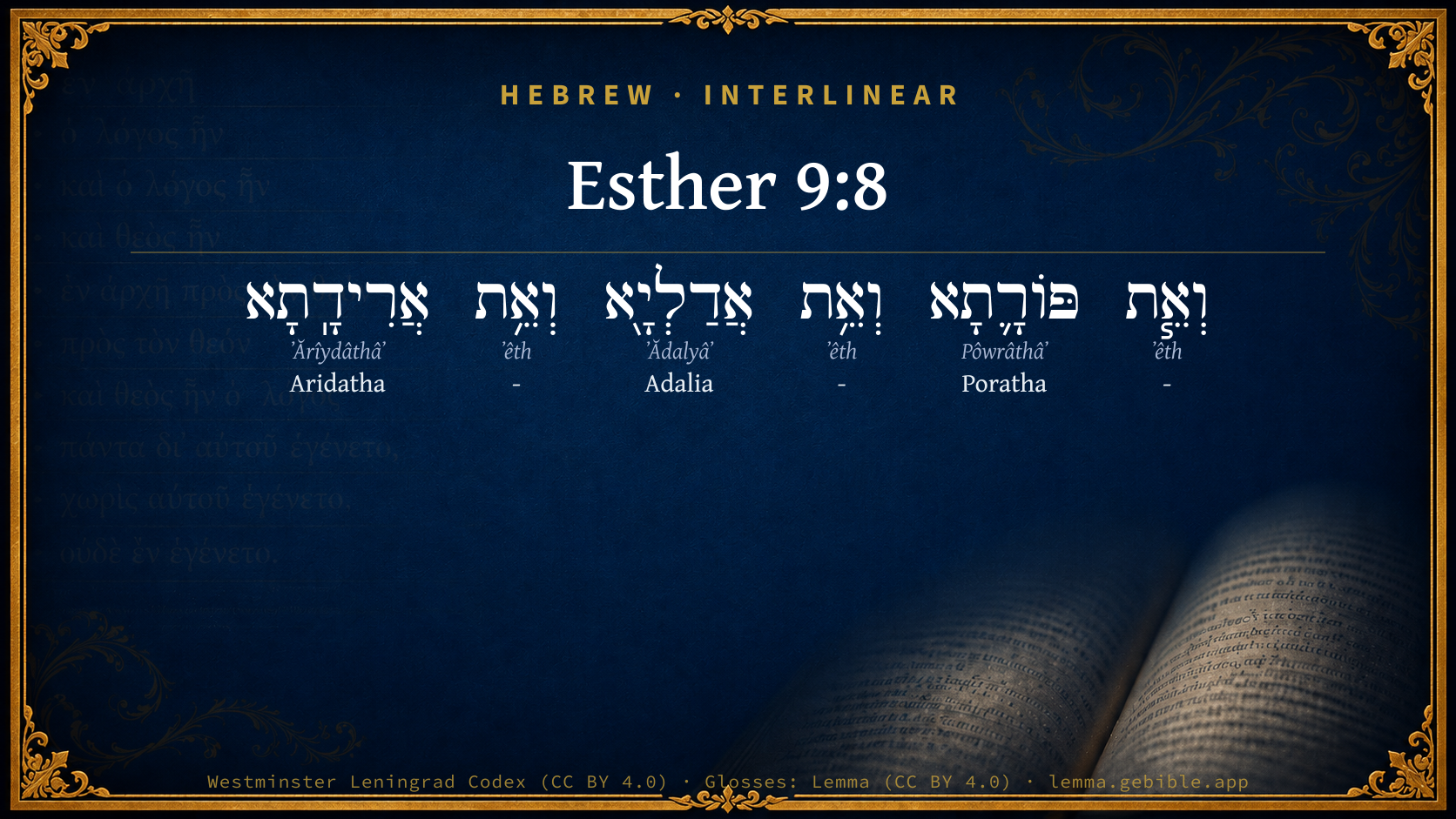
וְאֵ֧ת פּוֹרָ֛תָא וְאֵ֥ת אֲדַלְיָ֖א וְאֵ֥ת אֲרִידָֽתָא
and Poratha, and Adalia, and Aridatha,
World English Bible · Public Domain
and Poratha, and Adalia, and Aridatha,
One document with this verse’s original text, its word-by-word gloss line, the meaning frame, cross-references with their text, attributed commentary, and full source and license credits — printable, and it pastes into notes with its structure intact.
This verse Autodidact and up
A passage Seminary Student
Up to 50 verses in one chapter. A passage sheet keeps up to 6 commentary sources and 12 cross-references per verse, in the order this page ranks them, and says so on the sheet whenever that leaves anything out. Ask for a single verse and you get the Autodidact verse sheet above.
Everything on this page stays free to read, with no account — the sheet is a download of what is already on screen, not access to it.
The same verse in 3 English versions, stacked beneath the original-language interlinear above. Click any original word for its lexicon entry.
Each is an independent rendering of the whole verse — the interlinear is not word-aligned to these translations.
Highlighted words mark where these versions differ — a whole-verse word diff, not a word-by-word alignment.
and Poratha, and Adalia, and Aridatha,
And Poratha, and Adalia, and Aridatha,
and Poratha and Adalia and Aridatha
unfoldingWord Literal Text — © unfoldingWord, licensed CC BY-SA 4.0. Word-aligned USFM3 via Door43 (git.door43.org/unfoldingWord/en_ult).
Every available English version of this verse, each an independent rendering of the whole verse.
and Poratha, and Adalia, and Aridatha,
Poratha, Adalia, Aridatha,
Poratha, Adalia, Aridatha,
And Poratha, and Adalia, and Aridatha,
and Poratha, and Adalia, and Aridatha,
and Poratha, and Adalia, and Aridatha,
And Poratha, and Adalia, and Aridatha,
And Phoratha, and Adalia, and Aridatha,
and Poratha, and Adalia, and Aridatha,
and Poratha, and Adalia, and Aridatha,
Poratha, Adalia, Aridatha,
and Poratha and Adalia and Aridatha
and Poratha, and Adalia, and Aridatha,
Poratha, Adalia, Aridatha,
And Poratha, and Adalia, and Aridatha,
Poratha, Adalia, Aridatha,
Poratha, Adalia, Aridatha,
and Poratha, and Adalia, and Aridatha,
Literal Standard Version (2020), Covenant Press — licensed CC BY-SA 4.0. Text via the HelloAO Bible API (eBible.org). Unlocked Literal Bible (unfoldingWord) — licensed CC BY-SA 4.0. Text via the HelloAO Bible API (eBible.org). unfoldingWord Literal Text — © unfoldingWord, licensed CC BY-SA 4.0. Word-aligned USFM3 via Door43 (git.door43.org/unfoldingWord/en_ult). Free Bible Version, Dr. Jonathan Gallagher — licensed CC BY-SA 4.0. Text via the HelloAO Bible API (eBible.org).
More ways to search: Search by grammar → Find every occurrence → Compare this word →
Practice this passage: Drill this verse → Learn its vocabulary →
These counts appear in no published source. They are computed here, from the morphology-tagged text and Lemma’s own curated glosses. What Lemma adds →
Notable vocabulary
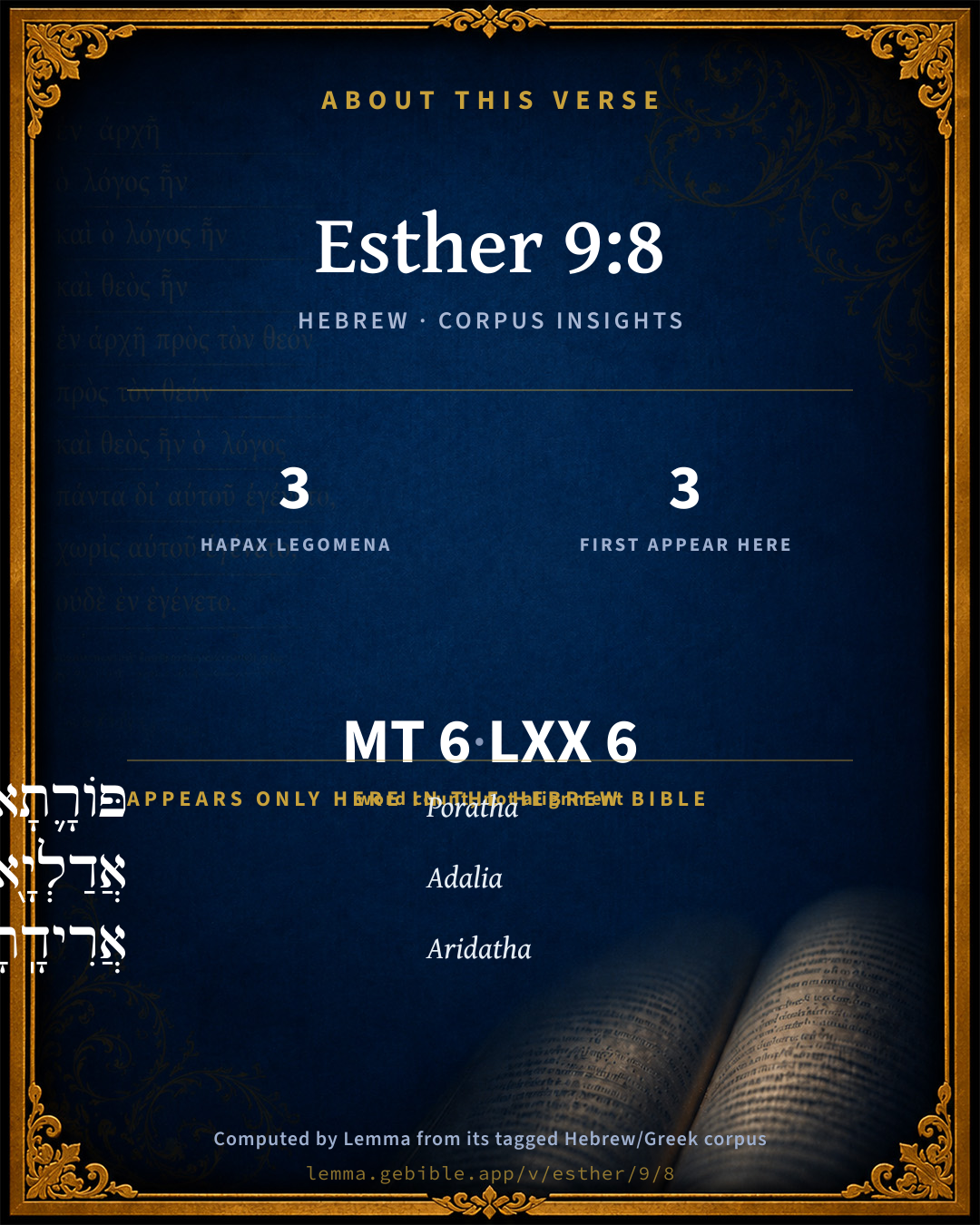
3 hapax legomena — words that appear only here in the entire Hebrew Bible:
First appearance in Scripture
These words make their first canonical appearance in the Hebrew Bible here:
Grammatical profile
Hebrew & Septuagint length
In English translation the verse runs 6 words from the Hebrew and 6 from the Septuagint (LXX English) — the same length.
A rough comparison of the two English renderings, which tokenize alike — not a word-level alignment.
Word counts can differ between the Hebrew and the Greek without any difference in meaning — e.g. the Hebrew direct-object marker אֵת has no separate Greek word, and Greek often adds the article ὁ.
In the original languages it is 6 Hebrew tokens and 6 Greek tokens — but the two are counted differently (Hebrew bundles its prefixes and suffixes into one token; the Greek is in lemma form), so that isn’t a like-for-like length.
The same verse in the two great witnesses to the Old Testament, shown verse-for-verse.
These are two independent witnesses, not word-aligned to each other, and the Septuagint is shown in lemma (dictionary) form.
וְאֵ֧ת פּוֹרָ֛תָא וְאֵ֥ת אֲדַלְיָ֖א וְאֵ֥ת אֲרִידָֽתָא
and Poratha, and Adalia, and Aridatha,
World English Bible · Public Domain
καί φαρδαθα καί βαρεα καί σαρβαχα
and Pharadatha, and Barea, and Sarbaca,
LXX2012 (modern English Septuagint) · Public Domain
Hebrew: Westminster Leningrad Codex (CC BY 4.0). Greek: Septuagint (public domain); English from LXX2012 (modern English Septuagint) (Public Domain). How the Septuagint differs from the Hebrew →
Teaching starters — assembled from the data on this page, not authored interpretation. Every prompt links to the verse data it draws on. Edit before teaching.
Esther, in the Historical, opens this verse with 6 words (4 distinct Hebrew lemmas). Its most distinctive word is Pôwrâthâʼ (“Poratha”). Read the whole chapter for the surrounding context.