שֶׁ֫לֶשׁ
Shelesh
BDB lists 2 entries for ‘Shelesh’ fuller range ↓
Full lexicon entry — Brown-Driver-Briggs (BDB)
From Brown-Driver-Briggs (BDB)
Where this word appears
Grammar key — what these labels mean
Noun type
- Proper
- A name of a specific person, place, or people (e.g. Abraham, Zion, Israel).
Every verse where H8028 appears — 1 distinct verse across 1 book. Click any verse to open its interlinear word-by-word view. Verse text shown in the World English Bible for context — . Each verse’s Hebrew form is shown with its reference; the English is not keyword-highlighted, since the data carries no word-level English alignment. Use “Compare translations” on any verse to read it across multiple English versions. This concordance covers the Hebrew Bible; Septuagint (Greek Old Testament) occurrences are not indexed here.
1 Chronicles 1 verse
About this entry
At a glance — auto-summarized from this page’s data, not written by a person. Every figure links to its source below. This summary describes the numbers; it doesn’t interpret them.
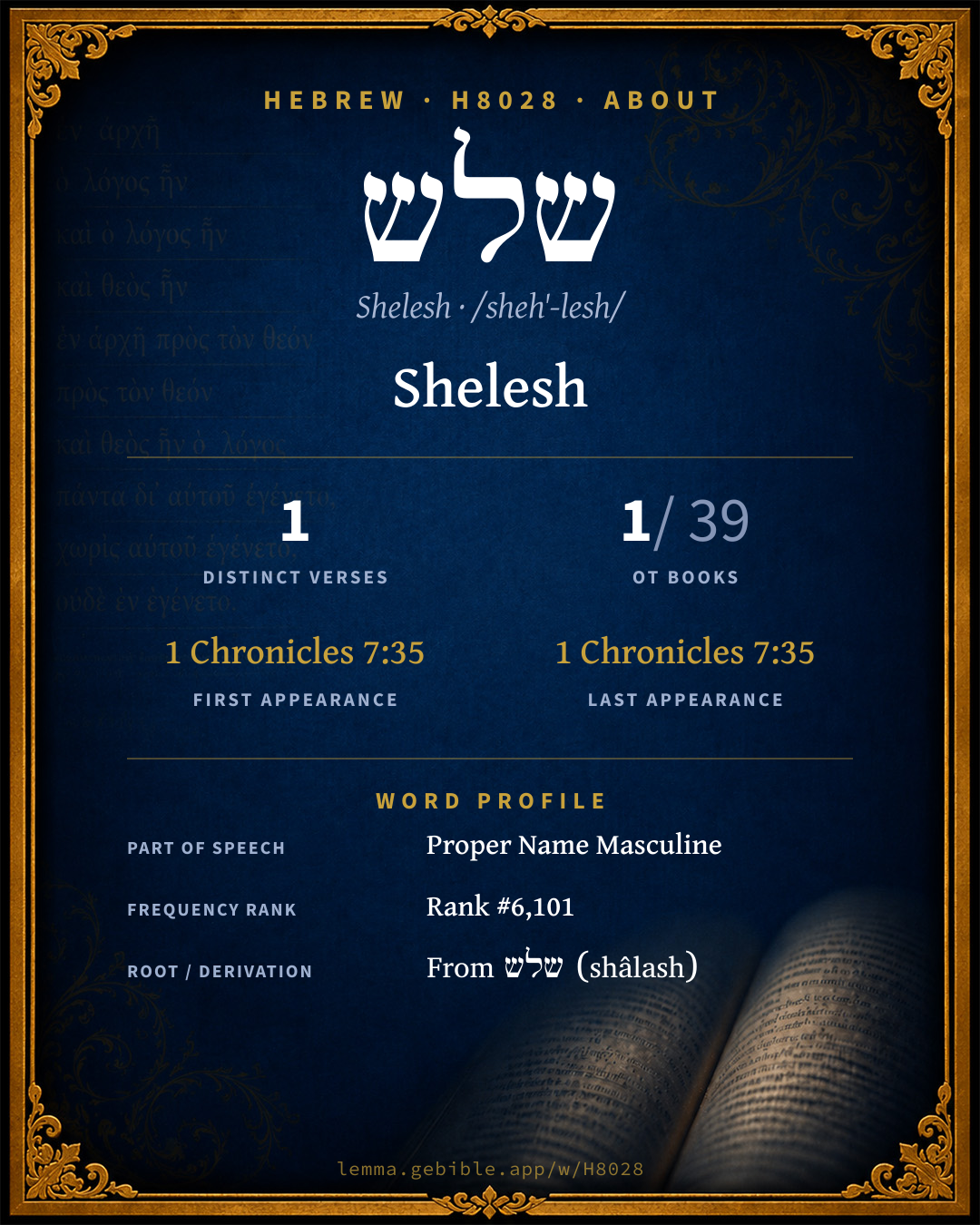
שלש — transliterated Shelesh — is a Hebrew name carrying the sense “Shelesh.” A scarce word — 1 verse in all of the Hebrew Bible. More than three-quarters of its appearances fall in 1 Chronicles. A true hapax — its single appearance is 1 Chronicles 7:35. See 1-verse concordance and the renderings breakdown below.
Gloss history
Strong's 1890 vs modern scholarship
About this word
Strong's H8028 catalogs a Hebrew word from the Hebrew Old Testament.
These counts are not copied from any lexicon or concordance. They are computed here, from the morphology-tagged Hebrew Old Testament. What Lemma adds →
- 1
- distinct verses
- The word appears in 1 distinct verse.
- 1 / 39
- OT books
- The word appears in 1 of 39 Old Testament books.
- #6,101
- by frequency
- Rank #6,101 (rank 6,101 of 8,640 Hebrew words by occurrence).
View all 1 occurrence in the concordance →
Most concentrated in
- 1 Chronicles 1 verse 100%
By section of the Old Testament
By traditional corpus
Conventional, traditional groupings — biblical authorship is debated, so this is a traditional corpus grouping, not an authorship claim. Each share is this word’s portion of its verses in that division of the Hebrew canon. Each figure is a share of the word’s 1 distinct verse.
- Writings (Ketuvim) 1 verse · 100%
How translations render this word
Counts come from each version’s own published word-to-Strong’s tagging or interlinear alignment — an approximate guide to how each version renders this word, not a word-level alignment the data otherwise carries. Because each total is that version’s own tagged count, the per-version totals vary from one another and need not match the appearance or distinct-verse counts above. These counts may also differ from a printed concordance because Lemma counts each distinctly tagged rendering and does not collapse phrase taggings into a single head-word total. This is a fixed set of word-tagged versions (KJV, ASV, BSB, ULT) and does not change with the reading translation you choose elsewhere. Each version’s license is shown beside its name below (and on Sources).
- King James Version: Shelesh 1×
- American Standard Version: Shelesh 1×
- Berean Standard Bible: Shelesh 1×
- unfoldingWord Literal Text: Shelesh 1×
King James Version Public Domain
Renders H8028 across 1 tagged occurrence — most commonly:
American Standard Version Public Domain
Renders H8028 across 1 tagged occurrence — most commonly:
Berean Standard Bible Public Domain
Renders H8028 across 1 tagged occurrence — most commonly:
unfoldingWord Literal Text CC BY-SA 4.0
Renders H8028 across 1 tagged occurrence — most commonly:
Senses in BDB
The 2 senses BDB distinguishes for this word, in lexicon order (not ranked by frequency or importance). The full entry — with sub-senses — is in the Lexicon Entry tab.
- Shelesh = "might"
- an Asherite, son of Helem
Word origin
שֶׁ֫לֶשׁ n.pr.m. in Asher, 1 Ch 7:35
— Brown-Driver-Briggs (Oxford 1906, public domain), digitized via Sefaria, supplemented by the OpenScriptures HebrewLexicon (CC BY 4.0). See Sources.
Derived from שלש (shâlash) (H8027) — to divide in three.
Jastrow Dictionary
A second Hebrew/Aramaic lexicon for comparison, covering Aramaic and post-biblical (Talmudic, Targumic, Midrashic) usage that the biblical-Hebrew BDB does not. Matched by lemma rather than by Strong’s number, so a lemma may carry more than one Jastrow headword (shown separately below), and the entries cover usage well beyond the Bible.
שָׁלשׁ
- , v. שְׁלשָׁה
שָׁלַשׁ
- 1. to do or come for the third time. Num. R. s. 420 לא יצאת אותה שנה ולא שינתה ולא שִׁילְּשָׁה וכ׳ not that year passed, nor the second, nor the third, when &c., i.e. within three years these things occurred; a. e.
- 2. to go back to the third generation. B. Bath. X, 7 יְשַׁלְּשׁוּ they should write the grandfather’s name in the document.
- 3. to divide into three parts. Ib. III, 4 מְשַׁלְּשִׁין ביניהם the fine is divided between them (the three sets of witnesses convicted of an alibi); Macc. I, 3. Ib. משלשין בממון ואין מש׳ במכות the monetary fine is divided, but not the punishment (but every one has to undergo the full punishment). Ab. Zar. 19ᵇ לעולם יְשַׁלִּשׁ אדם שנותיו שליש וכ׳ a man should always divide his years (his time) into three parts, devoting one third to Bible, one to Mishnah &c.; Kidd. 30ᵃ יַשְׁלִישׁ (Hif.). Ex. R. s. 1527 הריני מְשַׁלְּשָׁם I will divide them among us three; a. fr.—Part. pass. מְשׁוּלָּשׁ; f. מְשׁוּלֶּשֶׁת; pl. מְשׁוּלָּשִׁים, מְשׁוּלָּשִׁין; מְשׁוּלָּשׁוֹת a) done for the third time. Ab. Zar. l. c., כתוב … ומש׳ בכתובים stated in the Torah, a second time in the Prophets, and a third time in Hagiographa; Meg. 31ᵃ; a. fr.—b) divided into three, arranged in three classes, threefold. Deut. R. s. 233 (ref. to והשלשית, Zech. XIII, 8) אלו ישראל אנקראו שלישין שהם מש׳ וכ׳ that means Israel, who are called ‘thirds’, for they are divided into three classes, priests &c. Midr. Prov. to XXII, 20 (ref. to שלשים, ib.) כל מעשי תורה מש׳ היא מש׳ ואותיותיה מש׳ … שבט מש׳ וכ׳ all affairs of the Torah are threefold; itself is threefold: Torah, Prophets, and Hagiographa, and its signs are threefold: אמת (Truth); and it was given through a tribe third in order: Reuben, Shimeon, and Levi; משה מש׳ Moses the third born &c. Cant. R. to I, 1 כל מעשיו … מש׳ היו all the events of that man’s (Solomon’s) life were marked by three stages (rise, fall, and rise).—B. Bath. X, 7 ואם היו מש׳ and if the names are alike up to the grandfather (v. supra); a. fr.—Y. Shebi. I, 33ᵇ, v. מְשׁוּלָּשׁ.—c) developed to one third of the full growth, v. מְשׁוּלָּשׁ. e.g. Zechariah 13:8
- 4. (apocop. of שִׁלְשֵׁל) to let down, v. שִׁלְשֵׁל I.
- 1. to divide into three parts. Kidd. l. c., v. supra. B. Mets. 42ᵃ לעולם יַשְׁלִישׁ … שליש וכ׳ a man should always have his capital divided into three parts, one-third invested in land, one in merchandise, and one in ready money; Yalk. Deut. 897; a. e.
- 2. (v. שָׁלִישׁ) to deposit. Keth. VI, 7 המַשְׁלִישׁ מעות לבתו … מה שׁהוּשְׁלַשׁ בידו if a father deposits money for the benefit of his daughter, and she says, I trust my husband (and want it to be given to him), the trustee must do that with it for which it was deposited with him; ib. 69ᵇ המשליש … לחתנו וכ׳ if one deposits money with his son-in-law to buy with it &c.; Tosef. ib. VI, 9; a. e.
- to be deposited, v. supra.
- to have been at a thing for the third time. Num. R. s. 9, v. מוּעָד.
שָׁלַשׁ ²
- to let down, suspend, v. שִׁלְשֵׁל I.
שִׁלְשֵׁל
- (שָׁלַל I) to let down. Y. Ber. IV, 7ᵇ top היו מְשַׁלְשְׁלִין וכ׳ in (ed. Lehm. מְשׁלְּשִׁין) they lowered for them (the besiegers) two basketfuls of gold &c.; פעם שִׁילְשְׁלוּ וכ׳ once they let down &c.; Sot. 49ᵇ; Men. 64ᵇ; B. Kam. 82ᵇ מְשַׁלְּשִׁין. Sabb. I, 11 משלשלין את הפסח וכ׳ the Passover lamb is let down into the stove &c.; Tosef. Pes. VII, 1. Tosef. Bets. IV, 3 אין משלשלין אותן וכ׳ you must not let them down from the window, but you may let them slide down on ladders (v. ed. Zuck. note). Lev. R. s. 19 נטלוהו ושִׁלְשְׁלוּהוּ (לו) they seized him and let him down the wall; Gen. R. s. 94, end. Yeb. XVI, 4 (121ᵃ) מעשה שׁשִׁלְשְׁלוּהוּ לים וכ׳ it happened at ʿAsia with one whom they let down into the sea (as diver), and (in hauling him up) they brought up nothing but his leg.; Y. ib. 15ᵈ top ששלשלהו הים (corr. acc.). Erub. 87ᵃ מְשַׁלְשֵׁל דלי וכ׳ he may let the bucket down and fill &c.; Tosef. ib. IX (VI), 24. Gen. R. s. 11 צריך לְשַׁלְשֵׁל (on the Sabbath) one must let his cloak hang down (not tuck up as for travel). Ib. ושִׁילְשְׁלָהּ ר׳ זעירא R. Z. pulled it down; a. fr.—Part. pass. מְשׁוּלְשָׁל; f. מְשׁוּלְשֶׁלֶת hanging down. Men. 41ᵇ כמה תהא מש׳ Ms. M. (ed. מְשׁוּלֶּשֶׁת, v. Rabb. D. S. a. l. note) how far must the threads of the show-fringes hang down (beyond the border)?; Yalk. Num. 750; ib. מְשׁוּלְשָׁלוֹת ארבע (Men. l. c. sing.) hanging down four finger-breadths.
A Dictionary of the Targumim, the Talmud Babli and Yerushalmi, and the Midrashic Literature (Marcus Jastrow; London, Luzac, 1903) — Public Domain. Digitized via Sefaria. Digitized via Sefaria. Full attribution on Sources.
Same root — word family
Other BDB entries built from the same root as H8028, grouped by Strong’s listed origin. These share a root / origin per the lexicon — not necessarily a shared meaning. Each links to that word’s own entry.
Derives from
Shares the same root
Derived from this word
Proper names from this root
People and places named from this root — a name, not an additional meaning of the word.
Compare all same-root words → Showing 4 of 6 — not the complete family. 2 of the same-root words are proper names (people or places). They share a root, not necessarily a meaning.
Bible dictionary
Public-domain dictionary articles matched to this entry by name (Shelesh). A biblical name can be shared by more than one person or place, so an article may treat several.
Smith's Bible Dictionary · William Smith, 1863
(might), son of Helem. (1 Chronicles 7:35)
Hitchcock's Bible Names Dictionary · Roswell D. Hitchcock, 1869
captain; prince
Classic public-domain reference works; full attribution on Sources.
Septuagint verse parallels
This word appears in 1 verse that also exists in the Greek Old Testament (Septuagint), out of the 1 Hebrew verse it occurs in. You can read those verses in Greek by switching the Old Testament edition to the Septuagint.
Read these verses in the Septuagint
This is a verse-level parallel only — the same verses exist in both the Hebrew and Greek Old Testaments. No word-level Hebrew↔Greek correspondence is claimed: the data carries no such alignment, so no Greek word is shown as this Hebrew word’s translation. Coverage is not total — the Septuagint omits the deuterocanon and renumbers the Psalms, so some Hebrew verses have no direct Greek parallel.