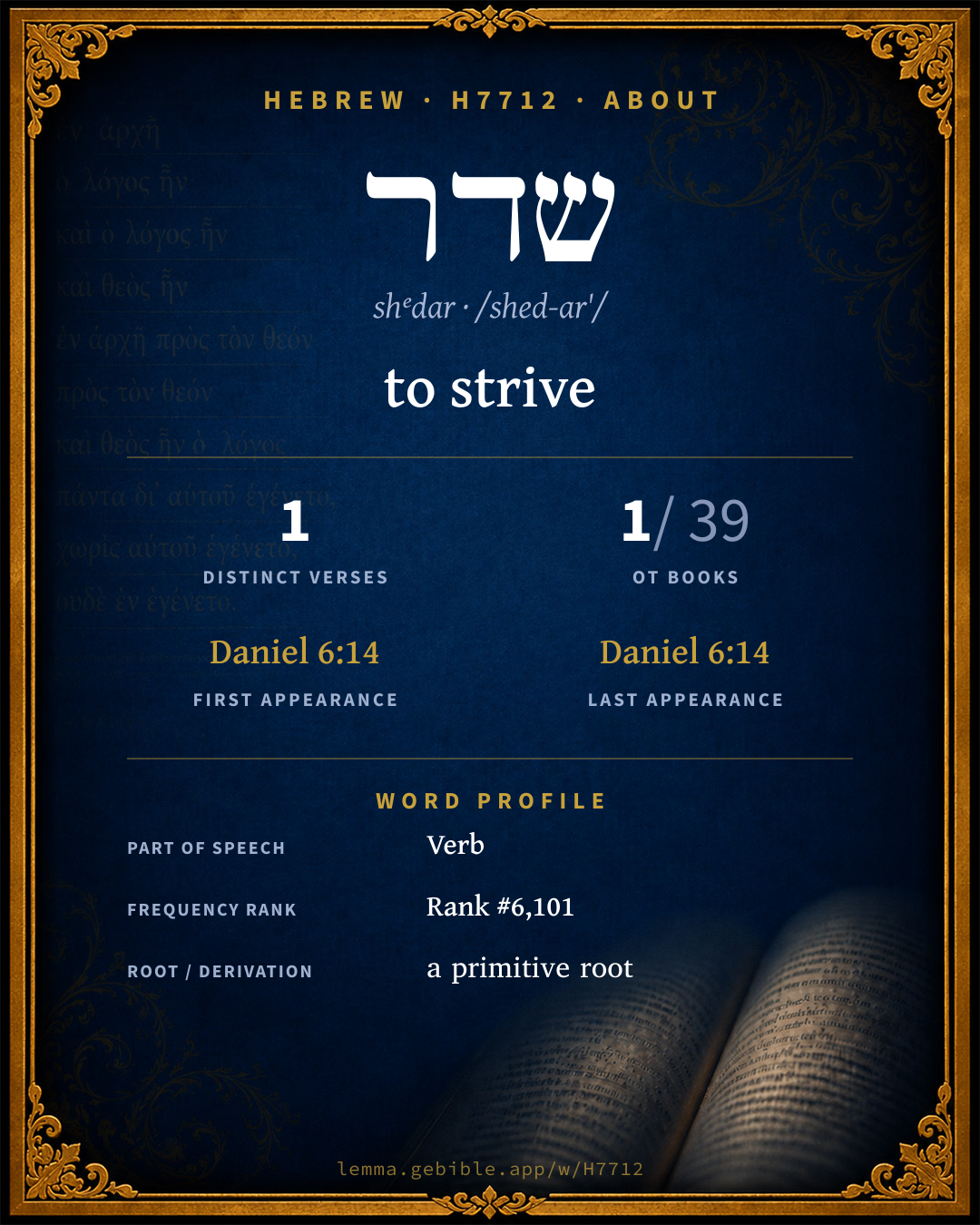
שְׁדַר
to strive
Full lexicon entry — Brown-Driver-Briggs (BDB)
From Brown-Driver-Briggs (BDB)
Where this word appears
Grammar key — what these labels mean
Part of speech
- Verb
- An action or state-of-being word.
Form
- Participle Active
- A verbal adjective expressing ongoing or characteristic action (“writing / one who writes”).
State
- Absolute
- The independent form of a noun, not bound to a following word.
Gender
- Masculine
- Grammatically masculine.
Number
- Singular
- One.
Every verse where H7712 appears — 1 distinct verse across 1 book. Click any verse to open its interlinear word-by-word view. Verse text shown in the World English Bible for context — . Each verse’s Hebrew form is shown with its reference; the English is not keyword-highlighted, since the data carries no word-level English alignment. Use “Compare translations” on any verse to read it across multiple English versions. This concordance covers the Hebrew Bible; Septuagint (Greek Old Testament) occurrences are not indexed here.
Daniel 1 verse
About this entry
At a glance — auto-summarized from this page’s data, not written by a person. Every figure links to its source below. This summary describes the numbers; it doesn’t interpret them.
The Hebrew verb שדר centers on the idea of “to strive.” With only 1 verse it sits in the long tail of Hebrew Bible vocabulary. The word gravitates to Daniel (100%). Scripture uses it exactly once, at Daniel 6:14. It shares a root with אשתדור. For the data behind this summary, explore the sense tree and the renderings breakdown below.
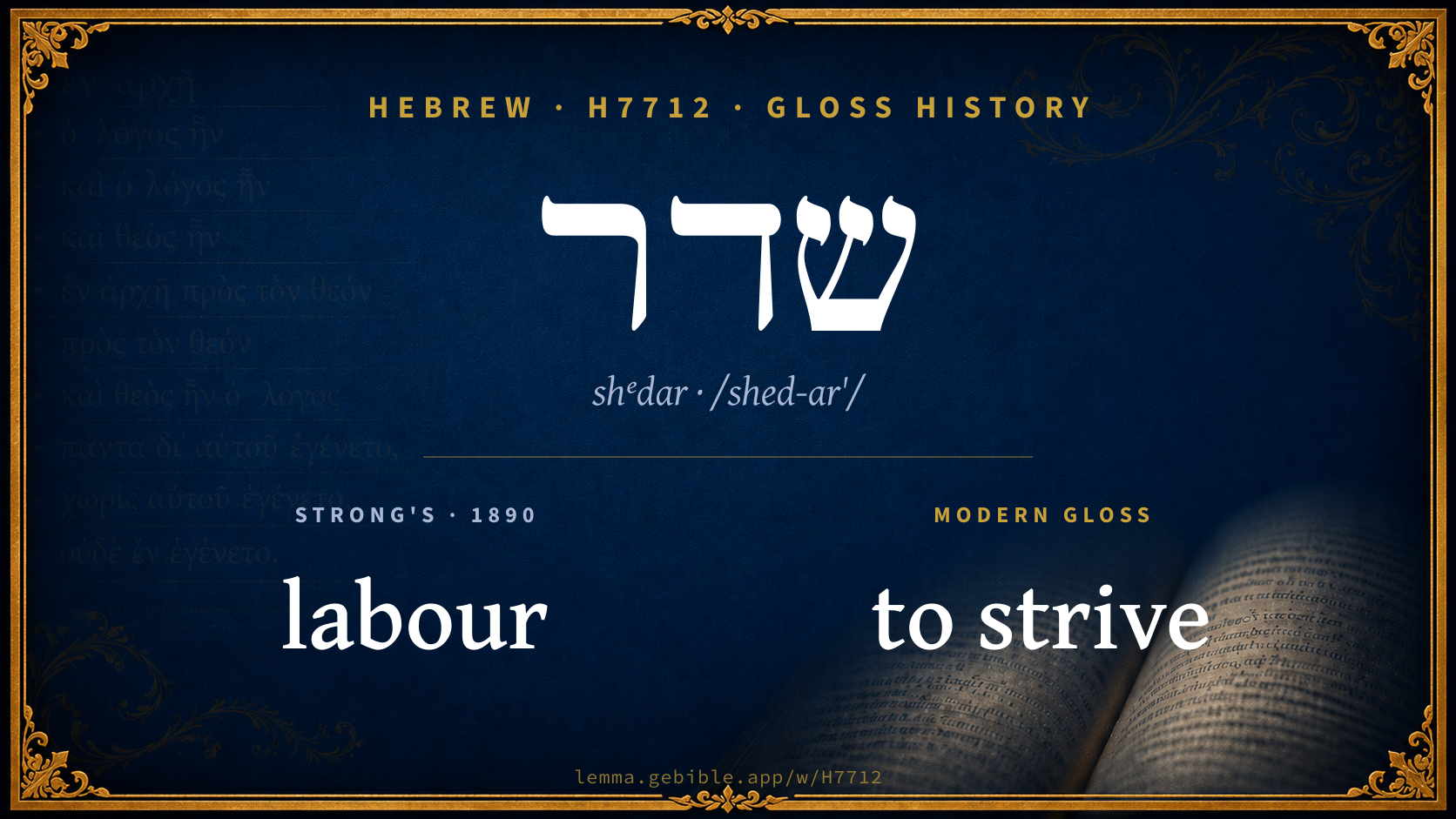
Gloss history
Strong's 1890 vs modern scholarship
About this word
Strong's H7712 catalogs a Hebrew word from the Hebrew Old Testament.
These counts are not copied from any lexicon or concordance. They are computed here, from the morphology-tagged Hebrew Old Testament. What Lemma adds →
- 1
- distinct verses
- The word appears in 1 distinct verse.
- 1 / 39
- OT books
- The word appears in 1 of 39 Old Testament books.
- #6,101
- by frequency
- Rank #6,101 (rank 6,101 of 8,640 Hebrew words by occurrence).
View all 1 occurrence in the concordance →
Most concentrated in
- Daniel 1 verse 100%
By section of the Old Testament
By traditional corpus
Conventional, traditional groupings — biblical authorship is debated, so this is a traditional corpus grouping, not an authorship claim. Each share is this word’s portion of its verses in that division of the Hebrew canon. Each figure is a share of the word’s 1 distinct verse.
- Writings (Ketuvim) 1 verse · 100%
How translations render this word
Counts come from each version’s own published word-to-Strong’s tagging or interlinear alignment — an approximate guide to how each version renders this word, not a word-level alignment the data otherwise carries. Because each total is that version’s own tagged count, the per-version totals vary from one another and need not match the appearance or distinct-verse counts above. These counts may also differ from a printed concordance because Lemma counts each distinctly tagged rendering and does not collapse phrase taggings into a single head-word total. This is a fixed set of word-tagged versions (KJV, ASV, BSB, ULT) and does not change with the reading translation you choose elsewhere. Each version’s license is shown beside its name below (and on Sources).
- King James Version: not separately translated
- Berean Standard Bible: He labored 1×
- unfoldingWord Literal Text: Exerting himself 1×
King James Version Public Domain
Does not render H7712 with a distinct English word (not separately translated in its 1 tagged occurrence).
Berean Standard Bible Public Domain
Renders H7712 across 1 tagged occurrence — most commonly:
unfoldingWord Literal Text CC BY-SA 4.0
Renders H7712 across 1 tagged occurrence — most commonly:
Senses in BDB
The 1 sense BDB distinguishes for this word, in lexicon order (not ranked by frequency or importance). The full entry — with sub-senses — is in the Lexicon Entry tab.
- (Ithpael) to struggle, strive
Word origin
[ שְׁדַר ] vb. Hithpa. struggle, strive;— Dn 6:15
— Brown-Driver-Briggs (Oxford 1906, public domain), digitized via Sefaria, supplemented by the OpenScriptures HebrewLexicon (CC BY 4.0). See Sources.
Origin: a primitive root
Jastrow Dictionary
A second Hebrew/Aramaic lexicon for comparison, covering Aramaic and post-biblical (Talmudic, Targumic, Midrashic) usage that the biblical-Hebrew BDB does not. Matched by lemma rather than by Strong’s number, so a lemma may carry more than one Jastrow headword (shown separately below), and the entries cover usage well beyond the Bible.
דֹּר
- , v. דּוֹר
דָּר
- part. of דּוּר.
דָּר ²
- (דּוּר) row.—Pl. דָּרִין. Gen. R. s. 20 (explain. דַּרְדַּר) שהיא עשוייה ד׳ ד׳ because it consists of rows above rows (of the imbricated form of the artichoke).
דָּר ³
- 1. same, row, range, order. Keth. 60ᵃ בד׳ דנשי in a row of women. B. Kam. 117ᵃ בד׳ קמא in the first row of scholars. Ḥull. 11ᵃ top ד׳ דגברי a row of men. Ib. 47ᵃ בד׳ דאוני within the ranges of the lobes of the lungs. Ib. 53ᵃ בד׳ דסיחופיה in the order in which the claws of the lion’s paw appear when he assaults an animal. Snh. 97ᵇ ד׳ קמא דקמי וכ׳ Ms. M. (ed. ד׳ דקמי; Ms. K. a. Ar. דָּרֵי, pl.) the first row (of righteous men) before the Lord; Succ. 45ᵇ (v. Rabb. D. S. a. l. note 9).—Kidd. 36ᵇ ר"י דדריה R. J. his class-mate; a. fr.—Pl. דָּרִין, דָּרֵי. Meg. 12ᵃ (expl. דַּר, Esth. I, 6) ד׳ ד׳ ranges of mosaics. Nidd. 20ᵃ תלתא ד׳ וכ׳ there are three ranges of leaves, and three leaves in each. Ber. 28ᵃ ד׳ חיוורתא rows of white hair. Ib. 62ᵇ (phonetic etymol. of קפנדריא) אַדָּ׳ וכ׳ אדמקיפנא in place of going around the rows of houses &c. Ab. Zar. 28ᵃ ומייתי דמא מבי דרי ed. (Ms. M. מבי ככי); Yoma 84ᵃ ואתי דמא מבי ד׳ (Ms. M. ומייתי ליה דמא מבי ככי ושיני) and he makes blood come (and blood will come) out from between the rows of teeth. [Ib. בככי דריה, v. דְּרָרָא.] [Taan. 3ᵇ; B. Mets. 73ᵃ; B. Kam. 113ᵇ בי ד׳, v. דָּרֵי.] e.g. Esther 1:6
- 2. a range of wood, pyre. Cant. R. to III, 4 ד׳ יקידא יקדת a burning pyre hast thou set on fire, v. יְקַד.—Pl. as above. Targ. Ps. LXXXII, 15 Ms. (ed. זרזי).
- 3. (v. דּוֹר) period, generation. Targ. Deut. XXXIII, 7. Targ. Job. VI, 17; a. fr.—Ḥag. 5ᵃ עד דמלי להו לד׳ until they have completed the period (lived the years allotted to them). Snh. 97ᵇ בכל ד׳ וד׳ (Ms. M.) in each generation; a. fr.—Pl. דָּרִין, דָּרַיָּא, דָּרֵי. Targ. Is. LI, 8 sq.—Targ. Ps. XLIX, 12 (Ms. דָּרָתָא); a. fr.—Ḥull. 93ᵇ; Yeb. 39ᵇ אכשור ד׳ have the generations (the present) grown better?
שָׁדַר
- (v. next w.), Hithpa. הִשְׁתַּדֵּר [to throw one’s self forward,] to strive. Ab. II, 5; ib. IV, 18 Ar., v. שָׁדַל.
שְׁדַר I
- (Shaf. of דור, דרר; cmp. שגר; Assyr. שדר to order); Pa. שַׁדַּר
- 1. to send. Targ. Gen. XXXVIII, 20; 23. Targ. Job XXXIX, 3; a. fr.—[Ḥull. 51ᵃ שדרן, read: שגרן, v. שְׁגַר I.] Gitt. 56ᵃ שַׁדַּר להו וכ׳ send them a sacrifice, and see whether they will accept it. Ib. אזל ש׳ בידיה וכ׳ he went and sent through him &c. Ḥull. 56ᵃ שַׁדְּרָהּ לקמיה וכ׳ he sent the case to Rab M. Keth. 85ᵃ, a. fr. לתקוני שַׁדַּרְתִּיךְ וכ׳, v. עֲוַת; a. fr.
- 2. to throw. Yalk. Gen. 109 אנא … ואת מְשַׁדֵּר ואזיל I shall open my mouth, and thou shalt go on throwing in; Gen. R. s. 63 תהי משתדר (corr. acc.; Pesik. R. s. 16, a. e. משלח).
- to be sent; to be thrown. Targ. Prov. XVII, 11. Targ. Job XVIII, 8; a. e.—[Gen. R. s. 63, v. supra.]
שְׁדַר II
- (preced.; cmp. שזר) to turn around, twist.
- to wrestle. Targ. Y. II, Gen. XXXII, 26 בשַׁדָּרוּתֵיה (verbal noun), v. שְׁדַל.
- 1. same, esp. to rebel, v. אֶשְׁתַּדּוּר.—
- *2. (trnsf.) to rise, grow stiff. Nidd. 48ᵇ אִשְׁתַּדְּרוּ דדיך Ar. thy breasts grew stiff (Var. in Ar. אשתררו, v. שְׁרַר; ed. אישתדו, v. שְׁדֵי), v. כְּרַף.
שֶׁדֶר
- f., v. שִׁדְרָה
A Dictionary of the Targumim, the Talmud Babli and Yerushalmi, and the Midrashic Literature (Marcus Jastrow; London, Luzac, 1903) — Public Domain. Digitized via Sefaria. Digitized via Sefaria. Full attribution on Sources.
Same root — word family
Other BDB entries built from the same root as H7712, grouped by Strong’s listed origin. These share a root / origin per the lexicon — not necessarily a shared meaning. Each links to that word’s own entry.
Derived from this word
Compare all same-root words → They share a root, not necessarily a meaning.
Septuagint verse parallels
This word appears in 1 verse that also exists in the Greek Old Testament (Septuagint), out of the 1 Hebrew verse it occurs in. You can read those verses in Greek by switching the Old Testament edition to the Septuagint.
Read these verses in the Septuagint
This is a verse-level parallel only — the same verses exist in both the Hebrew and Greek Old Testaments. No word-level Hebrew↔Greek correspondence is claimed: the data carries no such alignment, so no Greek word is shown as this Hebrew word’s translation. Coverage is not total — the Septuagint omits the deuterocanon and renumbers the Psalms, so some Hebrew verses have no direct Greek parallel.