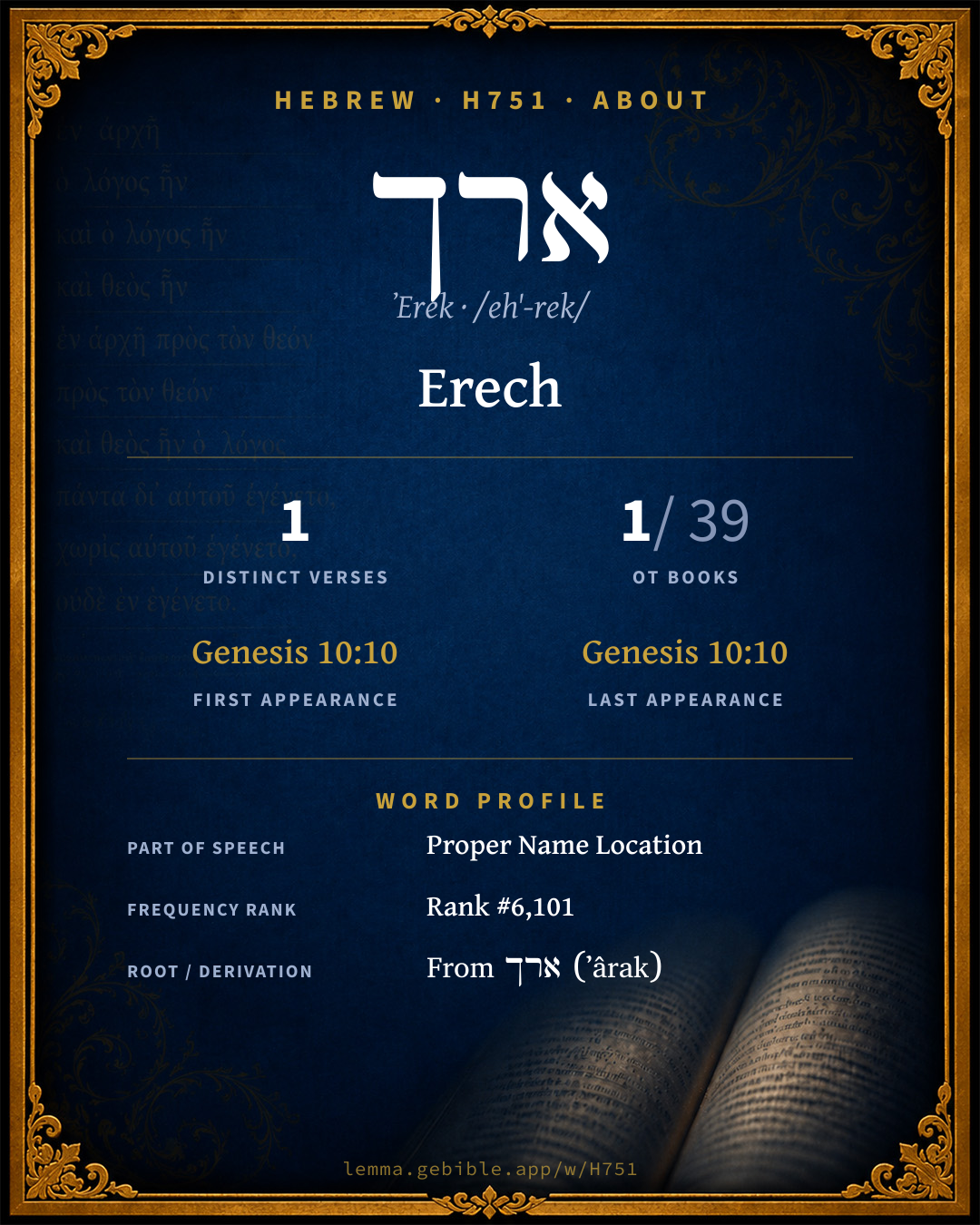
אֶ֫רֶךְ
Erech
BDB lists 2 entries for ‘Erech’ fuller range ↓
Full lexicon entry — Brown-Driver-Briggs (BDB)
From Brown-Driver-Briggs (BDB)
Where this word appears
Grammar key — what these labels mean
Noun type
- Proper
- A name of a specific person, place, or people (e.g. Abraham, Zion, Israel).
Every verse where H751 appears — 1 distinct verse across 1 book. Click any verse to open its interlinear word-by-word view. Verse text shown in the World English Bible for context — . Each verse’s Hebrew form is shown with its reference; the English is not keyword-highlighted, since the data carries no word-level English alignment. Use “Compare translations” on any verse to read it across multiple English versions. This concordance covers the Hebrew Bible; Septuagint (Greek Old Testament) occurrences are not indexed here.
Genesis 1 verse
About this entry
At a glance — auto-summarized from this page’s data, not written by a person. Every figure links to its source below. This summary describes the numbers; it doesn’t interpret them.
ארך (ʼErek) is a Hebrew name most often rendered “Erech.” It is rare — just 1 verse in the entire Hebrew Bible. Genesis dominates its distribution — 1 of 1 verses. Scripture uses it exactly once, at Genesis 10:10. The sections below give every occurrence and version rendering.
Gloss history
Strong's 1890 vs modern scholarship
About this word
Strong's H751 catalogs a Hebrew word from the Hebrew Old Testament.
These counts are not copied from any lexicon or concordance. They are computed here, from the morphology-tagged Hebrew Old Testament. What Lemma adds →
- 1
- distinct verses
- The word appears in 1 distinct verse.
- 1 / 39
- OT books
- The word appears in 1 of 39 Old Testament books.
- #6,101
- by frequency
- Rank #6,101 (rank 6,101 of 8,640 Hebrew words by occurrence).
View all 1 occurrence in the concordance →
Most concentrated in
- Genesis 1 verse 100%
By section of the Old Testament
By traditional corpus
Conventional, traditional groupings — biblical authorship is debated, so this is a traditional corpus grouping, not an authorship claim. Each share is this word’s portion of its verses in that division of the Hebrew canon. Each figure is a share of the word’s 1 distinct verse.
- Torah (Pentateuch) 1 verse · 100%
How translations render this word
Counts come from each version’s own published word-to-Strong’s tagging or interlinear alignment — an approximate guide to how each version renders this word, not a word-level alignment the data otherwise carries. Because each total is that version’s own tagged count, the per-version totals vary from one another and need not match the appearance or distinct-verse counts above. These counts may also differ from a printed concordance because Lemma counts each distinctly tagged rendering and does not collapse phrase taggings into a single head-word total. This is a fixed set of word-tagged versions (KJV, ASV, BSB, ULT) and does not change with the reading translation you choose elsewhere. Each version’s license is shown beside its name below (and on Sources).
- King James Version: Erech 1×
- American Standard Version: Erech 1×
- Berean Standard Bible: Erech 1×
- unfoldingWord Literal Text: Erech 1×
King James Version Public Domain
Renders H751 across 1 tagged occurrence — most commonly:
American Standard Version Public Domain
Renders H751 across 1 tagged occurrence — most commonly:
Berean Standard Bible Public Domain
Renders H751 across 1 tagged occurrence — most commonly:
unfoldingWord Literal Text CC BY-SA 4.0
Renders H751 across 1 tagged occurrence — most commonly:
Senses in BDB
The 2 senses BDB distinguishes for this word, in lexicon order (not ranked by frequency or importance). The full entry — with sub-senses — is in the Lexicon Entry tab.
- Erech = "long"
- a city 40 miles (64 kilometers) northwest of Ur toward Babylon on the left bank of the Euphrates river
Word origin
אֶ֫רֶךְ n.pr.loc. city in Babylonia
— Brown-Driver-Briggs (Oxford 1906, public domain), digitized via Sefaria, supplemented by the OpenScriptures HebrewLexicon (CC BY 4.0). See Sources.
Derived from ארך (ʼârak) (H748) — to be long.
Jastrow Dictionary
A second Hebrew/Aramaic lexicon for comparison, covering Aramaic and post-biblical (Talmudic, Targumic, Midrashic) usage that the biblical-Hebrew BDB does not. Matched by lemma rather than by Strong’s number, so a lemma may carry more than one Jastrow headword (shown separately below), and the entries cover usage well beyond the Bible.
ארך
- (√אר, cmp. ארג) to join, weave; whence to arrange, plan; v. ערך.—V. אֲרִיךְ II, אֲרוּכָה &c.
אָרֵךְ
- , cmp. Schr. KAT p. 497 ארג; cmp. also גדל to plait,to be tall) to be [pointed, stretched,] long, tall.
- 1. to prolong, be long in doing. Ber. I, 4 אמרו להַאֲרִיךְ they commended a lengthy benediction. Ib. 34ᵃ; cmp. אַרְכָן. Yoma 35ᵇ הֶאֱ׳ בתפלתו staid long in prayer.—הא׳ ימים to live long. Meg. 27ᵇ; a. fr.—Ber. 8ᵇ, a. fr. מַאֲרִיכִין ימיו his life will be prolonged.—פנים, הא׳ רוח to be long-suffering, forbearing. Y. Shebu. IV, beg. 35ᵇ; a. fr.—Y. Taan. II, 65ᵇ bot. when collecting debts (punishing) מאריך וגובה he is slow in collecting (punishes in long intervals, gives extension).
- 2. to be long, last long. Num. R. s. 20, end הא׳ הברזל the point of the spear grew longer, v. infra; a. fr.
- 3. [to lengthen the carrying pole,] to make heavy. Nidd. 16ᵇ כמה הֶאֱרַכְתָּ עלינו how heavy thou hast made our burden (through restrictive laws)!
- to be prolonged, grow longer. Sifré Num. 131; Yalk. ib. 771; (Num. R. l. c. האריך).
אֲרַךְ
- , v. אֲרִיךְ I
אֶרֶךְ
- (b. h.) only with אַף, אֲפַּיִם long-suffering, forbearing. Y. Taan. II, 65ᵇ; a. fr.; v. אַף.
A Dictionary of the Targumim, the Talmud Babli and Yerushalmi, and the Midrashic Literature (Marcus Jastrow; London, Luzac, 1903) — Public Domain. Digitized via Sefaria. Digitized via Sefaria. Full attribution on Sources.
Same root — word family
Other BDB entries built from the same root as H751, grouped by Strong’s listed origin. These share a root / origin per the lexicon — not necessarily a shared meaning. Each links to that word’s own entry.
Derives from
Shares the same root
- ארוכה ʼărûwkâh H724 healing
- ארך ʼărak H749 proper
- ארך ʼârêk H750 patient
- ארך ʼârôk H752 long
- ארך ʼôrek H753 length
Proper names from this root
People and places named from this root — a name, not an additional meaning of the word.
Compare all same-root words → Showing 4 of 9 — not the complete family. 2 of the same-root words are proper names (people or places). They share a root, not necessarily a meaning.
Bible dictionary
Public-domain dictionary articles matched to this entry by name (Erech). A biblical name can be shared by more than one person or place, so an article may treat several.
Easton's Bible Dictionary · M. G. Easton, 1897
(LXX., "Orech"), length, or Moon-town, one of the cities of Nimrod's kingdom in the plain of Shinar (Gen. 10:10); the Orchoe of the Greeks and Romans. It was probably the city of the Archevites, who were transplanted to Samaria by Asnapper (Ezra 4:9). It lay on the left bank of the Euphrates, about 120 miles south-east of Babylon, and is now represented by the mounds and ruins of Warka. It appears to have been the necropolis of the Assyrian kings, as the whole region is strewed with bricks and the remains of coffins. "Standing on the summit of the principal edifice, called the Buwarizza, a tower 200 feet square in the centre of the ruins, the beholder is struck with astonishment at the enormous accumulation of mounds and ancient relics at his feet. An irregular circle, nearly 6 miles in circumference, is defined by the traces of an earthen rampart, in some places 40 feet high."
Smith's Bible Dictionary · William Smith, 1863
(length), one of the cities of Nimrod's kingdom in the land of Shinar, (Genesis 10:10) doubtless the same as Orchoe, 82 miles south and 43 east of Babylon, the modern designations of the site--Warka, Irka and Irak--bearing a considerable affinity to the original name.
Hitchcock's Bible Names Dictionary · Roswell D. Hitchcock, 1869
length; health; physic
Classic public-domain reference works; full attribution on Sources.
Septuagint verse parallels
This word appears in 1 verse that also exists in the Greek Old Testament (Septuagint), out of the 1 Hebrew verse it occurs in. You can read those verses in Greek by switching the Old Testament edition to the Septuagint.
Read these verses in the Septuagint
This is a verse-level parallel only — the same verses exist in both the Hebrew and Greek Old Testaments. No word-level Hebrew↔Greek correspondence is claimed: the data carries no such alignment, so no Greek word is shown as this Hebrew word’s translation. Coverage is not total — the Septuagint omits the deuterocanon and renumbers the Psalms, so some Hebrew verses have no direct Greek parallel.