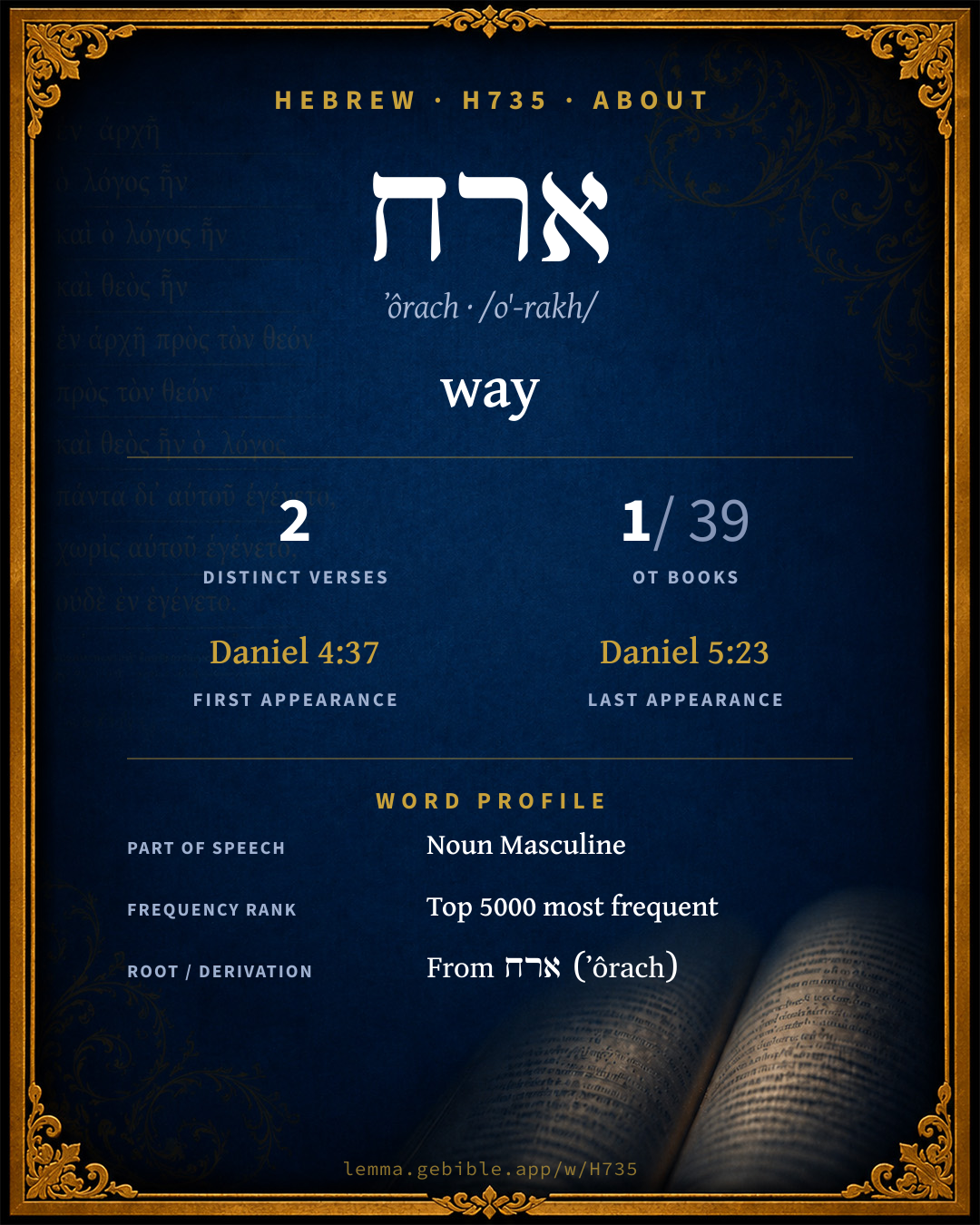
אֹ֫רַח
way
Full lexicon entry — Brown-Driver-Briggs (BDB)
From Brown-Driver-Briggs (BDB)
Where this word appears
Grammar key — what these labels mean
Part of speech
- Noun
- A naming word — a person, place, thing, or idea.
Noun type
- Common
- A common noun — a general class of person, place, or thing (“king,” “city,” “water”), not a specific name.
State
- Construct
- A noun bound to a following noun in a possessive / “of” relationship (the construct chain).
Gender
- Feminine
- Grammatically feminine.
Number
- Plural
- More than one (in Hebrew, generally three or more).
Every verse where H735 appears — 2 distinct verses across 1 book. Click any verse to open its interlinear word-by-word view. Verse text shown in the World English Bible for context — . Each verse’s Hebrew form is shown with its reference; the English is not keyword-highlighted, since the data carries no word-level English alignment. Use “Compare translations” on any verse to read it across multiple English versions. This concordance covers the Hebrew Bible; Septuagint (Greek Old Testament) occurrences are not indexed here.
Daniel 2 verses
- Daniel 4:37 וְ/אֹרְחָתֵ֖/הּ conj + n c fp cs + sfx pers 3ms Now I, Nebuchadnezzar, praise and extol and honor the King of heaven; for all his works are truth, and his ways justice; and those who walk in pride he is able to abase.
- Daniel 5:23 אֹרְחָתָ֥/ךְ n c fp cs + sfx pers 2ms but have lifted up yourself against the Lord of heaven; and they have brought the vessels of his house before you, and you and your lords, your wives and your concubines, have drunk wine from them; and you have praised the gods of silver and gold, of brass, iron, wood, and stone, which don't see, nor hear, nor know; and the God in whose hand your breath is, and whose are all your ways, you have not glorified.
About this entry
At a glance — auto-summarized from this page’s data, not written by a person. Every figure links to its source below. This summary describes the numbers; it doesn’t interpret them.
ארח (ʼôrach) is a Hebrew noun most often rendered “way.” A scarce word — 2 verses in all of the Hebrew Bible. It clusters heavily in Daniel, which alone accounts for 100% of its uses. Scripture first uses it in Daniel 4:37. For the data behind this summary, explore the sense tree and the renderings breakdown below.
Gloss history
Strong's 1890 vs modern scholarship
About this word
Strong's H735 catalogs a Hebrew word from the Hebrew Old Testament.
These counts are not copied from any lexicon or concordance. They are computed here, from the morphology-tagged Hebrew Old Testament. What Lemma adds →
- 2
- distinct verses
- The word appears in 2 distinct verses.
- 1 / 39
- OT books
- The word appears in 1 of 39 Old Testament books.
- #4,807
- by frequency
- Top 5000 most frequent Hebrew words (rank 4,807 of 8,640 Hebrew words by occurrence).
View all 2 occurrences in the concordance →
Most concentrated in
- Daniel 2 verses 100%
By section of the Old Testament
By traditional corpus
Conventional, traditional groupings — biblical authorship is debated, so this is a traditional corpus grouping, not an authorship claim. Each share is this word’s portion of its verses in that division of the Hebrew canon. Each figure is a share of the word’s 2 distinct verses.
- Writings (Ketuvim) 2 verses · 100%
How translations render this word
Counts come from each version’s own published word-to-Strong’s tagging or interlinear alignment — an approximate guide to how each version renders this word, not a word-level alignment the data otherwise carries. Because each total is that version’s own tagged count, the per-version totals vary from one another and need not match the appearance or distinct-verse counts above. These counts may also differ from a printed concordance because Lemma counts each distinctly tagged rendering and does not collapse phrase taggings into a single head-word total. This is a fixed set of word-tagged versions (KJV, ASV, BSB, ULT) and does not change with the reading translation you choose elsewhere. Each version’s license is shown beside its name below (and on Sources).
- King James Version: Ways 2×
- American Standard Version: Are all thy ways 1×, Ways 1×
- Berean Standard Bible: All his ways 1×, Ways 1×
- unfoldingWord Literal Text: Ways 2×
King James Version Public Domain
Renders H735 across 2 tagged occurrences — most commonly:
American Standard Version Public Domain
Renders H735 across 2 tagged occurrences — most commonly:
Berean Standard Bible Public Domain
Renders H735 across 2 tagged occurrences — most commonly:
unfoldingWord Literal Text CC BY-SA 4.0
Renders H735 across 2 tagged occurrences — most commonly:
Senses in BDB
The 1 sense BDB distinguishes for this word, in lexicon order (not ranked by frequency or importance). The full entry — with sub-senses — is in the Lexicon Entry tab.
- way, path, course of life
Word origin
[ אֹ֫רַח ] n.[ m.?] way (fig.)
— Brown-Driver-Briggs (Oxford 1906, public domain), digitized via Sefaria, supplemented by the OpenScriptures HebrewLexicon (CC BY 4.0). See Sources.
Derived from ארח (ʼôrach) (H734) — way.
Jastrow Dictionary
A second Hebrew/Aramaic lexicon for comparison, covering Aramaic and post-biblical (Talmudic, Targumic, Midrashic) usage that the biblical-Hebrew BDB does not. Matched by lemma rather than by Strong’s number, so a lemma may carry more than one Jastrow headword (shown separately below), and the entries cover usage well beyond the Bible.
אָרַח
- , v. ארר)
- 1. to go through; v. אָרִיחַ.
- 2. to go outside, to travel. Part. אוֹרֵחַ q. v.—Denom. אוֹרַח path
- (Denom. of אוֹרֵחַ) to receive a guest, to lodge. Ber. 63ᵇ המְאָרֵחַ. Y. Ab. Zar. I, 39ᶜ bot. לאָרְחוֹ.
- to be received, be the guest of. Sabb. 13ᵇ a. fr. Y. Ḥall. IV, 60ᵃ מִתְאָ׳.
אֲרַח
- , esp. to take lodging. Targ. Jud. XIX, 17. [ארח, ארחא Yoma 82ᵇ, a. e., Af. of רִיחַ.]
- , contr. אִתְרַח to dwell as a stranger, sojourn. Targ. Y. Deut. I, 6; v. אְחַר.
A Dictionary of the Targumim, the Talmud Babli and Yerushalmi, and the Midrashic Literature (Marcus Jastrow; London, Luzac, 1903) — Public Domain. Digitized via Sefaria. Digitized via Sefaria. Full attribution on Sources.
Forms in the corpus
The 2 distinct written forms H735 takes in the Hebrew Bible, most frequent first — each parse links to that state’s occurrences in the concordance. Hebrew forms include their vowel points and cantillation, so a single lemma takes many written forms.
| Form | Parsing | Example | Uses |
|---|---|---|---|
| אֹרְחָתָ֥/ךְ | Noun, Common, Feminine, Plural, Construct | Daniel 5:23 | 1 |
| וְ/אֹרְחָתֵ֖/הּ | Noun, Common, Feminine, Plural, Construct | Daniel 4:37 | 1 |