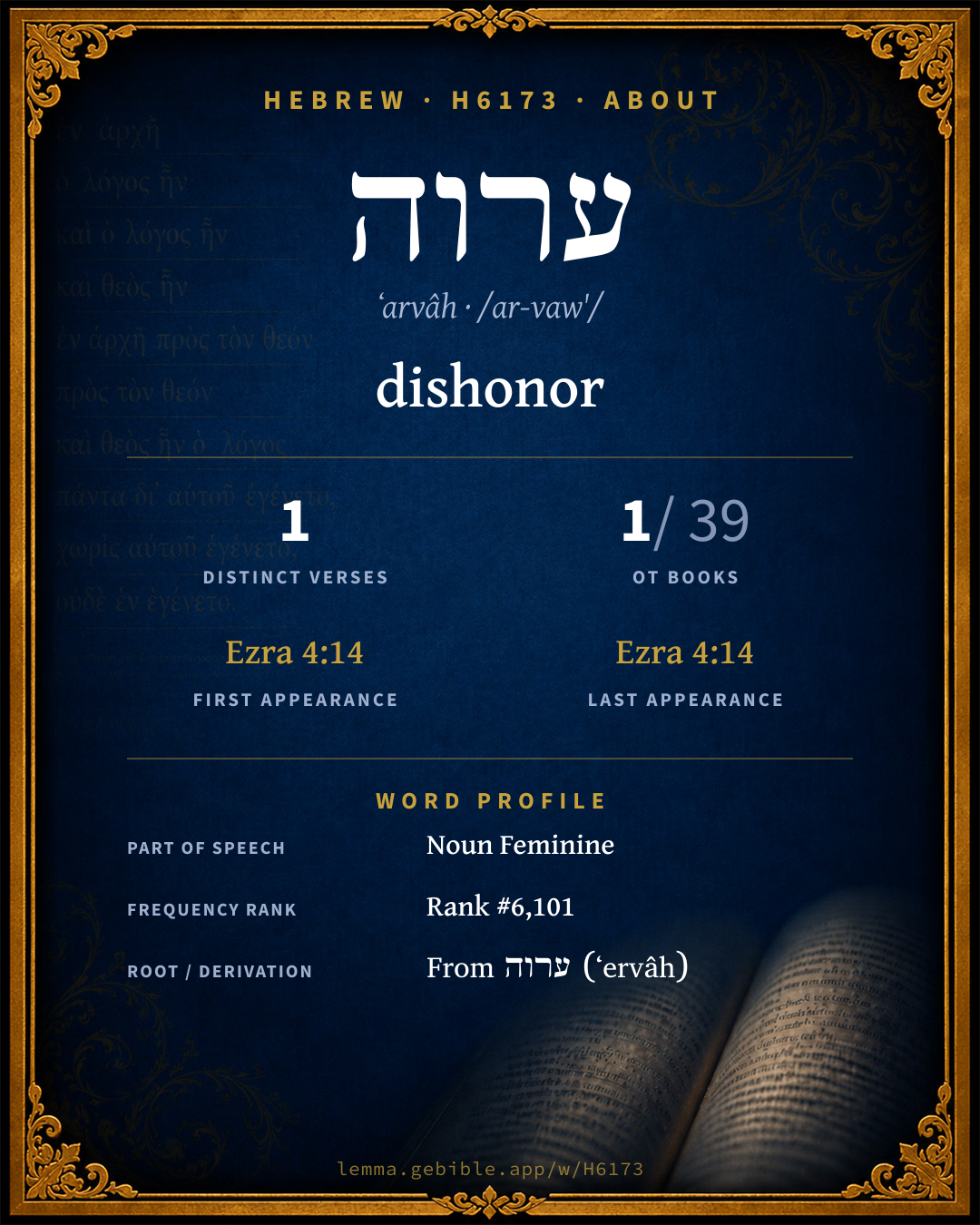
עַרְוָה
dishonor
‘dishonor’ is one of 2 main senses fuller range ↓
Full lexicon entry — Brown-Driver-Briggs (BDB)
From Brown-Driver-Briggs (BDB)
Where this word appears
Grammar key — what these labels mean
Noun type
- Common
- A common noun — a general class of person, place, or thing (“king,” “city,” “water”), not a specific name.
State
- Construct
- A noun bound to a following noun in a possessive / “of” relationship (the construct chain).
Gender
- Feminine
- Grammatically feminine.
Number
- Singular
- One.
Every verse where H6173 appears — 1 distinct verse across 1 book. Click any verse to open its interlinear word-by-word view. Verse text shown in the World English Bible for context — . Each verse’s Hebrew form is shown with its reference; the English is not keyword-highlighted, since the data carries no word-level English alignment. Use “Compare translations” on any verse to read it across multiple English versions. This concordance covers the Hebrew Bible; Septuagint (Greek Old Testament) occurrences are not indexed here.
Ezra 1 verse
About this entry
At a glance — auto-summarized from this page’s data, not written by a person. Every figure links to its source below. This summary describes the numbers; it doesn’t interpret them.
The Hebrew noun ערוה centers on the idea of “dishonor.” With only 1 verse it sits in the long tail of Hebrew Bible vocabulary. Ezra dominates its distribution — 1 of 1 verses. Found nowhere else but Ezra 4:14. Lexicons map it across 2 senses. Dig into 1-verse concordance and the renderings breakdown below.
Gloss history
Strong's 1890 vs modern scholarship
About this word
Strong's H6173 catalogs a Hebrew word from the Hebrew Old Testament.
These counts are not copied from any lexicon or concordance. They are computed here, from the morphology-tagged Hebrew Old Testament. What Lemma adds →
- 1
- distinct verses
- The word appears in 1 distinct verse.
- 1 / 39
- OT books
- The word appears in 1 of 39 Old Testament books.
- #6,101
- by frequency
- Rank #6,101 (rank 6,101 of 8,640 Hebrew words by occurrence).
View all 1 occurrence in the concordance →
Most concentrated in
- Ezra 1 verse 100%
By section of the Old Testament
By traditional corpus
Conventional, traditional groupings — biblical authorship is debated, so this is a traditional corpus grouping, not an authorship claim. Each share is this word’s portion of its verses in that division of the Hebrew canon. Each figure is a share of the word’s 1 distinct verse.
- Writings (Ketuvim) 1 verse · 100%
How translations render this word
Counts come from each version’s own published word-to-Strong’s tagging or interlinear alignment — an approximate guide to how each version renders this word, not a word-level alignment the data otherwise carries. Because each total is that version’s own tagged count, the per-version totals vary from one another and need not match the appearance or distinct-verse counts above. These counts may also differ from a printed concordance because Lemma counts each distinctly tagged rendering and does not collapse phrase taggings into a single head-word total. This is a fixed set of word-tagged versions (KJV, ASV, BSB, ULT) and does not change with the reading translation you choose elsewhere. Each version’s license is shown beside its name below (and on Sources).
- King James Version: Dishonour 1×
- American Standard Version: 's dishonor 1×
- Berean Standard Bible: Be dishonored 1×
- unfoldingWord Literal Text: And 1×, Nakedness of 1×
King James Version Public Domain
Renders H6173 across 1 tagged occurrence — most commonly:
American Standard Version Public Domain
Renders H6173 across 1 tagged occurrence — most commonly:
Berean Standard Bible Public Domain
Renders H6173 across 1 tagged occurrence — most commonly:
unfoldingWord Literal Text CC BY-SA 4.0
Renders H6173 across 2 tagged occurrences — most commonly:
Senses in BDB
The 2 senses BDB distinguishes for this word, in lexicon order (not ranked by frequency or importance). The full entry — with sub-senses — is in the Lexicon Entry tab.
- dishonour, nakedness
- dishonour (metaphor of nakedness)
Word origin
[ עַרְוָה ] n.f. dishonour;—cstr. Ezr 4:14.
— Brown-Driver-Briggs (Oxford 1906, public domain), digitized via Sefaria, supplemented by the OpenScriptures HebrewLexicon (CC BY 4.0). See Sources.
Derived from ערוה (ʻervâh) (H6172) — nakedness.
Jastrow Dictionary
A second Hebrew/Aramaic lexicon for comparison, covering Aramaic and post-biblical (Talmudic, Targumic, Midrashic) usage that the biblical-Hebrew BDB does not. Matched by lemma rather than by Strong’s number, so a lemma may carry more than one Jastrow headword (shown separately below), and the entries cover usage well beyond the Bible.
עֶרְוָה
- nakedness, shame; unchastity, lewdness, obscenity. Cant. R. to I, 2 מה מים מכסים עֶרְוָתוֹ … עֶרְוָתָן as water covers the nakedness of the sea, … so (study of) the Law covers up the nakedness (atones for the sins) of Israel. Ber. 24ᵇ לבו רואה את הע׳ his heart sees the nakedness, i.e. there is no garment (girdle &c.) separating the upper part of the body from the lower. Ib. 24ᵃ משום ע׳, v. עֲגָבָה. Ib. קול באשה ע׳ hearing a woman’s voice is indecency (you must not read the Sh’mʿa while a woman is singing within your heaving); שער באשה ע׳ the sight of woman’s hair is an impropriety (with regard to reading the Sh’mʿa). Gitt. IX, 10 לא יגרש … דבר ע׳ a man must not divorce his wife, unless he have found in her something improper (v. Deut. XXIV, 1). Ib. 90ᵃ (interpret. ערות דבר, Deut. l. c.) אם נאמר ערות … הייתי אומר משום ע׳ תצא משום דבר לא תצא if the text had ʿervath (meaning ʿervah) without dabar, I might have thought, for scandalous conduct she is to be dismissed, for ‘something’ (any other cause) she must not be dismissed. Ib. לא מצא בה לא ע׳ ולא דבר if he found in her neither indecency nor any other fault. Ib. 64ᵃ a. fr. אין דבר שבע׳ פחות משנים any act in which purity of sexual life is concerned (marriage, divorce &c.) requires no less than two witnesses. Ab. III, 13 שחוק … מרגילין (את האדם) לע׳ merriment and light-mindedness make man familiar with licentiousness; a. v. fr.—Esp. incest, trnsf. ʿervah, a woman forbidden to a man (and vice versa) on account of consanguinity. Yeb. 3ᵇ מה אחות אשה מיוחדת שהיא ע׳ … אף כל שהיא ע׳ וכ׳ as the sister of a man’s (living) wife who is singled out (Lev. XVIII, 18) as an ʿervah, with the punishment of extinction in case of wilfulness, and of a sin-offering in case of mistake, may not be taken in a levirate marriage, so no woman that is a forbidden relation … may be taken &c. Ib. 13ᵃ צרות ע׳ the rivals of a woman forbidden on account of consanguinity; a. v. fr.—Pl. עֲרָיוֹת (fr. עֶרְיָה). Keth. 13ᵇ, v. אֶפִּיטְרוֹפּוֹס.—גילוי ע׳, v. גִּילּוּי. Yeb. I, 2 היתה בתו או אחת מכל הע׳ האלו וכ׳ if a man’s daughter or any other of those (above mentioned) relations was married to his brother. Ib. 3ᵇ כל הע׳ האמורות בתורה all forbidden relations named in the Torah. Ib. I, 3 שש ע׳ חמורות מאלו six relations more rigorously forbidden than these. Meg. IV, 9, v. כָּנָה; a. fr. e.g. Deuteronomy 24:1
A Dictionary of the Targumim, the Talmud Babli and Yerushalmi, and the Midrashic Literature (Marcus Jastrow; London, Luzac, 1903) — Public Domain. Digitized via Sefaria. Digitized via Sefaria. Full attribution on Sources.
Same root — word family
Other BDB entries built from the same root as H6173, grouped by Strong’s listed origin. These share a root / origin per the lexicon — not necessarily a shared meaning. Each links to that word’s own entry.
Derives from
Shares the same root
Compare all same-root words → They share a root, not necessarily a meaning.
Septuagint verse parallels
This word appears in 1 verse that also exists in the Greek Old Testament (Septuagint), out of the 1 Hebrew verse it occurs in. You can read those verses in Greek by switching the Old Testament edition to the Septuagint.
Read these verses in the Septuagint
This is a verse-level parallel only — the same verses exist in both the Hebrew and Greek Old Testaments. No word-level Hebrew↔Greek correspondence is claimed: the data carries no such alignment, so no Greek word is shown as this Hebrew word’s translation. Coverage is not total — the Septuagint omits the deuterocanon and renumbers the Psalms, so some Hebrew verses have no direct Greek parallel.