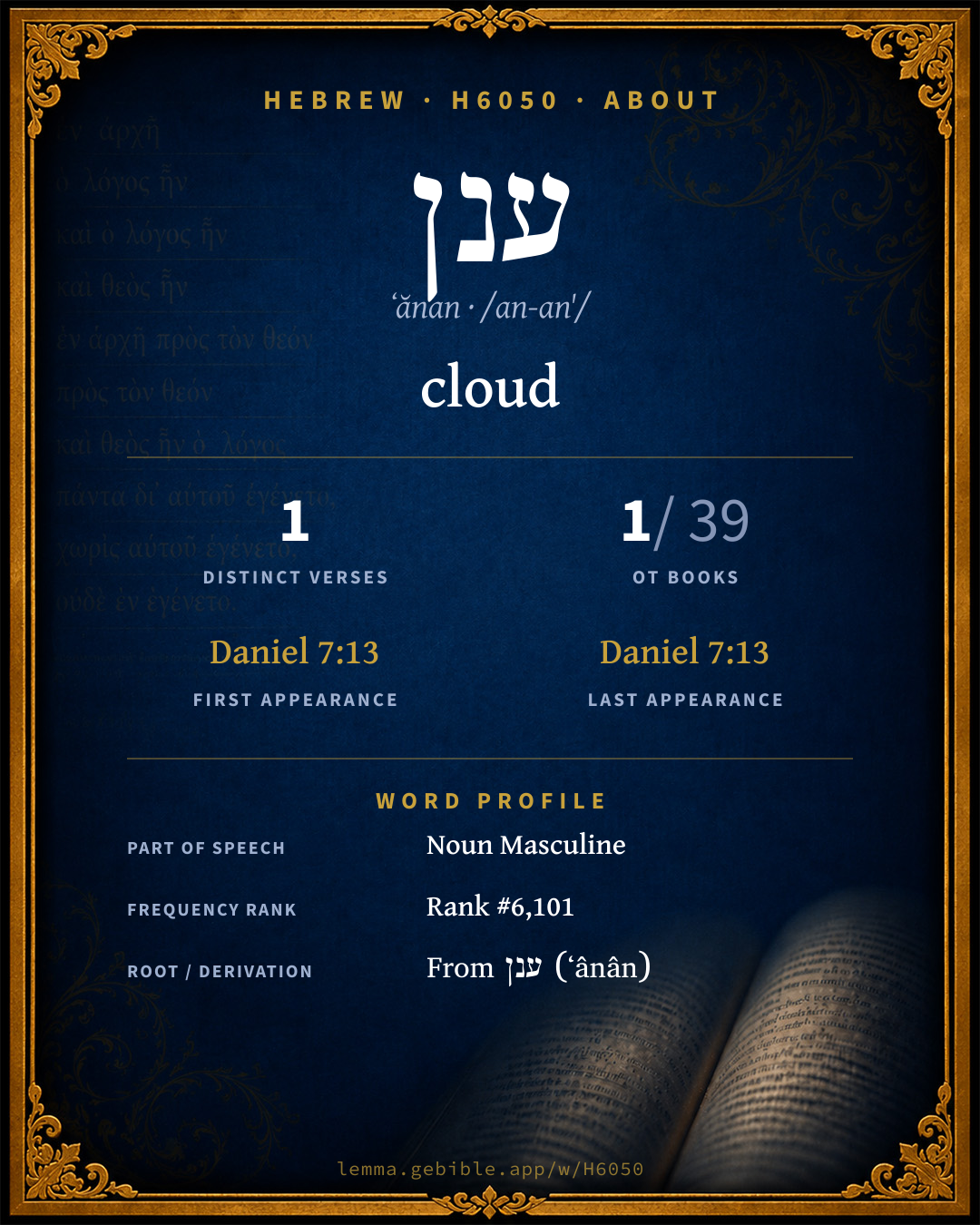
עֲנָן
cloud
Full lexicon entry — Brown-Driver-Briggs (BDB)
From Brown-Driver-Briggs (BDB)
Where this word appears
Grammar key — what these labels mean
Part of speech
- Noun
- A naming word — a person, place, thing, or idea.
Noun type
- Common
- A common noun — a general class of person, place, or thing (“king,” “city,” “water”), not a specific name.
State
- Construct
- A noun bound to a following noun in a possessive / “of” relationship (the construct chain).
Gender
- Masculine
- Grammatically masculine.
Number
- Plural
- More than one (in Hebrew, generally three or more).
Every verse where H6050 appears — 1 distinct verse across 1 book. Click any verse to open its interlinear word-by-word view. Verse text shown in the World English Bible for context — . Each verse’s Hebrew form is shown with its reference; the English is not keyword-highlighted, since the data carries no word-level English alignment. Use “Compare translations” on any verse to read it across multiple English versions. This concordance covers the Hebrew Bible; Septuagint (Greek Old Testament) occurrences are not indexed here.
Daniel 1 verse
About this entry
At a glance — auto-summarized from this page’s data, not written by a person. Every figure links to its source below. This summary describes the numbers; it doesn’t interpret them.
The Hebrew noun ענן centers on the idea of “cloud.” The Hebrew Bible uses it only 1 verse. Daniel dominates its distribution — 1 of 1 verses. A true hapax — its single appearance is Daniel 7:13. Sharing its root, it stands alongside ענן, עננה and ענן. For the data behind this summary, explore the sense tree and the renderings breakdown below.
Gloss history
Strong's 1890 vs modern scholarship
About this word
Strong's H6050 catalogs a Hebrew word from the Hebrew Old Testament.
These counts are not copied from any lexicon or concordance. They are computed here, from the morphology-tagged Hebrew Old Testament. What Lemma adds →
- 1
- distinct verses
- The word appears in 1 distinct verse.
- 1 / 39
- OT books
- The word appears in 1 of 39 Old Testament books.
- #6,101
- by frequency
- Rank #6,101 (rank 6,101 of 8,640 Hebrew words by occurrence).
View all 1 occurrence in the concordance →
Most concentrated in
- Daniel 1 verse 100%
By section of the Old Testament
By traditional corpus
Conventional, traditional groupings — biblical authorship is debated, so this is a traditional corpus grouping, not an authorship claim. Each share is this word’s portion of its verses in that division of the Hebrew canon. Each figure is a share of the word’s 1 distinct verse.
- Writings (Ketuvim) 1 verse · 100%
How translations render this word
Counts come from each version’s own published word-to-Strong’s tagging or interlinear alignment — an approximate guide to how each version renders this word, not a word-level alignment the data otherwise carries. Because each total is that version’s own tagged count, the per-version totals vary from one another and need not match the appearance or distinct-verse counts above. These counts may also differ from a printed concordance because Lemma counts each distinctly tagged rendering and does not collapse phrase taggings into a single head-word total. This is a fixed set of word-tagged versions (KJV, ASV, BSB, ULT) and does not change with the reading translation you choose elsewhere. Each version’s license is shown beside its name below (and on Sources).
- King James Version: Clouds 1×
- American Standard Version: Clouds 1×
- Berean Standard Bible: Clouds 1×
- unfoldingWord Literal Text: Clouds of 1×
King James Version Public Domain
Renders H6050 across 1 tagged occurrence — most commonly:
American Standard Version Public Domain
Renders H6050 across 1 tagged occurrence — most commonly:
Berean Standard Bible Public Domain
Renders H6050 across 1 tagged occurrence — most commonly:
unfoldingWord Literal Text CC BY-SA 4.0
Renders H6050 across 1 tagged occurrence — most commonly:
Senses in BDB
The 1 sense BDB distinguishes for this word, in lexicon order (not ranked by frequency or importance). The full entry — with sub-senses — is in the Lexicon Entry tab.
- cloud
Word origin
[ עֲנָן ] n.[m.] cloud;—pl. cstr. Dn 7:13.
— Brown-Driver-Briggs (Oxford 1906, public domain), digitized via Sefaria, supplemented by the OpenScriptures HebrewLexicon (CC BY 4.0). See Sources.
Derived from ענן (ʻânân) (H6051) — cloud.
Jastrow Dictionary
A second Hebrew/Aramaic lexicon for comparison, covering Aramaic and post-biblical (Talmudic, Targumic, Midrashic) usage that the biblical-Hebrew BDB does not. Matched by lemma rather than by Strong’s number, so a lemma may carry more than one Jastrow headword (shown separately below), and the entries cover usage well beyond the Bible.
עָנַן
- (b. h.), Pi. עִנֵּן to make cloudy. Part. pass. מְעוּנָּן; יום המע׳ a cloudy day. Neg. II, 2. Yoma 28ᵇ; a. fr.—[Polel עוֹנֵן, v. עוּן.]
עֲנַן I
- (preced.) to gather clouds. Targ. O. Gen. IX, 14 בעֲנָנוּתִי.
- to augur from clouds. Targ. II Kings XXI, 6. Targ. O. Lev. XIX, 26 תְעָנוֹן ed. Berl. (oth. ed. תְעַנּוּן, contr. of תְעַנְּנוּן; Ms. II תְעוֹנְנוּן, Pol. of עוּן).—V. מְעָנֵין, a. עָנְנָא.
עָנָן I
- Anan, an Amora, disciple of Samuel. Y. Sabb. III, beg. 5ᶜ. Keth. 69ᵃ; a. fr.
עָנָן II
- (b. h.) cloud, frequently used in the sense of cover protection. Gen. R. s. 60 כל זמן … היה ע׳ קשור וכ׳ as long as Sarah lived, a cloud was tied over the entrance of her tent; וכיון שמתה פסק אותו ע׳ and when she was dead, that cloud ceased. Cant. R. to II, 6 וימינו זה עֲנַן שכינה וכ׳ … ‘and his right hand embraces me’, that means the cloud of the Divine Presence in the future world (with ref. to Is. LX, 19). Y. Taan. III, 66ᶜ, v. עָנָיו; a. fr.—Pl. עֲנָנִים. Taan. 9ᵇ (ref. to Gen. II, 6) מלמד שהע׳ מתגברים וכ׳ this teaches that the clouds (like a hose) swell and rise to the sky, and there open their mouth like a hose and receive the rain water; Gen. R. s. 13. Ib. אין ע׳ אלא מלמעלה clouds (like a hose to receive the waters) come from above (ref. to Dan. VII, 13); אין ע׳ אלא מלמטה the clouds come from below (ref. to Ps. CXXXV, 7); Y. Succ. I, 52ᵇ bot.; Yalk. Ps. 883. R. Hash. 3ᵃ (ref. to Num. XXI, 1) שמע … ונסתלקו עַנְנֵי כבוד he heard that Aaron was dead, and the clouds of glory were removed. Tanḥ. R’eh 16 משיב רוחות ומעלה ע׳ ומוריד וכ׳ causes the winds to blow, and the clouds to rise, and the rains to come down; a. fr. e.g. Isaiah 60:19
עֲנַן II
- Targ. Is. XLIV, 22. Targ. Job VII, 9 Ms. (ed. תננא). Targ. O. Lev. XXIII, 43 עֲנָנִי ed. Berl. (oth. ed. עננין); a. fr.—Ber. 59ᵃ דקטר בע׳ when the sky is covered with a light cloud, opp. עֵיבָא. Ib. דבריק בע׳, v. בְּרַק I. Gen. R. s. 13 כך הקב"ה … אייתי עֲנָנִיךְ וקבל וכ׳ so the Lord says to the earth, bring thy cloud (hose, v. preced.) and receive the rain; Yalk. Ps. 883; a. fr.—Pl. עֲנָנִין, עֲנָנַיָּא, עֲנָנֵי. Targ. II Sam. XXII, 12. Targ. Is. XLV, 8. Targ. Y. II, Num. XXI, 1 ע׳ דיקרא (= ענני כבוד, v. preced.); a. fr.—Ber. l. c. (expl. רעמים, ib. IX, 2) ע׳ בגלגלא clouds (rolling) in the sphere; (oth. opin.) ע׳ דשפכי מיא וכ׳ clouds (bottles, v. preced.) that empty the waters from one to the other; ib. ע׳ חלחולי וכ׳, v. חַלְחֵל; בריק ברקא ומנהמי ע׳ וכ׳ the lightning flashes and the clouds rumble, and then comes the rain. Taan. 25ᵃ שמעינהו לע׳ דאמרי נשדי מיטרא וכ׳ Ms. M. (v. Rabb. D. S. a. l. note) overheard the clouds say, let us cast rain on Ammon &c. Cant. R. to IV, 8 כד אינון נקיין מן ע׳ (some ed. עֲנָנָן, f.) when the heavens are cloudless; a. fr.
A Dictionary of the Targumim, the Talmud Babli and Yerushalmi, and the Midrashic Literature (Marcus Jastrow; London, Luzac, 1903) — Public Domain. Digitized via Sefaria. Digitized via Sefaria. Full attribution on Sources.
Same root — word family
Other BDB entries built from the same root as H6050, grouped by Strong’s listed origin. These share a root / origin per the lexicon — not necessarily a shared meaning. Each links to that word’s own entry.
Derives from
Shares the same root
Proper names from this root
People and places named from this root — a name, not an additional meaning of the word.
Compare all same-root words → Showing 4 of 5 — not the complete family. 2 of the same-root words are proper names (people or places). They share a root, not necessarily a meaning.
Septuagint verse parallels
This word appears in 1 verse that also exists in the Greek Old Testament (Septuagint), out of the 1 Hebrew verse it occurs in. You can read those verses in Greek by switching the Old Testament edition to the Septuagint.
Read these verses in the Septuagint
This is a verse-level parallel only — the same verses exist in both the Hebrew and Greek Old Testaments. No word-level Hebrew↔Greek correspondence is claimed: the data carries no such alignment, so no Greek word is shown as this Hebrew word’s translation. Coverage is not total — the Septuagint omits the deuterocanon and renumbers the Psalms, so some Hebrew verses have no direct Greek parallel.