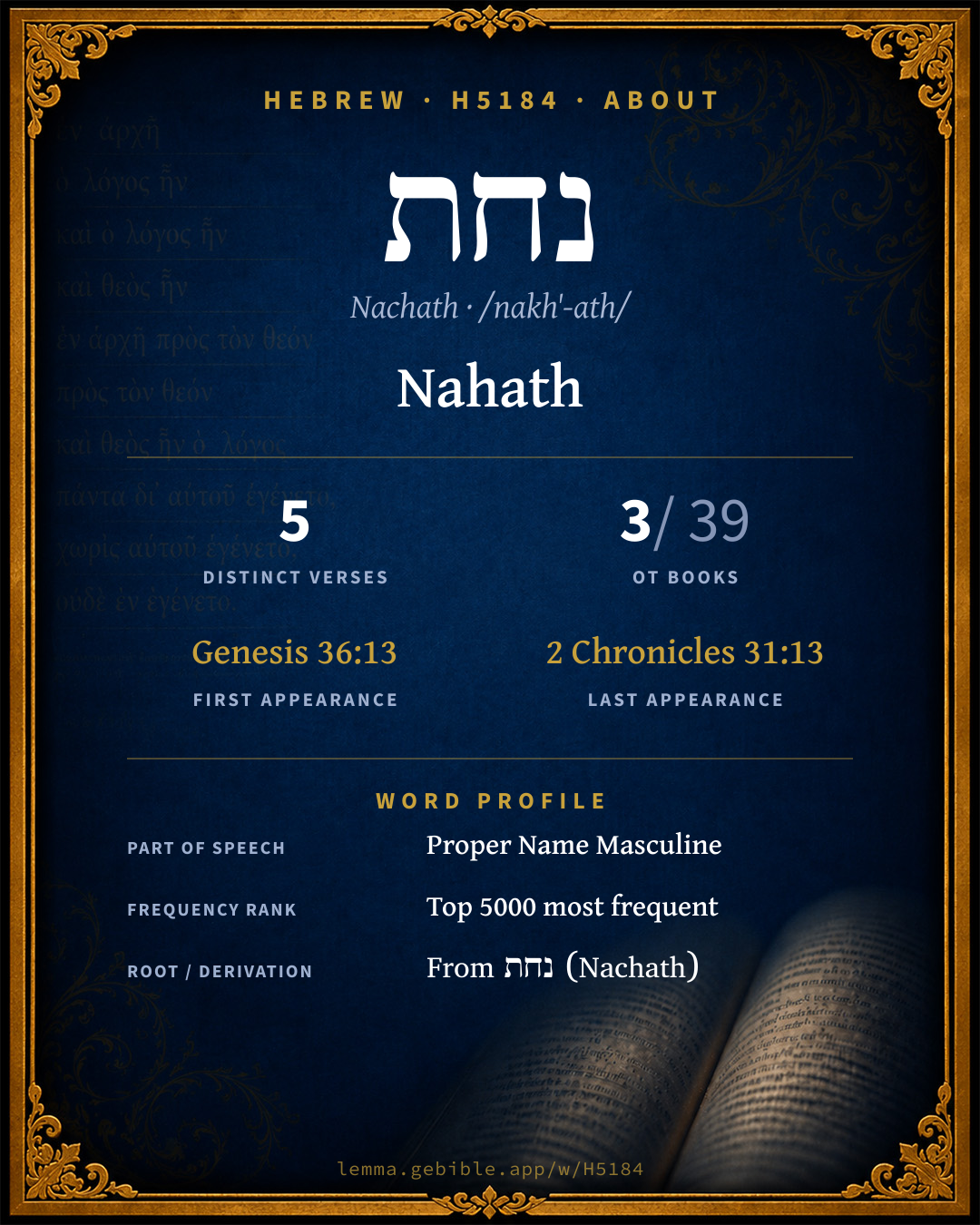
נַ֫חַת
Nahath
BDB lists 4 entries for ‘Nahath’ fuller range ↓
Full lexicon entry — Brown-Driver-Briggs (BDB)
From Brown-Driver-Briggs (BDB)
Where this word appears
Grammar key — what these labels mean
Part of speech
- Noun
- A naming word — a person, place, thing, or idea.
Noun type
- Proper
- A name of a specific person, place, or people (e.g. Abraham, Zion, Israel).
Every verse where H5184 appears — 5 distinct verses across 3 books. Click any verse to open its interlinear word-by-word view. Verse text shown in the World English Bible for context — . Each verse’s Hebrew form is shown with its reference; the English is not keyword-highlighted, since the data carries no word-level English alignment. Use “Compare translations” on any verse to read it across multiple English versions. This concordance covers the Hebrew Bible; Septuagint (Greek Old Testament) occurrences are not indexed here.
Genesis 2 verses
- Genesis 36:13 נַ֥חַת n Proper These are the sons of Reuel: Nahath, Zerah, Shammah, and Mizzah. These were the sons of Basemath, Esau's wife.
- Genesis 36:17 נַ֨חַת֙ n Proper These are the sons of Reuel, Esau's son: chief Nahath, chief Zerah, chief Shammah, chief Mizzah: these are the chiefs who came of Reuel in the land of Edom; these are the sons of Basemath, Esau's wife.
1 Chronicles 2 verses
2 Chronicles 1 verse
About this entry
At a glance — auto-summarized from this page’s data, not written by a person. Every figure links to its source below. This summary describes the numbers; it doesn’t interpret them.
“Nahath” is the headline sense of the Hebrew name נחת (Nachath). With only 5 verses it sits in the long tail of Hebrew Bible vocabulary. It concentrates in Genesis, which alone accounts for 40% of its uses. First canonically at Genesis 36:13, it enters the text early. The sections below give every occurrence and version rendering.
Gloss history
Strong's 1890 vs modern scholarship
About this word
Strong's H5184 catalogs a Hebrew word from the Hebrew Old Testament.
These counts are not copied from any lexicon or concordance. They are computed here, from the morphology-tagged Hebrew Old Testament. What Lemma adds →
- 5
- distinct verses
- The word appears in 5 distinct verses.
- 3 / 39
- OT books
- The word appears in 3 of 39 Old Testament books.
- #3,337
- by frequency
- Top 5000 most frequent Hebrew words (rank 3,337 of 8,640 Hebrew words by occurrence).
View all 5 occurrences in the concordance →
Most concentrated in
- Genesis 2 verses 40%
- 1 Chronicles 2 verses 40%
- 2 Chronicles 1 verse 20%
By section of the Old Testament
By traditional corpus
Conventional, traditional groupings — biblical authorship is debated, so this is a traditional corpus grouping, not an authorship claim. Each share is this word’s portion of its verses in that division of the Hebrew canon. Each figure is a share of the word’s 5 distinct verses.
- Writings (Ketuvim) 3 verses · 60%
- Torah (Pentateuch) 2 verses · 40%
How translations render this word
Counts come from each version’s own published word-to-Strong’s tagging or interlinear alignment — an approximate guide to how each version renders this word, not a word-level alignment the data otherwise carries. Because each total is that version’s own tagged count, the per-version totals vary from one another and need not match the appearance or distinct-verse counts above. These counts may also differ from a printed concordance because Lemma counts each distinctly tagged rendering and does not collapse phrase taggings into a single head-word total. This is a fixed set of word-tagged versions (KJV, ASV, BSB, ULT) and does not change with the reading translation you choose elsewhere. Each version’s license is shown beside its name below (and on Sources).
BDB lists this Strong’s number as 3 distinct words (homographs). Each count above pools all of them and is not split by sense — see the Senses section below. A low-frequency rendering may belong to a different one of those words, not the primary meaning.
- King James Version†: Nahath 5×
- American Standard Version†: Nahath 5×
- Berean Standard Bible†: Nahath 5×
- unfoldingWord Literal Text†: Nahath 5×
King James Version Public Domain
Renders H5184 across 5† tagged occurrences — most commonly:
American Standard Version Public Domain
Renders H5184 across 5† tagged occurrences — most commonly:
Berean Standard Bible Public Domain
Renders H5184 across 5† tagged occurrences — most commonly:
unfoldingWord Literal Text CC BY-SA 4.0
Renders H5184 across 5† tagged occurrences — most commonly:
Senses in the full BDB
What do BDB’s symbols mean?
BDB uses these scholarly abbreviations:
| Symbol | Meaning |
|---|---|
| 𝔊 | the Septuagint (the ancient Greek translation, LXX) |
| 𝔙 | the Vulgate (the Latin translation) |
| 𝔖 | the Syriac version (the Peshitta) |
| 𝔗 | the Targum (the Aramaic translation) |
| ψ | the Psalms |
| √ | root (the underlying root or stem) |
| ‖ | parallel passage (a synonymous or contrasted parallel) |
| † | the dagger: every passage where the word occurs is cited |
The 5 senses and sub-senses the full Brown-Driver-Briggs lexicon distinguishes for this word, in lexicon order (not ranked by frequency), with BDB’s own verbatim wording and sub-sense lettering. Shown in Hebrew script with BDB’s own scholarly abbreviations. The condensed entry is in the Lexicon Entry tab. See also the Forms in the corpus table below.
נחת I [f.] (appar. m. Jb 36
- 1. quietness, quiet attitude Is 30:15 (‖ הַשְׁקֵט); דִּבְרֵי חֲכָמִים בְּנ׳ נִשְׁמָעִים Ec 9:17; opp. עָמָל וּרְעוּת רוּחַ 4:6; opp. רָגַז, שָׂחַק Pr 29:9; of comfort of one’s table, i.e. its satisfying plenty, וְנ׳ שֻׁלְחָֽנְךָ מָלֵא דָ֑שֶׁן Jb 36:16 the comfort of thy table, which (i.e. the table) was full of fat(Di, cf. Bu; > that which is set on thy table shall be, etc. De al., making נ׳ subj. of מָלֵא, and so masc.). e.g. Isaiah 30:15
- 2. rest of death Jb 17:16; read נֵחָ֑ת (𝔊 Du Dr), √ נחת = descend (cf. 21:13). of a still-born child Ec 6:5.—ii, iii. נַחַת v. נחת. e.g. Job 17:16
נחת II [m.] descent
נחת III
- 1. son of Reuel, grandson of Esau Gn 36:13, 17 (P; 𝔊 Ναχομ, Ναχοθ, 𝔊L Ναχεθ), 1 Ch 1:37 (𝔊 Ναχες, A 𝔊L Ναχεθ). e.g. Genesis 36:13
- 2. grandson of Elkanah 1 Ch 6:11, 𝔊 Καιναθ, 𝔊L Νααθ;—prob. crpt. for תּוֹחַ v 19, or תֹּחוּ 1 S 1:1 (v. these words and Wede Gent. 37 f. [who proposes תַּחַת for נַחַת], Dr 1 S 1:1). e.g. 1 Chronicles 6:11
- 3. an overseer, Hezekiah’s time 2 Ch 31:13, 𝔊 Μαεθ, A Ναεθ, 𝔊L Νααθ. e.g. 2 Chronicles 31:13
Senses from the full Brown-Driver-Briggs lexicon (Brown, Driver, Briggs; Oxford 1906 — public domain), digitized via Sefaria, supplemented by the OpenScriptures HebrewLexicon (CC BY 4.0). Full attribution on Sources.
Word origin
I. n.[f.] (appar. m. Jb 36:16, but v. infr.) quietness, rest (under this √ Thes Ol § 164 c Sta§ 201 d Köii. 172 f.; > sub נחת DlProl 118 ff.);—נ׳ Is 30:15 + 2 times, נָ֑חַת Jb 17:16 + 2 times; cstr. נַ֫חַת Jb 36:16;—
II. n.[m.] descent;—only cstr., of י׳’s arm in judgment Is 30:30.—i. נַחַת v. sub נוח.
— Brown-Driver-Briggs (Oxford 1906, public domain), digitized via Sefaria, supplemented by the OpenScriptures HebrewLexicon (CC BY 4.0). See Sources.
Derived from נחת (Nachath) (H5183) — rest.
Jastrow Dictionary
A second Hebrew/Aramaic lexicon for comparison, covering Aramaic and post-biblical (Talmudic, Targumic, Midrashic) usage that the biblical-Hebrew BDB does not. Matched by lemma rather than by Strong’s number, so a lemma may carry more than one Jastrow headword (shown separately below), and the entries cover usage well beyond the Bible.
נַחַת
- 1. rest, tray, stand (v. אַנְחוּתָה). Ḥag. 26ᵇ; Men. 96ᵇ, a. e. כלי עץ העשוי לנ׳ a wooden utensil intended for resting things on it (table &c.). Gen. R. s. 25; s. 33 לשם נ׳ התיבה נקרא Noah was named from the resting of the ark (Gen. VIII, 4). Yeb. 103ᵇ סנדל של נ׳ ע"ז Ar. (in ed. our w. omitted) a sandal used as a rest for an idol. e.g. Genesis 8:4
- 2. ease; gentleness; comfort. Erub. 83ᵇ שלזה תשמישו בנ׳ which one neighbor can make use of with ease, opp. בקשה with difficulty. Ber. 56ᵇ בנ׳ at a slow trot, opp. ברדוף at full speed. Snh. 92ᵃ, v. נָהַג; a. fr.—נ׳ רוח gratification, pleasure. Keth. 95ᵃ תימא נ׳ ר׳ עשיתי לבעלי she may say, I did it only to gratify my husband (but did not mean to sell). Ḥag. 16ᵇ כדי לעשות נ׳ ר׳ לנשים to let the (offering) women have the satisfaction (of putting their hands on the sacrifices). Ber. 17ᵃ ועושה נ׳ ר׳ ליוצרו and acts so as to please his Creator; a. fr.
נָחַת
- to be put down, to go down.
- same, to be humbled, bow. Y. Ber. IV, beg. 7ᵃ (ref. to Mal. II, 5) קודם … נ׳ הוא before he mentions the Name (in the benediction), he must bow.—V. חָתָא. e.g. Malachi 2:5
נְחַת
- , to go down. Impf. יֵחוֹת, inf. מֵיחָת, מֵיחוּת, imper. חוֹת. Targ. Ex. XV, 5. Targ. Y. Gen. XLIV, 26; a. fr.—[Targ. Y. II, Gen. XLIX, 23 למִנְחֲתָא, some ed. למִנְחַתָּא, read: למְנַחֲתָא Pa.]—Sabb. 41ᵃ כי נָחֵית when one is going down (to bathe). Ib. כי קא נָחֲתֵי when they were going down. Meg. 25ᵃ ההוא דנ׳ וכ׳ a man went down (to the praying desk) in the presence of &c. B. Kam. 39ᵃ נ׳ לעומק וכ׳ goes down to the depth of the law; a. fr.—B. Bath. 133ᵃ נַחֲתָא לדיקלא she seizes the palm-tree for her widowhood, v. יָרַד.
- 1. to put down. Yoma 47ᵃ ונַחֲתֵיה וכ׳ and let him put down the pan; v. חֲתֵי I.
- 2. to lower, remove. Targ. Y. II, Gen. XLIX, 23 (v. supra; Y. I למַחְתָּא Af.).
- to put down, rest; to let come down. Targ. O. Deut. XXVIII, 56 (h. text הַצֵּג). Targ. Y. I Gen. XLIX, 23, v. supra. Targ. O. ib. II, 5. Targ. Ez. XXIII, 15; a. fr.—Part. pass. מַחַת (מָחֵית); f. מַתֲתָא; pl. מַחֲתִין; מַחֲתָן placed, resting, lying; inlaid. Targ. O. Gen. VIII, 11 (ed. Vien. נָחִית; Y. מְחִית). Targ. Jer. XXIV, 1. Targ. Esth. VIII, 15; a. fr.—Pesik. B’shall., p. 91ᵃ והוא מַנְחֵית לכון and he will take bread down out of the oven (cmp. רָדָה II). Taan. 21ᵇ הוה מָחֵית גברי וכ׳ used to place men apart &c. Sabb. 101ᵃ גוד אָחֵית וכ׳, v. נְגַד. Ned. 91ᵇ הוו מַחֲתָן תחלי וכ׳ cress was deposited there. B. Bath. 69ᵃ, a. fr.
- 1. to be brought down. Targ. Gen. XXXIX, 1. Targ. Ez. XXXI, 17; a. fr.—Y. Peah XIII, 21ᵃ bot. איתנחת מן ניכסוי became poor, v. יָרַד; Y. Keth. XI, 34ᵇ bot.
- 2. (of an argument) to be settled. B. Bath. 129ᵃ אִנַּחֲתַת לן חדא, v. נוּחַ Ithpe.
A Dictionary of the Targumim, the Talmud Babli and Yerushalmi, and the Midrashic Literature (Marcus Jastrow; London, Luzac, 1903) — Public Domain. Digitized via Sefaria. Digitized via Sefaria. Full attribution on Sources.
Forms in the corpus
The 4 distinct written forms H5184 takes in the Hebrew Bible, most frequent first — each parse links to that state’s occurrences in the concordance. Hebrew forms include their vowel points and cantillation, so a single lemma takes many written forms.
| Form | Parsing | Example | Uses |
|---|---|---|---|
| נַ֥חַת | Noun, Proper | Genesis 36:13 | 2 |
| וְ/נַ֥חַת | Noun, Proper | 1 Chronicles 6:26 | 1 |
| וְ/נַ֨חַת | Noun, Proper | 2 Chronicles 31:13 | 1 |
| נַ֨חַת֙ | Noun, Proper | Genesis 36:17 | 1 |
Bible dictionary
Public-domain dictionary articles matched to this entry by name (Nahath). A biblical name can be shared by more than one person or place, so an article may treat several.
Easton's Bible Dictionary · M. G. Easton, 1897
Rest. (1.) One of the four sons of Reuel, the son of Esau (Gen. 36:13, 17). (2.) A Kohathite Levite (1 Chr. 6:26). (3.) A Levite, one of the overseers of the sacred offerings of the temple (2 Chr. 31:13).
Smith's Bible Dictionary · William Smith, 1863
(rest).
+ One of the "dukes" of Edom, eldest son of Reuel the son of Esau. (Genesis 36:13,17; 1 Chronicles 1:37) (B.C. 1700.) + A Kohathite Levite, son of Zophai. (1 Chronicles 6:26) + A Levite in the reign of Hezekiah. (2 Chronicles 31:13) (B.C. 725.)
Hitchcock's Bible Names Dictionary · Roswell D. Hitchcock, 1869
rest; a leader
Classic public-domain reference works; full attribution on Sources.
Septuagint verse parallels
This word appears in 5 verses that also exist in the Greek Old Testament (Septuagint), out of the 5 Hebrew verses it occurs in. You can read those verses in Greek by switching the Old Testament edition to the Septuagint.
Read these verses in the Septuagint
This is a verse-level parallel only — the same verses exist in both the Hebrew and Greek Old Testaments. No word-level Hebrew↔Greek correspondence is claimed: the data carries no such alignment, so no Greek word is shown as this Hebrew word’s translation. Coverage is not total — the Septuagint omits the deuterocanon and renumbers the Psalms, so some Hebrew verses have no direct Greek parallel.