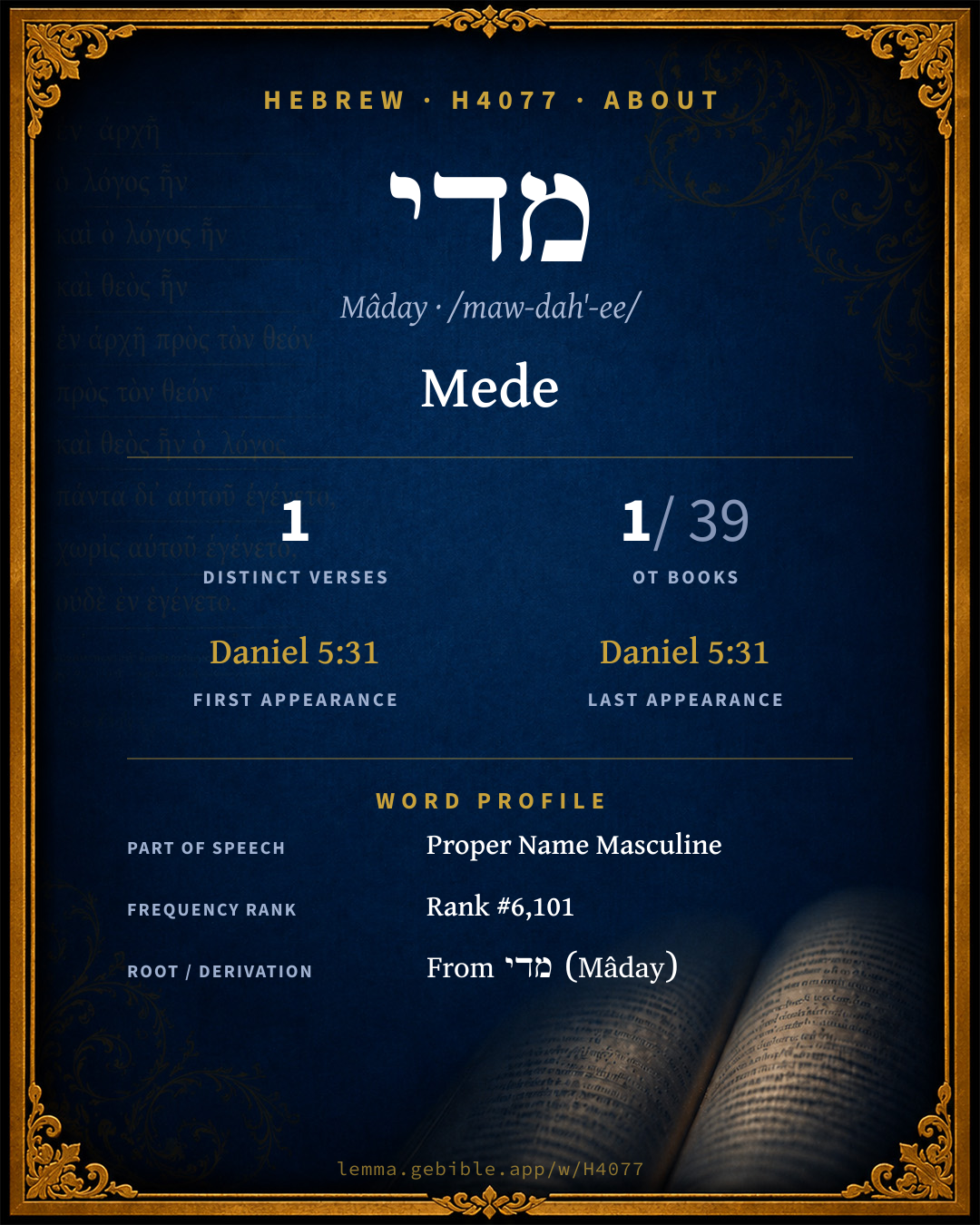
מָדָאָה
Mede
BDB lists 2 entries for ‘Mede’ fuller range ↓
Full lexicon entry — Brown-Driver-Briggs (BDB)
From Brown-Driver-Briggs (BDB)
Where this word appears
Every verse where H4077 appears — 1 distinct verse across 1 book. Click any verse to open its interlinear word-by-word view. Verse text shown in the World English Bible for context — . Each verse’s Hebrew form is shown with its reference; the English is not keyword-highlighted, since the data carries no word-level English alignment. Use “Compare translations” on any verse to read it across multiple English versions. This concordance covers the Hebrew Bible; Septuagint (Greek Old Testament) occurrences are not indexed here.
Daniel 1 verse
About this entry
At a glance — auto-summarized from this page’s data, not written by a person. Every figure links to its source below. This summary describes the numbers; it doesn’t interpret them.
The Hebrew name מדי centers on the idea of “Mede.” With only 1 verse it sits in the long tail of Hebrew Bible vocabulary. The word gravitates to Daniel (100%). A true hapax — its single appearance is Daniel 5:31. Dig into 1-verse concordance and the renderings breakdown below.
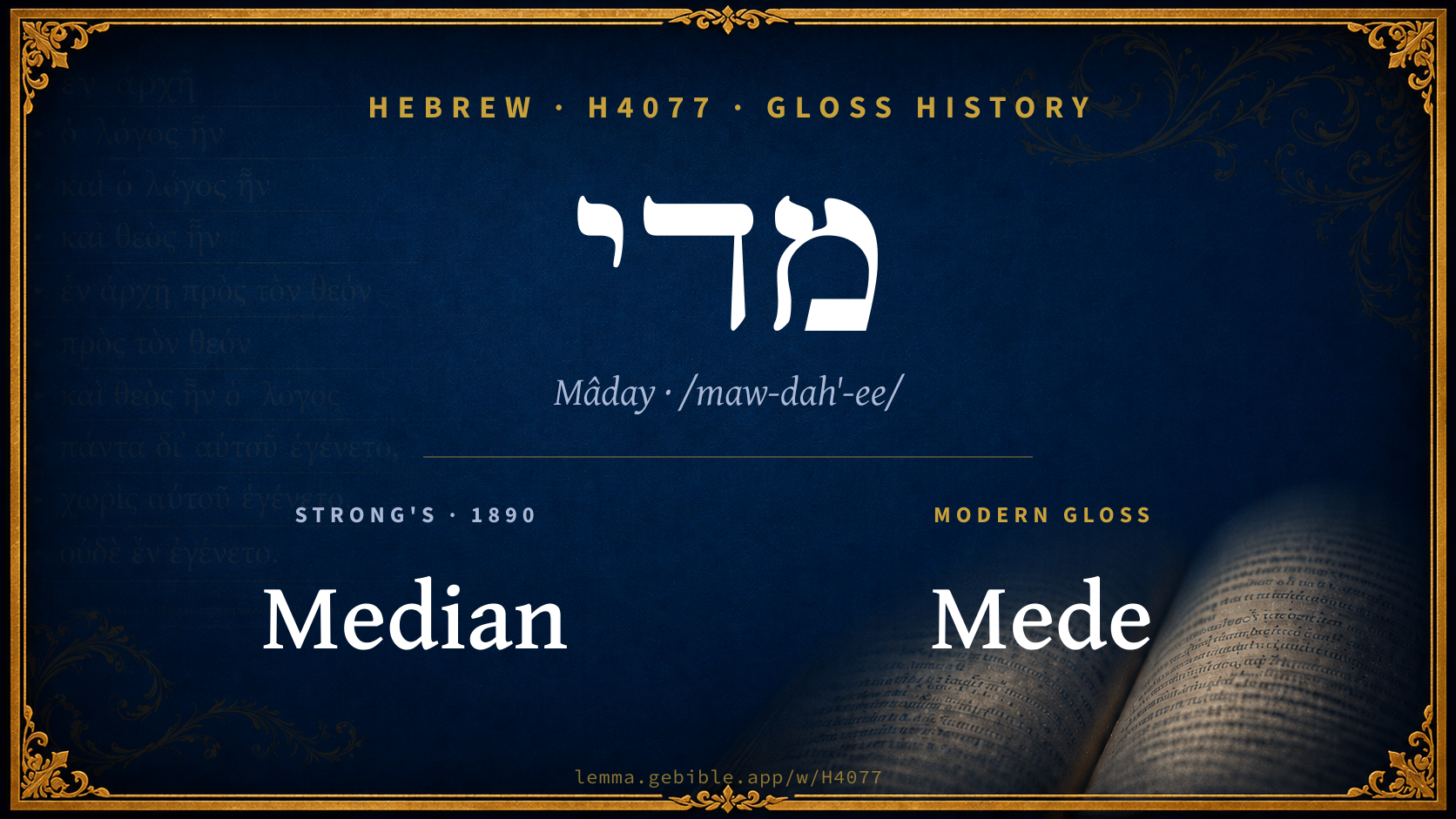
Gloss history
Strong's 1890 vs modern scholarship
About this word
Strong's H4077 catalogs a Hebrew word from the Hebrew Old Testament.
These counts are not copied from any lexicon or concordance. They are computed here, from the morphology-tagged Hebrew Old Testament. What Lemma adds →
- 1
- distinct verses
- The word appears in 1 distinct verse.
- 1 / 39
- OT books
- The word appears in 1 of 39 Old Testament books.
- #6,101
- by frequency
- Rank #6,101 (rank 6,101 of 8,640 Hebrew words by occurrence).
View all 1 occurrence in the concordance →
Most concentrated in
- Daniel 1 verse 100%
By section of the Old Testament
By traditional corpus
Conventional, traditional groupings — biblical authorship is debated, so this is a traditional corpus grouping, not an authorship claim. Each share is this word’s portion of its verses in that division of the Hebrew canon. Each figure is a share of the word’s 1 distinct verse.
- Writings (Ketuvim) 1 verse · 100%
How translations render this word
Counts come from each version’s own published word-to-Strong’s tagging or interlinear alignment — an approximate guide to how each version renders this word, not a word-level alignment the data otherwise carries. Because each total is that version’s own tagged count, the per-version totals vary from one another and need not match the appearance or distinct-verse counts above. These counts may also differ from a printed concordance because Lemma counts each distinctly tagged rendering and does not collapse phrase taggings into a single head-word total. This is a fixed set of word-tagged versions (KJV, ASV, BSB, ULT) and does not change with the reading translation you choose elsewhere. Each version’s license is shown beside its name below (and on Sources).
- King James Version: Median 1×
- American Standard Version: Mede 1×
- unfoldingWord Literal Text: Mede 1×
King James Version Public Domain
Renders H4077 across 1 tagged occurrence — most commonly:
American Standard Version Public Domain
Renders H4077 across 1 tagged occurrence — most commonly:
unfoldingWord Literal Text CC BY-SA 4.0
Renders H4077 across 1 tagged occurrence — most commonly:
Senses in the full BDB
What do BDB’s symbols mean?
BDB uses these scholarly abbreviations:
| Symbol | Meaning |
|---|---|
| 𝔊 | the Septuagint (the ancient Greek translation, LXX) |
| 𝔙 | the Vulgate (the Latin translation) |
| 𝔖 | the Syriac version (the Peshitta) |
| 𝔗 | the Targum (the Aramaic translation) |
| ψ | the Psalms |
| √ | root (the underlying root or stem) |
| ‖ | parallel passage (a synonymous or contrasted parallel) |
| † | the dagger: every passage where the word occurs is cited |
The 2 senses and sub-senses the full Brown-Driver-Briggs lexicon distinguishes for this word, in lexicon order (not ranked by frequency), with BDB’s own verbatim wording and sub-sense lettering. Shown in Hebrew script with BDB’s own scholarly abbreviations. The condensed entry is in the Lexicon Entry tab.
- 1. people, as ‘son’ of Japhet Gn 10:2 (P) = 1 Ch 1:5; as hostile power Is 13:17; 21:2; זֶרַע מָדַי Dn 9:1; land and people, מַלְכֵי מָדַי Je 25:25 (+ מַלְכֵי עֵילָם), 51:11, 28; מַלְכֵי מ׳ וּפָרַס Est 10:2; Dn 8:20; cf. פָּרַס וּמָדַי Est 1:3, 14, 18, 19; 𝔊 Μαδαι. e.g. Genesis 10:2
- 2. of land alone = Media 2 K 17:6; 18:11 (both עָרֵי מָדָ֑י). e.g. 2 Kings 17:6
Senses from the full Brown-Driver-Briggs lexicon (Brown, Driver, Briggs; Oxford 1906 — public domain), digitized via Sefaria, supplemented by the OpenScriptures HebrewLexicon (CC BY 4.0). Full attribution on Sources.
Word origin
n.pr.gent. et terr. Medes, Media (OPers. Mâda SpAPK, Assyrian Madai COTGloss, and on Gn 10:2 DlPar. 247);—
— Brown-Driver-Briggs (Oxford 1906, public domain), digitized via Sefaria, supplemented by the OpenScriptures HebrewLexicon (CC BY 4.0). See Sources.
Derived from מדי (Mâday) (H4075) — Mede.
Jastrow Dictionary
A second Hebrew/Aramaic lexicon for comparison, covering Aramaic and post-biblical (Talmudic, Targumic, Midrashic) usage that the biblical-Hebrew BDB does not. Matched by lemma rather than by Strong’s number, so a lemma may carry more than one Jastrow headword (shown separately below), and the entries cover usage well beyond the Bible.
מָדַי
- (b. h.) pr. n. Media. Shek. III, 4 לשום מ׳ on behalf of the Median Jews. B. Kam. IX, 5 יוליכנו אחריו (אפי׳) למ׳ he must carry it (the unlawful property) after him even as far as Media. Kidd. 71ᵇ מ׳ חולה Media is sick (doubtful as to purity of descent), v. גּוֹסֵס; Gen. R. s. 37, end; Y. Yeb. I, end, 3ᵇ; Y. Kidd. IV, 65ᵈ top מדוי (read מדיי). Esth. R. to I, 3 תשעה במ׳ nine portions (of beauty) has Media; (different in Kidd. 49ᵇ). Ab. d’R. N. ch. XXVIII עושרה של מ׳ (ed. Schechter רומי) the wealth of Media (Rome); a. fr.
מָדִי
- (preced.) Median. Sabb. II, 1, a. e., v. נָחוּם. Yoma 11ᵇ שער המ׳ a Median gate (archway). Esth. R. to I, 22 לשון מ׳ the Median language; a. e.—Fem. מָדִית, מָדִיִּית. Ib. Kel. XXIII, 2, v. מְדוֹכָה; a. e.—Pl. מָדִיּוֹת. Esth. R. to I, 11. Sabb. VI, 6, v. פָּרַף. Y. ib. XII, 13ᶜ bot.; ib. IX, end, 12ᵇ חטים מ׳ Median wheat-grains; a. e.
A Dictionary of the Targumim, the Talmud Babli and Yerushalmi, and the Midrashic Literature (Marcus Jastrow; London, Luzac, 1903) — Public Domain. Digitized via Sefaria. Digitized via Sefaria. Full attribution on Sources.
Bible dictionary
Public-domain dictionary articles matched to this entry by name (Mede). A biblical name can be shared by more than one person or place, so an article may treat several.
Easton's Bible Dictionary · M. G. Easton, 1897
(Heb. Madai), a Median or inhabitant of Media (Dan. 11:1). In Gen. 10:2 the Hebrew word occurs in the list of the sons of Japheth. But probably this is an ethnic and not a personal name, and denotes simply the Medes as descended from Japheth.
Classic public-domain reference works; full attribution on Sources.