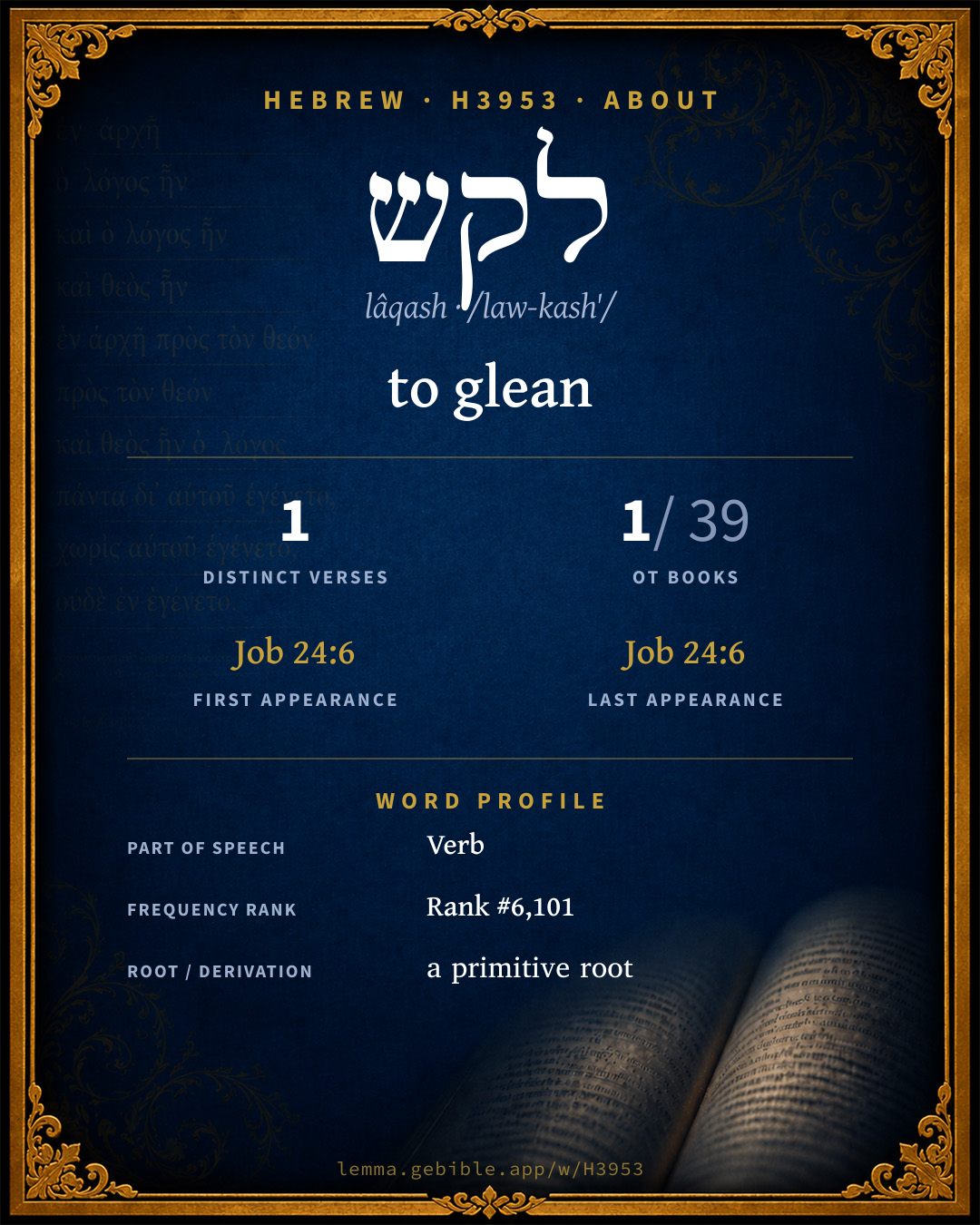
לָקַשׁ
to glean
also: gather, take the aftermath, take everything fuller range ↓
Full lexicon entry — Brown-Driver-Briggs (BDB)
From Brown-Driver-Briggs (BDB)
Where this word appears
Grammar key — what these labels mean
Part of speech
- Verb
- An action or state-of-being word.
Stem
- Piel
- An intensive or resultative active stem.
Form
- Imperfect
- An incomplete, ongoing, or future action (“he will / would write”).
Person
- 3rd Person
- The one spoken about (“he / she / it / they”).
Gender
- Masculine
- Grammatically masculine.
Number
- Plural
- More than one (in Hebrew, generally three or more).
Every verse where H3953 appears — 1 distinct verse across 1 book. Click any verse to open its interlinear word-by-word view. Verse text shown in the World English Bible for context — . Each verse’s Hebrew form is shown with its reference; the English is not keyword-highlighted, since the data carries no word-level English alignment. Use “Compare translations” on any verse to read it across multiple English versions. This concordance covers the Hebrew Bible; Septuagint (Greek Old Testament) occurrences are not indexed here.
Job 1 verse
About this entry
At a glance — auto-summarized from this page’s data, not written by a person. Every figure links to its source below. This summary describes the numbers; it doesn’t interpret them.
“to glean” is the headline sense of the Hebrew verb לקש (lâqash). With only 1 verse it sits in the long tail of Hebrew Bible vocabulary. More than three-quarters of its appearances fall in Job. It occurs only once, in Job 24:6. Not a single-sense word, it carries 2 senses, among them “gather”, “take the aftermath”, and “take everything”. See the sense tree, 1-verse concordance, and the renderings breakdown below.
Gloss history
Strong's 1890 vs modern scholarship

About this word
Strong's H3953 catalogs a Hebrew word from the Hebrew Old Testament.
These counts are not copied from any lexicon or concordance. They are computed here, from the morphology-tagged Hebrew Old Testament. What Lemma adds →
- 1
- distinct verses
- The word appears in 1 distinct verse.
- 1 / 39
- OT books
- The word appears in 1 of 39 Old Testament books.
- #6,101
- by frequency
- Rank #6,101 (rank 6,101 of 8,640 Hebrew words by occurrence).
View all 1 occurrence in the concordance →
Most concentrated in
- Job 1 verse 100%
By section of the Old Testament
By traditional corpus
Conventional, traditional groupings — biblical authorship is debated, so this is a traditional corpus grouping, not an authorship claim. Each share is this word’s portion of its verses in that division of the Hebrew canon. Each figure is a share of the word’s 1 distinct verse.
- Writings (Ketuvim) 1 verse · 100%
How translations render this word
Counts come from each version’s own published word-to-Strong’s tagging or interlinear alignment — an approximate guide to how each version renders this word, not a word-level alignment the data otherwise carries. Because each total is that version’s own tagged count, the per-version totals vary from one another and need not match the appearance or distinct-verse counts above. These counts may also differ from a printed concordance because Lemma counts each distinctly tagged rendering and does not collapse phrase taggings into a single head-word total. This is a fixed set of word-tagged versions (KJV, ASV, BSB, ULT) and does not change with the reading translation you choose elsewhere. Each version’s license is shown beside its name below (and on Sources).
- King James Version: They gather 1×
- American Standard Version: They glean 1×
- Berean Standard Bible: Glean 1×
- unfoldingWord Literal Text: They glean 1×
King James Version Public Domain
Renders H3953 across 1 tagged occurrence — most commonly:
American Standard Version Public Domain
Renders H3953 across 1 tagged occurrence — most commonly:
Berean Standard Bible Public Domain
Renders H3953 across 1 tagged occurrence — most commonly:
unfoldingWord Literal Text CC BY-SA 4.0
Renders H3953 across 1 tagged occurrence — most commonly:
Senses in BDB
The 2 senses BDB distinguishes for this word, in lexicon order (not ranked by frequency or importance). The full entry — with sub-senses — is in the Lexicon Entry tab.
- to glean, gather, take the aftermath, take everything
- (Piel) to despoil, gather everything from, strip
Word origin
[ לָקַשׁ ] vb. only Pi. 3mpl. prob. denom. fr. לֶ֫קֶשׁ = take the aftermath, i.e. take everything;— despoil; Jb 24:6
— Brown-Driver-Briggs (Oxford 1906, public domain), digitized via Sefaria, supplemented by the OpenScriptures HebrewLexicon (CC BY 4.0). See Sources.
Origin: a primitive root
Jastrow Dictionary
A second Hebrew/Aramaic lexicon for comparison, covering Aramaic and post-biblical (Talmudic, Targumic, Midrashic) usage that the biblical-Hebrew BDB does not. Matched by lemma rather than by Strong’s number, so a lemma may carry more than one Jastrow headword (shown separately below), and the entries cover usage well beyond the Bible.
לָקַשׁ
- (b. h.) to be slow, late.
- 1. to retard. Num. R. s. 1, beg. (ref. to מאפליה, Jer. II, 31; cmp. אָפִיל) שמא … והִלְקַשְׁתִּי אותה did I ever promise … and retard it?; Tanḥ. B’midb. 2; Yalk. Jer. 267; Num. R. s. 23 שמא … והִלְקַשְׁתִּי אתכם did I promise to bring you … and keep you back? e.g. Jeremiah 2:31
- 2. to do a thing late, finish in a hurry, in a state of exhaustion. Lev. R. s. 30 (interpret. יעטף, Ps. CII, 1, with ref. to Gen. XXX, 42) מה הפועל … לכשיפליג ממלאכתו קימעה ויַלְקִישֶׁנָּה בסוף (not מלאכתו) as a laborer sits waiting for the time when he may rest a while from his labor, and finally finishes it in a hurry (when it is late). e.g. Psalms 102:1
לְקַשׁ
- , Pa. לַקֵּישׁ to be late, tired. Targ. Y. Gen. XXX, 42 לַקּוּשֵׁי (infin., not לִ׳), v. לַקִּישׁוּתָא.
- as preced. Hif. 2. Yalk. Ps. 855 (ref. to יעטף, v. preced.) דהוא אתי ומַלְקֵשׁ לה for he (the poor man) comes (to prayer late) and goes through it in a state of exhaustion.
לַקִּשׁ
- , v. לַקִּישׁ
קַשׁ
- old, v. קְשַׁשׁ.
קַשׁ ²
- קשש to be hard, stiff; cmp. קָשֶׁה) straw, stubble. Sabb. III, 1 בקש ובגבבא with straw or rakings. Ib. 66ᵃ כוורת של קש; Kel. XV, 1 כוורת הקש, v. כְּוֶורֶת. Ib. XVII, 17, v. שְׁפוֹפֶרֶת. Y. Peah IV, beg. 18ᵃ הנח … בקַשָּׁהּ leave for them (the poor) the grain with its straw (stalks); a. fr.—[Tosef. Sabb. IX (X), 2 הקש שבחזיר some ed. the stiff bristle &c., v. קָשֶׁה.]—Pl. קַשִּׁים, קַשִּׁין. Y. Peah V, end, 19ᵃ בזוכר את הק׳ when he recalls the straw (with which he covered the sheaves). Taan. 6ᵃ בקַשֶּׁיהָ, v. מַלְקוֹשׁ.
A Dictionary of the Targumim, the Talmud Babli and Yerushalmi, and the Midrashic Literature (Marcus Jastrow; London, Luzac, 1903) — Public Domain. Digitized via Sefaria. Digitized via Sefaria. Full attribution on Sources.
Same root — word family
Other BDB entries built from the same root as H3953, grouped by Strong’s listed origin. These share a root / origin per the lexicon — not necessarily a shared meaning. Each links to that word’s own entry.
Derived from this word
Compare all same-root words → They share a root, not necessarily a meaning.
Septuagint verse parallels
This word appears in 1 verse that also exists in the Greek Old Testament (Septuagint), out of the 1 Hebrew verse it occurs in. You can read those verses in Greek by switching the Old Testament edition to the Septuagint.
Read these verses in the Septuagint
This is a verse-level parallel only — the same verses exist in both the Hebrew and Greek Old Testaments. No word-level Hebrew↔Greek correspondence is claimed: the data carries no such alignment, so no Greek word is shown as this Hebrew word’s translation. Coverage is not total — the Septuagint omits the deuterocanon and renumbers the Psalms, so some Hebrew verses have no direct Greek parallel.