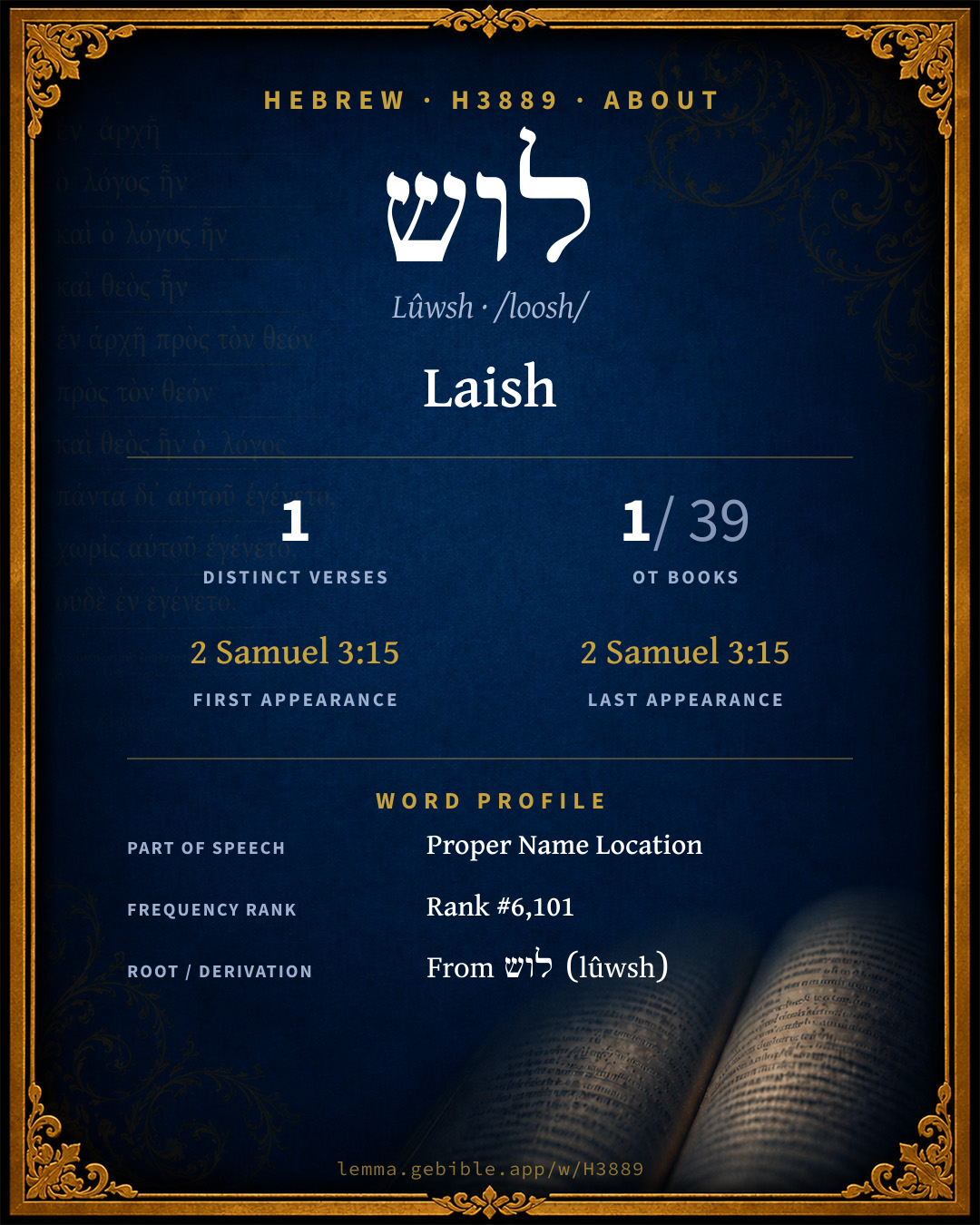
לוּשׁ
Laish
BDB lists 2 entries for ‘Laish’ fuller range ↓
Full lexicon entry — Brown-Driver-Briggs (BDB)
From Brown-Driver-Briggs (BDB)
Where this word appears
Grammar key — what these labels mean
Part of speech
- Noun
- A naming word — a person, place, thing, or idea.
Noun type
- Proper
- A name of a specific person, place, or people (e.g. Abraham, Zion, Israel).
Every verse where H3889 appears — 1 distinct verse across 1 book. Click any verse to open its interlinear word-by-word view. Verse text shown in the World English Bible for context — . Each verse’s Hebrew form is shown with its reference; the English is not keyword-highlighted, since the data carries no word-level English alignment. Use “Compare translations” on any verse to read it across multiple English versions. This concordance covers the Hebrew Bible; Septuagint (Greek Old Testament) occurrences are not indexed here.
2 Samuel 1 verse
About this entry
At a glance — auto-summarized from this page’s data, not written by a person. Every figure links to its source below. This summary describes the numbers; it doesn’t interpret them.
At its core, לוש (Lûwsh) means “Laish.” The Hebrew Bible uses it only 1 verse. The word gravitates to 2 Samuel (100%). A true hapax — its single appearance is 2 Samuel 3:15. Each statement above links to its evidence; the full detail follows below.
Gloss history
Strong's 1890 vs modern scholarship
About this word
Strong's H3889 catalogs a Hebrew word from the Hebrew Old Testament.
These counts are not copied from any lexicon or concordance. They are computed here, from the morphology-tagged Hebrew Old Testament. What Lemma adds →
- 1
- distinct verses
- The word appears in 1 distinct verse.
- 1 / 39
- OT books
- The word appears in 1 of 39 Old Testament books.
- #6,101
- by frequency
- Rank #6,101 (rank 6,101 of 8,640 Hebrew words by occurrence).
View all 1 occurrence in the concordance →
Most concentrated in
- 2 Samuel 1 verse 100%
By section of the Old Testament
By traditional corpus
Conventional, traditional groupings — biblical authorship is debated, so this is a traditional corpus grouping, not an authorship claim. Each share is this word’s portion of its verses in that division of the Hebrew canon. Each figure is a share of the word’s 1 distinct verse.
- Prophets (Nevi'im) 1 verse · 100%
How translations render this word
Counts come from each version’s own published word-to-Strong’s tagging or interlinear alignment — an approximate guide to how each version renders this word, not a word-level alignment the data otherwise carries. Because each total is that version’s own tagged count, the per-version totals vary from one another and need not match the appearance or distinct-verse counts above. These counts may also differ from a printed concordance because Lemma counts each distinctly tagged rendering and does not collapse phrase taggings into a single head-word total. This is a fixed set of word-tagged versions (KJV, ASV, BSB, ULT) and does not change with the reading translation you choose elsewhere. Each version’s license is shown beside its name below (and on Sources).
- King James Version: Laish 1×
- American Standard Version: Laish 1×
- Berean Standard Bible: Laish 1×
King James Version Public Domain
Renders H3889 across 1 tagged occurrence — most commonly:
American Standard Version Public Domain
Renders H3889 across 1 tagged occurrence — most commonly:
Berean Standard Bible Public Domain
Renders H3889 across 1 tagged occurrence — most commonly:
Senses in BDB
The 2 senses BDB distinguishes for this word, in lexicon order (not ranked by frequency or importance). The full entry — with sub-senses — is in the Lexicon Entry tab.
- Laish = "lion"
- father of Phaltiel…
Word origin
Derived from לוש (lûwsh) (H3888) — to knead.
Jastrow Dictionary
A second Hebrew/Aramaic lexicon for comparison, covering Aramaic and post-biblical (Talmudic, Targumic, Midrashic) usage that the biblical-Hebrew BDB does not. Matched by lemma rather than by Strong’s number, so a lemma may carry more than one Jastrow headword (shown separately below), and the entries cover usage well beyond the Bible.
לוּשׁ
- (b. h.) to knead. Sabb. VII, 2 הַלָּשׁ he who kneads (on the Sabbath). Y. ib. VII, 10ᵇ bot., a. fr. חייב משום לָשׁ is guilty of an act coming under the category of kneading (v. בילוס). Pes. 30ᵃ, a. e. אין לָשִׁין את וכ׳ you must not knead dough (of bread) with milk; a. v. fr.—Part. pass. לוּשׁ, fr. לוּשָׁה. Y. Sot. IX, 24ᵇ bot. ל׳ בדבש וכ׳ kneaded with honey and cream (Bab. ib. 48ᵇ דומה לעיסה שנִילּוֹשָׁהוכ׳).
- to be kneaded. Pes. 35ᵃ עיסה שנִילּוֹשָׁה וכ׳ dough kneaded with wine, oil or honey. Sot. 48ᵇ, v. supra. Men. V, 2 (55ᵃ) נָלוֹשׁוֹת בפושרין (Bab. ed. נִילָּשׁוֹת) must be kneaded with tepid water; a. fr.—Yalk. Prov. 959 (etymol. of לַיִשׁ) שבשרו של אדם נלוש בשיניו (not בולש) man’s flesh is kneaded between his (the lion’s) teeth; Ab. d’R. N. II Vers. ch. XLIII (ed. Schechter, p. 122) שהכל נָלוֹשִׁין בפיו כמין בצק (not נעשין).
לוּשׁ ²
- Targ. O. Gen. XVIII, 6. Targ. Hos. VII, 4 מעידן דמֵלַשׁ ed. Lag. (oth. ed. דמֵילַשׁ, דמֵילוּשׁ) from the time of kneading.—Part. pass. לִישׁ. Targ. O. Num. XI, 8 (h. text לשד).—Pes. 36ᵃ לא תְלוּשׁוּ לי וכ׳ do not knead (the bread on Passover) for me with &c. Pesik. R. s. 22 אזלת מֵלִישׁ וכ׳ went to knead (and bake her bread) at her neighbor’s; Lev. R. s. 6 למֵילַשׁ; a. e.
A Dictionary of the Targumim, the Talmud Babli and Yerushalmi, and the Midrashic Literature (Marcus Jastrow; London, Luzac, 1903) — Public Domain. Digitized via Sefaria. Digitized via Sefaria. Full attribution on Sources.
Same root — word family
Other BDB entries built from the same root as H3889, grouped by Strong’s listed origin. These share a root / origin per the lexicon — not necessarily a shared meaning. Each links to that word’s own entry.
Derives from
Shares the same root
Compare all same-root words → They share a root, not necessarily a meaning.
Bible dictionary
Public-domain dictionary articles matched to this entry by name (Laish). A biblical name can be shared by more than one person or place, so an article may treat several.
Easton's Bible Dictionary · M. G. Easton, 1897
A lion. (1.) A city of the Sidonians, in the extreme north of Palestine (Judg. 18:7, 14); called also Leshem (Josh. 19:47) and Dan (Judg. 18:7, 29; Jer. 8:16). It lay near the sources of the Jordan, about 4 miles from Paneas. The restless and warlike tribe of Dan (q.v.), looking out for larger possessions, invaded this country and took Laish with its territory. It is identified with the ruin Tell-el-Kady, "the mound of the judge," to the north of the Waters of Merom (Josh. 11:5).
(2.) A place mentioned in Isa. 10:30. It has been supposed to be the modern el-Isawiyeh, about a mile north-east of Jerusalem.
(3.) The father of Phalti (1 Sam. 25:44).
Smith's Bible Dictionary · William Smith, 1863
(lion), father of Phaltiel, to whom Saul had given Michal, David's wife. (1 Samuel 25:44; 2 Samuel 3:15)
Hitchcock's Bible Names Dictionary · Roswell D. Hitchcock, 1869
a lion
Classic public-domain reference works; full attribution on Sources.
Septuagint verse parallels
This word appears in 1 verse that also exists in the Greek Old Testament (Septuagint), out of the 1 Hebrew verse it occurs in. You can read those verses in Greek by switching the Old Testament edition to the Septuagint.
Read these verses in the Septuagint
This is a verse-level parallel only — the same verses exist in both the Hebrew and Greek Old Testaments. No word-level Hebrew↔Greek correspondence is claimed: the data carries no such alignment, so no Greek word is shown as this Hebrew word’s translation. Coverage is not total — the Septuagint omits the deuterocanon and renumbers the Psalms, so some Hebrew verses have no direct Greek parallel.