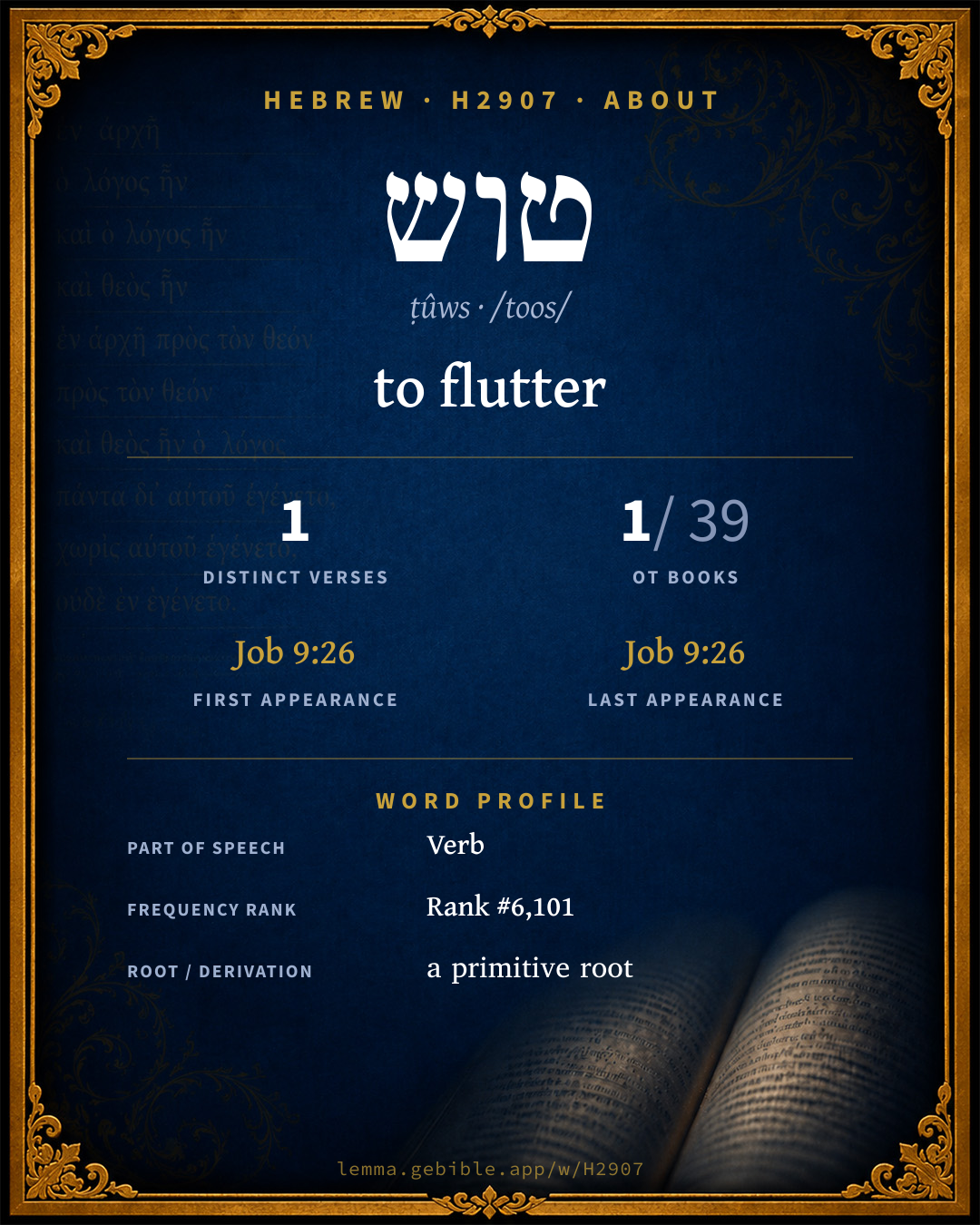
טוּשׂ
to flutter
Full lexicon entry — Brown-Driver-Briggs (BDB)
From Brown-Driver-Briggs (BDB)
Where this word appears
Grammar key — what these labels mean
Part of speech
- Verb
- An action or state-of-being word.
Stem
- Qal
- The basic, simple active stem — the plain form of the verb (“he wrote”).
Form
- Imperfect
- An incomplete, ongoing, or future action (“he will / would write”).
Person
- 3rd Person
- The one spoken about (“he / she / it / they”).
Gender
- Masculine
- Grammatically masculine.
Number
- Singular
- One.
Every verse where H2907 appears — 1 distinct verse across 1 book. Click any verse to open its interlinear word-by-word view. Verse text shown in the World English Bible for context — . Each verse’s Hebrew form is shown with its reference; the English is not keyword-highlighted, since the data carries no word-level English alignment. Use “Compare translations” on any verse to read it across multiple English versions. This concordance covers the Hebrew Bible; Septuagint (Greek Old Testament) occurrences are not indexed here.
Job 1 verse
About this entry
At a glance — auto-summarized from this page’s data, not written by a person. Every figure links to its source below. This summary describes the numbers; it doesn’t interpret them.
טוש (ṭûws) is a Hebrew verb most often rendered “to flutter.” With only 1 verse it sits in the long tail of Hebrew Bible vocabulary. It clusters heavily in Job, which alone accounts for 100% of its uses. Scripture uses it exactly once, at Job 9:26. For the data behind this summary, explore the sense tree and the renderings breakdown below.
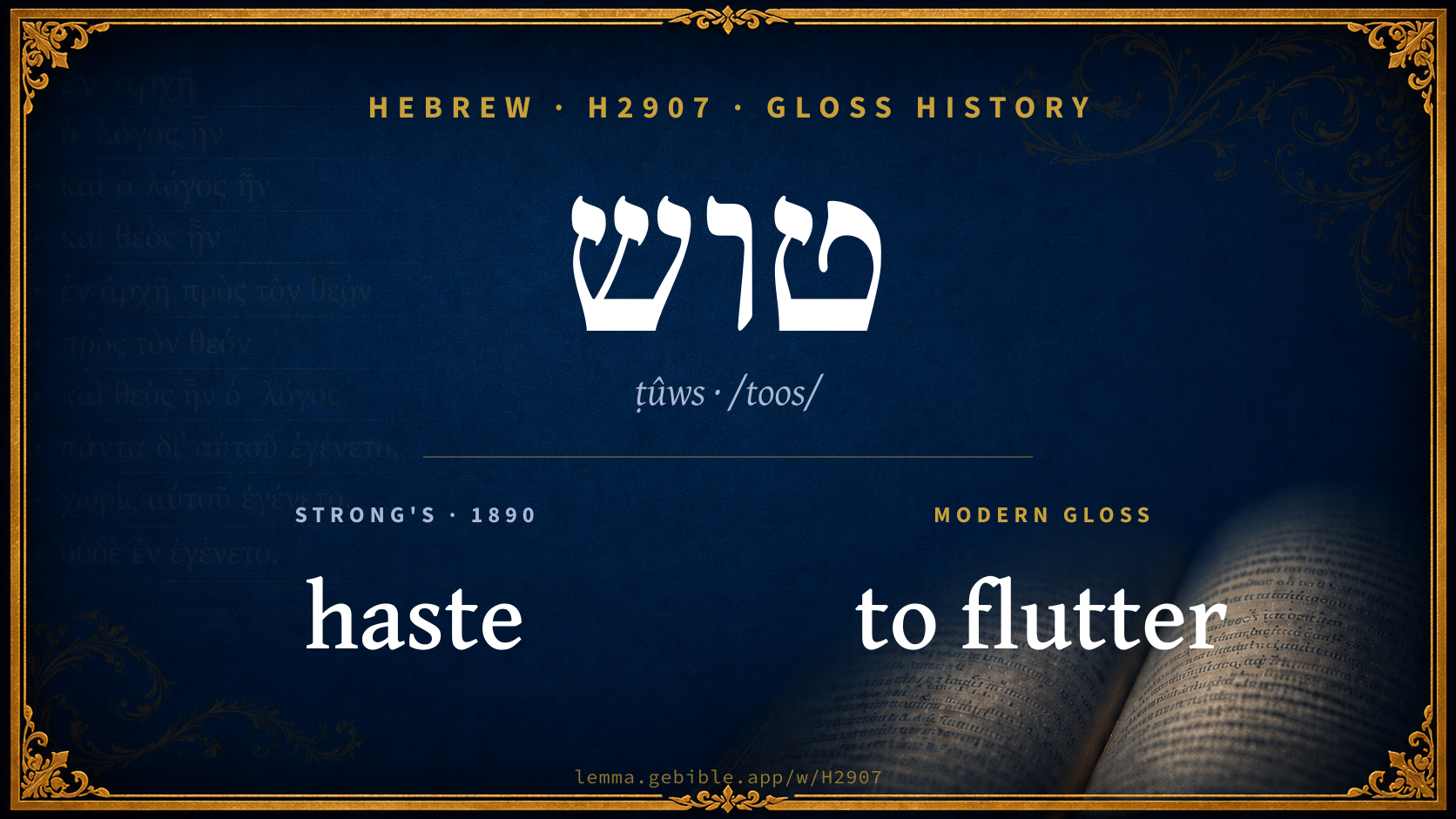
Gloss history
Strong's 1890 vs modern scholarship
About this word
Strong's H2907 catalogs a Hebrew word from the Hebrew Old Testament.
These counts are not copied from any lexicon or concordance. They are computed here, from the morphology-tagged Hebrew Old Testament. What Lemma adds →
- 1
- distinct verses
- The word appears in 1 distinct verse.
- 1 / 39
- OT books
- The word appears in 1 of 39 Old Testament books.
- #6,101
- by frequency
- Rank #6,101 (rank 6,101 of 8,640 Hebrew words by occurrence).
View all 1 occurrence in the concordance →
Most concentrated in
- Job 1 verse 100%
By section of the Old Testament
By traditional corpus
Conventional, traditional groupings — biblical authorship is debated, so this is a traditional corpus grouping, not an authorship claim. Each share is this word’s portion of its verses in that division of the Hebrew canon. Each figure is a share of the word’s 1 distinct verse.
- Writings (Ketuvim) 1 verse · 100%
How translations render this word
Counts come from each version’s own published word-to-Strong’s tagging or interlinear alignment — an approximate guide to how each version renders this word, not a word-level alignment the data otherwise carries. Because each total is that version’s own tagged count, the per-version totals vary from one another and need not match the appearance or distinct-verse counts above. These counts may also differ from a printed concordance because Lemma counts each distinctly tagged rendering and does not collapse phrase taggings into a single head-word total. This is a fixed set of word-tagged versions (KJV, ASV, BSB, ULT) and does not change with the reading translation you choose elsewhere. Each version’s license is shown beside its name below (and on Sources).
- King James Version: Hasteth 1×
- American Standard Version: Swoopeth 1×
- Berean Standard Bible: Swooping down 1×
- unfoldingWord Literal Text: Pounces 1×
King James Version Public Domain
Renders H2907 across 1 tagged occurrence — most commonly:
American Standard Version Public Domain
Renders H2907 across 1 tagged occurrence — most commonly:
Berean Standard Bible Public Domain
Renders H2907 across 1 tagged occurrence — most commonly:
unfoldingWord Literal Text CC BY-SA 4.0
Renders H2907 across 1 tagged occurrence — most commonly:
Senses in BDB
The 1 sense BDB distinguishes for this word, in lexicon order (not ranked by frequency or importance). The full entry — with sub-senses — is in the Lexicon Entry tab.
- (Qal) to dart, flutter, rush
Word origin
[ טוּשׂ ] vb. rush, dart —only Qal Jb 9:26
— Brown-Driver-Briggs (Oxford 1906, public domain), digitized via Sefaria, supplemented by the OpenScriptures HebrewLexicon (CC BY 4.0). See Sources.
Origin: a primitive root
Jastrow Dictionary
A second Hebrew/Aramaic lexicon for comparison, covering Aramaic and post-biblical (Talmudic, Targumic, Midrashic) usage that the biblical-Hebrew BDB does not. Matched by lemma rather than by Strong’s number, so a lemma may carry more than one Jastrow headword (shown separately below), and the entries cover usage well beyond the Bible.
טוּשׂ
- , v. טוּס
טוּשׁ I
- (cmp. טוּחַ I) to cover with a cohesive substance, to polish (with a fatty matter); to besmear, soil, pollute. Pes. 30ᵇ; Zeb. 95ᵇ, a. e. אין טָשִׁין וכ׳ one must not polish the stove with &c. Tosef. B. Kam. IX, 31 [in a misplaced passage, belonging after שבידיו; read:] הרָק כנגד פני חבירו וטָשׁ פניו (ref. to Is. L, 6ᵇ) who spat into or besmeared his neighbor’s face; (cmp. Mish. ib. VIII, 6; Sifra Emor Par. 14, ch. XX).
- (fr. טָשַׁשׁ)
- 1. to make viscid, soften. Taan. 22ᵇ מְטַשְׁטְשִׁין את הארץ (the heavy rains) make the soil muddy and it yields no fruit; Yalk. Lev. 671.
- 2. to smear over, besmear. Part. pass. מְטוּשְׁטָשׁ, pl. מְטוּשְׁטָשִׁין. Pes. 65ᵇ היו בגדיו מט׳ if his (the priest’s) garments were besmeared (with blood &c.); Zeb. 18ᵃ, sq.; ib. 35ᵃ.—Meg. 18ᵇ אותיות מְטוּשְׁטָשׁוֹת letters made illegible by being smeared over.
- , Hithpa. הִיטַּשְׁטֵשׁ to be smeared over, be dirty. B. Bath. 168ᵇ נמחק או נט׳ if the writing was blotted out or blurred. Tosef. Kel. B. Mets. IV, 13 נִטַּשְׁטְשָׁה a metal mirror which became blurred (blind). Sabb. 81ᵃ נִיטַּשְׁטְשׁוּ Ms. M. (ed. נשטש׳, corr. acc.) the spots were washed away (became indistinct). Cant. R. to VIII, 9 a picture on a wall אע"פ שמִטַּשְׁטֶשֶׁת (prob. שמְטוּשְׁטֶשֶׁת, v. supra) even if it be smeared over.
טוּשׁ
- Targ. Y. Deut. XXVIII, 40 תטושון Ar. (ed. תשוטון, corr. acc. or תשועון, v. שׁוּע) you will oint yourselves. Targ. Y. II, Lev. XIV, 42 ויטשון (read וִיטוּשׁוּן) shall plaster over; (Targ. Y. I ויִתְטַשׁ Ithpa.).—Gen. R. s. 34, end וטָשִׁין מותיה (not וטושין) and paste the plaster on its scull.
- to be plastered. Targ. Y. Lev. XIV, 43; 48; v. supra.
- to smear over, to make muddy. Part. pass. מְטַשְׁטַשׁ; v. infra.
- to be smeared over, to be made muddy. Targ. Job. XVI, 16 מִטַּ׳ Ms. (ed. מְטַ׳; h. text חמרמר׳); Targ. Ps. XLVI, 4 (h. text חמר; cmp. חֵמָרָא).
טוּשׁ II
- (v. טְשֵׁי), Af. אָטֵישׁ to hide, reserve (corresp. to h. צָפַן). Targ. Ps. XXXI, 20 אָטֵשְתָּא Ms. (ed. אַטְשֵׁיתָא, v. טְשִׁי). Ib. CXIX, 11 (some ed. אשיש׳, corr. acc.). Targ. Job X, 13. Ib. XXIII, 12.
- to be hidden. Ib. XV, 20. Ib. XXIV, 1.—V. טְשֵׁי, נטש.
A Dictionary of the Targumim, the Talmud Babli and Yerushalmi, and the Midrashic Literature (Marcus Jastrow; London, Luzac, 1903) — Public Domain. Digitized via Sefaria. Digitized via Sefaria. Full attribution on Sources.
Septuagint verse parallels
This word appears in 1 verse that also exists in the Greek Old Testament (Septuagint), out of the 1 Hebrew verse it occurs in. You can read those verses in Greek by switching the Old Testament edition to the Septuagint.
Read these verses in the Septuagint
This is a verse-level parallel only — the same verses exist in both the Hebrew and Greek Old Testaments. No word-level Hebrew↔Greek correspondence is claimed: the data carries no such alignment, so no Greek word is shown as this Hebrew word’s translation. Coverage is not total — the Septuagint omits the deuterocanon and renumbers the Psalms, so some Hebrew verses have no direct Greek parallel.