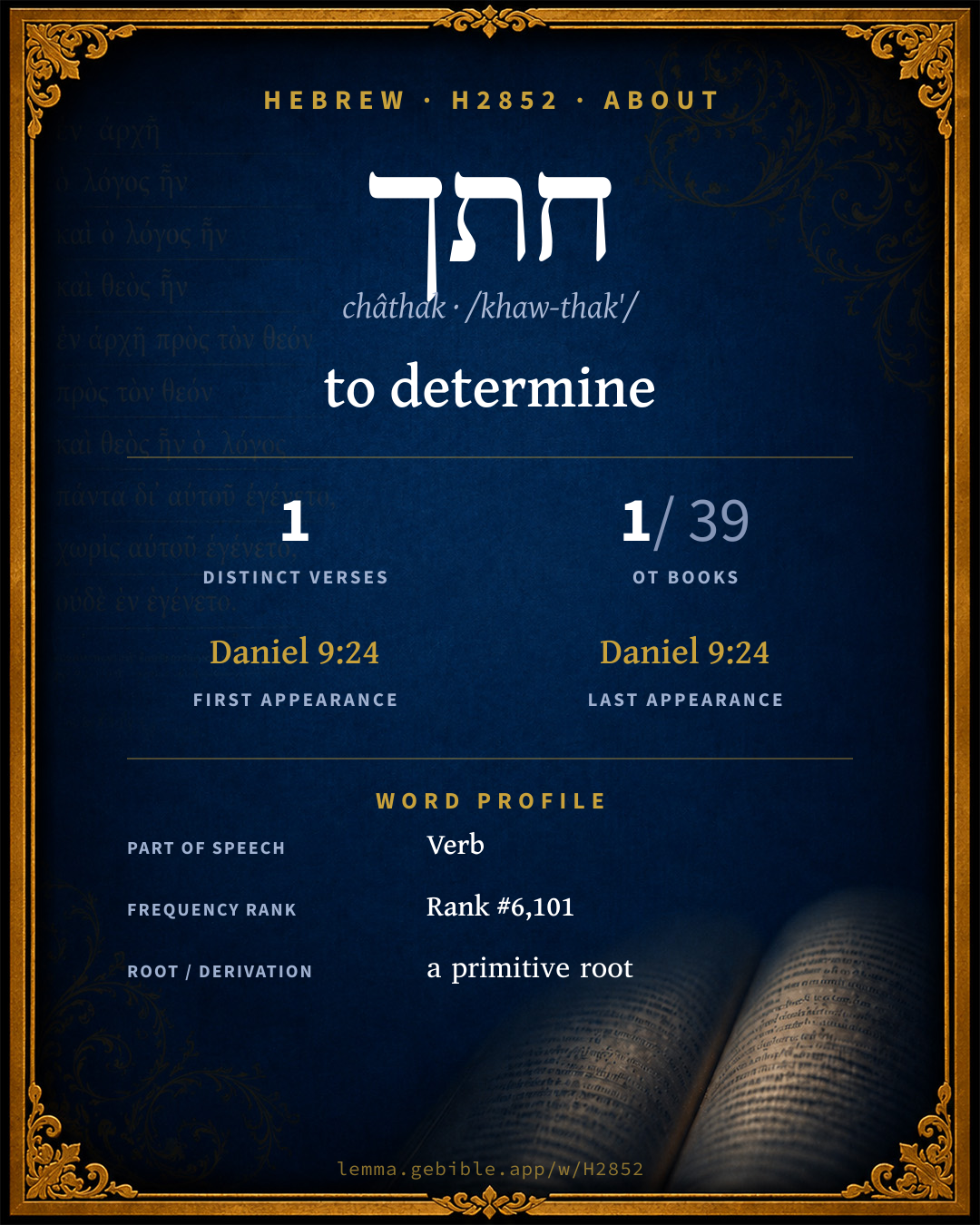
חָתַךְ
to determine
‘to determine’ is one of 2 main senses fuller range ↓
Full lexicon entry — Brown-Driver-Briggs (BDB)
From Brown-Driver-Briggs (BDB)
Where this word appears
Grammar key — what these labels mean
Part of speech
- Verb
- An action or state-of-being word.
Stem
- Niphal
- Usually the simple passive or reflexive of the Qal (“he was written”).
Form
- Perfect
- A completed action or state — Hebrew marks aspect (completeness) more than strict tense (“he wrote”).
Person
- 3rd Person
- The one spoken about (“he / she / it / they”).
Gender
- Masculine
- Grammatically masculine.
Number
- Singular
- One.
Every verse where H2852 appears — 1 distinct verse across 1 book. Click any verse to open its interlinear word-by-word view. Verse text shown in the World English Bible for context — . Each verse’s Hebrew form is shown with its reference; the English is not keyword-highlighted, since the data carries no word-level English alignment. Use “Compare translations” on any verse to read it across multiple English versions. This concordance covers the Hebrew Bible; Septuagint (Greek Old Testament) occurrences are not indexed here.
Daniel 1 verse
About this entry
At a glance — auto-summarized from this page’s data, not written by a person. Every figure links to its source below. This summary describes the numbers; it doesn’t interpret them.
חתך (châthak) is a Hebrew verb most often rendered “to determine.” It is rare — just 1 verse in the entire Hebrew Bible. Daniel dominates its distribution — 1 of 1 verses. A true hapax — its single appearance is Daniel 9:24. Its lexical range runs to 2 senses. The sections below give every sense, occurrence, and version rendering.
Gloss history
Strong's 1890 vs modern scholarship
About this word
Strong's H2852 catalogs a Hebrew word from the Hebrew Old Testament.
These counts are not copied from any lexicon or concordance. They are computed here, from the morphology-tagged Hebrew Old Testament. What Lemma adds →
- 1
- distinct verses
- The word appears in 1 distinct verse.
- 1 / 39
- OT books
- The word appears in 1 of 39 Old Testament books.
- #6,101
- by frequency
- Rank #6,101 (rank 6,101 of 8,640 Hebrew words by occurrence).
View all 1 occurrence in the concordance →
Most concentrated in
- Daniel 1 verse 100%
By section of the Old Testament
By traditional corpus
Conventional, traditional groupings — biblical authorship is debated, so this is a traditional corpus grouping, not an authorship claim. Each share is this word’s portion of its verses in that division of the Hebrew canon. Each figure is a share of the word’s 1 distinct verse.
- Writings (Ketuvim) 1 verse · 100%
How translations render this word
Counts come from each version’s own published word-to-Strong’s tagging or interlinear alignment — an approximate guide to how each version renders this word, not a word-level alignment the data otherwise carries. Because each total is that version’s own tagged count, the per-version totals vary from one another and need not match the appearance or distinct-verse counts above. These counts may also differ from a printed concordance because Lemma counts each distinctly tagged rendering and does not collapse phrase taggings into a single head-word total. This is a fixed set of word-tagged versions (KJV, ASV, BSB, ULT) and does not change with the reading translation you choose elsewhere. Each version’s license is shown beside its name below (and on Sources).
- King James Version: Are determined 1×
- American Standard Version: Are decreed 1×
- Berean Standard Bible: Are decreed 1×
- unfoldingWord Literal Text: Are decreed 1×
King James Version Public Domain
Renders H2852 across 1 tagged occurrence — most commonly:
American Standard Version Public Domain
Renders H2852 across 1 tagged occurrence — most commonly:
Berean Standard Bible Public Domain
Renders H2852 across 1 tagged occurrence — most commonly:
unfoldingWord Literal Text CC BY-SA 4.0
Renders H2852 across 1 tagged occurrence — most commonly:
Senses in BDB
The 2 senses BDB distinguishes for this word, in lexicon order (not ranked by frequency or importance). The full entry — with sub-senses — is in the Lexicon Entry tab.
- to divide, determine
- (Niphal) to be determined, be decreed, be settled, be marked out
Word origin
[ חָתַךְ ] vb. divide, determine —only Niph. Dn 9:24
— Brown-Driver-Briggs (Oxford 1906, public domain), digitized via Sefaria, supplemented by the OpenScriptures HebrewLexicon (CC BY 4.0). See Sources.
Origin: a primitive root
Jastrow Dictionary
A second Hebrew/Aramaic lexicon for comparison, covering Aramaic and post-biblical (Talmudic, Targumic, Midrashic) usage that the biblical-Hebrew BDB does not. Matched by lemma rather than by Strong’s number, so a lemma may carry more than one Jastrow headword (shown separately below), and the entries cover usage well beyond the Bible.
חָתַךְ
- (b. h.)
- 1. to cut, dissect; to sever. Ḥull. 33ᵃ חוֹתֵךְ כזית וכ׳ cuts out flesh of the size of an olive. Ib. 32ᵃ ח׳ דלעת וכ׳ if in slaughtering he cut a pumpkin at the same time. Ib. 48ᵇ a. e. חוֹתְכָהּ מכאן וכ׳ he amputates on one place and the animal survives &c. Bets. 32ᵇ חוֹתְכָהּ באיר he may sever the wick over the light. Y. Meg. IV, 75ᵃ חותך the reader cuts one verse into two (reading Gen. I, 5, a. I, 8 as two verses severally); a. fr.—[Lev. R. s. 10 לחתוך את אביו וכ׳, v. חָתַר.]—Part. pass. חָתוּךְ cut into, having the incisions of limbs &c., outlined. Nidd. 24ᵇ גוף שאינו ח׳ a shapeless body (not articulated); ראש שאינו ח׳ a shapeless head (without indications of the nose &c.) Ib. 24ᵃ יד חֲתוּכָה a well-shaped hand (of an embryo); a. fr. e.g. Genesis 1:5
- 2. (cmp. פָּסַק, גָּזַר) to decide, sentence. Lev. R. s. 4, beg. (ref. to התוך, Jer. XXXIX, 3) ששם חוֹתְכִין את ההלכה for there they decide the practice. Ib. וחוֹתֶכֶת דיניהם וכ׳ and decides the cases &c. Shebu. 30ᵇ bot. אֶחְתְּכֶנּוּ I will decide the case (in accordance with the testimony).—Part. pass. as ab. Y. Snh. IV, beg. 22ᵃ אילו … התורה חתוכה if the Law had been given in the form of clear decisions (leaving no room for differences of opinion, discretion &c.) e.g. Jeremiah 39:3
- 1. to be cut off, severed; to be cut into. Ḥull. IV, 6 שנֶחְתְּכוּ רגליה whose feet have been amputated. Ib. 32ᵃ נֶחְתְּכָה דלעת וכ׳ if by accident a pumpkin has been cut simultaneously with the animal (opp. to חָתַךְ, v. supra); a. fr.
- 2. to be decided, decreed. Meg. 15ᵃ (play on ה̇ת̇ך̇, Esth. IV, 5) שכל … נֶחְ֗תָּ֗כִ֗ין על יפיו all the government affairs were decided upon his opinion. e.g. Esther 4:5
- 1. to cut. Ḥull. IV, 2 מְחַתֵּךְ אבר אבר he may cut off limb after limb. Ib. 98ᵇ מחתך לה וכ׳ he carves the foreleg and then boils it.—Part. pass. מְחוּתָּךְ piecemeal, limbwise. Y. Nidd. III, 50ᶜ יצא מח׳ if the embryo came out by pieces.
- 2. to decide. Snh. 7ᵇ צדק … חַתְּכֵהוּ make the case clear and then decide it. Ber. 61ᵃ לשון מְחַתֵּךְ וכ׳ the tongue forms the sentence, the mouth closes (the case, makes it irreversible).
- 3. to dig ore (in lumps). Keth. 77ᵃ (expl. מצרף) המְחַתֵּךְ … מעיקרו he who digs copper in the shaft. [Tosef. Ohol. IV, 3 וחיתכו, וחתכו, read: והִתִּיכוֹ or והִיתְּכוֹ, v. נָתַךְ a. התך.]
חֲתַךְ
- Pa. חַתֵּיךְ to cut off. Ḥull. 11ᵃ ח׳ ליה לגמרי he severed it entirely, v. לוּף.—Part. pass. מְחַתַּךְ in pieces. Targ. Y. Lev. VII, 30 (ed. Amst. מַחְתַּךְ, incorr.). Targ. Y. I Num. XII, 12 כד מח׳ (not מְחַתֵּיךְ).
- to be cut, to be decided. Targ. Esth. IV, 5 (v. Meg. 15ᵃ, quot. in preced.).
חֲתָךְ
- (preced.) cut, wound. Tosef. Mikv. VII (VIII), 3 מפני הח׳ on account of the place where the handle is intended to be lopped off (v. Mikv. X, 5).—Erub. 18ᵃ. Ḥull. 32ᵇ שחט במקום ח׳ he slaughtered by setting the knife into the wound (and continued the cut).
A Dictionary of the Targumim, the Talmud Babli and Yerushalmi, and the Midrashic Literature (Marcus Jastrow; London, Luzac, 1903) — Public Domain. Digitized via Sefaria. Digitized via Sefaria. Full attribution on Sources.
Septuagint verse parallels
This word appears in 1 verse that also exists in the Greek Old Testament (Septuagint), out of the 1 Hebrew verse it occurs in. You can read those verses in Greek by switching the Old Testament edition to the Septuagint.
Read these verses in the Septuagint
This is a verse-level parallel only — the same verses exist in both the Hebrew and Greek Old Testaments. No word-level Hebrew↔Greek correspondence is claimed: the data carries no such alignment, so no Greek word is shown as this Hebrew word’s translation. Coverage is not total — the Septuagint omits the deuterocanon and renumbers the Psalms, so some Hebrew verses have no direct Greek parallel.