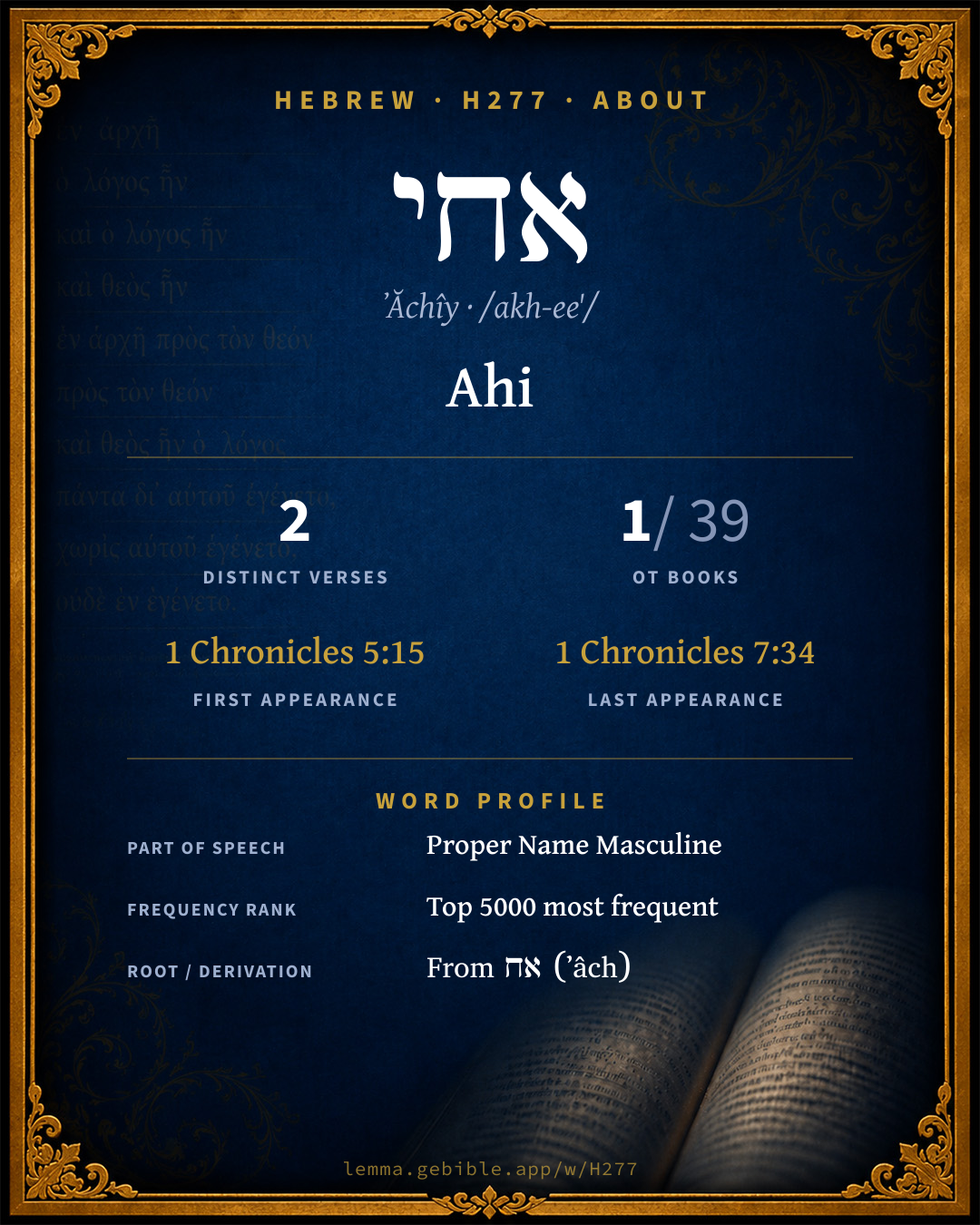
אֲחִי
Ahi
BDB lists 3 entries for ‘Ahi’ fuller range ↓
Full lexicon entry — Brown-Driver-Briggs (BDB)
From Brown-Driver-Briggs (BDB)
Where this word appears
Grammar key — what these labels mean
Part of speech
- Noun
- A naming word — a person, place, thing, or idea.
Noun type
- Proper
- A name of a specific person, place, or people (e.g. Abraham, Zion, Israel).
Every verse where H277 appears — 2 distinct verses across 1 book. Click any verse to open its interlinear word-by-word view. Verse text shown in the World English Bible for context — . Each verse’s Hebrew form is shown with its reference; the English is not keyword-highlighted, since the data carries no word-level English alignment. Use “Compare translations” on any verse to read it across multiple English versions. This concordance covers the Hebrew Bible; Septuagint (Greek Old Testament) occurrences are not indexed here.
1 Chronicles 2 verses
About this entry
At a glance — auto-summarized from this page’s data, not written by a person. Every figure links to its source below. This summary describes the numbers; it doesn’t interpret them.
At its core, אחי (ʼĂchîy) means “Ahi.” The Hebrew Bible uses it only 2 verses. Its uses cluster heavily in 1 Chronicles (100% of all occurrences). It first appears in 1 Chronicles 5:15. For the data behind this summary, explore 2-verse concordance and the renderings breakdown below.
Gloss history
Strong's 1890 vs modern scholarship
About this word
Strong's H277 catalogs a Hebrew word from the Hebrew Old Testament.
These counts are not copied from any lexicon or concordance. They are computed here, from the morphology-tagged Hebrew Old Testament. What Lemma adds →
- 2
- distinct verses
- The word appears in 2 distinct verses.
- 1 / 39
- OT books
- The word appears in 1 of 39 Old Testament books.
- #4,807
- by frequency
- Top 5000 most frequent Hebrew words (rank 4,807 of 8,640 Hebrew words by occurrence).
View all 2 occurrences in the concordance →
Most concentrated in
- 1 Chronicles 2 verses 100%
By section of the Old Testament
By traditional corpus
Conventional, traditional groupings — biblical authorship is debated, so this is a traditional corpus grouping, not an authorship claim. Each share is this word’s portion of its verses in that division of the Hebrew canon. Each figure is a share of the word’s 2 distinct verses.
- Writings (Ketuvim) 2 verses · 100%
How translations render this word
Counts come from each version’s own published word-to-Strong’s tagging or interlinear alignment — an approximate guide to how each version renders this word, not a word-level alignment the data otherwise carries. Because each total is that version’s own tagged count, the per-version totals vary from one another and need not match the appearance or distinct-verse counts above. These counts may also differ from a printed concordance because Lemma counts each distinctly tagged rendering and does not collapse phrase taggings into a single head-word total. This is a fixed set of word-tagged versions (KJV, ASV, BSB, ULT) and does not change with the reading translation you choose elsewhere. Each version’s license is shown beside its name below (and on Sources).
- King James Version: Ahi 2×
- American Standard Version: Ahi 2×
- Berean Standard Bible: Ahi 2×
- unfoldingWord Literal Text: Ahi 2×
King James Version Public Domain
Renders H277 across 2 tagged occurrences — most commonly:
American Standard Version Public Domain
Renders H277 across 2 tagged occurrences — most commonly:
Berean Standard Bible Public Domain
Renders H277 across 2 tagged occurrences — most commonly:
unfoldingWord Literal Text CC BY-SA 4.0
Renders H277 across 2 tagged occurrences — most commonly:
Senses in BDB
The 3 senses BDB distinguishes for this word, in lexicon order (not ranked by frequency or importance). The full entry — with sub-senses — is in the Lexicon Entry tab.
- Ahi = "my brother"
- a head of the families of Gad
- an Asherite
Word origin
Derived from אח (ʼâch) (H251) — brother.
Jastrow Dictionary
A second Hebrew/Aramaic lexicon for comparison, covering Aramaic and post-biblical (Talmudic, Targumic, Midrashic) usage that the biblical-Hebrew BDB does not. Matched by lemma rather than by Strong’s number, so a lemma may carry more than one Jastrow headword (shown separately below), and the entries cover usage well beyond the Bible.
אַח
- Targ. fr.—Pl. אָחִין. Targ. Gen. XIII, 8; a. e.—אַחֵי Yeb. 65ᵇ.—Y. Yoma VI, 43ᵈ אֲחֵינָן our brothers
אחי
- (√חו, cmp. חבב) to unite. Part. pass. אָחוּי united. Num. R. s. 13, beg. שיהיו אֲחוּיִים אצלו they shall be united with him (around his table).
- to join; to sew together (with fine stitches); cmp. חוּט; חוּד I. Gen. R. s. 39 beg. אברהם שאֹ׳ את וכ׳ Abraham who united all mankind into a brotherhood (by the belief in one God), כזה שהוא מְאָחֶה וכ׳ like one who sews &c., v. infra. Ex. R. s. 40, end.—Esp. to mend, by stitching, the rent of the garment torn in mourning. M. Kat. 22ᵇ; a. fr. Ib. 26ᵃ לאַחוֹתָן to stitch them together.
- 1. to be joined; to be stitched together. Num. R. s. 13, beg. (play on אחותי Cant. V, 1) נִתְאָחוּ לי וכ׳ they were joined to me (I joined them) in the captivity. Gen. R. s. 68 מִתְאָחוֹת, v. אֶבֶן. M. Kat. 26ᵃ אין מתאחין must not be stitched together. e.g. Song of Solomon 5:1
- 2. to be joined by grafting, to grow together. Y. Kil. I, 27ᵃ top הן נתא׳ וכ׳ they (the two seeds) combine. Y. Shebi. II, end, 34ᵃ bot. Y. Orl. I, 61ᵃ bot.
אחי ²
- Pa. אַחֵי as foreg. Pi. Targ. Koh. III, 7 לאחאה to sew together.
חֲיִי
- Targ. Gen. V, 3; a. v. fr.—Part. חָאִי, חָיֵי. Targ. Y. Num. XXI, 8. Targ. Deut. VIII, 3; a. fr.—Taan. 25ᵃ דחֲיִית … או דחָיֵינָא (v. Ms. M. a. Rashi) is what I have lived more or what I have yet to live? Answ. דחֲיַית what thou hast lived. Snh. 81ᵃ מאן דעביד לכולהו הוא דח׳ will he only live who practiced all these virtues?; a. fr.—Ḥull. 7ᵇ הא קחזינא דחָיֵי but do’nt we see that they do recover?—Snh. 91ᵃ דחָיִין מיתי דמיתי חָיִין if those who live must die, can those who died, live again?; a. fr.
- as preced. Pi. Targ. Ps. LXXI, 20 תְּחַיֵּי (some ed. תֶּחִי). Targ. Job XXXVI, 6; a. fr.
- , אַחְיָיא same. Targ. II Kings VIII, 1.—Targ. Y. II, Deut. III, 1; a. e.
A Dictionary of the Targumim, the Talmud Babli and Yerushalmi, and the Midrashic Literature (Marcus Jastrow; London, Luzac, 1903) — Public Domain. Digitized via Sefaria. Digitized via Sefaria. Full attribution on Sources.
Forms in the corpus
The 2 distinct written forms H277 takes in the Hebrew Bible, most frequent first — each parse links to that state’s occurrences in the concordance. Hebrew forms include their vowel points and cantillation, so a single lemma takes many written forms.
| Form | Parsing | Example | Uses |
|---|---|---|---|
| אֲחִ֥י | Noun, Proper | 1 Chronicles 7:34 | 1 |
| אֲחִי֙ | Noun, Proper | 1 Chronicles 5:15 | 1 |
Same root — word family
Other BDB entries built from the same root as H277, grouped by Strong’s listed origin. These share a root / origin per the lexicon — not necessarily a shared meaning. Each links to that word’s own entry.
Derives from
Shares the same root
Proper names from this root
People and places named from this root — a name, not an additional meaning of the word.
- אחאב ʼAchʼâb H256 Ahab
- אחבן ʼAchbân H257 Ahban
- אחוח ʼĂchôwach H265 Ahoah
- אחומי ʼĂchûwmay H267 Ahumai
- אחיאם ʼĂchîyʼâm H279 Ahiam
- אחיה ʼĂchîyâh H281 Ahijah
- אחיהוד ʼĂchîyhûwd H282 Ahihud
- אחיו ʼAchyôw H283 Ahio
- אחיחד ʼĂchîychud H284 Ahihud
- אחיטוב ʼĂchîyṭûwb H285 Ahitub
- אחילוד ʼĂchîylûwd H286 Ahilud
- אחימות ʼĂchîymôwth H287 Ahimoth
- אחימלך ʼĂchîymelek H288 Ahimelech
- אחימן ʼĂchîyman H289 Ahiman
- אחימעץ ʼĂchîymaʻats H290 Ahimaaz
- אחין ʼAchyân H291 Ahian
- אחינדב ʼĂchîynâdâb H292 Ahinadab
- אחינעם ʼĂchîynôʻam H293 Ahinoam
- אחיסמך ʼĂchîyçâmâk H294 Ahisamach
- אחיעזר ʼĂchîyʻezer H295 Ahiezer
- אחיקם ʼĂchîyqâm H296 Ahikam
- אחירם ʼĂchîyrâm H297 Ahiram
- אחירע ʼĂchîyraʻ H299 Ahira
- אחישחר ʼĂchîyshachar H300 Ahishahar
- אחי ʼÊchîy H278 Ehi
+2 more proper names from this root (not shown).
Compare all same-root words → Showing 4 of 32 — not the complete family. 27 of the same-root words are proper names (people or places). They share a root, not necessarily a meaning.
Bible dictionary
Public-domain dictionary articles matched to this entry by name (Ahi). A biblical name can be shared by more than one person or place, so an article may treat several.
Smith's Bible Dictionary · William Smith, 1863
(a brother).
+ A Gadite, chief of a family who lived in Gilead in Bashan, (1 Chronicles 5:15) in the days of Jotham and of Judah. (B.C. 758.) + A descendant of Shamer, of the tribe of Asher. (1 Chronicles 7:34)
Hitchcock's Bible Names Dictionary · Roswell D. Hitchcock, 1869
my brother; my brethren
Classic public-domain reference works; full attribution on Sources.
Septuagint verse parallels
This word appears in 2 verses that also exist in the Greek Old Testament (Septuagint), out of the 2 Hebrew verses it occurs in. You can read those verses in Greek by switching the Old Testament edition to the Septuagint.
Read these verses in the Septuagint
This is a verse-level parallel only — the same verses exist in both the Hebrew and Greek Old Testaments. No word-level Hebrew↔Greek correspondence is claimed: the data carries no such alignment, so no Greek word is shown as this Hebrew word’s translation. Coverage is not total — the Septuagint omits the deuterocanon and renumbers the Psalms, so some Hebrew verses have no direct Greek parallel.