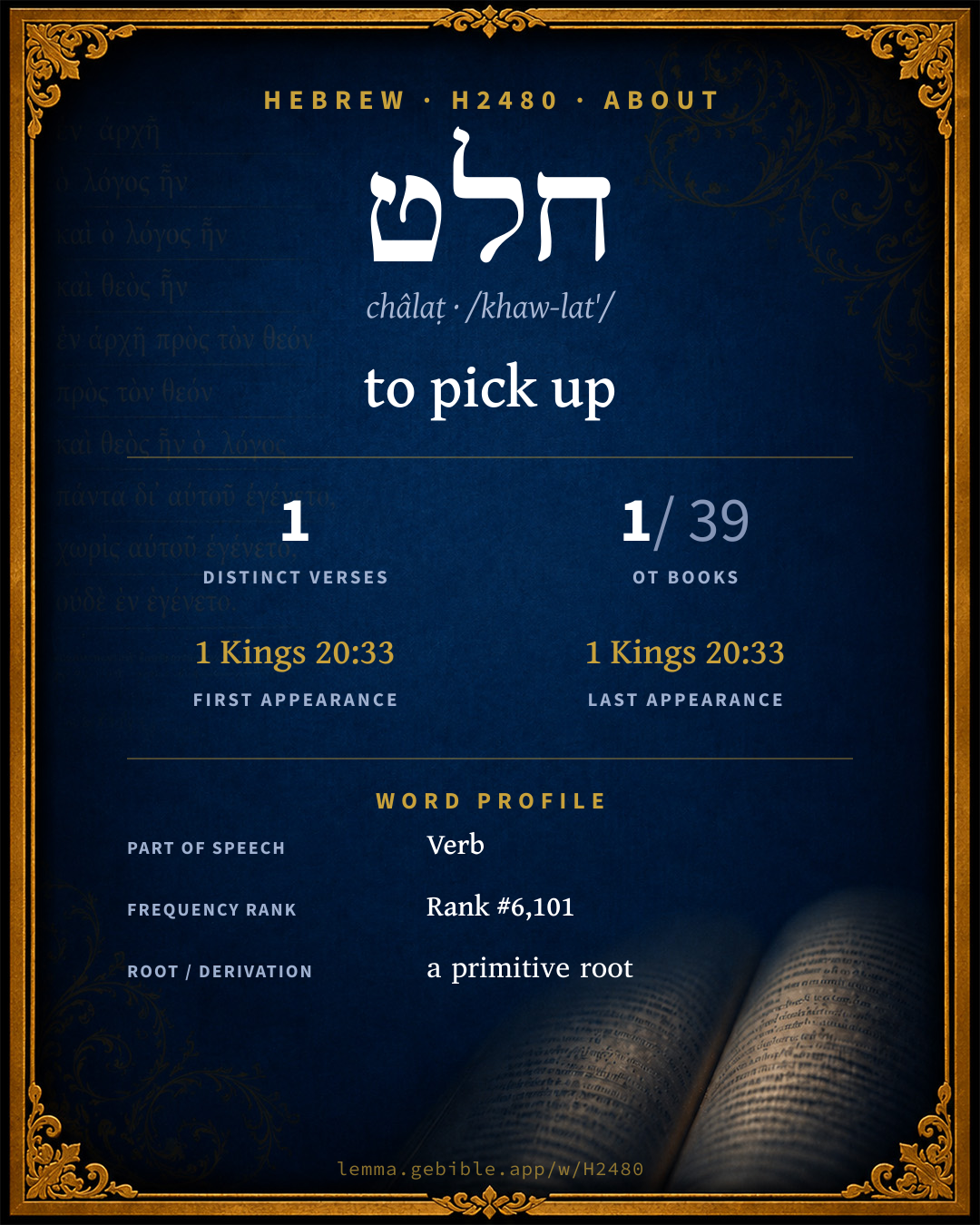
חָלַט
to pick up
Full lexicon entry — Brown-Driver-Briggs (BDB)
From Brown-Driver-Briggs (BDB)
Where this word appears
Grammar key — what these labels mean
Stem
- Hiphil
- The causative active stem (“he caused / brought about”).
Form
- Sequential Imperfect
- An imperfect with prefixed waw — the standard past-narrative form (waw-consecutive imperfect).
Person
- 3rd Person
- The one spoken about (“he / she / it / they”).
Gender
- Masculine
- Grammatically masculine.
Number
- Plural
- More than one (in Hebrew, generally three or more).
Every verse where H2480 appears — 1 distinct verse across 1 book. Click any verse to open its interlinear word-by-word view. Verse text shown in the World English Bible for context — . Each verse’s Hebrew form is shown with its reference; the English is not keyword-highlighted, since the data carries no word-level English alignment. Use “Compare translations” on any verse to read it across multiple English versions. This concordance covers the Hebrew Bible; Septuagint (Greek Old Testament) occurrences are not indexed here.
1 Kings 1 verse
About this entry
At a glance — auto-summarized from this page’s data, not written by a person. Every figure links to its source below. This summary describes the numbers; it doesn’t interpret them.
At its core, חלט (châlaṭ) means “to pick up.” It is rare — just 1 verse in the entire Hebrew Bible. Its uses cluster heavily in 1 Kings (100% of all occurrences). Its lone occurrence is 1 Kings 20:33. Dig into 1-verse concordance and the renderings breakdown below.
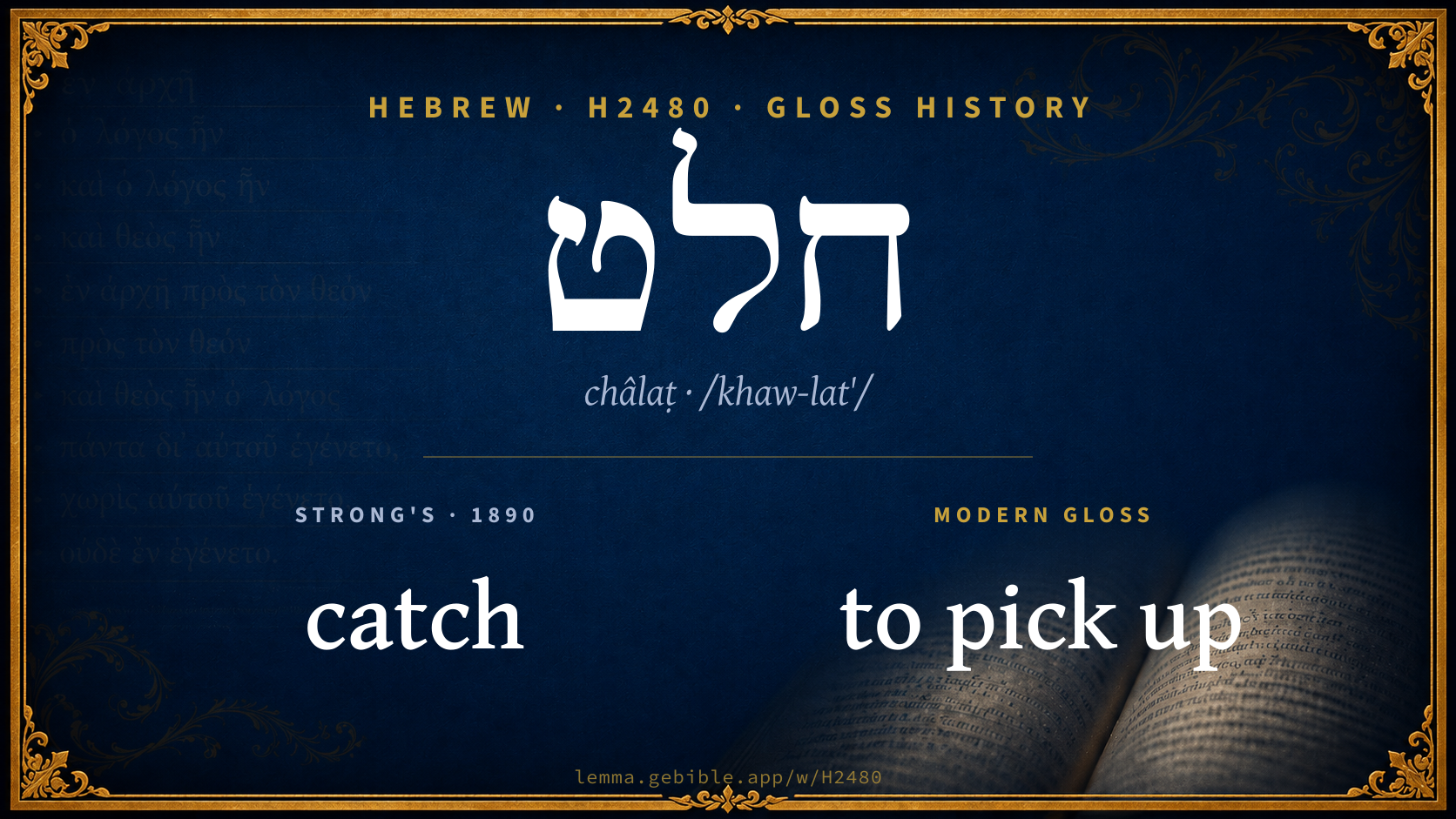
Gloss history
Strong's 1890 vs modern scholarship
About this word
Strong's H2480 catalogs a Hebrew word from the Hebrew Old Testament.
These counts are not copied from any lexicon or concordance. They are computed here, from the morphology-tagged Hebrew Old Testament. What Lemma adds →
- 1
- distinct verses
- The word appears in 1 distinct verse.
- 1 / 39
- OT books
- The word appears in 1 of 39 Old Testament books.
- #6,101
- by frequency
- Rank #6,101 (rank 6,101 of 8,640 Hebrew words by occurrence).
View all 1 occurrence in the concordance →
Most concentrated in
- 1 Kings 1 verse 100%
By section of the Old Testament
By traditional corpus
Conventional, traditional groupings — biblical authorship is debated, so this is a traditional corpus grouping, not an authorship claim. Each share is this word’s portion of its verses in that division of the Hebrew canon. Each figure is a share of the word’s 1 distinct verse.
- Prophets (Nevi'im) 1 verse · 100%
How translations render this word
Counts come from each version’s own published word-to-Strong’s tagging or interlinear alignment — an approximate guide to how each version renders this word, not a word-level alignment the data otherwise carries. Because each total is that version’s own tagged count, the per-version totals vary from one another and need not match the appearance or distinct-verse counts above. These counts may also differ from a printed concordance because Lemma counts each distinctly tagged rendering and does not collapse phrase taggings into a single head-word total. This is a fixed set of word-tagged versions (KJV, ASV, BSB, ULT) and does not change with the reading translation you choose elsewhere. Each version’s license is shown beside its name below (and on Sources).
- King James Version: Catch 1×
- American Standard Version: Hasted to catch 1×
- Berean Standard Bible: Grasped 1×
- unfoldingWord Literal Text: Caught 1×
King James Version Public Domain
Renders H2480 across 1 tagged occurrence — most commonly:
American Standard Version Public Domain
Renders H2480 across 1 tagged occurrence — most commonly:
Berean Standard Bible Public Domain
Renders H2480 across 1 tagged occurrence — most commonly:
unfoldingWord Literal Text CC BY-SA 4.0
Renders H2480 across 1 tagged occurrence — most commonly:
Senses in BDB
The 1 sense BDB distinguishes for this word, in lexicon order (not ranked by frequency or importance). The full entry — with sub-senses — is in the Lexicon Entry tab.
- (Hiphil) to take up, catch, pick up (a word)
Word origin
[ חָלַט ] vb. only 1 K 20:33, and they snatched it from him, caught the word fr. his lips
— Brown-Driver-Briggs (Oxford 1906, public domain), digitized via Sefaria, supplemented by the OpenScriptures HebrewLexicon (CC BY 4.0). See Sources.
Origin: a primitive root
Jastrow Dictionary
A second Hebrew/Aramaic lexicon for comparison, covering Aramaic and post-biblical (Talmudic, Targumic, Midrashic) usage that the biblical-Hebrew BDB does not. Matched by lemma rather than by Strong’s number, so a lemma may carry more than one Jastrow headword (shown separately below), and the entries cover usage well beyond the Bible.
חָלַט I
- (v. חָלַט II, a. Syr. חלט P. Sm. 1277) bind up, mix, esp. to stir flour in hot water, v. חֲלִיטָה II.—Part. pass. חָלוּט a paste prepared by stirring, dumpling. Y. Ḥall. I, 58ᵃ top; Y. Maasr. I, 49ᵇ ח׳ ברור a real ḥalut (concerning which there is no doubt as to the obligation of Ḥallah). Y. Ab. Zar. II, 42ᵃ top ה׳ מחוסר וכ׳ the ḥalut (prepared by a gentile) wants finishing through fire (frying or boiling); a. fr.
- to become consistent through stirring. Y. Ḥall. l. c. נֶחְלְטָה כל צורכה sufficiently stirred to be a consistent paste-ball.
חֲלַט
- 1. to make a paste. Targ. II Sam. XIII, 6.
- 2. (cmp. next wds. a. צמת) to cause contraction by scalding or by putting in vinegar. Part. pass. חָלִיט. Ḥull. 111ᵃ ח׳ הוי מעיקרא Rashi (ed. מִיּחֲלַט הוה ח׳ ליה וכ׳) it (the liver) was first scalded (so as to emit no blood in boiling).
- to cause contraction, to scald, put in vinegar. Ib. חַלְּטֵי ליה וכ׳. Pes. 74ᵇ bot. חלא דח׳ ביה וכ׳ vinegar which one has used once for drawing the blood from meat and contracting the blood vessels, must not be used a second time.
- 1. to be mixed up, to mingle. Targ. Prov. XX, 19; XXIV, 21 (h. text תתערב).
- 2. to be confused. Ib. XIV, 16 (h. text מתעבר!).
- 3. to be contracted, v. supra.
חָלַט II
- [to surround, tie up (corresp. to b. h. צמת),]
- 1. to make final. Part. pass. חָלוּט, f. חֲלוּטָה permanently sold, irredeemable. Arakh. IX, 4 הגיע … היה ח׳ וכו׳ (Talm. ed. 31ᵃ היתה ח׳, read: חלוטה) when the last day … had passed and it (the house) was not redeemed, it was his forever …, for we read לצמיתות (Lev. XXV, 30); (Tosef. ib. V, 10 צמת). Arakh. l. c. בראשונה … שיהא ח׳ לו formerly the purchaser used to hide himself on the last day … in order that it might become his irredeemably; Sifra B’har ch. V, Par. 4 שתהא חלוטה לו. Arakh. 31ᵇ למי ח׳ to which (of the two buyers) did it belong finally?; a. fr.—V. חֲלוּטִין. e.g. Leviticus 25:30
- 2. to pass final judgment on a leper after probationary enclosure (Lev. XIII). Zeb. 102ᵃ אני מסגירה ואני חוֹלְטָהּ וכ׳ I will lock her up, declare her a leper and discharge her.
- 1. to pass final judgment, to make valid; to adjudicate. Y. Dem. VII, beg. 26ᵃ צריך להַחֲלִיט וכ׳ he must make the consecrating conditions valid by speech. Y. Keth. X, 33ᵈ bot. אי זה … להַחֲלִיט מַחֲלִיטִין which of them the court chooses to declare valid, it may &c. Gen. R. s. 61 שלא תַחֲלִיט להם וכ׳ lest thou surrender the country to them (through bad argument); Yalk. ib. 110 (insert להם). Y. Ab. Zar. I, 39ᵇ top גסות … היא הֶחֱלִיטָתוֹ his haughtiness made Jerob. a confirmed sinner; a. e.
- 2. to declare a person a leper. Y. M. Kat. I, 80ᶜ bot. מטמא ומַחֲלִיט declares him unclean and this a decided leper; ורבנן … ומַחֲלִיטִין and the Rabbis say, he must be examined as if it were a new case, but at all events they declare &c.—Part. pass. מוּחֲלָט, f. מוּחֲלֶטֶת 1) irrevocable, confirmed. Yoma 86ᵇ תשובת המוּחֲלָטִין the repentance of the confirmed sinners.—2) the declared leper, opp. to מוּסְגָּר. Meg. I, 7. Yeb. 103ᵇ. Tosef. Naz. VI, 1 מ׳ בספק one declared a leper from doubt; Y. ib. VIII, end, 57ᵇ; a. fr.
חֲלַט ²
- 1. Part. pass. חָלִיט, חֲלִיטָא irredeemably sold. Targ. Y. Gen. XLVII, 20.
- 2. to sentence a leper. Targ. Y. Deut. XXI, 5 למִחְלוֹט, v. Af.
- to sell irredeemably, to forfeit. Y. Pes. IV, 31ᵇ bot. ולא יְחַלְּטוּן בניהון that they might not forfeit their pledged children. Y. Shebi. VI, 36ᶜ bot. [read:] בגין דלא תְחַלְּטוּן … בידן that you might not surrender the government to their (the Samaritans’) hands. Y. Keth. IX, 33ᵇ bot. אנן מְחַלְּטִין וכ׳ we shall declare their property forfeited. Arakh. 31ᵇ ולחַלְּטֵיה הקדש let the sacred treasury be declared its permanent owner; a. e.
- to sentence a leper. Targ. Y. Lev. XIII, 11.—Part. pass. מַחְלַט, f. מַחְלְטָא. Ib. 51.
- to become irredeemable. Arakh. 32ᵇ וירושלים מי מִיחֲלַט בה are buildings in Jerusalem ever irredeemable?
A Dictionary of the Targumim, the Talmud Babli and Yerushalmi, and the Midrashic Literature (Marcus Jastrow; London, Luzac, 1903) — Public Domain. Digitized via Sefaria. Digitized via Sefaria. Full attribution on Sources.