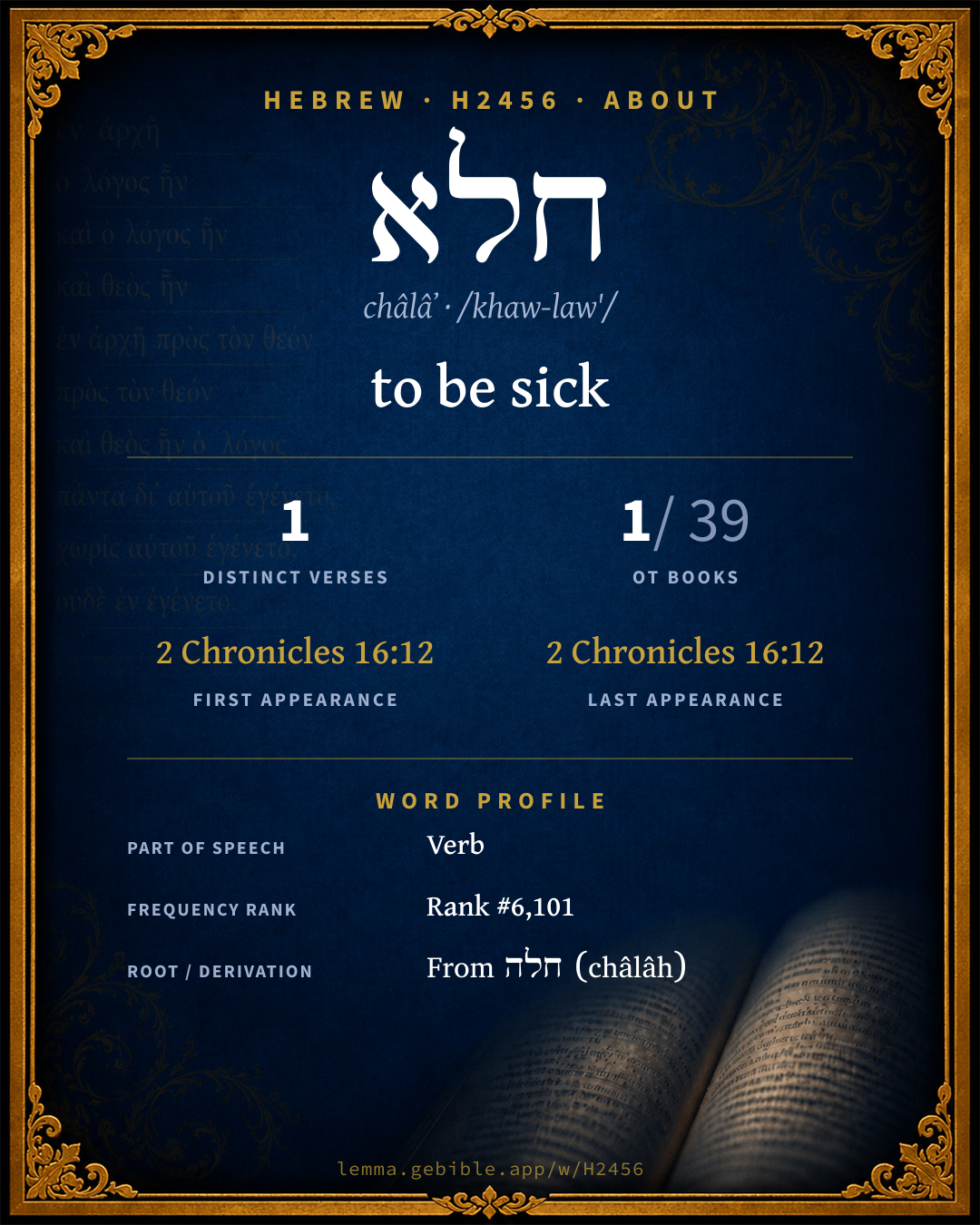
חָלָא
to be sick
Full lexicon entry — Brown-Driver-Briggs (BDB)
From Brown-Driver-Briggs (BDB)
Where this word appears
Grammar key — what these labels mean
Stem
- Qal
- The basic, simple active stem — the plain form of the verb (“he wrote”).
Form
- Sequential Imperfect
- An imperfect with prefixed waw — the standard past-narrative form (waw-consecutive imperfect).
Person
- 3rd Person
- The one spoken about (“he / she / it / they”).
Gender
- Masculine
- Grammatically masculine.
Number
- Singular
- One.
Every verse where H2456 appears — 1 distinct verse across 1 book. Click any verse to open its interlinear word-by-word view. Verse text shown in the World English Bible for context — . Each verse’s Hebrew form is shown with its reference; the English is not keyword-highlighted, since the data carries no word-level English alignment. Use “Compare translations” on any verse to read it across multiple English versions. This concordance covers the Hebrew Bible; Septuagint (Greek Old Testament) occurrences are not indexed here.
2 Chronicles 1 verse
About this entry
At a glance — auto-summarized from this page’s data, not written by a person. Every figure links to its source below. This summary describes the numbers; it doesn’t interpret them.
The Hebrew verb חלא centers on the idea of “to be sick.” It occurs a mere 1 verse across Scripture. The word gravitates to 2 Chronicles (100%). It occurs only once, in 2 Chronicles 16:12. It clusters with חלה, חלי and חלי under a shared root. Dig into 1-verse concordance and the renderings breakdown below.
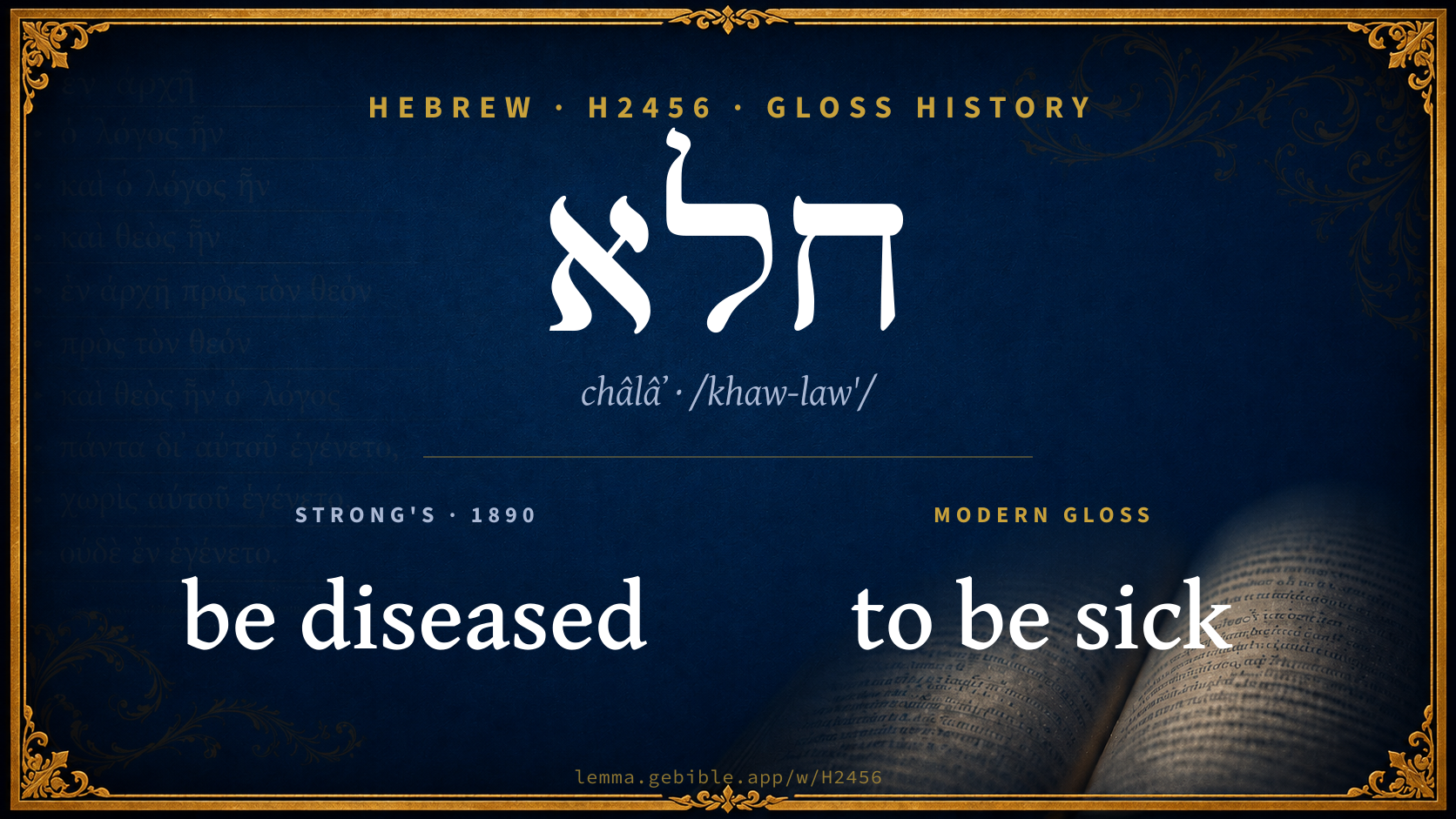
Gloss history
Strong's 1890 vs modern scholarship
About this word
Strong's H2456 catalogs a Hebrew word from the Hebrew Old Testament.
These counts are not copied from any lexicon or concordance. They are computed here, from the morphology-tagged Hebrew Old Testament. What Lemma adds →
- 1
- distinct verses
- The word appears in 1 distinct verse.
- 1 / 39
- OT books
- The word appears in 1 of 39 Old Testament books.
- #6,101
- by frequency
- Rank #6,101 (rank 6,101 of 8,640 Hebrew words by occurrence).
View all 1 occurrence in the concordance →
Most concentrated in
- 2 Chronicles 1 verse 100%
By section of the Old Testament
By traditional corpus
Conventional, traditional groupings — biblical authorship is debated, so this is a traditional corpus grouping, not an authorship claim. Each share is this word’s portion of its verses in that division of the Hebrew canon. Each figure is a share of the word’s 1 distinct verse.
- Writings (Ketuvim) 1 verse · 100%
How translations render this word
Counts come from each version’s own published word-to-Strong’s tagging or interlinear alignment — an approximate guide to how each version renders this word, not a word-level alignment the data otherwise carries. Because each total is that version’s own tagged count, the per-version totals vary from one another and need not match the appearance or distinct-verse counts above. These counts may also differ from a printed concordance because Lemma counts each distinctly tagged rendering and does not collapse phrase taggings into a single head-word total. This is a fixed set of word-tagged versions (KJV, ASV, BSB, ULT) and does not change with the reading translation you choose elsewhere. Each version’s license is shown beside its name below (and on Sources).
- King James Version: Was diseased 1×
- American Standard Version: Was diseased 1×
- Berean Standard Bible: Became diseased 1×
- unfoldingWord Literal Text: And 1×, Became sick 1×
King James Version Public Domain
Renders H2456 across 1 tagged occurrence — most commonly:
American Standard Version Public Domain
Renders H2456 across 1 tagged occurrence — most commonly:
Berean Standard Bible Public Domain
Renders H2456 across 1 tagged occurrence — most commonly:
unfoldingWord Literal Text CC BY-SA 4.0
Renders H2456 across 2 tagged occurrences — most commonly:
Senses in BDB
The 1 sense BDB distinguishes for this word, in lexicon order (not ranked by frequency or importance). The full entry — with sub-senses — is in the Lexicon Entry tab.
- (Qal) to suffer, be sick, be diseased
Word origin
[ חָלָא ] vb. be sick, diseased 2 Ch 16:12
— Brown-Driver-Briggs (Oxford 1906, public domain), digitized via Sefaria, supplemented by the OpenScriptures HebrewLexicon (CC BY 4.0). See Sources.
Derived from חלה (châlâh) (H2470) — to be sick.
Jastrow Dictionary
A second Hebrew/Aramaic lexicon for comparison, covering Aramaic and post-biblical (Talmudic, Targumic, Midrashic) usage that the biblical-Hebrew BDB does not. Matched by lemma rather than by Strong’s number, so a lemma may carry more than one Jastrow headword (shown separately below), and the entries cover usage well beyond the Bible.
חַלָּא
- (חלל, cmp. גלל) a globular concretion.—Pl. חַלֵּי. Bekh. 7ᵇ ח׳ דיחמורתא ball-like concretions found in the yaḥmur (fallow-deer), v. יַחְמוּרָא.
חָלָא I
- = h. חוֹל I, sand. Targ. Gen. XXXII, 13; a. fr.—Pes. 113ᵃ, v. אַדְּ־.—Pl. חָלָתָא (fem.). Sabb. 110ᵃ בי ח׳ between the sand-mounds.
חָלָא II
- m. = חוֹל II. Targ. Job XXIX, 18.
חָלָא III
- (חול or חלל) [turned, spoiled,] vinegar. Targ. O. Num. VI, 3 חַל; Y. חֲלָא. Targ. Ps. LXIX, 22 חָ׳ ed. (Ms. חֲ׳). Targ. Prov. XXV, 20 חלא ed. Lag. (ed. חֵילָא, Ms. חוֹ׳). Targ. Ruth II, 14.—Ab. Zar. 12ᵇ. Gen. R. s. 39, v. זוּל I ch.—Ḥull. 120ᵃ ח׳ דקריש Ar. (ed. חלב) a jellied vinegar sauce of meat; a. fr.—Y. Maasr. III, 50ᵈ bot. ח׳ בר חמרא a deteriorated son, v. חוֹמֶץ; Ḥull. 105ᵃ. [Y. Ter. VII, 45ᵈ bot. בחלא, read: בחַקְלָא.]
חֲלָא
- to be sick, v. חֲלִי.
חֲלִי
- 1. to be soft, sweet. Targ. Prov. XXVII, 7. Targ. Y. II, Lev. II, 11 (h. text דבש); a. e.—
- 2. to be sick, grieve. Yoma 22ᵇ; B. Kam. 20ᵇ כמה לא ח׳ וכ׳ how little does he whom the Lord supports need to grieve or trouble himself!
- 3. to remit. Keth. 86ᵃ top ותִיחֲלָה, v. חוּל II ch.
- 1. to sweeten.—Part. pass. f. מְחַלְיָא. Cant. R. to III, 4 בשעת מְחַלְיַית שינתא during the sweetest sleep. Ab. Zar. 39ᵃ מח׳ שמנוניתא Ms. M. the fatty substance (absorbed in the knife) becomes sweet again (loses its bad taste); ed. מְחַלְּיָּא ליה ש׳ (read: לש׳) it (the strong taste of assa foetida) sweetens &c. [Ber. 6ᵇ קא מחליין ed., Ms. מחללי, v. חֲלַל I.]
- to become sweet. Targ. Y. II, Ex. XV, 25.
A Dictionary of the Targumim, the Talmud Babli and Yerushalmi, and the Midrashic Literature (Marcus Jastrow; London, Luzac, 1903) — Public Domain. Digitized via Sefaria. Digitized via Sefaria. Full attribution on Sources.
Same root — word family
Other BDB entries built from the same root as H2456, grouped by Strong’s listed origin. These share a root / origin per the lexicon — not necessarily a shared meaning. Each links to that word’s own entry.
Derives from
Shares the same root
- חלי chălîy H2481 ornament
- חלי chŏlîy H2483 sickness
- חלל châlal H2490 to profane
- מחלה machăleh H4245 disease
- מחלי machluy H4251 sickness
Derived from this word
Proper names from this root
People and places named from this root — a name, not an additional meaning of the word.
- מחלה Machlâh H4244 Mahlah
- מחלון Machlôwn H4248 Mahlon
- מחלי Machlîy H4249 Mahli
- מחלת machălath H4257 Mahalath
Compare all same-root words → Showing 4 of 13 — not the complete family. 4 of the same-root words are proper names (people or places). They share a root, not necessarily a meaning.
Septuagint verse parallels
This word appears in 1 verse that also exists in the Greek Old Testament (Septuagint), out of the 1 Hebrew verse it occurs in. You can read those verses in Greek by switching the Old Testament edition to the Septuagint.
Read these verses in the Septuagint
This is a verse-level parallel only — the same verses exist in both the Hebrew and Greek Old Testaments. No word-level Hebrew↔Greek correspondence is claimed: the data carries no such alignment, so no Greek word is shown as this Hebrew word’s translation. Coverage is not total — the Septuagint omits the deuterocanon and renumbers the Psalms, so some Hebrew verses have no direct Greek parallel.