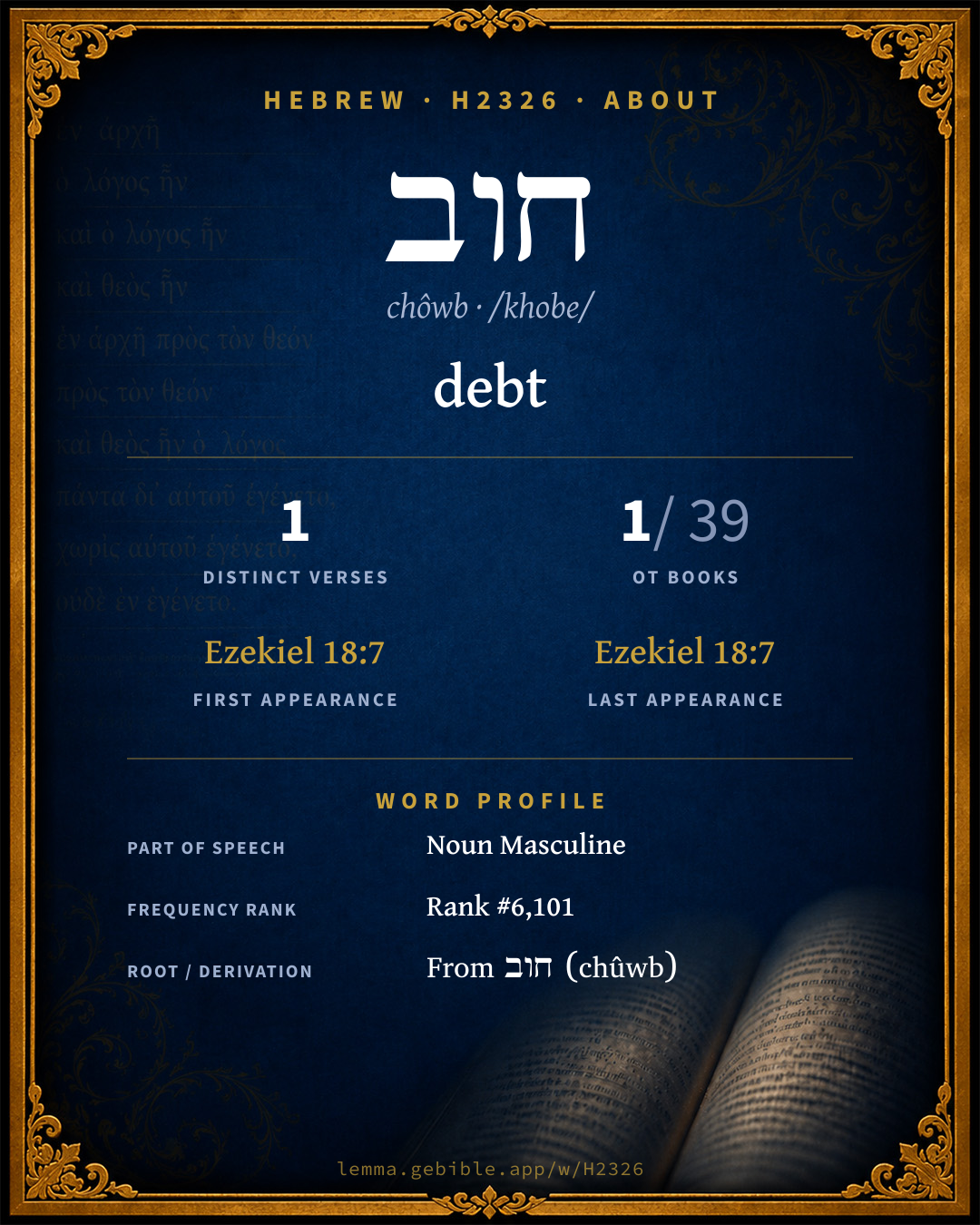
חוֹב
debt
Full lexicon entry — Brown-Driver-Briggs (BDB)
From Brown-Driver-Briggs (BDB)
Where this word appears
Grammar key — what these labels mean
Part of speech
- Noun
- A naming word — a person, place, thing, or idea.
Noun type
- Common
- A common noun — a general class of person, place, or thing (“king,” “city,” “water”), not a specific name.
State
- Absolute
- The independent form of a noun, not bound to a following word.
Gender
- Masculine
- Grammatically masculine.
Number
- Singular
- One.
Every verse where H2326 appears — 1 distinct verse across 1 book. Click any verse to open its interlinear word-by-word view. Verse text shown in the World English Bible for context — . Each verse’s Hebrew form is shown with its reference; the English is not keyword-highlighted, since the data carries no word-level English alignment. Use “Compare translations” on any verse to read it across multiple English versions. This concordance covers the Hebrew Bible; Septuagint (Greek Old Testament) occurrences are not indexed here.
Ezekiel 1 verse
About this entry
At a glance — auto-summarized from this page’s data, not written by a person. Every figure links to its source below. This summary describes the numbers; it doesn’t interpret them.
חוב (chôwb) is a Hebrew noun most often rendered “debt.” A scarce word — 1 verse in all of the Hebrew Bible. It clusters heavily in Ezekiel, which alone accounts for 100% of its uses. It occurs only once, in Ezekiel 18:7. The sections below give every sense, occurrence, and version rendering.
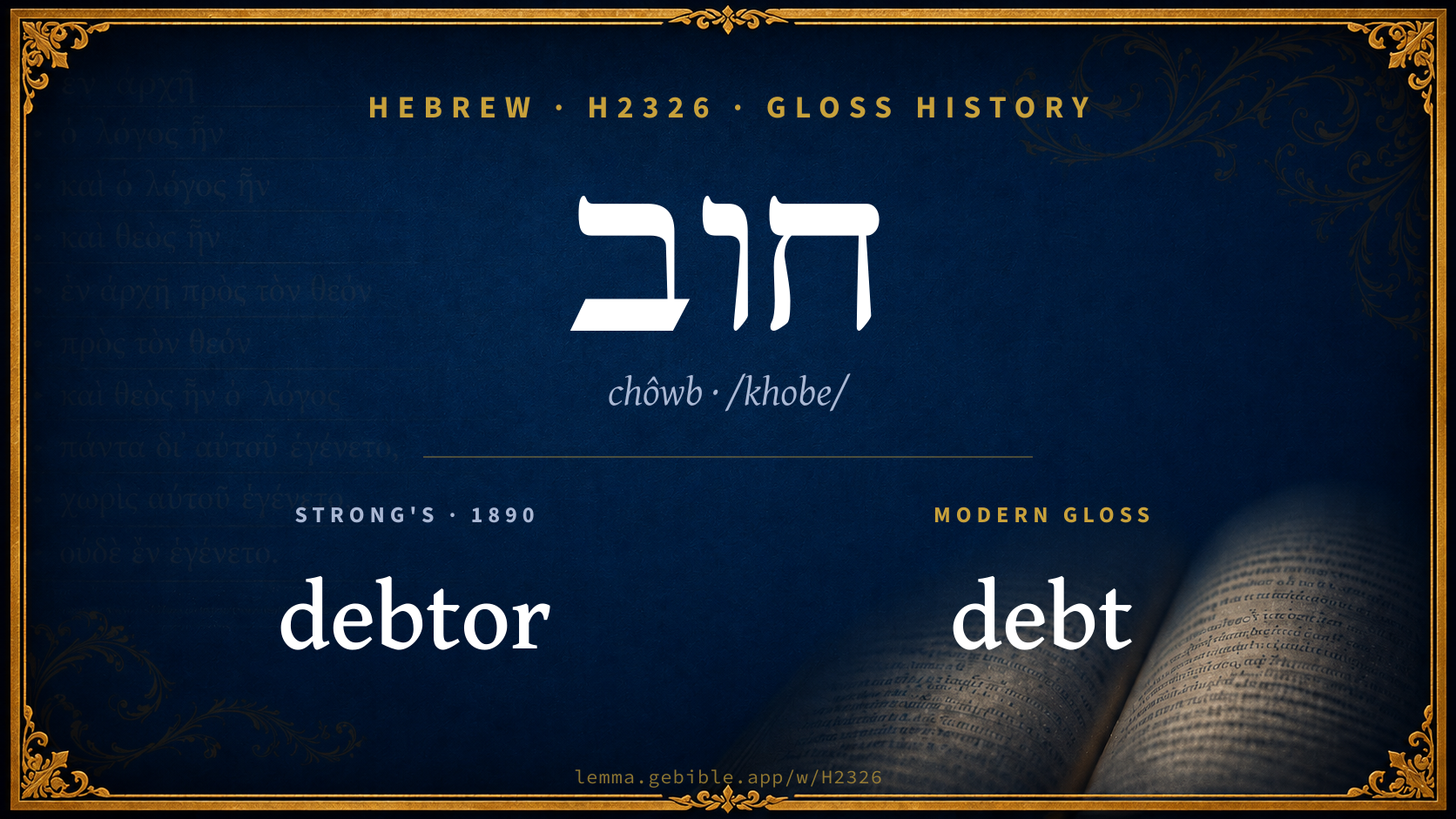
Gloss history
Strong's 1890 vs modern scholarship
About this word
Strong's H2326 catalogs a Hebrew word from the Hebrew Old Testament.
These counts are not copied from any lexicon or concordance. They are computed here, from the morphology-tagged Hebrew Old Testament. What Lemma adds →
- 1
- distinct verses
- The word appears in 1 distinct verse.
- 1 / 39
- OT books
- The word appears in 1 of 39 Old Testament books.
- #6,101
- by frequency
- Rank #6,101 (rank 6,101 of 8,640 Hebrew words by occurrence).
View all 1 occurrence in the concordance →
Most concentrated in
- Ezekiel 1 verse 100%
By section of the Old Testament
By traditional corpus
Conventional, traditional groupings — biblical authorship is debated, so this is a traditional corpus grouping, not an authorship claim. Each share is this word’s portion of its verses in that division of the Hebrew canon. Each figure is a share of the word’s 1 distinct verse.
- Prophets (Nevi'im) 1 verse · 100%
How translations render this word
Counts come from each version’s own published word-to-Strong’s tagging or interlinear alignment — an approximate guide to how each version renders this word, not a word-level alignment the data otherwise carries. Because each total is that version’s own tagged count, the per-version totals vary from one another and need not match the appearance or distinct-verse counts above. These counts may also differ from a printed concordance because Lemma counts each distinctly tagged rendering and does not collapse phrase taggings into a single head-word total. This is a fixed set of word-tagged versions (KJV, ASV, BSB, ULT) and does not change with the reading translation you choose elsewhere. Each version’s license is shown beside its name below (and on Sources).
- King James Version: Debtor 1×
- American Standard Version: Debtor 1×
- Berean Standard Bible: Debtor 1×
- unfoldingWord Literal Text: Debtor 1×, He gives 1×
King James Version Public Domain
Renders H2326 across 1 tagged occurrence — most commonly:
American Standard Version Public Domain
Renders H2326 across 1 tagged occurrence — most commonly:
Berean Standard Bible Public Domain
Renders H2326 across 1 tagged occurrence — most commonly:
unfoldingWord Literal Text CC BY-SA 4.0
Renders H2326 across 2 tagged occurrences — most commonly:
Senses in BDB
The 1 sense BDB distinguishes for this word, in lexicon order (not ranked by frequency or importance). The full entry — with sub-senses — is in the Lexicon Entry tab.
- a debt, debtor
Word origin
n.[m.] debt (NH id.; Aramaic ܚܰܘܒܳܐ, חוֹבָא);—חֲבֹלָתוֹ ח׳ יָשִׁיב Ez 18:7 his pledge as to indebtedness he restores, v. Hi-Sm Ew§ 291 b Ges§ 131 R 5, b KöLgb. i. 497 f. and cf. Dr§ 193 (but constr. hard: Co שׁוֹב; dittogr. from חבל׳ Bev Dn 1:10, cf. v 12, 16).
— Brown-Driver-Briggs (Oxford 1906, public domain), digitized via Sefaria, supplemented by the OpenScriptures HebrewLexicon (CC BY 4.0). See Sources.
Derived from חוב (chûwb) (H2325) — to be guilty.
Jastrow Dictionary
A second Hebrew/Aramaic lexicon for comparison, covering Aramaic and post-biblical (Talmudic, Targumic, Midrashic) usage that the biblical-Hebrew BDB does not. Matched by lemma rather than by Strong’s number, so a lemma may carry more than one Jastrow headword (shown separately below), and the entries cover usage well beyond the Bible.
חוּב
- (b. h.), perf. חָב, part. חַיָיב, חָב [to be bound over, seized,]
- 1. to be declared guilty, be sentenced; to be punishable; to be (legally, morally or religiously) bound, to be responsible. B. Kam. I, 1 חב המזיק he who caused the damage must pay. Ib. 6ᵇ חב … חייב … מיבעי לה the Mishnah says ḥab, ought it not rather to read ḥayab (part.)?—[Answ.: they are the words of a Jerusalem Tannai.]—Ib. I, 2 כל שׁחַבְתִּי בשמירתו וכ׳ for whatever I am legally bound to guard, I am legally answerable in case of injury. Sabb. I, 1 העני חייב the recipient (the person standing outside) is guilty (of transgressing the Sabbath law).—Y. Ned. I, 36ᵈ top חב על כל וכ׳ he is punishable for each separately.—Ber. IX, 5 חייב אדם וכ׳ man must praise the Lord &c. Ḥag. 4ᵃ, a. e. כל מצוה שהאשה חַיֶיבֶת בה וכ׳ whatever religious act is obligatory on woman, is also obligatory &c.—Ib. מה להלן נשים חַיָיבוֹת as there (Deut. XXXI, 12) women are included in the obligation; a. v. fr. e.g. Deuteronomy 31:12
- 2. to act in behalf of a person to the latter’s disadvantage. Erub. VII, 11 ואין חָבִין וכ׳, v. זָכָה. Y. B. Kam. IV, 4ᵇ bot. בתחלה … ע"מ לָחוֹב להן וכ׳ originally guardians are not assigned to minors that they may eventually act to their disadvantage &c.; ואם חָבוּ חָבוּ but if they have done so, their action is legal (and they cannot be held responsible); Y. Gitt. V, 47ᵃ top.—Y. Keth. XI, 34ᵇ bot. נמצאתה חב וכ׳ then you would cause a disadvantage to the relics; a. fr.—ח׳ בעצמו to be alone answerable for one’s loss. Ber. I, 3 כדאי היית לָחוֹב בעצמך thou wouldst have deserved to be made answerable &c., i.e. if you had met with an accident you would have had none but yourself to blame.
- 3. to owe, be indebted. Shebu. VII, 5; a. fr.—ח׳ חטאת to be bound to bring a sin-offering; ח׳ מיתה to be subject to death penalty. Sabb. VII, 1. Ib. XI, 6 כל חַיְיבֵי חטאת וכ׳ all those eventually bound to bring &c., are not bound, unless &c. Snh. 58ᵇ; a. fr.
- to declare guilty, to convict, sentence (opp. זִיכָּה, פָּטַר). Snh. 6ᵃ ח׳ את הזכאי if a judge (by an illegal decision) convicted one who ought to have been acquitted. Ib. III, 6 ואחד מְחַיֵּיב and one votes for acquittal. Shebu. IV, 13 ר׳ מאיר מח׳ וכ׳ R. M. says, he is guilty (of blasphemy); a. v. fr.—Ex. R. s. 32, beg. חִיַּיבְתֶּם עצמיכם you have given judgment against yourselves. B. Mets. 3ᵇ פיו אין מְחַיְּיבוֹ ממון וכ׳ the defendant’s own statement cannot cause a judgment against him to pay a penalty, but causes the imposition of an oath. Yoma 35ᵇ הלל מח׳ וכ׳, v. הִלֵּל.—Part. pass. מְחוּיָּיב, מְחוּיָּב = חַיָיב, sentenced, bound. Y. Keth. III, 27ᵇ מְחוּיְּיבֵי מיתות those sentenced to death, מ׳ מכות sentenced to lashes.—Ber. 20ᵇ, a. fr. כל שׁאינו מ׳ בדבר וכ׳ whatever is not obligatory upon a person himself, cannot be done by him as a representative of the community, v. חוֹבָה; a. fr.
- 1. to be convicted, amenable to law. Keth. 30ᵇ מי שנ׳ סקילה he who (under Jewish jurisdiction) would have been sentenced to death through stoning. Ib. כבר נ׳ בגניבה וכ׳ he was amenable to punishment for theft, before he transgressed &c. Ib. מִתְחַיֵּיב בנפשו לא הוה וכ׳ but guilty of a deadly sin he was not until he ate it; a. fr.
- 2. to be responsible. Ab. III, 4, a. fr. הרי זה מתח׳ בנפשו he is responsible for his life, would have himself to blame, if any accident should befall him (v. Ber. 3 quoted above).
- 3. to be doomed, to have the misfortune to. Tosef. Shebu. III, 4 אין אדם מתח׳ לשמוע וכ׳ one has not the misfortune to hear (a curse &c.), unless he sinned himself (ref. to Lev. V, 1). Ib. הרואה … עבירה נ׳ לראות if one sees people sin, (we say) he had the misfortune to see, opp. זכה. e.g. Leviticus 5:1
חוּב ²
- perf. a. part. חָב, חַב same, esp. to incur guilt, to sin. Targ. Ex. XXXII, 31. Targ. Lev. IV, 22; a. fr.—Targ. O. Num. XV, 28 בִּמְחֲבֵיה ed. Berl. (oth. ed. בְּמֵחֲבֵיה, בְּמֶחֲ׳).
- 1. as preced. Pi. Targ. Job XXXIV, 17; a. fr.—Lam. R. to II, 1 (expl. יָעִיב, ib.) איך ח׳ וכ׳ how did the Lord … condemn &c.; there are places דצווחין לחַיָיבָא עייבא where ḥayaba (the guilty) is pronounced ͑ayaba, v. עוּב.—B. Kam. 68ᵇ לא לִיחַיְּיבֵיה (omitted in Ms. F.) do not condemn him (to pay a fine). Ber. 20ᵇ וכל מ"ע נְחַיְּיבִינְהוּ וכ׳ we might just as well by rabbinical ordinance declare them subject to all positive religious duties; a. fr.—Part. pass. מְחַיַּיב (interch. with מִיחַיַּיב, v. infra).
- 2. to induce to sin. Targ. II Kings XXI, 16; a. e.
- 1. to become guilty, to be induced to sin. Targ. I Sam. XIX, 5 (ed. Lag. את מחייב). Targ. Y. Lev. V, 19; a. e.
- 2. to be convicted, sentenced &c.; to be amenable to law, be bound. Targ. Ps. XXXIV, 23; a. e.—Keth. 85ᵃ ההיא … דאִיחַיְּיבָא שבועה וכ׳ a woman was declared bound to make oath in the court of &c. R. Hash. 29ᵃ מִיחַיְּיבֵי are bound (subject to the law about Shofar). Ib. אימא … לא לִיחַיְּיבוּ I might have thought they ought not to be bound. B. Kam. 72ᵇ כי קא מְחַיַּיב (v. supra) when does he become responsible; a. v. fr.
חוֹב I
- preced. wds.) debt, indebtedness.—בעל ח׳ (abbr. ב"ח) creditor. Keth. IX, 2 והניח … וב"ח וכ׳ and left a widow, a creditor (claiming a debt) and heirs. Ib. 3 וב"ח יותר על חוֹבוֹ and the creditor (seized) more than his debt amounted to. Ib. 69ᵃ בת בעלת ח׳ הויא a daughter (of a deceased father) has the privileges of a creditor, contrad. to יורשת, heiress; a. fr.—שטר ח׳ note of indebtedness. Ib. XIII, 8 המוציא ש׳ ח׳ וכ׳ if one produces a note against &c.; a. fr.—Pl. חוֹבִין. Ned. 47ᵇ בעלי ח׳ creditors.
חוֹב II
- 1. bosom, trnsf. the full ramification of a tree, opp. חוּד the point, the body of the tree reaching above the main branches. B. Kam. 81ᵃ bot. חוּבּוֹ של אילן Ar., Ms. H. a. F. (Rashi version: חיבו; ed. אִיבֹּו, v. אֵב).
- 2. seam, rim.—Pl. חוּבִּין. Ib. 119ᵇ top ולא … שלשה ח׳ he must not use (of the cloth for stretching and hackling) more than three widths of a seam; [Tosef. ib. XI, 13 ed. Zuck. חכין, also some Mss. B. Kam. l. c., Ms. F. a. R. חֻבִּין, v. Rabb. D. S. a. l., note; v. חַכָּה].
A Dictionary of the Targumim, the Talmud Babli and Yerushalmi, and the Midrashic Literature (Marcus Jastrow; London, Luzac, 1903) — Public Domain. Digitized via Sefaria. Digitized via Sefaria. Full attribution on Sources.
Septuagint verse parallels
This word appears in 1 verse that also exists in the Greek Old Testament (Septuagint), out of the 1 Hebrew verse it occurs in. You can read those verses in Greek by switching the Old Testament edition to the Septuagint.
Read these verses in the Septuagint
This is a verse-level parallel only — the same verses exist in both the Hebrew and Greek Old Testaments. No word-level Hebrew↔Greek correspondence is claimed: the data carries no such alignment, so no Greek word is shown as this Hebrew word’s translation. Coverage is not total — the Septuagint omits the deuterocanon and renumbers the Psalms, so some Hebrew verses have no direct Greek parallel.