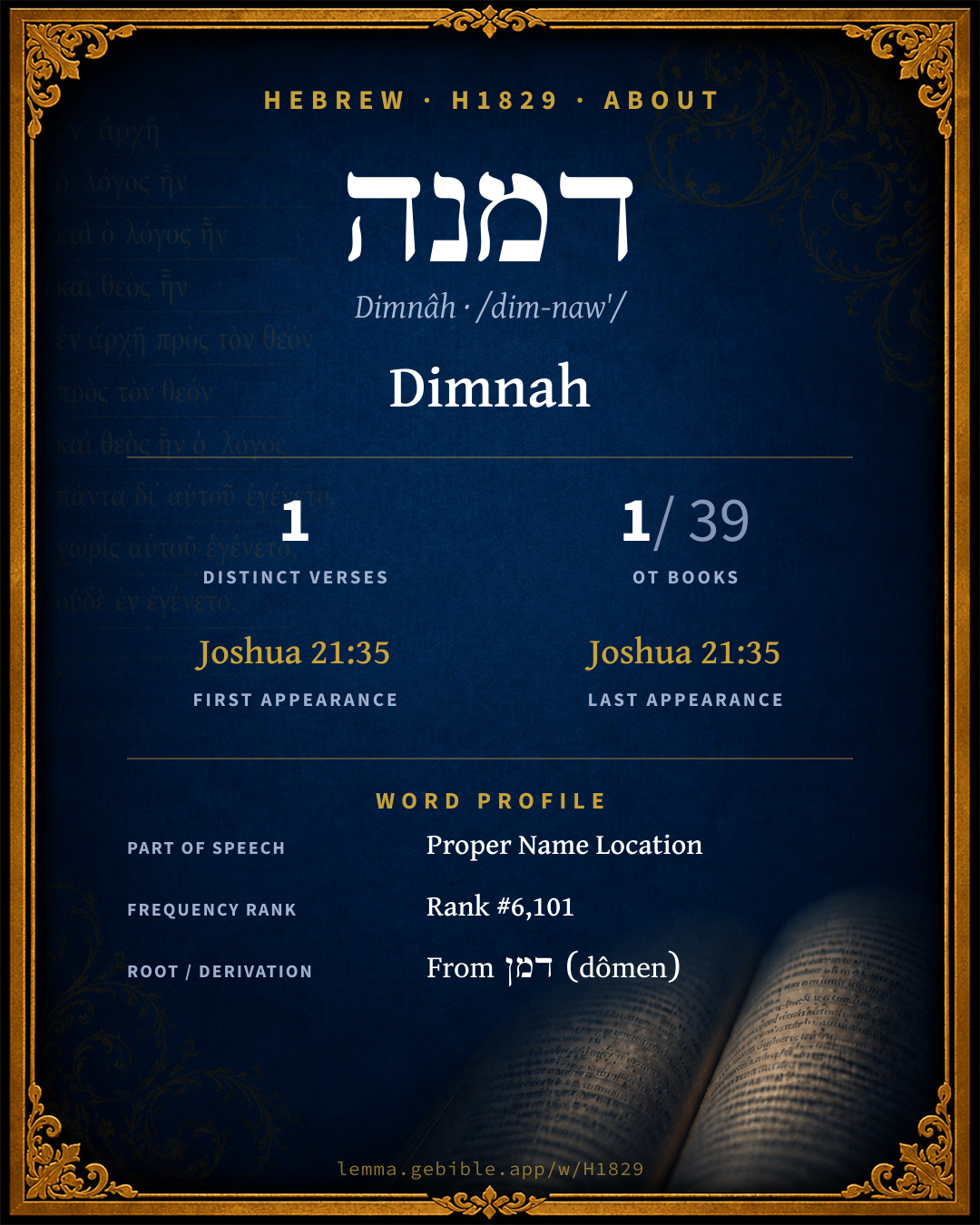
דִּמְנָה
Dimnah
BDB lists 2 entries for ‘Dimnah’ fuller range ↓
Full lexicon entry — Brown-Driver-Briggs (BDB)
From Brown-Driver-Briggs (BDB)
Where this word appears
Grammar key — what these labels mean
Part of speech
- Noun
- A naming word — a person, place, thing, or idea.
Noun type
- Proper
- A name of a specific person, place, or people (e.g. Abraham, Zion, Israel).
Every verse where H1829 appears — 1 distinct verse across 1 book. Click any verse to open its interlinear word-by-word view. Verse text shown in the World English Bible for context — . Each verse’s Hebrew form is shown with its reference; the English is not keyword-highlighted, since the data carries no word-level English alignment. Use “Compare translations” on any verse to read it across multiple English versions. This concordance covers the Hebrew Bible; Septuagint (Greek Old Testament) occurrences are not indexed here.
Joshua 1 verse
About this entry
At a glance — auto-summarized from this page’s data, not written by a person. Every figure links to its source below. This summary describes the numbers; it doesn’t interpret them.
The Hebrew name דמנה centers on the idea of “Dimnah.” It is rare — just 1 verse in the entire Hebrew Bible. Joshua dominates its distribution — 1 of 1 verses. It occurs only once, in Joshua 21:35. For the data behind this summary, explore 1-verse concordance and the renderings breakdown below.
Gloss history
Strong's 1890 vs modern scholarship
About this word
Strong's H1829 catalogs a Hebrew word from the Hebrew Old Testament.
These counts are not copied from any lexicon or concordance. They are computed here, from the morphology-tagged Hebrew Old Testament. What Lemma adds →
- 1
- distinct verses
- The word appears in 1 distinct verse.
- 1 / 39
- OT books
- The word appears in 1 of 39 Old Testament books.
- #6,101
- by frequency
- Rank #6,101 (rank 6,101 of 8,640 Hebrew words by occurrence).
View all 1 occurrence in the concordance →
Most concentrated in
- Joshua 1 verse 100%
By section of the Old Testament
By traditional corpus
Conventional, traditional groupings — biblical authorship is debated, so this is a traditional corpus grouping, not an authorship claim. Each share is this word’s portion of its verses in that division of the Hebrew canon. Each figure is a share of the word’s 1 distinct verse.
- Prophets (Nevi'im) 1 verse · 100%
How translations render this word
Counts come from each version’s own published word-to-Strong’s tagging or interlinear alignment — an approximate guide to how each version renders this word, not a word-level alignment the data otherwise carries. Because each total is that version’s own tagged count, the per-version totals vary from one another and need not match the appearance or distinct-verse counts above. These counts may also differ from a printed concordance because Lemma counts each distinctly tagged rendering and does not collapse phrase taggings into a single head-word total. This is a fixed set of word-tagged versions (KJV, ASV, BSB, ULT) and does not change with the reading translation you choose elsewhere. Each version’s license is shown beside its name below (and on Sources).
- King James Version: Dimnah 1×
- American Standard Version: Dimnah 1×
- Berean Standard Bible: Dimnah 1×
- unfoldingWord Literal Text: Dimnah 1×
King James Version Public Domain
Renders H1829 across 1 tagged occurrence — most commonly:
American Standard Version Public Domain
Renders H1829 across 1 tagged occurrence — most commonly:
Berean Standard Bible Public Domain
Renders H1829 across 1 tagged occurrence — most commonly:
unfoldingWord Literal Text CC BY-SA 4.0
Renders H1829 across 1 tagged occurrence — most commonly:
Senses in BDB
The 2 senses BDB distinguishes for this word, in lexicon order (not ranked by frequency or importance). The full entry — with sub-senses — is in the Lexicon Entry tab.
- Dimnah = "dunghill"
- a Levitical city in Zebulun
Word origin
n.pr.loc. Levitical city in Zebulun Jos 21:35 (but read perhaps רִמֹּנָה +; cf. 1 Ch 6:62; Jos 19:13, and v. Di).
— Brown-Driver-Briggs (Oxford 1906, public domain), digitized via Sefaria, supplemented by the OpenScriptures HebrewLexicon (CC BY 4.0). See Sources.
Derived from דמן (dômen) (H1828) — dung.
Jastrow Dictionary
A second Hebrew/Aramaic lexicon for comparison, covering Aramaic and post-biblical (Talmudic, Targumic, Midrashic) usage that the biblical-Hebrew BDB does not. Matched by lemma rather than by Strong’s number, so a lemma may carry more than one Jastrow headword (shown separately below), and the entries cover usage well beyond the Bible.
מָנֶה
- from which μνᾶ, [one hundred,] Maneh, a weight in gold or silver, equal to one hundred common or fifty sacred shekels (v. Zuckerm. Talm. Münz. p. 7, sq.). Bekh. 5ᵃ מ׳ של קודש כפול היה the sacred Maneh was double the weight of the common. Ib. VIII, 7 במ׳ צורי taking the Tyrian M. as a standard. Ib. 49ᵇ מ׳ צורי … מ׳ של צורי ‘the Tyrian M.’ … means the standard of the Tyrian system (one Sela = 4 Zuz, Rashi). Keth. I, 2 בתולה … מאתים ואלמנה מ׳ the widowhood of a maiden is two hundred (Zuz), and that of a widow (remarried) is one hundred (Zuz, a common Shekel). B. Kam. 90ᵇ מ׳ צורי תנן או מ׳ מדינה תנן does the Mishnah (Snh. VIII, 6) mean a Tyrian or a country Maneh (twelve and a half Zuz)? Shebu. VI, 1 מ׳ לי בידך thou owest me one hundred denars. Snh. VIII, 2 מ׳ בשר meat of the weight of a Maneh. Shebi. I, 2 ששים מ׳ באיטלקי the weight of sixty M. in the Italian system. Ker. 6ᵃ; a. fr.—Erub. 85ᵃ bot. פנו מקום לבן מאה מ׳ make room for one worth one hundred M. (in gold).—Trnsf. מ׳ בן פרס a Maneh son of a P’ras (half a Maneh), i.e. a distinguished son of a less distinguished father. Taan. 21ᵇ.—Pl. מָנִים, מָנִין. Y. Shek. VI, 49ᶜ bot. אלף … מ׳ the weight of fifteen hundred M. Ker. l. c.; a. e.—Chald. form: מָנֵי. Targ. Ez. XLV, 12 (Kimḥi מָנָא).—Pl. מָנִין, מָנַיָּא, מָנָן, מָנָאֵי, מָנוֹי. Ib. Targ. Is. VII, 23. Targ. I Kings X, 17; a. e.—Esth. R. to VI, 10; Lev. R. s. 28.—Sabb. 133ᵇ שב מ׳ תרבא (not מינאי, v. Rabb. D. S. a. l. note 90) fat weighing seven M. (Rashi: seven portions of fat). Y. B. Kam. IX, 6ᵈ bot. [read as Tosaf. to Bab. B. Kam. 100ᵇ:) חמש מנוי עמר וח׳ מ׳ סממנין וכ׳ wool worth five M., dyeing material worth five, and ten M. wages. Y. Meg. IV, 74ᵈ bot. מניי (corr. acc.); a. e.
מָנָה I
- preced.) share, portion. Bekh. V, 1 שוקלין מ׳ כנגד מ׳ you must weigh one piece (of the meat of the first-born) against another piece (of secular meat of ascertained weight). Gitt. 59ᵇ, a. e. ליטול מ׳ מ׳ יפה ראשון that he (the priest) have the privilege of first choice (when a division is made). Sifré Deut. 53; Yalk. ib. 875 מ׳ יפה the best portion (at the meal). Yalk. Num. 765, end מלך שבירר לעצמו מ׳ וכ׳ a king who selected a portion for himself, and another came and spoke disparagingly of it; a. fr.—Pl. מָנוֹת. Sabb. 149ᵃ; Tosef. ib. XVII (XVIII), 5. Ib. 4 מפיסין על מָנוֹתֵיהֶן cast lots for their portions (at the table); a. e.—V. מְנָת.
מָנָה II
- to count, v. מני.
מני
- (b. h.) to divide, distribute; to count. Bekh. IX, 7 ומוֹנֶה בשבט אחד וכ׳ (Bab. ed. 58ᵇ ומונין א׳) and he counts with the rod, one, two &c. Ib. מְנָאָם רביצין if he counted them while they were crouching. Shebu. 34ᵃ bot. מָנֶה מָנִיתִי לך וכ׳ (not מְנִיתִיךָ, v. Rabb. D. S. a. l. note) I counted (delivered) to thee a Maneh (as a loan) in the presence &c.; ib.ᵇ R. Hash. 12ᵃ חכמי ישראל מוֹנִין למבול וכ׳ the Jewish scholars count the dates of the flood in accordance with R. El. (beginning the year with Tishri), and the astronomical calendar in accordance with R. J. (beginning with Nisan), Pesik. R. s. 15, beg. אין מונין ללבנה וכ׳ we count by the moon (fix the date of the new month) only when seen after sunset. Succ. 29ᵃ, a. fr. מונין ללבנה regulate the seasons by the moon (have a lunar year). Men. 65ᵇ, a. e. מְנֵה ימים וכ׳ count the required number of days and proclaim (one day as) the New Moon Day. Yoma V, 3; a. fr.—Part. pass. מָנוּי; f. מְנוּיָה; pl. מְנוּיִים, מְנוּיִין, מְנוּיִן; מְנוּיוֹת a) counted. Taan. 8ᵇ דבר המ׳ that which has been counted (is known by number). Bekh. IX, 7 אחד מן המ׳ one of the sheep already counted.—b) classified; (pl.) class. Ḥag. 17ᵇ מה חדש למְנוּיָיו אף עצרת למְנוּיָיו (עצרת = שבוע של ע׳) as the New Moon festival belongs to its class (of days), so does the Pentecost (which is determined by counting weeks) belong to its class (of weeks), i.e. the pilgrim’s sacrifice (חגיגה) may be offered during the entire eighth week from Passover; R. Hash. 5ᵃ למְנוּיָו.—c) (v. Nif.) entered for a share in the sacrifice. Zeb. V, 8 אינו נאכל אלא למנויו can be partaken of only by those registered for it. Pes. V, 3 (61ᵃ) שחטו שלא לאוכליו ושלא למנוייו (Bab. ed. למנויו) if while slaughtering he had in mind such as were unable to partake of it (sick persons &c.) or such as had not been registered for it. Ib. 61ᵃ bot. איתקש אוכלין למנויין (Ms. M. אוכליו למנוייו) the partakers (to be held in mind) are analogous to the registered. Ib. 70ᵃ אינה … למְנוּיֶהָ Ms. M. (ed. incorr. למנוייו, למנויו) it (the pilgrim’s sacrifice) can only be partaken of by those registered for it; a. fr.
- 1. to be counted. Num. R. s. 1 אינן נִמְנִים ולא נמדדין are neither numbered nor measured. Bets. 3ᵇ, a. e. את שדרכו לִימָּנוֹת, v. אֵת. Gitt. V, 6 נִמְנוּ (usu. נמנו וגמרו) they (their votes) were counted, they resolved, v. גָּמַר II; a. fr.
- 2. to be counted on for a share in the Passover lamb, to be registered (Ex. XII, 4). Pes. VIII, 3 לעולם נִימְנִין עליו וכ׳ persons may continually be entered for a share in it, as long as there remains for each &c. Ib. נימנין ומושכין וכ׳ they may be entered and withdraw again. Ib. 89ᵃ אבל לִימָּנוֹת but as for registering (additional names). Tosef. ib. VII, 7 רצו להמשך ולהִמָּנוֹת וכ׳ (ed. Zuck. incorr.) if some of them wish to withdraw and have others entered on their share &c.; a. fr. e.g. Exodus 12:4
- 3. to be specified. Y. Taan. IV, 68ᵇ (ref. to Mish. ib. IV, 5) מה ראה … להִימָּנוֹת what reason was there for that specification of the time when each family of priests and the people had to offer wood?; Y. Shek. IV, beg. 47ᵈ; Y. Meg. I, 70ᶜ top.
- to cause to be entered; to add to the number of sharers; to transmit one’s share to another person. Y. Pes. VIII, 36ᵃ top הי׳ אותו על חנם he gave him a share gratuitously. Tosef. ib. l. c. בני חבורה שרצו להַמְנוֹת וכ׳ (ed. Zuck. לַמְנוֹת) members of a party who desire to give others a share in their own portion. Ib. המַמְנֶה אחרים על חלקו (ed. Zuck. פסחו) he who assigns to others a share in his portion; a. fr.
- to be added to the number; to be entered as a member of a group or of a family. Tosef. ib. VIII, 3 ה׳ על אחד מהם if he (the orphan) has been entered as his guest by one of the guardians. Ib. 6 בני חבורה שהוּמְנוּ וכ׳ ed. Zuck. (oth. ed. שנמנו) members of a group who have been entered (in a body) in addition to the original participants; a. e.
- to appoint, elect. Gitt. V, 4 שמי׳ להן אביהן וכ׳ for whom their father had appointed an executor. Ib. שמִינָּהוּ אבי וכ׳ whom the father … has appointed. Taan. 10ᵇ כל שראוי למַנּוֹתוֹ וכ׳ who is worthy to be elected manager &c.; a. fr.—Part. pass. מְמוּנֶּה; pl. מְמוּנִּים. Sot. 42ᵃ למה סגן ממ׳ for what purpose is a deputy high priest appointed?; Yoma 39ᵃ מימינו ed. (corr. acc.; v. Rabb. D. S. a. l. note); a. fr.—Hor. 13ᵇ שאביהם ממונים פרנס וכ׳ Ms. M. (ed. שממ׳ אביהם, = מן הממונים) whose father is of those worthy to be elected manager (v. Taan. l. c.).—V. מְמוּנֶּה.—Esp. to ordain as teacher and judge. Y. Snh. I, 19ᵃ bot. ב"ד שמי׳ שלא וכ׳ a court that ordained without the consent of the Nasi. Ib. היה כל אחד מְמַנֶּה וכ׳ each teacher used to ordain his own pupils; a. fr.
- 1. to be appointed, designated as deputy, to be ordained. Sifra Aḥăré Par. 5, ch. VIII לרבות כהן אחר המִתְמַנֶּה to imply the other priest that is designated as a deputy. Y. Bicc. III, 65ᵈ top חכם שנ׳ וכ׳ when a scholar is ordained, his sins are forgiven. Ib. זה שהוא מתמ׳ בכסף וכ׳ (not מתמני) before him who has been ordained for money, we must not stand up, nor do we call him rabbi, and the cloak upon him is like the cover of ass. Yoma 22ᵇ. Y. Shek. V, 48ᵈ bot. מאי אם זה שנ׳ על … אתם שאתם מִתְמַנִּין וכ׳ if this one appointed superintendent of wicks, was privileged to be counted among the great of the generation, how much more you who are to be appointed over the preservation of lives (as directors of charities). R. Hash. II, 9 (25ᵃ) שנִתְמַנּוּ ב"ד על וכ׳ Ms. O. (ed. שעמדו, v. Rabb. D. S. a. l. note 90) who have been ordained as a court for all Israel; a. fr.
- 2. (of things) to be assigned. Tosef. Sot. VII, 20 נִתְמַנָּה לאדם פרנסה וכ׳ if a livelihood has been assigned to a man (by Providence, i.e. if he has succeeded in establishing a livelihood), he must buy a house; חזר נ׳ לו יקח וכ׳ (v. ed. Zuckerm. note) if more has been provided for him, he must buy a field … and then marry a wife.
A Dictionary of the Targumim, the Talmud Babli and Yerushalmi, and the Midrashic Literature (Marcus Jastrow; London, Luzac, 1903) — Public Domain. Digitized via Sefaria. Digitized via Sefaria. Full attribution on Sources.
Same root — word family
Other BDB entries built from the same root as H1829, grouped by Strong’s listed origin. These share a root / origin per the lexicon — not necessarily a shared meaning. Each links to that word’s own entry.
Derives from
Shares the same root
Proper names from this root
People and places named from this root — a name, not an additional meaning of the word.
Compare all same-root words → 1 of the same-root words is a proper name (a person or place). They share a root, not necessarily a meaning.
Bible dictionary
Public-domain dictionary articles matched to this entry by name (Dimnah). A biblical name can be shared by more than one person or place, so an article may treat several.
Easton's Bible Dictionary · M. G. Easton, 1897
Dunghill, a city of Zebulun given to the Merarite Levites (Josh. 21:35). In 1 Chr. 6:77 the name "Rimmon" is substituted.
Smith's Bible Dictionary · William Smith, 1863
(dung), a city int he tribe of Zebulun, given to the Merarite Levites. (Joshua 21:35)
Classic public-domain reference works; full attribution on Sources.
Septuagint verse parallels
This word appears in 1 verse that also exists in the Greek Old Testament (Septuagint), out of the 1 Hebrew verse it occurs in. You can read those verses in Greek by switching the Old Testament edition to the Septuagint.
Read these verses in the Septuagint
This is a verse-level parallel only — the same verses exist in both the Hebrew and Greek Old Testaments. No word-level Hebrew↔Greek correspondence is claimed: the data carries no such alignment, so no Greek word is shown as this Hebrew word’s translation. Coverage is not total — the Septuagint omits the deuterocanon and renumbers the Psalms, so some Hebrew verses have no direct Greek parallel.