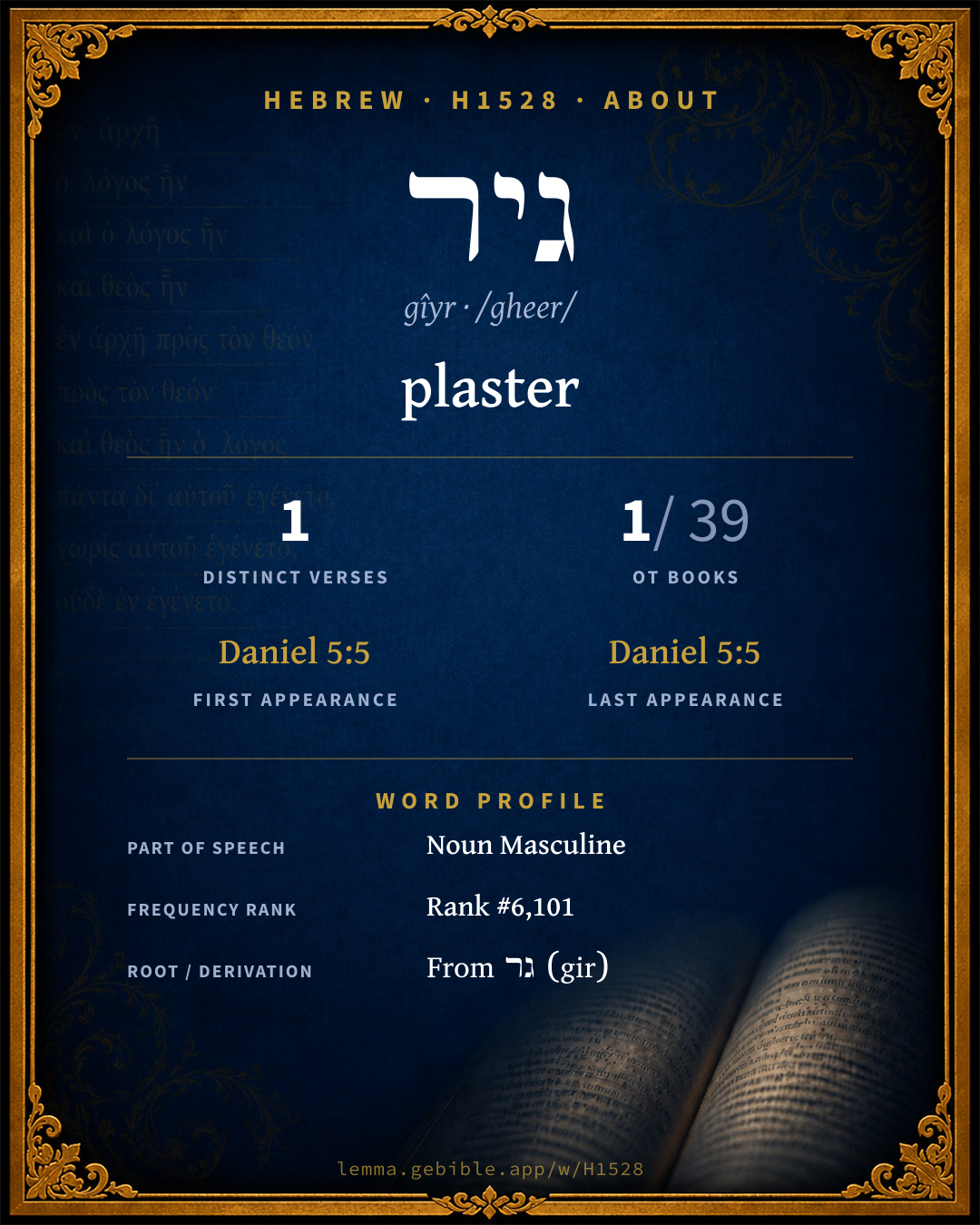
גִּיר
plaster
Full lexicon entry — Brown-Driver-Briggs (BDB)
From Brown-Driver-Briggs (BDB)
Where this word appears
Every verse where H1528 appears — 1 distinct verse across 1 book. Click any verse to open its interlinear word-by-word view. Verse text shown in the World English Bible for context — . Each verse’s Hebrew form is shown with its reference; the English is not keyword-highlighted, since the data carries no word-level English alignment. Use “Compare translations” on any verse to read it across multiple English versions. This concordance covers the Hebrew Bible; Septuagint (Greek Old Testament) occurrences are not indexed here.
Daniel 1 verse
About this entry
At a glance — auto-summarized from this page’s data, not written by a person. Every figure links to its source below. This summary describes the numbers; it doesn’t interpret them.
The Hebrew noun גיר centers on the idea of “plaster.” A scarce word — 1 verse in all of the Hebrew Bible. Daniel dominates its distribution — 1 of 1 verses. A true hapax — its single appearance is Daniel 5:5. For the data behind this summary, explore the sense tree and the renderings breakdown below.
Gloss history
Strong's 1890 vs modern scholarship
About this word
Strong's H1528 catalogs a Hebrew word from the Hebrew Old Testament.
These counts are not copied from any lexicon or concordance. They are computed here, from the morphology-tagged Hebrew Old Testament. What Lemma adds →
- 1
- distinct verses
- The word appears in 1 distinct verse.
- 1 / 39
- OT books
- The word appears in 1 of 39 Old Testament books.
- #6,101
- by frequency
- Rank #6,101 (rank 6,101 of 8,640 Hebrew words by occurrence).
View all 1 occurrence in the concordance →
Most concentrated in
- Daniel 1 verse 100%
By section of the Old Testament
By traditional corpus
Conventional, traditional groupings — biblical authorship is debated, so this is a traditional corpus grouping, not an authorship claim. Each share is this word’s portion of its verses in that division of the Hebrew canon. Each figure is a share of the word’s 1 distinct verse.
- Writings (Ketuvim) 1 verse · 100%
How translations render this word
Counts come from each version’s own published word-to-Strong’s tagging or interlinear alignment — an approximate guide to how each version renders this word, not a word-level alignment the data otherwise carries. Because each total is that version’s own tagged count, the per-version totals vary from one another and need not match the appearance or distinct-verse counts above. These counts may also differ from a printed concordance because Lemma counts each distinctly tagged rendering and does not collapse phrase taggings into a single head-word total. This is a fixed set of word-tagged versions (KJV, ASV, BSB, ULT) and does not change with the reading translation you choose elsewhere. Each version’s license is shown beside its name below (and on Sources).
- King James Version: Plaister 1×
- American Standard Version: Plaster 1×
- Berean Standard Bible: Plaster 1×
- unfoldingWord Literal Text: Plaster 1×
King James Version Public Domain
Renders H1528 across 1 tagged occurrence — most commonly:
American Standard Version Public Domain
Renders H1528 across 1 tagged occurrence — most commonly:
Berean Standard Bible Public Domain
Renders H1528 across 1 tagged occurrence — most commonly:
unfoldingWord Literal Text CC BY-SA 4.0
Renders H1528 across 1 tagged occurrence — most commonly:
Senses in BDB
The 1 sense BDB distinguishes for this word, in lexicon order (not ranked by frequency or importance). The full entry — with sub-senses — is in the Lexicon Entry tab.
- chalk, plaster
Word origin
[ גִּיר ] n.[m.] chalk, plaster;—emph. Dn 5:5.
— Brown-Driver-Briggs (Oxford 1906, public domain), digitized via Sefaria, supplemented by the OpenScriptures HebrewLexicon (CC BY 4.0). See Sources.
Derived from גר (gir) (H1615) — chalk.
Jastrow Dictionary
A second Hebrew/Aramaic lexicon for comparison, covering Aramaic and post-biblical (Talmudic, Targumic, Midrashic) usage that the biblical-Hebrew BDB does not. Matched by lemma rather than by Strong’s number, so a lemma may carry more than one Jastrow headword (shown separately below), and the entries cover usage well beyond the Bible.
*גִּיר I
- (Syriac גיר, P. Sm. 709 sq., prob. fr. גרר, cmp. גְּרָרָא) as a consequence, for &c. Targ. Prov. XXIX, 19 (agreeing with Peshito) ידע ג׳ דלא בליע ed. Lag. (Var. ולא, ed. דידע ג׳ ולא וכ׳, Peshito … בלע) for he understands (from being spoken to) only that he will receive no blows. [Ib. XXIII, 14 אנת ביר וכ׳ Ms. (missing in ed.), read: גיר (as in Peshito) thou, therefore, &c.]
גִּיר II
- or גור to boil, effervesce, v. H., v. H. Dict. s. v.)
- 1. lime. Sabb. 80ᵇ ביצת הג׳ Ar. (ed. הסיד), v. בֵּיצָה.—Denom. גִּיֵּיר to plaster. Lam. R. to IV, 11 Ar. (ed. סייד).—Ḥull. 88ᵇ bot. הג׳ והזרניך quot. in Rashi to Ex. XVI, 14 (ed. only הז׳) powdered lime and orpiment. e.g. Exodus 16:14
- 2. ink-stone, or sulphate of iron (sory). Bets. 15ᵃ ביצת הג׳ a lump of ink-stone (for blackening leather).—In gen. powder, in compounds גִּירְגִּבְסִין powder of gypsum; גִּירְקְרָרִין wax dust, v. אַגֵּין. Y. Sabb. VII, 10ᵇ bot. (perh. to be read in two words: lime, gypsum &c.).
- 3. froth. Men. VIII, 7 (87ᵃ) זרק הג׳ (Mish. ז׳ את הגיד, corr. acc.) if the froth (of the fermenting wine) burst forth; Tosef. ib. IX, 11 ג׳ של שמרים.
גִּיר
- , lime, plaster. Dan. V, 5.—Targ. O. Ex. XVI, 14 דעדק כג׳ thin and brittle like a coat of lime (h. text מחספס). Targ. Y. Deut. XXVII, 2 (h. text סיד); a. e.—2) froth, foam. Pl. גִּירִין Targ. Y. Ex. XV, 10 ג׳ דימא the foaming billows. [Targ. Jer. IX, 14, read כגידין, v. גִּידָּא II.]—3) name of a disease, a sort of fever (?). Gitt. 69ᵇ, v. next w. e.g. Daniel 5:5
גִּיר III
- (גרי, גרר; cmp. b. h. שֶׁלַח)
- 1. projectile, arrow. Targ. Is. XXXVII, 33. Targ. Job XLI, 20; a. fr.—Gitt. 56ᵃ שדא ג׳ וכ׳ he shot an arrow eastward. B. Kam. 26ᵇ בעידנא דשדייה פסוקי מפסקי גִירֵיה (v. Rabb. D. S. a. l. note) at the time he let his arrow off, its force was broken, i.e. when he threw the vessel down, polsters were there to prevent its breaking. Succ. 38ᵃ דין ג׳ בעיניה וכ׳ this is an arrow in the tempter’s eyes, i.e. this enables us to defy him. Kidd. 30ᵃ I should say to Satan ג׳ בעיניך I defy thee; ib. 81ᵃ.—Taan. 25ᵃ אגרי בך גִירַי I shall let my arrow loose against thee (v. Rabb. D. S. a. l. note; oth. vers. v. גּוּר I ch.). Pes. 28ᵃ, v. גִּירָאָה; a. fr.—ג׳ דלילתא (Ar. דלוליתא) the arrow of Lilith, supposed to be a wedge-shaped meteoric stone. Gitt. 69ᵇ לגירא ליתי ג׳ דל׳ as a remedy for gira (v. preced.) let one get a gira of &c.—Pl. גִּירִין, גִּירֵי, גִּירַיָּא; גִּירְרִין, גִּירְרַיָּא. Targ. II Sam. I, 22. Targ. Y. I Gen. XLIX, 23, Targ. Y. II, Gen. XLIX, 23 (not גיד׳). Targ. Ps. CXX, 4; a. fr.—Snh. 108ᵇ גילי והוו ג׳ he threw chaff and it turned into arrows. B. Bath. 73ᵃ; v. בְּזַק. Y. ib. II, 13ᵇ bot. מן קל גורי וכ׳ (corr. acc.) from the hissing sound of the arrows; a. fr.
- 2. shoot of a plant. Pl. גִּירֵי. Sabb. 109ᵇ ג׳ דרוביא shoots of fenugreek; (oth. opin. in Ar. flax-seeds, Ms. O. גידא, v. גִּידָּא I).
A Dictionary of the Targumim, the Talmud Babli and Yerushalmi, and the Midrashic Literature (Marcus Jastrow; London, Luzac, 1903) — Public Domain. Digitized via Sefaria. Digitized via Sefaria. Full attribution on Sources.
Septuagint verse parallels
This word appears in 1 verse that also exists in the Greek Old Testament (Septuagint), out of the 1 Hebrew verse it occurs in. You can read those verses in Greek by switching the Old Testament edition to the Septuagint.
Read these verses in the Septuagint
This is a verse-level parallel only — the same verses exist in both the Hebrew and Greek Old Testaments. No word-level Hebrew↔Greek correspondence is claimed: the data carries no such alignment, so no Greek word is shown as this Hebrew word’s translation. Coverage is not total — the Septuagint omits the deuterocanon and renumbers the Psalms, so some Hebrew verses have no direct Greek parallel.