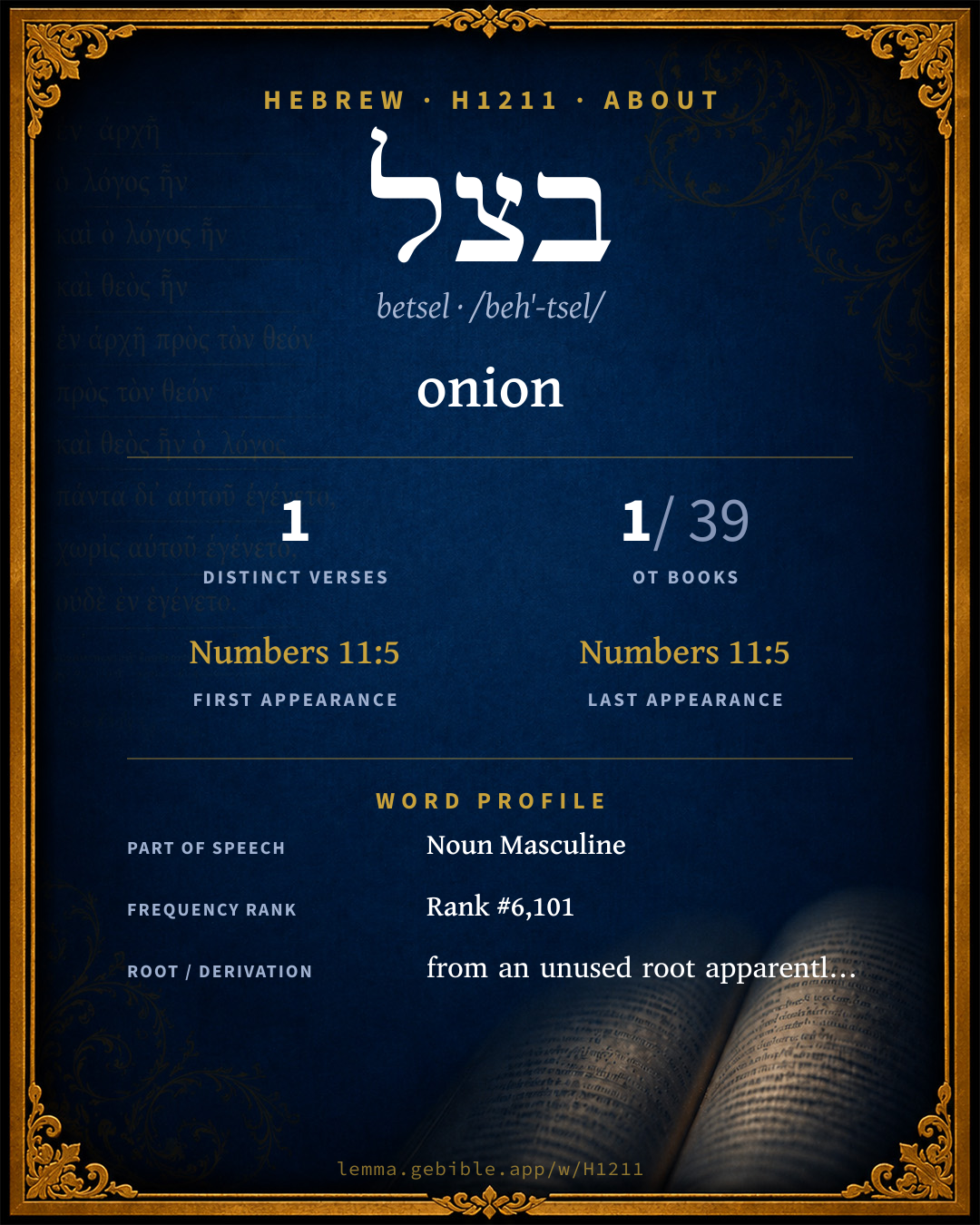
בָּצָל
onion
Full lexicon entry — Brown-Driver-Briggs (BDB)
From Brown-Driver-Briggs (BDB)
Where this word appears
Grammar key — what these labels mean
Noun type
- Common
- A common noun — a general class of person, place, or thing (“king,” “city,” “water”), not a specific name.
State
- Absolute
- The independent form of a noun, not bound to a following word.
Gender
- Masculine
- Grammatically masculine.
Number
- Plural
- More than one (in Hebrew, generally three or more).
Every verse where H1211 appears — 1 distinct verse across 1 book. Click any verse to open its interlinear word-by-word view. Verse text shown in the World English Bible for context — . Each verse’s Hebrew form is shown with its reference; the English is not keyword-highlighted, since the data carries no word-level English alignment. Use “Compare translations” on any verse to read it across multiple English versions. This concordance covers the Hebrew Bible; Septuagint (Greek Old Testament) occurrences are not indexed here.
Numbers 1 verse
About this entry
At a glance — auto-summarized from this page’s data, not written by a person. Every figure links to its source below. This summary describes the numbers; it doesn’t interpret them.
בצל (betsel) is a Hebrew noun most often rendered “onion.” A scarce word — 1 verse in all of the Hebrew Bible. Numbers dominates its distribution — 1 of 1 verses. Scripture uses it exactly once, at Numbers 11:5. Related forms include בצלות. The sections below give every sense, occurrence, and version rendering.
Gloss history
Strong's 1890 vs modern scholarship
About this word
Strong's H1211 catalogs a Hebrew word from the Hebrew Old Testament.
These counts are not copied from any lexicon or concordance. They are computed here, from the morphology-tagged Hebrew Old Testament. What Lemma adds →
- 1
- distinct verses
- The word appears in 1 distinct verse.
- 1 / 39
- OT books
- The word appears in 1 of 39 Old Testament books.
- #6,101
- by frequency
- Rank #6,101 (rank 6,101 of 8,640 Hebrew words by occurrence).
View all 1 occurrence in the concordance →
Most concentrated in
- Numbers 1 verse 100%
By section of the Old Testament
By traditional corpus
Conventional, traditional groupings — biblical authorship is debated, so this is a traditional corpus grouping, not an authorship claim. Each share is this word’s portion of its verses in that division of the Hebrew canon. Each figure is a share of the word’s 1 distinct verse.
- Torah (Pentateuch) 1 verse · 100%
How translations render this word
Counts come from each version’s own published word-to-Strong’s tagging or interlinear alignment — an approximate guide to how each version renders this word, not a word-level alignment the data otherwise carries. Because each total is that version’s own tagged count, the per-version totals vary from one another and need not match the appearance or distinct-verse counts above. These counts may also differ from a printed concordance because Lemma counts each distinctly tagged rendering and does not collapse phrase taggings into a single head-word total. This is a fixed set of word-tagged versions (KJV, ASV, BSB, ULT) and does not change with the reading translation you choose elsewhere. Each version’s license is shown beside its name below (and on Sources).
- King James Version: Onions 1×
- American Standard Version: Onions 1×
- Berean Standard Bible: Onions 1×
- unfoldingWord Literal Text: Onions 1×
King James Version Public Domain
Renders H1211 across 1 tagged occurrence — most commonly:
American Standard Version Public Domain
Renders H1211 across 1 tagged occurrence — most commonly:
Berean Standard Bible Public Domain
Renders H1211 across 1 tagged occurrence — most commonly:
unfoldingWord Literal Text CC BY-SA 4.0
Renders H1211 across 1 tagged occurrence — most commonly:
Senses in BDB
The 1 sense BDB distinguishes for this word, in lexicon order (not ranked by frequency or importance). The full entry — with sub-senses — is in the Lexicon Entry tab.
- onion
Word origin
Origin: from an unused root apparently meaning to peel
Jastrow Dictionary
A second Hebrew/Aramaic lexicon for comparison, covering Aramaic and post-biblical (Talmudic, Targumic, Midrashic) usage that the biblical-Hebrew BDB does not. Matched by lemma rather than by Strong’s number, so a lemma may carry more than one Jastrow headword (shown separately below), and the entries cover usage well beyond the Bible.
בְּצַל
- (√בץ, cmp. פצל) to peel; to split, branch off. Lam. R. introd.; Koh. R. to XII, 7 (interpret. אם הדרך Ezek. XXI, 26) (אם) אמה דבצלית an arm which branches off (direction post on the cross-road). e.g. Ezekiel 21:26
- (denom. of בָּצְלָא) to grow bulbous. Erub. 29ᵇ top אי׳ זירתא (ed. Pesaro a. Ar. אפציל, Var. אבציל) the bulb has grown to the length of a span.
בָּצֵל
- v. preced.) onion. Nidd. 17ᵃ; a. fr.—Maasr. V, 7 (8) ב׳ של רכפה, expl. in Y. ib. 52ᵃ ‘the stalk of which is pressed inward’; oth. opin. ‘which has no acerbity’, v. אֶרֶס.—Pl. בְּצָלִים. Shebi. II, 9 הב׳ הסריסים which produce no seeds. Ib. V, 4 ב׳ הקיצונים summer onions; a. fr.—Ukts. II, 8 עלי ב׳ ובני ב׳ the leek-like sprouts, and the central sprouts of onions. Gen. R. s. 82 (ref. to Ob. I, 6) קליפת ב׳ (not בצליא) like peeling onions (laying bare Esau’s shame). e.g. Obadiah 1:6
צַל
- , v. צְלַל
צֵל
- , v. טְלָלָא) shade, shadow; protection. Succ. 2ᵃ עד … אדם יושב בצל סוכה up to a height (of the walls) of twenty cubits one sits in the shade of the ceiling of the booth; למעלה … בצל רפנות above twenty cubits, one sits no longer shaded by the ceiling, but shaded by the walls. Ib.ᵇ כיון דרויחא איכא צל סוכה when the Succah is very large, there is the shade of the ceiling (even when the walls are higher than twenty cubits). Koh. R. to I, 2 (ref. to ib. VI, 12) כאיזה צל אם כצִלּוֹ של כותל וכ׳ like what shadow? if like the shadow of a wall, there is some reality in it; ib. כצִלָּן של דבורים וכ׳ like the shadow cast by flying bees &c.; Gen. R. s. 96 כצִילּוֹ וכ׳. Pes. 114ᵃ אכול בָּצֵל ושב בַּצֵּל וכ׳ eat onions and sit in the shade (of thy house in contentment) rather than &c. Y. Ab. Zar. III, 43ᵇ bot. צִיּלָּהּ אסור צל צילה מותר the shade of a worshipped tree is forbidden (to be enjoyed), the shade of the shade is permitted; כל שאילן … זהו צילה וכ׳ as far as the tree would reach if felled, so far is its shadow; what is beyond, is the shadow of the shadow; Bab. Ab. Zar. 48ᵇ צל קומתה the extent of the shadow corresponding to the height of the tree. Midr. Sam. ch. XIV; Yalk. Sam. 109, v. צַח. Ex. R. s. 34 (ref. to Ps. XCI, 1) בצל שעשה בצלאל in the shade which Bezalel has made (the Tabernacle). Ber. 55ᵃ (play on בצלאל) שמא בצל אל היית וכ׳ hast thou been in the shade of God that thou knowest it?; a. v. fr. e.g. Psalms 91:1
A Dictionary of the Targumim, the Talmud Babli and Yerushalmi, and the Midrashic Literature (Marcus Jastrow; London, Luzac, 1903) — Public Domain. Digitized via Sefaria. Digitized via Sefaria. Full attribution on Sources.
Same root — word family
Other BDB entries built from the same root as H1211, grouped by Strong’s listed origin. These share a root / origin per the lexicon — not necessarily a shared meaning. Each links to that word’s own entry.
Proper names from this root
People and places named from this root — a name, not an additional meaning of the word.
Compare all same-root words → 1 of the same-root words is a proper name (a person or place). They share a root, not necessarily a meaning.
Septuagint verse parallels
This word appears in 1 verse that also exists in the Greek Old Testament (Septuagint), out of the 1 Hebrew verse it occurs in. You can read those verses in Greek by switching the Old Testament edition to the Septuagint.
Read these verses in the Septuagint
This is a verse-level parallel only — the same verses exist in both the Hebrew and Greek Old Testaments. No word-level Hebrew↔Greek correspondence is claimed: the data carries no such alignment, so no Greek word is shown as this Hebrew word’s translation. Coverage is not total — the Septuagint omits the deuterocanon and renumbers the Psalms, so some Hebrew verses have no direct Greek parallel.