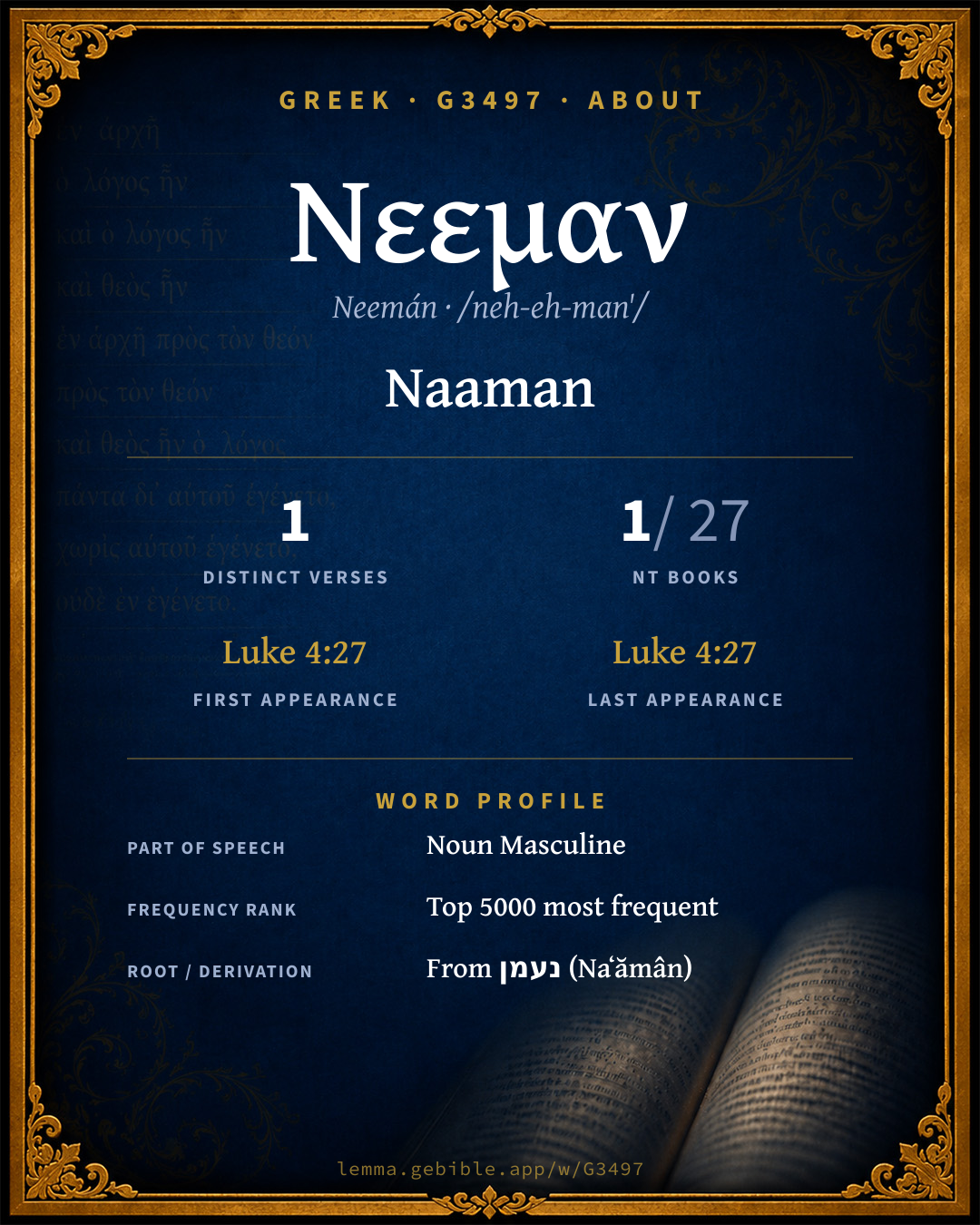
Νεεμάν
Naaman
Thayer's lists 2 entries for ‘Naaman’ fuller range ↓
Full lexicon entry — Thayer's Greek Lexicon
From Thayer's Greek Lexicon
Where this word appears
Every verse where G3497 appears — 1 distinct verse across 1 book. Click any verse to open its interlinear word-by-word view. Verse text shown in the World English Bible for context — . Each verse’s Greek form is shown with its reference; the English is not keyword-highlighted, since the data carries no word-level English alignment. Use “Compare translations” on any verse to read it across multiple English versions. This concordance covers the Greek New Testament; Septuagint (Greek Old Testament) occurrences of this word are not indexed here.
Luke 1 verse
About this entry
At a glance — auto-summarized from this page’s data, not written by a person. Every figure links to its source below. This summary describes the numbers; it doesn’t interpret them.
“Naaman” is the headline sense of the Greek name Νεεμαν (Neemán). The Greek New Testament uses it only 1 verse. It clusters heavily in Luke, which alone accounts for 100% of its uses. Found nowhere else but Luke 4:27. See 1-verse concordance and the renderings breakdown below.
Gloss history
Strong's 1890 vs modern scholarship
About this word
Strong's G3497 catalogs a Greek word from the Greek New Testament.
These counts are not copied from any lexicon or concordance. They are computed here, from the morphology-tagged Greek New Testament. What Lemma adds →
- 1
- distinct verses
- The word appears in 1 distinct verse.
- 1 / 27
- NT books
- The word appears in 1 of 27 New Testament books.
- #3,503
- by frequency
- Top 5000 most frequent Greek words (rank 3,503 of 5,347 Greek words by occurrence).
View all 1 occurrence in the concordance →
Most concentrated in
- Luke 1 verse 100%
By section of the New Testament
By traditional corpus
Conventional, traditional groupings — biblical authorship is debated, so this is a traditional corpus grouping, not an authorship claim. Some books belong to more than one corpus (Luke is in both the Gospels and the Lukan corpus, and so on), so these shares overlap and need not total 100%. Each figure is a share of the word’s 1 distinct verse.
- Gospels 1 verse · 100%
- Lukan (Luke–Acts) 1 verse · 100%
How translations render this word
Counts come from each version’s own published word-to-Strong’s tagging or interlinear alignment — an approximate guide to how each version renders this word, not a word-level alignment the data otherwise carries. Because each total is that version’s own tagged count, the per-version totals vary from one another and need not match the appearance or distinct-verse counts above. These counts may also differ from a printed concordance because Lemma counts each distinctly tagged rendering and does not collapse phrase taggings into a single head-word total. This is a fixed set of word-tagged versions (KJV, ASV, BSB, ULT) and does not change with the reading translation you choose elsewhere. Each version’s license is shown beside its name below (and on Sources).
- King James Version: Naaman 1×
- American Standard Version: Only naaman 1×
- Berean Standard Bible: Naaman 1×
- unfoldingWord Literal Text: Naaman 1×
King James Version Public Domain
Renders G3497 across 1 tagged occurrence — most commonly:
American Standard Version Public Domain
Renders G3497 across 1 tagged occurrence — most commonly:
Berean Standard Bible Public Domain
Renders G3497 across 1 tagged occurrence — most commonly:
unfoldingWord Literal Text CC BY-SA 4.0
Renders G3497 across 1 tagged occurrence — most commonly:
Senses in Thayer's
The 2 senses Thayer's distinguishes for this word, in lexicon order (not ranked by frequency or importance). The full entry — with sub-senses — is in the Lexicon Entry tab.
- Naaman the Syrian = "pleasantness"
- commander-in-chief of the army of Syria
Word origin
Derived from נעמן (Naʻămân) (H5283) — Naaman.
Of hebrew origin [ H5283 ]; Neeman (that is Naaman ) a Syrian : - Naaman.
— Strong’s Exhaustive Concordance (1890), public domain.
Same root — word family
Other Thayer's entries built from the same root as G3497, grouped by Strong’s listed origin. These share a root / origin per the lexicon — not necessarily a shared meaning. Each links to that word’s own entry.
Derives from
Proper names from this root
People and places named from this root — a name, not an additional meaning of the word.
Compare all same-root words → 2 of the same-root words are proper names (people or places). They share a root, not necessarily a meaning.
Bible dictionary
Public-domain dictionary articles matched to this entry by name (Naaman). A biblical name can be shared by more than one person or place, so an article may treat several.
Easton's Bible Dictionary · M. G. Easton, 1897
Pleasantness, a Syrian, the commander of the armies of Benhadad II. in the time of Joram, king of Israel. He was afflicted with leprosy; and when the little Hebrew slave-girl that waited on his wife told her of a prophet in Samaria who could cure her master, he obtained a letter from Benhadad and proceeded with it to Joram. The king of Israel suspected in this some evil design against him, and rent his clothes. Elisha the prophet hearing of this, sent for Naaman, and the strange interview which took place is recorded in 2 Kings 5. The narrative contains all that is known of the Syrian commander. He was cured of his leprosy by dipping himself seven times in the Jordan, according to the word of Elisha. His cure is alluded to by our Lord (Luke 4:27).
Smith's Bible Dictionary · William Smith, 1863
(pleasantness).
+ "Naaman the Syrian." (Luke 4:27) Naaman was commander-in-chief of the army of Syria, and was nearest to the person of the king, Ben-hadad II., whom he accompanied officially and supported when he went to worship in the temple of Rimmon, (2 Kings 5:18) at Damascus, the capital. (B.C. 885.) A Jewish tradition at least as old as the time of Josephus, and which may very well be a genuine one identifies him with the archer whose arrow, whether at random or not, struck Ahab with his mortal wound, and thus "gave deliverance to Syria." The expression in (2 Kings 5:1) is remarkable--"because that by him Jehovah had given deliverance to Syria." The most natural explanation perhaps is that Naaman in delivering his country, had killed one who was the enemy of Jehovah not less than he was of Syria. Whatever the particular exploit referred to was, it had given Naaman a great position at the court of Ben-hadad. Naaman was afflicted with a leprosy of the white kind which had hitherto defied cure. A little Israelitish captive maiden tells him of the fame and skill of Elisha, and he is cured by him by following his simple directions to bathe in the Jordan seven times. See (2 Kings 5:14) His first business after his cure is to thank his benefactor and gratefully acknowledge the power of the God of Israel, and promise "henceforth to offer neither burnt offering nor sacrifice unto other gods, but unto the Lord." How long Naaman lived to continue a worshipper of Jehovah while assisting officially at the worship of Rimmon we are not told; ("but his memory is perpetuated by a leper hospital which occupies the traditional site of his house in Damascus, on the banks of the Abana."--Schaff.) + One of the family of Benjamin who came down to Egypt with Jacob as read in (Genesis 46:21) He was the son of Bela, and head of the family of the Naamites. (Numbers 26:40; 1 Chronicles 8:3,4) (B.C. 1706.)
Classic public-domain reference works; full attribution on Sources.