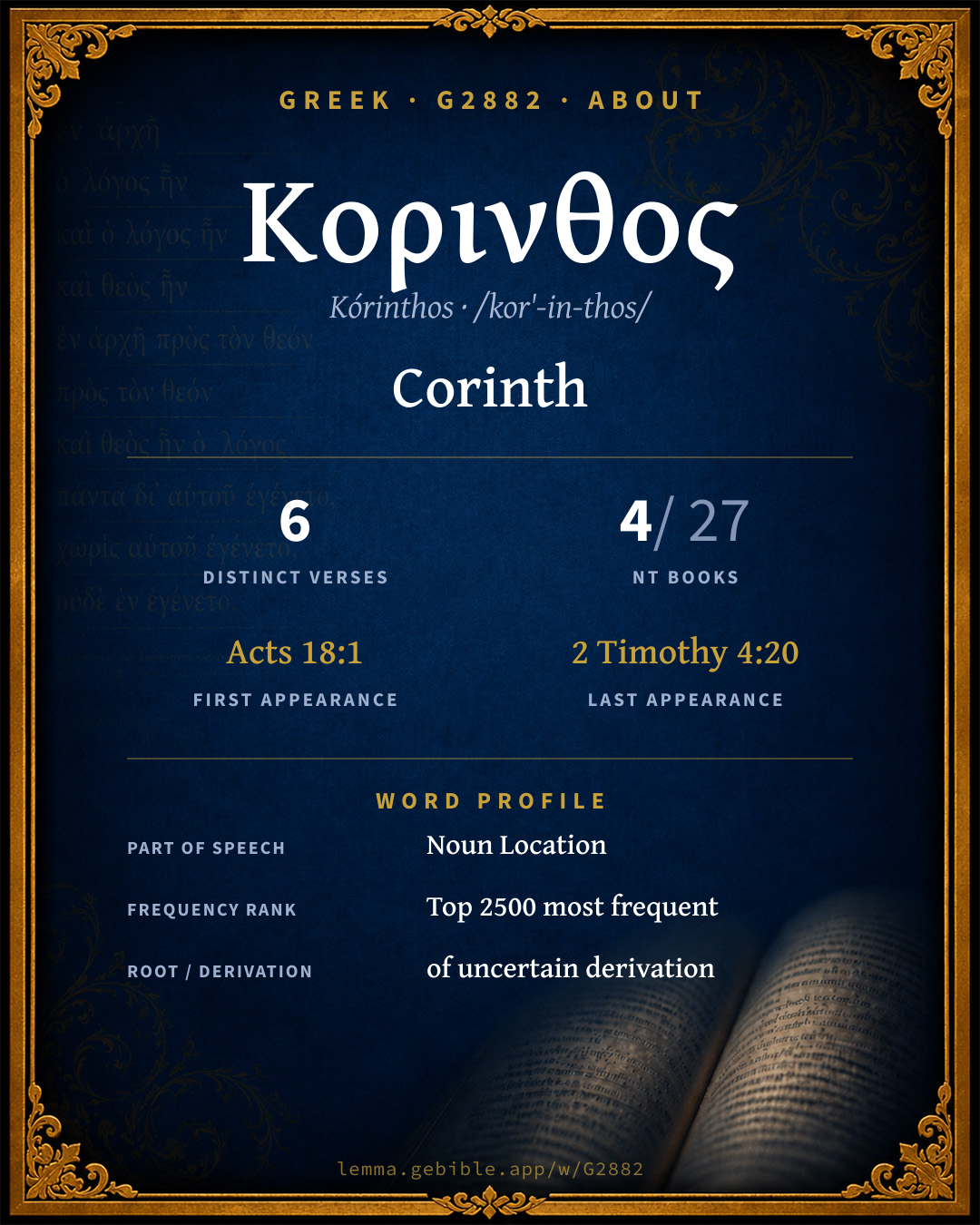
Κόρινθος
Corinth
Thayer's lists 2 entries for ‘Corinth’ fuller range ↓
Full lexicon entry — Thayer's Greek Lexicon
From Thayer's Greek Lexicon
Where this word appears
Grammar key — what these labels mean
Part of speech
- Noun
- A naming word — a person, place, thing, or idea.
Case
- Dative
- The case of the indirect object, means, or location — “to / for / with / in.”
- Accusative
- The case of the direct object and of extent.
Gender
- Feminine
- Grammatically feminine.
Number
- Singular
- One.
Every verse where G2882 appears in the Book of 2 Timothy — 1 distinct verse. Click any verse to open its interlinear word-by-word view. Verse text shown in the World English Bible for context — . Each verse’s Greek form is shown with its reference; the English is not keyword-highlighted, since the data carries no word-level English alignment. Use “Compare translations” on any verse to read it across multiple English versions. This concordance covers the Greek New Testament; Septuagint (Greek Old Testament) occurrences of this word are not indexed here.
2 Timothy
About this entry
At a glance — auto-summarized from this page’s data, not written by a person. Every figure links to its source below. This summary describes the numbers; it doesn’t interpret them.
Κορινθος — transliterated Kórinthos — is a Greek name carrying the sense “Corinth.” It first appears in Acts 18:1. The Greek New Testament uses it across 6 verses — uncommon. More than a third of its appearances fall in Acts. Each statement above links to its evidence; the full detail follows below.
Gloss history
Strong's 1890 vs modern scholarship
About this word
Strong's G2882 catalogs a Greek word from the Greek New Testament.
These counts are not copied from any lexicon or concordance. They are computed here, from the morphology-tagged Greek New Testament. What Lemma adds →
- 6
- distinct verses
- The word appears in 6 distinct verses.
- 4 / 27
- NT books
- The word appears in 4 of 27 New Testament books.
- #1,476
- by frequency
- Top 2500 most frequent Greek words (rank 1,476 of 5,347 Greek words by occurrence).
View all 6 occurrences in the concordance →
Most concentrated in
- Acts 2 verses 33%
- 2 Corinthians 2 verses 33%
- 1 Corinthians 1 verse 17%
By section of the New Testament
By traditional corpus
Conventional, traditional groupings — biblical authorship is debated, so this is a traditional corpus grouping, not an authorship claim. Some books belong to more than one corpus (Luke is in both the Gospels and the Lukan corpus, and so on), so these shares overlap and need not total 100%. Each figure is a share of the word’s 6 distinct verses.
- Pauline corpus 4 verses · 67%
- Lukan (Luke–Acts) 2 verses · 33%
How translations render this word
Counts come from each version’s own published word-to-Strong’s tagging or interlinear alignment — an approximate guide to how each version renders this word, not a word-level alignment the data otherwise carries. Because each total is that version’s own tagged count, the per-version totals vary from one another and need not match the appearance or distinct-verse counts above. These counts may also differ from a printed concordance because Lemma counts each distinctly tagged rendering and does not collapse phrase taggings into a single head-word total. This is a fixed set of word-tagged versions (KJV, ASV, BSB, ULT) and does not change with the reading translation you choose elsewhere. Each version’s license is shown beside its name below (and on Sources).
- King James Version: Corinth 6×
- American Standard Version: Corinth 6×
- Berean Standard Bible: Corinth 6×
- unfoldingWord Literal Text: Corinth 6×
King James Version Public Domain
Renders G2882 across 6 tagged occurrences — most commonly:
American Standard Version Public Domain
Renders G2882 across 6 tagged occurrences — most commonly:
Berean Standard Bible Public Domain
Renders G2882 across 6 tagged occurrences — most commonly:
unfoldingWord Literal Text CC BY-SA 4.0
Renders G2882 across 6 tagged occurrences — most commonly:
Senses in Thayer's
The 2 senses Thayer's distinguishes for this word, in lexicon order (not ranked by frequency or importance). The full entry — with sub-senses — is in the Lexicon Entry tab.
- Corinth = "satiated"
- an ancient and famous city of Greece, on the Isthmus of Corinth, and about 40 miles (65 km) west of Athens
Word origin
Origin: of uncertain derivation
Of uncertain derivation; Corinthus a city of Greece : - Corinth.
— Strong’s Exhaustive Concordance (1890), public domain.
Forms in the corpus
The 2 distinct written forms G2882 takes in the Greek New Testament, most frequent first — each parse links to that case’s occurrences in the concordance.
| Form | Parsing | Example | Uses |
|---|---|---|---|
| Κορίνθῳ Korínthō | Noun, Dative, Singular, Feminine | Acts 19:1 | 4 |
| Κόρινθον Kórinthon | Noun, Accusative, Singular, Feminine | Acts 18:1 | 2 |
Same root — word family
Other Thayer's entries built from the same root as G2882, grouped by Strong’s listed origin. These share a root / origin per the lexicon — not necessarily a shared meaning. Each links to that word’s own entry.
Proper names from this root
People and places named from this root — a name, not an additional meaning of the word.
Compare all same-root words → 1 of the same-root words is a proper name (a person or place). They share a root, not necessarily a meaning.
Bible dictionary
Public-domain dictionary articles matched to this entry by name (Corinth). A biblical name can be shared by more than one person or place, so an article may treat several.
Easton's Bible Dictionary · M. G. Easton, 1897
A Grecian city, on the isthmus which joins the Peloponnesus to the mainland of Greece. It is about 48 miles west of Athens. The ancient city was destroyed by the Romans (B.C. 146), and that mentioned in the New Testament was quite a new city, having been rebuilt about a century afterwards and peopled by a colony of freedmen from Rome. It became under the Romans the seat of government for Southern Greece or Achaia (Acts 18:12-16). It was noted for its wealth, and for the luxurious and immoral and vicious habits of the people. It had a large mixed population of Romans, Greeks, and Jews. When Paul first visited the city (A.D. 51 or 52), Gallio, the brother of Seneca, was proconsul. Here Paul resided for eighteen months (18:1-18). Here he first became aquainted with Aquila and Priscilla, and soon after his departure Apollos came to it from Ephesus. After an interval he visited it a second time, and remained for three months (20:3). During this second visit his Epistle to the Romans was written (probably A.D. 55). Although there were many Jewish converts at Corinth, yet the Gentile element prevailed in the church there.
Some have argued from 2 Cor. 12:14; 13:1, that Paul visited Corinth a third time (i.e., that on some unrecorded occasion he visited the city between what are usually called the first and second visits). But the passages referred to only indicate Paul's intention to visit Corinth (comp. 1 Cor. 16:5, where the Greek present tense denotes an intention), an intention which was in some way frustrated. We can hardly suppose that such a visit could have been made by the apostle without more distinct reference to it.
Smith's Bible Dictionary · William Smith, 1863
an ancient and celebrated city of Greece, on the Isthmus of Corinth, and about 40 miles west of Athens. In consequence of its geographical position it formed the most direct communication between the Ionian and AEgean seas. A remarkable feature was the AcroCorinthus, a vast citadel of rock, which rises abruptly to the height of 2000 feet above the level of the sea, and the summit of which is so extensive that it once contained a whole town. The situation of Corinth, and the possession of its eastern and western harbors, Cenchreae and Lechaeum, are the secrets of its history. Corinth was a place of great mental activity, as well as of commercial and manufacturing enterprise. Its wealth was so celebrated as to be proverbial; so were the vice and profligacy of its inhabitants. The worship of Venus where was attended with shameful licentiousness. Corinth is still an episcopal see. The city has now shrunk to a wretched village, ont he old site and bearing the old name, which, however, is corrupted into Gortho . St. Paul preached here, (Acts 18:11) and founded a church, to which his Epistles to the Corinthians are addressed. [EPISTLES TO THE Corinthians, First Epistle To The, Corinthians, Second Epistle To The]
Hitchcock's Bible Names Dictionary · Roswell D. Hitchcock, 1869
which is satisfied; ornament; beauty
Classic public-domain reference works; full attribution on Sources.