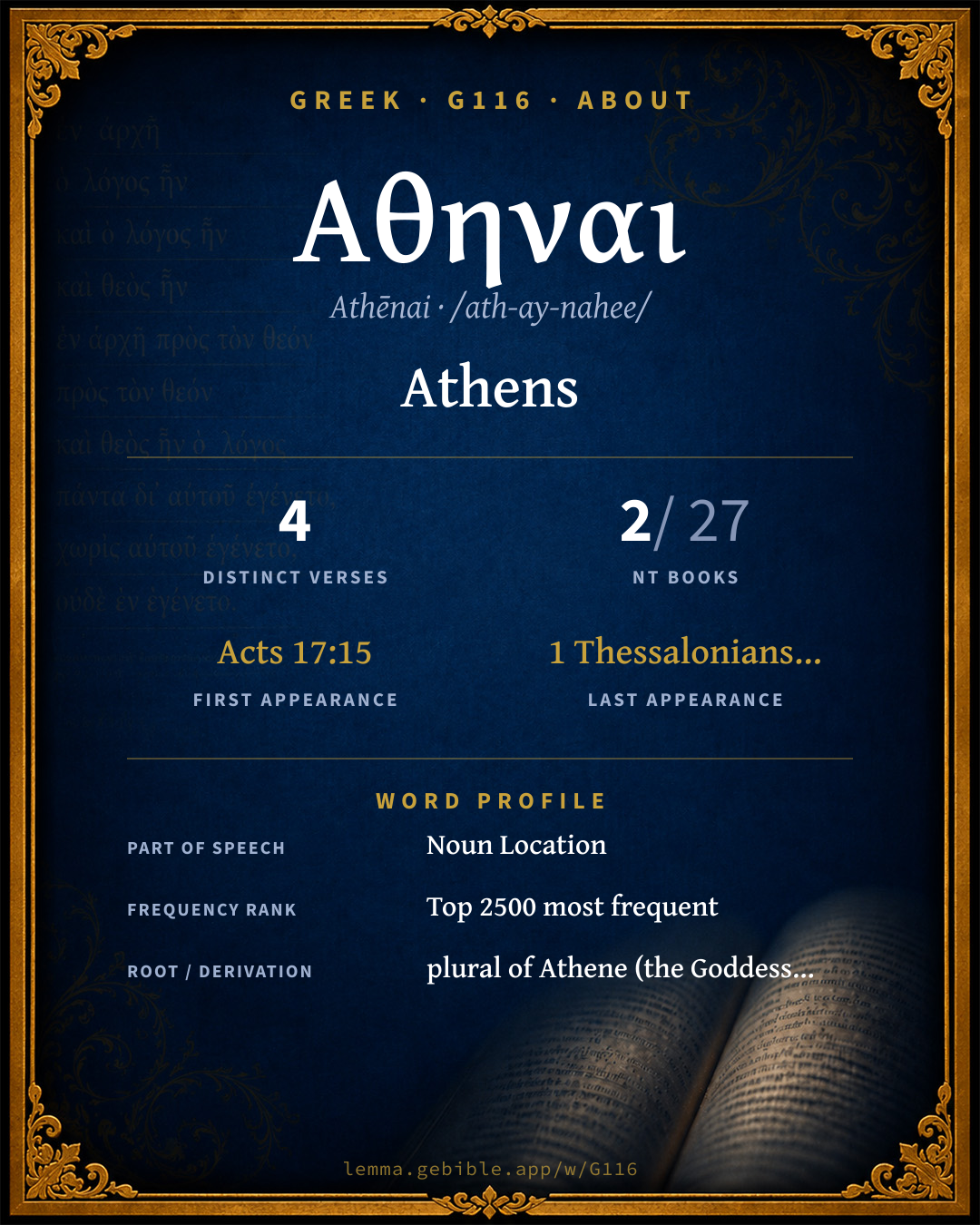
Ἀθῆναι
Athens
Thayer's lists 2 entries for ‘Athens’ fuller range ↓
Full lexicon entry — Thayer's Greek Lexicon
From Thayer's Greek Lexicon
Where this word appears
See every Dative-case word in the Greek New Testament →
Grammar key — what these labels mean
Part of speech
- Noun
- A naming word — a person, place, thing, or idea.
Case
- Dative
- The case of the indirect object, means, or location — “to / for / with / in.”
- Genitive
- The case of source, possession, or “of” — answers “whose / from what.”
Gender
- Feminine
- Grammatically feminine.
Number
- Plural
- More than one.
2 distinct verses where G116 appears in the Dative case, across 2 books. Filtered view — show all forms. Click any verse to open its interlinear word-by-word view. Verse text shown in the World English Bible for context — . Each verse’s Greek form is shown with its reference; the English is not keyword-highlighted, since the data carries no word-level English alignment. Use “Compare translations” on any verse to read it across multiple English versions. This concordance covers the Greek New Testament; Septuagint (Greek Old Testament) occurrences of this word are not indexed here.
Acts 1 verse
1 Thessalonians 1 verse
About this entry
At a glance — auto-summarized from this page’s data, not written by a person. Every figure links to its source below. This summary describes the numbers; it doesn’t interpret them.
Αθηναι (Athēnai) is a Greek name most often rendered “Athens.” It is rare — just 4 verses in the entire Greek New Testament. Acts dominates its distribution — 3 of 4 verses. It first appears in Acts 17:15. For the data behind this summary, explore 4-verse concordance and the renderings breakdown below.
Gloss history
Strong's 1890 vs modern scholarship
About this word
Strong's G116 catalogs a Greek word from the Greek New Testament.
These counts are not copied from any lexicon or concordance. They are computed here, from the morphology-tagged Greek New Testament. What Lemma adds →
- 4
- distinct verses
- The word appears in 4 distinct verses.
- 2 / 27
- NT books
- The word appears in 2 of 27 New Testament books.
- #1,877
- by frequency
- Top 2500 most frequent Greek words (rank 1,877 of 5,347 Greek words by occurrence).
View all 4 occurrences in the concordance →
Most concentrated in
- Acts 3 verses 75%
- 1 Thessalonians 1 verse 25%
By section of the New Testament
By traditional corpus
Conventional, traditional groupings — biblical authorship is debated, so this is a traditional corpus grouping, not an authorship claim. Some books belong to more than one corpus (Luke is in both the Gospels and the Lukan corpus, and so on), so these shares overlap and need not total 100%. Each figure is a share of the word’s 4 distinct verses.
- Lukan (Luke–Acts) 3 verses · 75%
- Pauline corpus 1 verse · 25%
How translations render this word
Counts come from each version’s own published word-to-Strong’s tagging or interlinear alignment — an approximate guide to how each version renders this word, not a word-level alignment the data otherwise carries. Because each total is that version’s own tagged count, the per-version totals vary from one another and need not match the appearance or distinct-verse counts above. These counts may also differ from a printed concordance because Lemma counts each distinctly tagged rendering and does not collapse phrase taggings into a single head-word total. This is a fixed set of word-tagged versions (KJV, ASV, BSB, ULT) and does not change with the reading translation you choose elsewhere. Each version’s license is shown beside its name below (and on Sources).
- King James Version: Athens 4×
- American Standard Version: Athens 4×
- Berean Standard Bible: Athens 4×
- unfoldingWord Literal Text: Athens 4×
King James Version Public Domain
Renders G116 across 4 tagged occurrences — most commonly:
American Standard Version Public Domain
Renders G116 across 4 tagged occurrences — most commonly:
Berean Standard Bible Public Domain
Renders G116 across 4 tagged occurrences — most commonly:
unfoldingWord Literal Text CC BY-SA 4.0
Renders G116 across 4 tagged occurrences — most commonly:
Senses in Thayer's
The 2 senses Thayer's distinguishes for this word, in lexicon order (not ranked by frequency or importance). The full entry — with sub-senses — is in the Lexicon Entry tab.
- Athens = "uncertainty"
- A famous city in Greece…
Word origin
Origin: plural of Athene (the Goddess of wisdom, who was reputed to have founded the city)
Plural of Ἀθήνη Athē nē (the Goddess of wisdom who was reputed to have founded the city); Athenae the captital of Greece : - Athens.
— Strong’s Exhaustive Concordance (1890), public domain.
Forms in the corpus
The 2 distinct written forms G116 takes in the Greek New Testament, most frequent first — each parse links to that case’s occurrences in the concordance.
| Form | Parsing | Example | Uses |
|---|---|---|---|
| Ἀθήναις Athḗnais | Noun, Dative, Plural, Feminine | Acts 17:16 | 2 |
| Ἀθηνῶν Athēnō̂n | Noun, Genitive, Plural, Feminine | Acts 17:15 | 2 |
Same root — word family
Other Thayer's entries built from the same root as G116, grouped by Strong’s listed origin. These share a root / origin per the lexicon — not necessarily a shared meaning. Each links to that word’s own entry.
Proper names from this root
People and places named from this root — a name, not an additional meaning of the word.
Compare all same-root words → 1 of the same-root words is a proper name (a person or place). They share a root, not necessarily a meaning.
Bible dictionary
Public-domain dictionary articles matched to this entry by name (Athens). A biblical name can be shared by more than one person or place, so an article may treat several.
Easton's Bible Dictionary · M. G. Easton, 1897
The capital of Attica, the most celebrated city of the ancient world, the seat of Greek literature and art during the golden period of Grecian history. Its inhabitants were fond of novelty (Acts 17:21), and were remarkable for their zeal in the worship of the gods. It was a sarcastic saying of the Roman satirist that it was "easier to find a god at Athens than a man."
On his second missionary journey Paul visited this city (Acts 17:15; comp. 1 Thess. 3:1), and delivered in the Areopagus his famous speech (17:22-31). The altar of which Paul there speaks as dedicated "to the [properly "an"] unknown God" (23) was probably one of several which bore the same inscription. It is supposed that they originated in the practice of letting loose a flock of sheep and goats in the streets of Athens on the occasion of a plague, and of offering them up in sacrifice, at the spot where they lay down, "to the god concerned."
Smith's Bible Dictionary · William Smith, 1863
(city of Athene), the capital of Attica, and the chief seat of Grecian learning and civilization during the golden period of the history of Greece. Description--Athens is situated about three miles from the seacoast, in the central plain of Attica. In this plain rise several eminences Of these the most prominent is a lofty insulated mountain with a conical peaked Summit, now called the Hill of St. George, and which bore in ancient times the name of Lycabettus . This mountain, which was not included within the ancient walls, lies to the northeast of Athens, and forms the most striking feature in the environs of the city. It is to Athens what Vesuvius is to Naples, or Arthur's Seat to Edinburgh Southwest of Lycabettua there are four hills of moderate height, all of which formed part of the city. Of these the nearest to Lycabettus and at the distance of a mile from the latter, was the Aeropolis, or citadel of Athens, a square craggy rock rising abruptly about 150 feet, with a flat summit of about 1000 feet long from east to west, by 500 feet broad from north to south. Immediately west of the Aeropolis is a second hill of irregular form, the Areopagus (Mars' Hill). To the southwest there rises a third hill, the Pnyx, on which the assemblies of the citizens were held. South of the city was seen the Saronic Gulf, with the harbors of Athens. History.--Athens is said to have derived its name from the prominence given to the worship of the goddess Athena (Minerva) by its king, Erechtheus. The inhabitants were previously called Cecropidae, from Cecrops, who, according to tradition, was the original founder of the city. This at first occupied only the hill or rock which afterwards became the Acropolis; but gradually the buildings spread over the ground at the southern foot of this hill. It was not till the time of Pisistratus and his sons (B.C. 560-514) that the city began to assume any degree of splendor. The most remarkable building of these despots was the gigantic temple of the Olympian Zeus or Jupiter. Under Themistocles the Acropolis began to form the centre of the city, round which the new walls described an irregular circle of about 60 stadia or 7 1/4 miles in circumference. Themistocles transferred the naval station of the Athenians to the peninsula of Piraeus, which is distant about 4 1/2 miles from Athens, and contains three natural harbors. It was not till the administration of Pericles that the walls were built which connected Athens with her ports. Buildings.--Under the administration of Pericles, Athens was adorned with numerous public buildings, which existed in all their glory when St. Paul visited the city. The Acropolis was the centre of the architectural splendor of Athens. It was covered with the temples of gods and heroes; and thus its platform presented not only a sanctuary, but a museum containing the finest productions of the architect and the sculptor, in which the whiteness of the marble was relieved by brilliant colors, and rendered still more dazzling by the transparent clearness of the Athenian atmosphere. The chief building was the Parthenon (i.e. House of the Virgin), the most perfect production of Grecian architecture. It derived its name from its being the temple of Athena Parthenos, or Athena the Virgin, the invincible goddess of war. It stood on the highest part of the Acropolis, near its centre. It was entirely of Pentelic marble, on a rustic basement of ordinary limestone, and its architecture, which was of the Doric order, was of the purest kind. It was adorned with the most exquisite sculptures, executed by various artists under the direction of Phidias. But the chief wonder of the Parthenon was the colossal statue of the virgin goddess executed by Phidias himself: The Acropolis was adorned with another colossal figure of Athena, in bronze, also the work of Phidias. It stood in the open air, nearly opposite the Propylaea. With its pedestal it must have been about 70 feet high, and consequently towered above the roof of the Parthenon, so that the point of its spear and the crest of its helmet were visible off the promontory of Sunium to ships approaching Athens. The Areopagus, or Hill of Ares (Mars), is described elsewhere. [Mars Hill' HILL] The Pnyx, or place for holding the public assemblies of the Athenians, stood on the side of a low rocky hill, at the distance of about a quarter of a mile from the Areopagus. Between the Pnyx on the west) the Areopagus on the north and the Acropolis on the east, and closely adjoining the base of these hills, stood the Agora or "Market," where St. Paul disputed daily. Through it ran the road to the gymnasium and gardens of the Academy, which were situated about a mile from the walls. The Academy was the place where Plato and his disciples taught. East of the city, and outside the walls was the Lyceum, a gymnasium dedicated to Apollo Lyceus, and celebrated as the place in which Aristotle taught. Character.--The remark of the sacred historian respecting the inquisitive character of the Athenians (Acts 17:21) is attested by the unanimous voice of antiquity. Their natural liveliness was partly owing to the purity and clearness of the atmosphere of Attica, which also allowed them to pass much of their time in the open air. The Athenian carefulness in religion is confirmed by the ancient writers. Of the Christian church, founded by St. Paul at Athens, according to ecclesiastical tradition, Dionysius the Areopagite was the first bishop. [Dionysius] Present condition.-- (The population of Athens in 1871 was 48,000. Its university has 52 professors and 1200 students. Educational institutions are very numerous. A railway connects the Pirzeus or port with the city and its terminus stands in the midst of what was once the Agora.--ED.)
Classic public-domain reference works; full attribution on Sources.