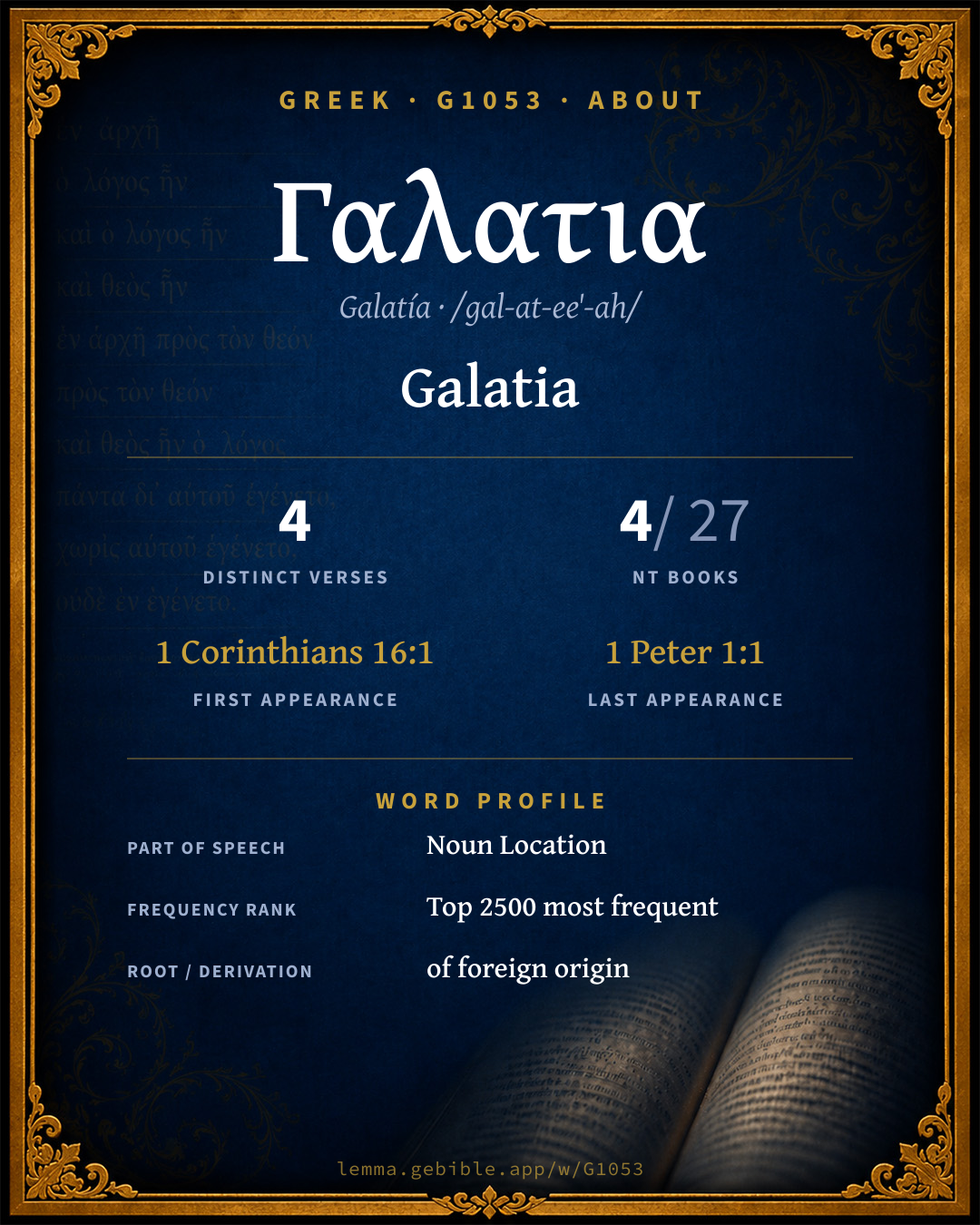
Γαλατία
Galatia
Thayer's lists 2 entries for ‘Galatia’ fuller range ↓
Full lexicon entry — Thayer's Greek Lexicon
From Thayer's Greek Lexicon
Where this word appears
Grammar key — what these labels mean
Part of speech
- Noun
- A naming word — a person, place, thing, or idea.
Case
- Genitive
- The case of source, possession, or “of” — answers “whose / from what.”
- Accusative
- The case of the direct object and of extent.
Gender
- Feminine
- Grammatically feminine.
Number
- Singular
- One.
Every verse where G1053 appears in the Book of 1 Corinthians — 1 distinct verse. Click any verse to open its interlinear word-by-word view. Verse text shown in the World English Bible for context — . Each verse’s Greek form is shown with its reference; the English is not keyword-highlighted, since the data carries no word-level English alignment. Use “Compare translations” on any verse to read it across multiple English versions. This concordance covers the Greek New Testament; Septuagint (Greek Old Testament) occurrences of this word are not indexed here.
1 Corinthians
About this entry
At a glance — auto-summarized from this page’s data, not written by a person. Every figure links to its source below. This summary describes the numbers; it doesn’t interpret them.
The Greek name Γαλατια centers on the idea of “Galatia.” It is rare — just 4 verses in the entire Greek New Testament. 1 Corinthians dominates its distribution — 1 of 4 verses. First canonically at 1 Corinthians 16:1, it enters the text early. For the data behind this summary, explore 4-verse concordance and the renderings breakdown below.
Gloss history
Strong's 1890 vs modern scholarship
About this word
Strong's G1053 catalogs a Greek word from the Greek New Testament.
These counts are not copied from any lexicon or concordance. They are computed here, from the morphology-tagged Greek New Testament. What Lemma adds →
- 4
- distinct verses
- The word appears in 4 distinct verses.
- 4 / 27
- NT books
- The word appears in 4 of 27 New Testament books.
- #1,877
- by frequency
- Top 2500 most frequent Greek words (rank 1,877 of 5,347 Greek words by occurrence).
View all 4 occurrences in the concordance →
Most concentrated in
- 1 Corinthians 1 verse 25%
- Galatians 1 verse 25%
- 2 Timothy 1 verse 25%
By section of the New Testament
By traditional corpus
Conventional, traditional groupings — biblical authorship is debated, so this is a traditional corpus grouping, not an authorship claim. Some books belong to more than one corpus (Luke is in both the Gospels and the Lukan corpus, and so on), so these shares overlap and need not total 100%. Each figure is a share of the word’s 4 distinct verses.
- Pauline corpus 3 verses · 75%
- General (Catholic) Epistles 1 verse · 25%
How translations render this word
Counts come from each version’s own published word-to-Strong’s tagging or interlinear alignment — an approximate guide to how each version renders this word, not a word-level alignment the data otherwise carries. Because each total is that version’s own tagged count, the per-version totals vary from one another and need not match the appearance or distinct-verse counts above. These counts may also differ from a printed concordance because Lemma counts each distinctly tagged rendering and does not collapse phrase taggings into a single head-word total. This is a fixed set of word-tagged versions (KJV, ASV, BSB, ULT) and does not change with the reading translation you choose elsewhere. Each version’s license is shown beside its name below (and on Sources).
- King James Version: Galatia 4×
- American Standard Version: Galatia 4×
- Berean Standard Bible: Galatia 4×
- unfoldingWord Literal Text: Galatia 4×
King James Version Public Domain
Renders G1053 across 4 tagged occurrences — most commonly:
American Standard Version Public Domain
Renders G1053 across 4 tagged occurrences — most commonly:
Berean Standard Bible Public Domain
Renders G1053 across 4 tagged occurrences — most commonly:
unfoldingWord Literal Text CC BY-SA 4.0
Renders G1053 across 4 tagged occurrences — most commonly:
Senses in Thayer's
The 2 senses Thayer's distinguishes for this word, in lexicon order (not ranked by frequency or importance). The full entry — with sub-senses — is in the Lexicon Entry tab.
- Galatia = "land of the Galli, Gauls"
- the Roman province of Galatia my be roughly described as the central region of the peninsula of Asia Minor…
Word origin
Origin: of foreign origin
Of foreign origin; Galatia a region of Asia : - Galatia.
— Strong’s Exhaustive Concordance (1890), public domain.
Forms in the corpus
The 2 distinct written forms G1053 takes in the Greek New Testament, most frequent first — each parse links to that case’s occurrences in the concordance.
| Form | Parsing | Example | Uses |
|---|---|---|---|
| Γαλατίας Galatías | Noun, Genitive, Singular, Feminine | 1 Corinthians 16:1 | 3 |
| Γαλλίαν Gallían | Noun, Accusative, Singular, Feminine | 2 Timothy 4:10 | 1 |
Same root — word family
Other Thayer's entries built from the same root as G1053, grouped by Strong’s listed origin. These share a root / origin per the lexicon — not necessarily a shared meaning. Each links to that word’s own entry.
Proper names from this root
People and places named from this root — a name, not an additional meaning of the word.
Compare all same-root words → 2 of the same-root words are proper names (people or places). They share a root, not necessarily a meaning.
Bible dictionary
Public-domain dictionary articles matched to this entry by name (Galatia). A biblical name can be shared by more than one person or place, so an article may treat several.
Easton's Bible Dictionary · M. G. Easton, 1897
Has been called the "Gallia" of the East, Roman writers calling its inhabitants Galli. They were an intermixture of Gauls and Greeks, and hence were called Gallo-Graeci, and the country Gallo-Graecia. The Galatians were in their origin a part of that great Celtic migration which invaded Macedonia about B.C. 280. They were invited by the king of Bithynia to cross over into Asia Minor to assist him in his wars. There they ultimately settled, and being strengthened by fresh accessions of the same clan from Europe, they overran Bithynia, and supported themselves by plundering neighbouring countries. They were great warriors, and hired themselves out as mercenary soldiers, sometimes fighting on both sides in the great battles of the times. They were at length brought under the power of Rome in B.C. 189, and Galatia became a Roman province B.C. 25.
This province of Galatia, within the limits of which these Celtic tribes were confined, was the central region of Asia Minor.
During his second missionary journey Paul, accompanied by Silas and Timothy (Acts 16:6), visited the "region of Galatia," where he was detained by sickness (Gal. 4:13), and had thus the longer opportunity of preaching to them the gospel. On his third journey he went over "all the country of Galatia and Phrygia in order" (Acts 18:23). Crescens was sent thither by Paul toward the close of his life (2 Tim. 4:10).
Smith's Bible Dictionary · William Smith, 1863
(land of the Galli, Gauls). The Roman province of Galatia may be roughly described as the central region of the peninsula of Asia Minor, bounded on the north by Bithynia and Paphlagonia; on the east by Pontus; on the south by Cappadocia and Lycaonia; on the west by Phrygia.--Encyc. Brit. It derived its name from the Gallic or Celtic tribes who, about 280 B.C., made an irruption into Macedonia and Thrace. It finally became a Roman province. The Galatia of the New Testament has really the "Gaul" of the East. The people have always been described as "susceptible of quick impressions and sudden changes, with a fickleness equal to their courage and enthusiasm, and a constant liability to that disunion which is the fruit of excessive vanity.--The Galatian churches were founded by Paul at his first visit, when he was detained among, them by sickness, (Galatians 4:13) during his second missionary journey, about A.D 51. He visited them again on his third missionary tour.
Hitchcock's Bible Names Dictionary · Roswell D. Hitchcock, 1869
white; the color of milk
Classic public-domain reference works; full attribution on Sources.