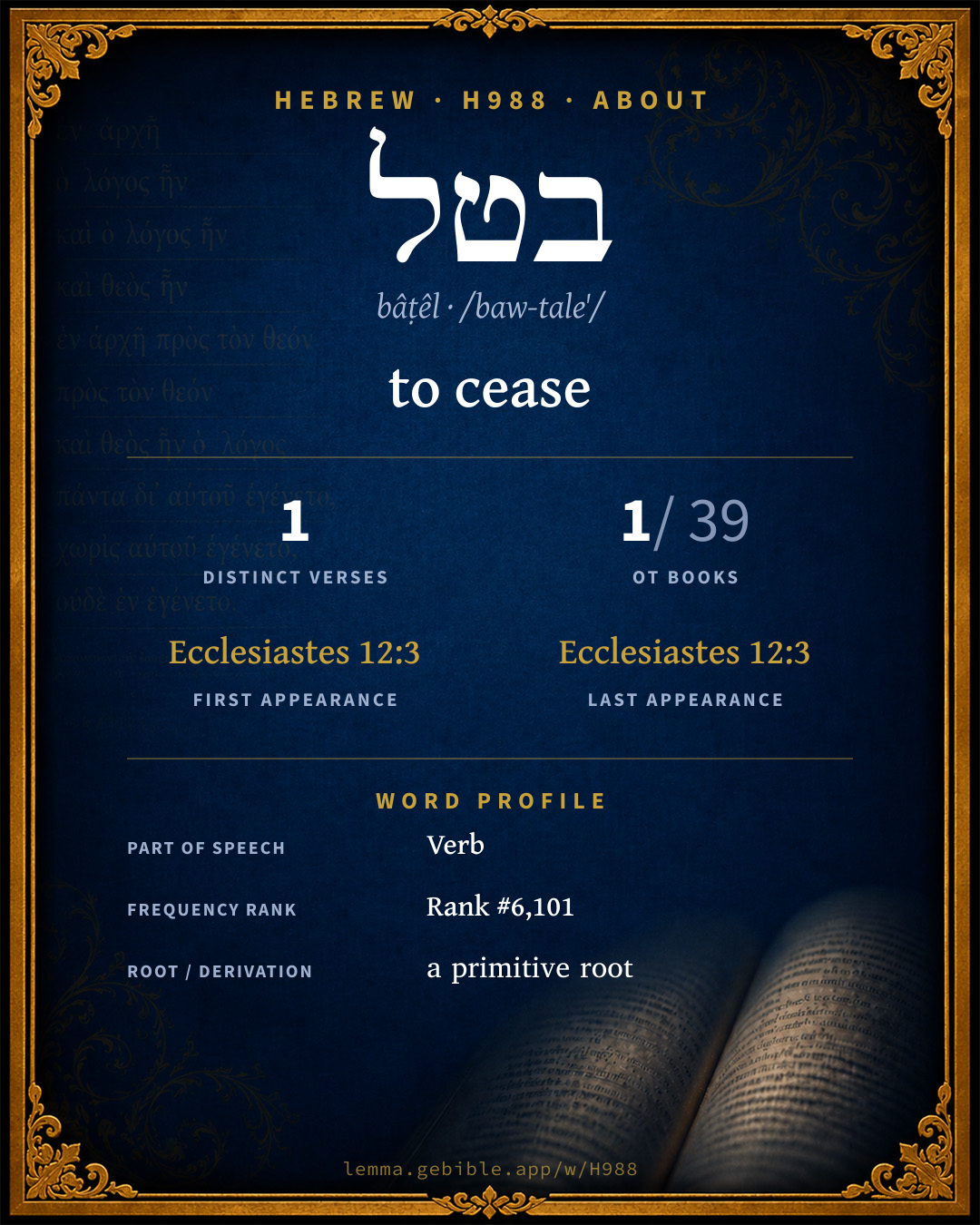
בָּטַל
to cease
‘to cease’ is one of 2 main senses fuller range ↓
Full lexicon entry — Brown-Driver-Briggs (BDB)
From Brown-Driver-Briggs (BDB)
Where this word appears
Grammar key — what these labels mean
Stem
- Qal
- The basic, simple active stem — the plain form of the verb (“he wrote”).
Form
- Sequential Perfect
- A perfect with prefixed waw continuing a preceding imperfect or command (waw-consecutive perfect).
Person
- 3rd Person
- The one spoken about (“he / she / it / they”).
Gender
- Common
- Either gender — not distinguished for this form.
Number
- Plural
- More than one (in Hebrew, generally three or more).
Every verse where H988 appears — 1 distinct verse across 1 book. Click any verse to open its interlinear word-by-word view. Verse text shown in the World English Bible for context — . Each verse’s Hebrew form is shown with its reference; the English is not keyword-highlighted, since the data carries no word-level English alignment. Use “Compare translations” on any verse to read it across multiple English versions. This concordance covers the Hebrew Bible; Septuagint (Greek Old Testament) occurrences are not indexed here.
Ecclesiastes 1 verse
About this entry
At a glance — auto-summarized from this page’s data, not written by a person. Every figure links to its source below. This summary describes the numbers; it doesn’t interpret them.
“to cease” is the headline sense of the Hebrew verb בטל (bâṭêl). It is rare — just 1 verse in the entire Hebrew Bible. It clusters heavily in Ecclesiastes, which alone accounts for 100% of its uses. It occurs only once, in Ecclesiastes 12:3. Lexicons map it across 2 senses. See the sense tree, 1-verse concordance, and the renderings breakdown below.
Gloss history
Strong's 1890 vs modern scholarship
About this word
Strong's H988 catalogs a Hebrew word from the Hebrew Old Testament.
These counts are not copied from any lexicon or concordance. They are computed here, from the morphology-tagged Hebrew Old Testament. What Lemma adds →
- 1
- distinct verses
- The word appears in 1 distinct verse.
- 1 / 39
- OT books
- The word appears in 1 of 39 Old Testament books.
- #6,101
- by frequency
- Rank #6,101 (rank 6,101 of 8,640 Hebrew words by occurrence).
View all 1 occurrence in the concordance →
Most concentrated in
- Ecclesiastes 1 verse 100%
By section of the Old Testament
By traditional corpus
Conventional, traditional groupings — biblical authorship is debated, so this is a traditional corpus grouping, not an authorship claim. Each share is this word’s portion of its verses in that division of the Hebrew canon. Each figure is a share of the word’s 1 distinct verse.
- Writings (Ketuvim) 1 verse · 100%
How translations render this word
Counts come from each version’s own published word-to-Strong’s tagging or interlinear alignment — an approximate guide to how each version renders this word, not a word-level alignment the data otherwise carries. Because each total is that version’s own tagged count, the per-version totals vary from one another and need not match the appearance or distinct-verse counts above. These counts may also differ from a printed concordance because Lemma counts each distinctly tagged rendering and does not collapse phrase taggings into a single head-word total. This is a fixed set of word-tagged versions (KJV, ASV, BSB, ULT) and does not change with the reading translation you choose elsewhere. Each version’s license is shown beside its name below (and on Sources).
- King James Version: Cease 1×
- American Standard Version: Grinders cease 1×
- Berean Standard Bible: Cease 1×
- unfoldingWord Literal Text: And 1×, Cease 1×
King James Version Public Domain
Renders H988 across 1 tagged occurrence — most commonly:
American Standard Version Public Domain
Renders H988 across 1 tagged occurrence — most commonly:
Berean Standard Bible Public Domain
Renders H988 across 1 tagged occurrence — most commonly:
unfoldingWord Literal Text CC BY-SA 4.0
Renders H988 across 2 tagged occurrences — most commonly:
Senses in BDB
The 2 senses BDB distinguishes for this word, in lexicon order (not ranked by frequency or importance). The full entry — with sub-senses — is in the Lexicon Entry tab.
- to cease
- (Qal) to cease
Word origin
Origin: a primitive root
Jastrow Dictionary
A second Hebrew/Aramaic lexicon for comparison, covering Aramaic and post-biblical (Talmudic, Targumic, Midrashic) usage that the biblical-Hebrew BDB does not. Matched by lemma rather than by Strong’s number, so a lemma may carry more than one Jastrow headword (shown separately below), and the entries cover usage well beyond the Bible.
בָּטֵל I
- v. בטי) [to be hollow];
- 1. to be void, abolished, suspended; to cease to exist. Keth. 103ᵇ בָּטְלָה קדושה sanctity of life ceased; [oth. opin.: the levitical law concerning the contact with a corpse was suspended in favor of Rabbi; v. Tosaf. a. l.]. Ab. V, 16 ב׳ דבר בְּטֵלָה וכ׳ as soon as the (sensual) attraction disappears, love will disappear. Ib. 21 as if dead ועבר וב׳ מן העולם and passed away and disappeared from this world. Y. Meg. I, 70ᵈ top, a. e. בטלה מגלת תענית the Scroll of Fasts has been abolished (the festive commemorations enumerated therein are no more observed). Sot. IX, 9 (47ᵃ); a. fr.
- 2. to rest from labor, be at ease, be idle. Ab. IV, 10 אם בָּטַלְתָּ מן וכ׳ if thou choosest not to study the law, there will be many disturbances (excuses) to assist thee. Ib. I, 5 בּוֹטֵל מד"ת he neglects the study of the Law; a. fr.
- 1. to be abolished, suspended. Y. Meg. I, 70ᵈ bot. עתידין לִיבָּטֵל (= לְהִיבָּטֵל) shall in future be abolished (neglected). Gitt. 32ᵃ, v. infra.
- 2. to be excused, be exempt. Ib. II, 16 thou art not a free man להִבָּטֵל ממנה so as to be exempt from life’s duties.
- 3. to remain single. Gitt. IV, 5 (41ᵇ) יִבָּטֵל shall he never marry?
- 1. to abolish, suspend, cancel, undo, neglect. Ab. II, 4 בַּטֵּל רצונך וכ׳ set aside thy will for the sake of the Lord’s will, in order that He may set aside the will of others (euphem. for His will) for the sake of thy will (withdraw evil decrees at thy prayer). Ib. IV, 9 המְבַטֵּל וכ׳ he who neglects the study of the Law on account of his wealth. Sot. IX, 10 (47ᵃ) אף הוא בִּטֵּל את המעוררין he also abolished (the custom of) the wakers, v. עָרַר. Sabb. 63ᵃ מְבַטְּלָהּ he (the observer of the Law) will cancel it (avert God’s evil decree). Mekh. B’shall., Amalek, 2, v. אִיפָּטִיקוֹס. Macc. 24ᵃ. Ab. Zar. IV, 7 למה אינו מְבַטְּלָהּ why does He not destroy it (the objects of idol worship)?—Gitt. IV, 1 שוב אינו יכול לבַטְּלוֹ he can no longer annul it (his letter of divorce). Ib. 2 in former times a man could summon a court in a strange place ובִּטְּלוֹ and declare it (the letter of divorce which he had sent off) void. Ib. 32ᵇ אתי דיבור ומבטל דיבור a word (declaration) comes and cancels a word.—Ab. Zar. IV, 4 (42ᵇ) an idolator (gentile) מבטל אליל שלו וכ׳ may (by mutilation &c.) cancel his own or his neigbor’s idol (so that it is no longer subject to the law forbidding Jews to derive any benefits from idolatrous paraphernalia), but an Israelite cannot &c. Ib. המב׳ אליל ב׳ וכ׳ in cancelling an idol, one has at the same time cancelled its attachments; a. fr.—ב׳ רשות to resign possession, a legal fiction by which the carrying of objects on the Sabbath from one’s own place to one common to several persons, may be permitted. Erub. VI, 7 מְבַטֵּל את רשותו he (the brother who forgot to lay the Erub, v. עֵירוּב) must resign his share in the common property. Ib. 68ᵇ מבטלין וחוזרין ומב׳ you may resign your share to your neighbor, and then he may resign to you; a. fr.—ב׳ חמץ to renounce (by declaration) the possession of anything leavened that may have remained undiscovered in one’s possession. Pes. 6ᵇ הבודק צריך שיְבַטֵּל after one has searched the house for leavened things, he must renounce (whatever he may have failed to find); a. fr.—Part. pass. מְבוּטָּל, f. מְבוּטֶּלֶת. Erub. 69ᵇ רשותי מב׳ לך my possession be resigned to thee (for Sabbath purposes). Gitt. 32ᵃ if a recipient says, מתנה זו מב׳ ‘this donation be void’, תִּיבָּטֵל ‘shall be void’, opp. to בְּטֵלָה היא ‘is a void one’, i.e. has been annulled.—Eduy. I, 5; Gitt. 36ᵇ, a. fr. אין ב"ד יכול לבַ׳ וכ׳ no court can repeal (overrule) the decisions of another court, unless &c.
- 2. to neutralize an admixture of forbidden food &c. in a certain quantity. Ḥull. 108ᵃ ושאינו מינו … ומבטלו and the portion of the mixture which is not its kind is prevailing and neutralizes the forbidden portion (as if did not exist at all); a. fr.
- 3. to disturb, cause suspense, interfere with. Erub. 63ᵇ; Meg. 3ᵃ בִּיטַּלְתֶּם וכ׳ ye interfered with the daily offering; a. fr.—Ber. II, 5 לבטל ממני וכ׳ to suspend (shake off) the yoke of heavenly government even one minute.
- to cause interruption, to order suspension. Succ. V, 5 להַבְטִיל את העם וכ׳ to cause the people to cease working.
- to be interrupted &c., v. Nif.—Tan. d’be El. I, 5; II, 3.
בְּטֵל
- ; 1) as h. Kal 1). Targ. Lam. V, 15; a. e.—Sot. 33ᵃ בטילת עבידתא וכ׳ the decree enforcing idol worship in the Temple has been repealed. Meg. Taan. XI on the twenty second (of Shebat) ב׳ עבידתא was the decree &c. revoked. Sabb. 139ᵃ, Snh. 98ᵃ אי בטלי וכ׳; v. אַמְגּוֹשָׁא. R. Hash. 18ᵇ בטילת אדכרתא (Meg. Taan. VII אתנטילת, read אתב׳), v. אַדְכַּרְתָּא; a. fr.—2) as h. Kal 2). Targ. Y. Ex. XVII, 1 [read:] דבְטִילוּ אידיהון when their hands were lazy &c.—Part. pass. בָּטִיל annulled; neutralized (in a larger quantity, v. preced. Pi.). Ḥull. 100ᵃ, a. fr. (in Hebr. phraseol.) מין במינו לא ב׳ in a mixture of homogeneous things (of which one is forbidden) the rule of neutralization by quantity takes no effect. Ib. 99ᵃ ברובא ב׳ it is neutralized in any larger quantity (than the forbidden ingredient); a. fr.—Ib. 100ᵃ top ותבטיל, v. Ithpe.
- as h. Pi. Targ. Ps. XXXIII, 10 (some ed. incorr. בְּטִיל); a. e.—Erub. 66ᵇ למאן נִיבַטֵּיל to whom should he resign his right of usage (for Sabbath purposes)? לִיבַטֵּיל וכ׳ shall he resign &c.? Ib. 67ᵃ בַּטּוּלֵי … מְבַטֵיל. Pes. 6ᵇ לְבַטְּלֵיה let him renounce it (the leavened thing). Ib. וניבטליה בארבע let him renounce it at four hours of the day. Gitt. 36ᵇ אֲבַטְּלִינֵיה I would repeal it (that law). Ib. 32ᵃ דבטולי בטליה that he revoked it (the letter of divorce); a. fr.
- 1. = Pa. Targ. Y. Gen. VI, 7 1) = Pa. Targ. Y. Gen. VI, 7 אַבְטִיל I will undo (h. text אמחה); a. e.
- 2. = h. Hif. Targ. Is. XXX, 11 אַבְטְלוּנָא מ־ make ye us free from tradition.
- , contr. אִיבְּטִיל.
- 1. to be abolished, removed, undone. Targ. Job XVII, 11; a. fr.—Gitt. 32ᵃ; 32ᵇ בָּטֵל has two meanings משמע דבטל ומשמע דלִיבְּטִיל it may mean ‘it is void’, and may mean ‘be it declared void’. Ḥull. 100ᵃ ותבְּטִיל ברובא (or ותִבְטִיל) let it be neutralized in the larger mixture; (why is it not &c.?)
- 2. to be disturbed, to be forced to be idle. Targ. Koh. XII, 3; a. e.
בָּטֵל II
- (preced. ws.)
- 1. null, void; vain. Gitt. IV, 1 ב׳ הוא is void (revoked); v. בְּטֵל Ithpe.; a. fr.—Pl. בְּטֵלִים, בְּטֵלִין, בְּטֵי׳.—דברים ב׳ vanities, absurdities. Ab. Zar. 16ᵇ; a. fr.
- 2. idle, unemployed, not needed. Snh. 21ᵃ one horse והוא ב׳ when not needed (for war). Koh. R. to VI, 8.—Pl. as supra. Y. Meg. I, 70ᵇ bot. עשרה בטילין … לביה"כ (where there are) ten men at leisure for attending Synagogue, v. בַּטְלָן. Ber. 16ᵃ והוא שב׳ ממלאכתן provided they stop working. Ib. 17ᵇ ת"ח ב׳ scholars have to abstain from work; a. fr.—Fem. בְּטֵלָה, בְּטֵילָה. Ab. V, 16, v. בָּטֵל I. Gitt. 32ᵃ, v. בָּטֵל I, Pi.; a. fr.
טַל
- [hanging drop, cmp. טִלְטוּלַיָּא,] dew. Taan. 3ᵃ בטל וברוחות וכ׳ as to mentioning dew and winds in the prayer &c.—Ib. 3ᵇ טל דברכה a fructifying dew; a. fr.—Pl. טְלָלִים, טְלָלֵין. Ḥag. 12ᵇ עליית ט׳ the upper chamber (store) of dews, v. אֲגָלִים. Lev. R. s. 28 ט׳ קשים injurious dews; a. fr.
טַל ²
- Targ. Is. XVIII, 4. Targ. O. Gen. XXVII, 28; a. fr.—Pl. טַלִּין. Targ. Y. Gen. l. c.; a. e.
A Dictionary of the Targumim, the Talmud Babli and Yerushalmi, and the Midrashic Literature (Marcus Jastrow; London, Luzac, 1903) — Public Domain. Digitized via Sefaria. Digitized via Sefaria. Full attribution on Sources.
Same root — word family
Other BDB entries built from the same root as H988, grouped by Strong’s listed origin. These share a root / origin per the lexicon — not necessarily a shared meaning. Each links to that word’s own entry.
Derived from this word
Compare all same-root words → They share a root, not necessarily a meaning.
Septuagint verse parallels
This word appears in 1 verse that also exists in the Greek Old Testament (Septuagint), out of the 1 Hebrew verse it occurs in. You can read those verses in Greek by switching the Old Testament edition to the Septuagint.
Read these verses in the Septuagint
This is a verse-level parallel only — the same verses exist in both the Hebrew and Greek Old Testaments. No word-level Hebrew↔Greek correspondence is claimed: the data carries no such alignment, so no Greek word is shown as this Hebrew word’s translation. Coverage is not total — the Septuagint omits the deuterocanon and renumbers the Psalms, so some Hebrew verses have no direct Greek parallel.