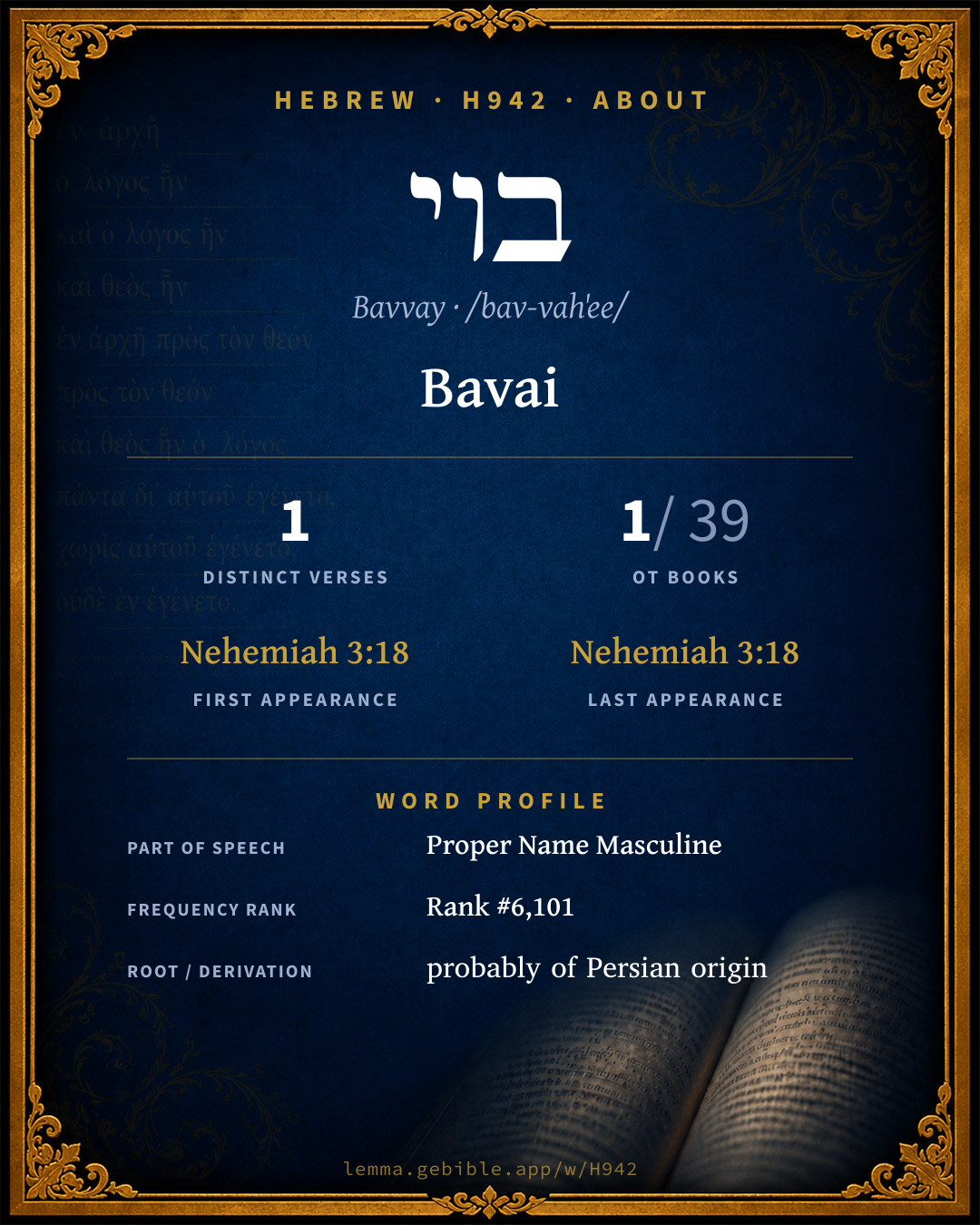
בַּוַּי
Bavai
BDB lists 2 entries for ‘Bavai’ fuller range ↓
Full lexicon entry — Brown-Driver-Briggs (BDB)
From Brown-Driver-Briggs (BDB)
Where this word appears
Grammar key — what these labels mean
Part of speech
- Noun
- A naming word — a person, place, thing, or idea.
Noun type
- Proper
- A name of a specific person, place, or people (e.g. Abraham, Zion, Israel).
Every verse where H942 appears — 1 distinct verse across 1 book. Click any verse to open its interlinear word-by-word view. Verse text shown in the World English Bible for context — . Each verse’s Hebrew form is shown with its reference; the English is not keyword-highlighted, since the data carries no word-level English alignment. Use “Compare translations” on any verse to read it across multiple English versions. This concordance covers the Hebrew Bible; Septuagint (Greek Old Testament) occurrences are not indexed here.
Nehemiah 1 verse
About this entry
At a glance — auto-summarized from this page’s data, not written by a person. Every figure links to its source below. This summary describes the numbers; it doesn’t interpret them.
The Hebrew name בוי centers on the idea of “Bavai.” The Hebrew Bible uses it only 1 verse. Nehemiah dominates its distribution — 1 of 1 verses. Found nowhere else but Nehemiah 3:18. For the data behind this summary, explore 1-verse concordance and the renderings breakdown below.
Gloss history
Strong's 1890 vs modern scholarship
About this word
Strong's H942 catalogs a Hebrew word from the Hebrew Old Testament.
These counts are not copied from any lexicon or concordance. They are computed here, from the morphology-tagged Hebrew Old Testament. What Lemma adds →
- 1
- distinct verses
- The word appears in 1 distinct verse.
- 1 / 39
- OT books
- The word appears in 1 of 39 Old Testament books.
- #6,101
- by frequency
- Rank #6,101 (rank 6,101 of 8,640 Hebrew words by occurrence).
View all 1 occurrence in the concordance →
Most concentrated in
- Nehemiah 1 verse 100%
By section of the Old Testament
By traditional corpus
Conventional, traditional groupings — biblical authorship is debated, so this is a traditional corpus grouping, not an authorship claim. Each share is this word’s portion of its verses in that division of the Hebrew canon. Each figure is a share of the word’s 1 distinct verse.
- Writings (Ketuvim) 1 verse · 100%
How translations render this word
Counts come from each version’s own published word-to-Strong’s tagging or interlinear alignment — an approximate guide to how each version renders this word, not a word-level alignment the data otherwise carries. Because each total is that version’s own tagged count, the per-version totals vary from one another and need not match the appearance or distinct-verse counts above. These counts may also differ from a printed concordance because Lemma counts each distinctly tagged rendering and does not collapse phrase taggings into a single head-word total. This is a fixed set of word-tagged versions (KJV, ASV, BSB, ULT) and does not change with the reading translation you choose elsewhere. Each version’s license is shown beside its name below (and on Sources).
- King James Version: Bavai 1×
- American Standard Version: Bavvai 1×
- Berean Standard Bible: Under binnui 1×
- unfoldingWord Literal Text: Binnui 1×
King James Version Public Domain
Renders H942 across 1 tagged occurrence — most commonly:
American Standard Version Public Domain
Renders H942 across 1 tagged occurrence — most commonly:
Berean Standard Bible Public Domain
Renders H942 across 1 tagged occurrence — most commonly:
unfoldingWord Literal Text CC BY-SA 4.0
Renders H942 across 1 tagged occurrence — most commonly:
Senses in BDB
The 2 senses BDB distinguishes for this word, in lexicon order (not ranked by frequency or importance). The full entry — with sub-senses — is in the Lexicon Entry tab.
- Bavai = "my goings"
- a rebuilder of Jerusalem's walls in Nehemiah's time
Word origin
n.pr.m. a Jew of Nehem.’s time Ne 3:18 = בִּנּוּי v 24 which prob. read also v 18 (𝔊 Βεδει, Βενει, Βεζερ); cf. further SmListen 12.
— Brown-Driver-Briggs (Oxford 1906, public domain), digitized via Sefaria, supplemented by the OpenScriptures HebrewLexicon (CC BY 4.0). See Sources.
Origin: probably of Persian origin
Jastrow Dictionary
A second Hebrew/Aramaic lexicon for comparison, covering Aramaic and post-biblical (Talmudic, Targumic, Midrashic) usage that the biblical-Hebrew BDB does not. Matched by lemma rather than by Strong’s number, so a lemma may carry more than one Jastrow headword (shown separately below), and the entries cover usage well beyond the Bible.
בְּזֵי ²
- (= בְּזַע q. v.) to break, divide. Part. pass. Pes. 110ᵃ דיקולא בָזְיָיא ed. (Ms. M. 2 דיקולי בזיין pl., v. Rashi a. l. a. Rabb. D. S. a. l. note) a broken basket.—*Num. R. s. 12 דהוה בזא וכ׳ for he breaks into (compels to interrupt) the lessons of the day (as a ref. to קטב, v. בְּזַז).
- to divide, change off. B. Bath. 37ᵃ דבוִּי בַּזּוּיֵי Ms. M. (ed. דבאזי באזוזי, read with Rashi דבזְּאֵי בזויי or בּזּוּאֵי; v. Rabb. D. S. a. l. note) he divided the usufruct of each year betw. the trees of each division of the orchard (so as to have actually been in undisturbed possession of the entire orchard for three consecutive years.
- to be divided, cut apart. Targ. Job X, 1 אתבזיית Ms. Var. (ed. Vien. אתגזרת, Ms. אתכזרית; h. text נקטה).
A Dictionary of the Targumim, the Talmud Babli and Yerushalmi, and the Midrashic Literature (Marcus Jastrow; London, Luzac, 1903) — Public Domain. Digitized via Sefaria. Digitized via Sefaria. Full attribution on Sources.
Bible dictionary
Public-domain dictionary articles matched to this entry by name (Bavai). A biblical name can be shared by more than one person or place, so an article may treat several.
Smith's Bible Dictionary · William Smith, 1863
son of Henadad, ruler of the district of Keilah in the time of Nehemiah. (Nehemiah 3:18) (B.C. 446.)
Classic public-domain reference works; full attribution on Sources.