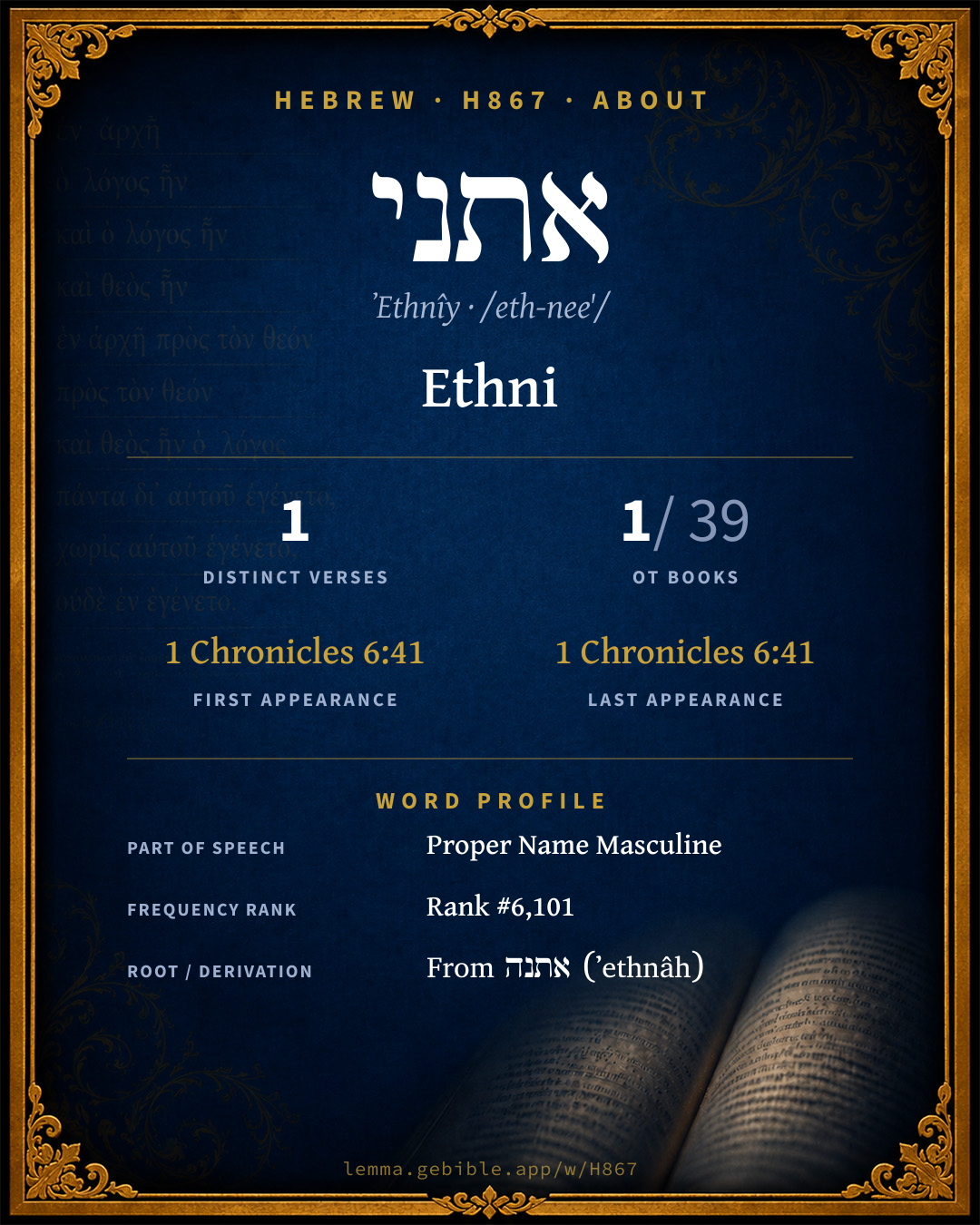
אֶתְנִי
Ethni
BDB lists 2 entries for ‘Ethni’ fuller range ↓
Full lexicon entry — Brown-Driver-Briggs (BDB)
From Brown-Driver-Briggs (BDB)
Where this word appears
Grammar key — what these labels mean
Part of speech
- Noun
- A naming word — a person, place, thing, or idea.
Noun type
- Proper
- A name of a specific person, place, or people (e.g. Abraham, Zion, Israel).
Every verse where H867 appears — 1 distinct verse across 1 book. Click any verse to open its interlinear word-by-word view. Verse text shown in the World English Bible for context — . Each verse’s Hebrew form is shown with its reference; the English is not keyword-highlighted, since the data carries no word-level English alignment. Use “Compare translations” on any verse to read it across multiple English versions. This concordance covers the Hebrew Bible; Septuagint (Greek Old Testament) occurrences are not indexed here.
1 Chronicles 1 verse
About this entry
At a glance — auto-summarized from this page’s data, not written by a person. Every figure links to its source below. This summary describes the numbers; it doesn’t interpret them.
At its core, אתני (ʼEthnîy) means “Ethni.” The Hebrew Bible uses it only 1 verse. Its uses cluster heavily in 1 Chronicles (100% of all occurrences). Its lone occurrence is 1 Chronicles 6:41. Each statement above links to its evidence; the full detail follows below.
Gloss history
Strong's 1890 vs modern scholarship
About this word
Strong's H867 catalogs a Hebrew word from the Hebrew Old Testament.
These counts are not copied from any lexicon or concordance. They are computed here, from the morphology-tagged Hebrew Old Testament. What Lemma adds →
- 1
- distinct verses
- The word appears in 1 distinct verse.
- 1 / 39
- OT books
- The word appears in 1 of 39 Old Testament books.
- #6,101
- by frequency
- Rank #6,101 (rank 6,101 of 8,640 Hebrew words by occurrence).
View all 1 occurrence in the concordance →
Most concentrated in
- 1 Chronicles 1 verse 100%
By section of the Old Testament
By traditional corpus
Conventional, traditional groupings — biblical authorship is debated, so this is a traditional corpus grouping, not an authorship claim. Each share is this word’s portion of its verses in that division of the Hebrew canon. Each figure is a share of the word’s 1 distinct verse.
- Writings (Ketuvim) 1 verse · 100%
How translations render this word
Counts come from each version’s own published word-to-Strong’s tagging or interlinear alignment — an approximate guide to how each version renders this word, not a word-level alignment the data otherwise carries. Because each total is that version’s own tagged count, the per-version totals vary from one another and need not match the appearance or distinct-verse counts above. These counts may also differ from a printed concordance because Lemma counts each distinctly tagged rendering and does not collapse phrase taggings into a single head-word total. This is a fixed set of word-tagged versions (KJV, ASV, BSB, ULT) and does not change with the reading translation you choose elsewhere. Each version’s license is shown beside its name below (and on Sources).
- King James Version: Ethni 1×
- American Standard Version: Ethni 1×
- Berean Standard Bible: Ethni 1×
- unfoldingWord Literal Text: Ethni 1×
King James Version Public Domain
Renders H867 across 1 tagged occurrence — most commonly:
American Standard Version Public Domain
Renders H867 across 1 tagged occurrence — most commonly:
Berean Standard Bible Public Domain
Renders H867 across 1 tagged occurrence — most commonly:
unfoldingWord Literal Text CC BY-SA 4.0
Renders H867 across 1 tagged occurrence — most commonly:
Senses in BDB
The 2 senses BDB distinguishes for this word, in lexicon order (not ranked by frequency or importance). The full entry — with sub-senses — is in the Lexicon Entry tab.
- Ethni = "my hire"
- an ancestor of Asaph
Word origin
n.pr.m. an ancestor of Asaph 1 Ch 6:26 apparently identical with יְאָֽתְרַי v 6.
— Brown-Driver-Briggs (Oxford 1906, public domain), digitized via Sefaria, supplemented by the OpenScriptures HebrewLexicon (CC BY 4.0). See Sources.
Derived from אתנה (ʼethnâh) (H866) — hire.
Jastrow Dictionary
A second Hebrew/Aramaic lexicon for comparison, covering Aramaic and post-biblical (Talmudic, Targumic, Midrashic) usage that the biblical-Hebrew BDB does not. Matched by lemma rather than by Strong’s number, so a lemma may carry more than one Jastrow headword (shown separately below), and the entries cover usage well beyond the Bible.
אַתְנָא
- she-ass. Targ. Num. XXII, 21; a. fr.—Pl. אַתְנָן, אַתְנֵי (אתניי), אֲתָנַיָּא (אַתָּ׳). Targ. Gen. XXXII, 15. Targ. I Sam. IX, 3; a. e.
תְּנֵי
- 1. to repeat, do a second time. Targ. II Sam. XX, 10. Targ. I Sam. XXVI, 8 (ed. Wil. אֶשְׁנֵי). Targ. I Kings XVIII, 34. Targ. Job XXIX, 22 (ed. Wil. Pa.). Targ. Prov. XXVI, 11 דתָאנֵי ed. Lag. (ed. Wil. דתָנֵי); a. e.
- 2. to tell, relate; to teach. Targ. Ps. L, 6. Ib. XLIX, 14 (Ms. Pa.). Ib. CXLVII, 19. Targ. Y. Deut. V, 5 למִתְנְיָא (ed. Vien. למִתַּנְיָא Ithpe.); a. fr.—Esp. (denom. of מתניתא) to teach or study Mishnah or Boraitha; in gen. to report a tradition, teach, study. Erub. 36ᵇ ליתא למתניתן מדתָנֵי איו דת׳ איו וכ׳ our Mishnah is no authority, as it is contradicted by what Ayo teaches, for Ayo taught &c. Yoma 27ᵇ והא אנן לא תְּנָן הכי but we have not so learned in the Mishnah! Ib. הך … קתני הך … לא קתני the Mishnah speaks of that which, if neglected, can be remedied; that which cannot be remedied it does not mention. Sabb. 2ᵃ תנן התם וכ׳ there (in the Mishnah, Shebu. I, 1) we read &c. Ib.ᵇ מאי שנא הכא דת׳ … ומ"ש התם דת׳ וכ׳ why does the Mishnah here read …, and there &c.? Ber. 8ᵇ תְּנִינָא וכ׳ we are taught in the Mishnah &c. Ib. 2ᵃ דקת׳ מאימתי, v. קָאֵי. Ib. כדתַנְיָא as it is stated (in the Boraitha). Yoma 26ᵃ לכדתניא (the word peder is needed) to intimate the law taught in the Boraitha. Ib. והתניא וכ׳ but has it not been taught &c.?; ib. 28ᵃ, a. fr.—Ber. 28ᵃ, a. fr. והתניא and so it has been taught.—Y. Ḥall. II, 58ᶜ ר׳ יונה ת׳ דר"ש וכ׳ R. Jonah taught (and adopted) the opinion of R. S. b. J.—Y. Kidd. I, 58ᶜ bot. תמן תנינן there (in a Mishnah) we read &c. Meg. 24ᵇ לימא תנינן להא דתָנוּ רבנן וכ׳ shall we say that we are here taught that which the Rabbis have taught &c. (i.e. is this a confirmation of what &c.)?—Ber. 13ᵃ, a. fr. תָּנוּ רבנן (abbrev. ת"ר) the Rabbis have taught (introducing a discussion); a. v. fr.—[In Talm. Babli תנן refers to Mishnah, תניא to Boraitha.]
- 1. to change. Targ. Job XIV, 20.
- 2. to tell, relate; to teach. Targ. Y. Gen. XXII, 20. Ib. XXXII, 6. Targ. Ps. XXX, 10 הַיְתַנּוּן ed. Lag. (Ms. אפשר דיתנון; ed. Wil. החויתון; oth. ed. החויתינון, corr. acc.). Targ. II Chr. IX, 2; a. fr.—Ber. 49ᵃ ברכת … וחַנּוּיֵי קא מְתַנִּינָא Ms. M. (or מַתְנִינָא Af.; ed. מְתַנִּינָן or מַתְנִינָן) I have not learned the benediction over food, and shall I teach (Mishnah)?
- 1. to stipulate, agree, make a condition. Targ. Y. Ex. IV, 24.—Keth. 3ᵃ כיון דאיבעי ליה לאַתְנוּיֵי ולא א׳ וכ׳ because he ought to have made it a condition (not to count so common an obstacle as the absence of a ferry), and he did not make it, he has to take the consequences. Shebu. 11ᵇ וכי קיימי ב"ד ומַתְנוּ משום עורה Ms. M. (ed. וקיימי ב"ד ומתנו אדעתא דעורה) did the court establish a general law (that dead sacrificial animals need not be redeemed,) and stipulate that it must be redeemed for the value of its skin?; a. e.
- 2. to relate, teach. Ber. 8ᵇ איכא דמַתְנֵי להא וכ׳ some one quoted that opinion of R. A. bar Ḥ. with reference to what has been taught, ‘R. S. b. Y. says &c.’ Keth. 17ᵃ sq. וה"מ למאן דקרי ותני אבל למאן דמתני וכ׳ this has been said concerning the funeral only of one who was versed in Bible and a student of Mishnah, but as regards one who was a teacher of Mishnah, there is no limit (of attendance at his funeral). Ḥull. 48ᵃ הא … אתון אהא מַתְנִיתוּן לה אנן אדרבא מַתְנִינָן לה you report that action of R. N. … in connection with this, we report it in connection with what Raba said &c.; a. fr.
- 1. to be repeated. Targ. Gen. XLI, 32. Targ. Y. Deut. XXVII, 26.
- 2. to be told, reported. Targ. Y. Gen. XXXVIII, 13 (not ואַתְ׳). Targ. Y. II ib. XLIV, 18 (ed. Vien. אֲתַנֵּי, corr. acc.); a. e.
תְּנֵי II
- (cmp. שנן) to be pointed, sharp.
- to sharpen, to speak sharp words. Targ. Ps. CXL, 4 מְתַנְּיָן בלישנ׳ (prob. to be read: לישנ׳; h. text שננו לשונם).
- to be sharpened. Targ. Ez. XXI, 14 (h. text הוחדה).
A Dictionary of the Targumim, the Talmud Babli and Yerushalmi, and the Midrashic Literature (Marcus Jastrow; London, Luzac, 1903) — Public Domain. Digitized via Sefaria. Digitized via Sefaria. Full attribution on Sources.
Same root — word family
Other BDB entries built from the same root as H867, grouped by Strong’s listed origin. These share a root / origin per the lexicon — not necessarily a shared meaning. Each links to that word’s own entry.
Derives from
Shares the same root
Compare all same-root words → They share a root, not necessarily a meaning.
Bible dictionary
Public-domain dictionary articles matched to this entry by name (Ethni). A biblical name can be shared by more than one person or place, so an article may treat several.
Smith's Bible Dictionary · William Smith, 1863
(munificent), a Gershonite Levite. (1 Chronicles 6:41)
Hitchcock's Bible Names Dictionary · Roswell D. Hitchcock, 1869
strong
Classic public-domain reference works; full attribution on Sources.
Septuagint verse parallels
This word appears in 1 verse that also exists in the Greek Old Testament (Septuagint), out of the 1 Hebrew verse it occurs in. You can read those verses in Greek by switching the Old Testament edition to the Septuagint.
Read these verses in the Septuagint
This is a verse-level parallel only — the same verses exist in both the Hebrew and Greek Old Testaments. No word-level Hebrew↔Greek correspondence is claimed: the data carries no such alignment, so no Greek word is shown as this Hebrew word’s translation. Coverage is not total — the Septuagint omits the deuterocanon and renumbers the Psalms, so some Hebrew verses have no direct Greek parallel.