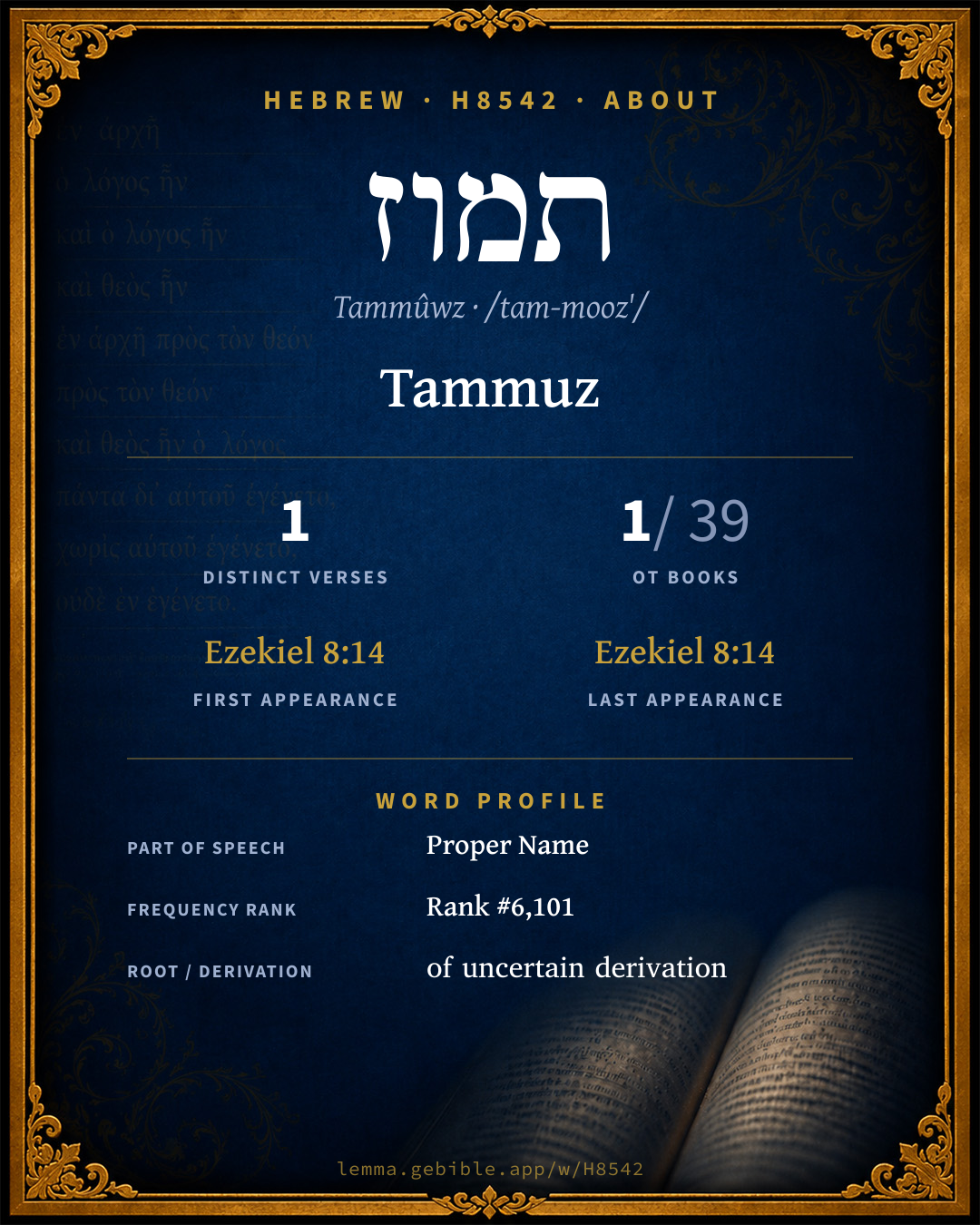
תַּמּוּז
Tammuz
BDB lists 2 entries for ‘Tammuz’ fuller range ↓
Full lexicon entry — Brown-Driver-Briggs (BDB)
From Brown-Driver-Briggs (BDB)
Where this word appears
Grammar key — what these labels mean
Noun type
- Proper
- A name of a specific person, place, or people (e.g. Abraham, Zion, Israel).
Every verse where H8542 appears — 1 distinct verse across 1 book. Click any verse to open its interlinear word-by-word view. Verse text shown in the World English Bible for context — . Each verse’s Hebrew form is shown with its reference; the English is not keyword-highlighted, since the data carries no word-level English alignment. Use “Compare translations” on any verse to read it across multiple English versions. This concordance covers the Hebrew Bible; Septuagint (Greek Old Testament) occurrences are not indexed here.
Ezekiel 1 verse
About this entry
At a glance — auto-summarized from this page’s data, not written by a person. Every figure links to its source below. This summary describes the numbers; it doesn’t interpret them.
תמוז (Tammûwz) is a Hebrew name most often rendered “Tammuz.” A scarce word — 1 verse in all of the Hebrew Bible. Ezekiel dominates its distribution — 1 of 1 verses. Found nowhere else but Ezekiel 8:14. For the data behind this summary, explore 1-verse concordance and the renderings breakdown below.
Gloss history
Strong's 1890 vs modern scholarship
About this word
Strong's H8542 catalogs a Hebrew word from the Hebrew Old Testament.
These counts are not copied from any lexicon or concordance. They are computed here, from the morphology-tagged Hebrew Old Testament. What Lemma adds →
- 1
- distinct verses
- The word appears in 1 distinct verse.
- 1 / 39
- OT books
- The word appears in 1 of 39 Old Testament books.
- #6,101
- by frequency
- Rank #6,101 (rank 6,101 of 8,640 Hebrew words by occurrence).
View all 1 occurrence in the concordance →
Most concentrated in
- Ezekiel 1 verse 100%
By section of the Old Testament
By traditional corpus
Conventional, traditional groupings — biblical authorship is debated, so this is a traditional corpus grouping, not an authorship claim. Each share is this word’s portion of its verses in that division of the Hebrew canon. Each figure is a share of the word’s 1 distinct verse.
- Prophets (Nevi'im) 1 verse · 100%
How translations render this word
Counts come from each version’s own published word-to-Strong’s tagging or interlinear alignment — an approximate guide to how each version renders this word, not a word-level alignment the data otherwise carries. Because each total is that version’s own tagged count, the per-version totals vary from one another and need not match the appearance or distinct-verse counts above. These counts may also differ from a printed concordance because Lemma counts each distinctly tagged rendering and does not collapse phrase taggings into a single head-word total. This is a fixed set of word-tagged versions (KJV, ASV, BSB, ULT) and does not change with the reading translation you choose elsewhere. Each version’s license is shown beside its name below (and on Sources).
- King James Version: Tammuz 1×
- American Standard Version: Tammuz 1×
- Berean Standard Bible: Tammuz 1×
- unfoldingWord Literal Text: Tammuz 1×
King James Version Public Domain
Renders H8542 across 1 tagged occurrence — most commonly:
American Standard Version Public Domain
Renders H8542 across 1 tagged occurrence — most commonly:
Berean Standard Bible Public Domain
Renders H8542 across 1 tagged occurrence — most commonly:
unfoldingWord Literal Text CC BY-SA 4.0
Renders H8542 across 1 tagged occurrence — most commonly:
Senses in BDB
The 2 senses BDB distinguishes for this word, in lexicon order (not ranked by frequency or importance). The full entry — with sub-senses — is in the Lexicon Entry tab.
- Tammuz = "sprout of life"
- a Sumerian deity of food or vegetation
Word origin
תַּמּוּז n.pr.div. Tammuz;— Ez 8:14
— Brown-Driver-Briggs (Oxford 1906, public domain), digitized via Sefaria, supplemented by the OpenScriptures HebrewLexicon (CC BY 4.0). See Sources.
Origin: of uncertain derivation
Jastrow Dictionary
A second Hebrew/Aramaic lexicon for comparison, covering Aramaic and post-biblical (Talmudic, Targumic, Midrashic) usage that the biblical-Hebrew BDB does not. Matched by lemma rather than by Strong’s number, so a lemma may carry more than one Jastrow headword (shown separately below), and the entries cover usage well beyond the Bible.
תַּמּוּז
- name of a deity) Tammuz, the fourth month of the Hebrew calendar, of twenty-nine days, varying between the ninth of June and the sixth of August. Targ. II Esth. III, 7. Targ. Cant. I, 7. Targ. Y. Gen. VIII, 5; a. e.—Taan. IV, 6 (26ᵃ) חמשה … בשבעה עשר בת׳ five things (misfortunes) happened to our ancestors on the seventeenth of Tammuz. Ib. 28ᵇ בשיבסר נחית וכ׳ on the seventeenth of Tammuz he (Moses) descended, and came down and broke the tablets; a. fr.—תקופת ת׳, v. תְּקוּפָה.
A Dictionary of the Targumim, the Talmud Babli and Yerushalmi, and the Midrashic Literature (Marcus Jastrow; London, Luzac, 1903) — Public Domain. Digitized via Sefaria. Digitized via Sefaria. Full attribution on Sources.
Bible dictionary
Public-domain dictionary articles matched to this entry by name (Tammuz). A biblical name can be shared by more than one person or place, so an article may treat several.
Easton's Bible Dictionary · M. G. Easton, 1897
A corruption of Dumuzi, the Accadian sun-god (the Adonis of the Greeks), the husband of the goddess Ishtar. In the Chaldean calendar there was a month set apart in honour of this god, the month of June to July, the beginning of the summer solstice. At this festival, which lasted six days, the worshippers, with loud lamentations, bewailed the funeral of the god, they sat "weeping for Tammuz" (Ezek. 8:14).
The name, also borrowed from Chaldea, of one of the months of the Hebrew calendar.
Smith's Bible Dictionary · William Smith, 1863
(sprout of life), properly "the Tammuz," the article indicating that at some time or other the word had been regarded as an appellative. (Ezekiel 8:14) Jerome identifies Tammuz with Adonis, of Grecian mythology, who was fabled to have lost his wife while hunting, by a wound from the tusk of a wild boar. He was greatly beloved by the goddess Venus, who was inconsolable at his loss. His blood according to Ovid produced the anemone, but according to others the adonium, while the anemone sprang from the tears of Venus. A festival in honor of Adonis was celebrated at Byblus in Phoenicia and in most of the Grecian cities, and even by the Jews when they degenerated into idolatry. It took place in July, and was accompanied by obscene rites.
Hitchcock's Bible Names Dictionary · Roswell D. Hitchcock, 1869
abstruse; concealed; consumed
Classic public-domain reference works; full attribution on Sources.
Septuagint verse parallels
This word appears in 1 verse that also exists in the Greek Old Testament (Septuagint), out of the 1 Hebrew verse it occurs in. You can read those verses in Greek by switching the Old Testament edition to the Septuagint.
Read these verses in the Septuagint
This is a verse-level parallel only — the same verses exist in both the Hebrew and Greek Old Testaments. No word-level Hebrew↔Greek correspondence is claimed: the data carries no such alignment, so no Greek word is shown as this Hebrew word’s translation. Coverage is not total — the Septuagint omits the deuterocanon and renumbers the Psalms, so some Hebrew verses have no direct Greek parallel.