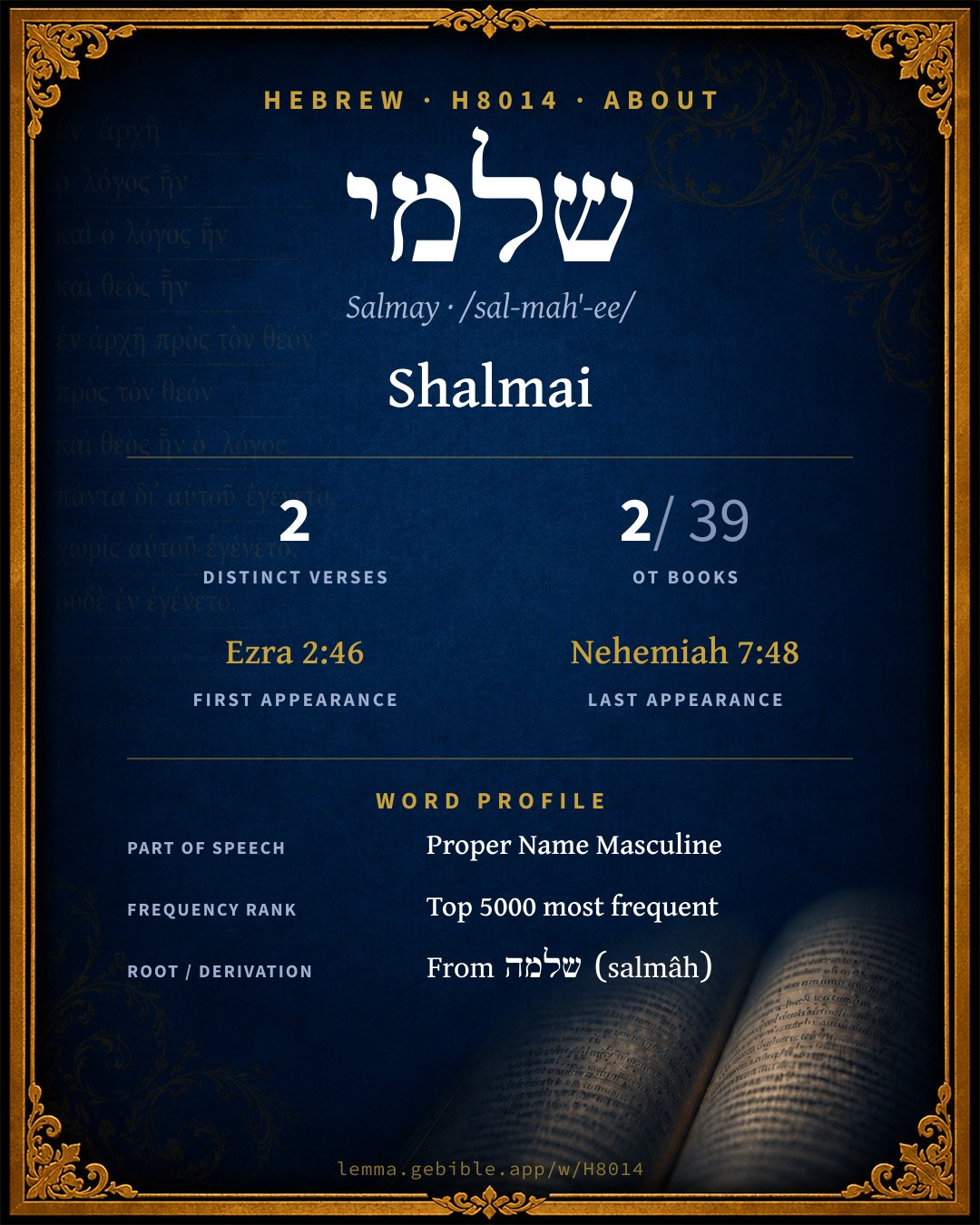
שַׂלְמַי
Shalmai
BDB lists 2 entries for ‘Shalmai’ fuller range ↓
Full lexicon entry — Brown-Driver-Briggs (BDB)
From Brown-Driver-Briggs (BDB)
Where this word appears
Grammar key — what these labels mean
Part of speech
- Noun
- A naming word — a person, place, thing, or idea.
Noun type
- Proper
- A name of a specific person, place, or people (e.g. Abraham, Zion, Israel).
Every verse where H8014 appears — 2 distinct verses across 2 books. Click any verse to open its interlinear word-by-word view. Verse text shown in the World English Bible for context — . Each verse’s Hebrew form is shown with its reference; the English is not keyword-highlighted, since the data carries no word-level English alignment. Use “Compare translations” on any verse to read it across multiple English versions. This concordance covers the Hebrew Bible; Septuagint (Greek Old Testament) occurrences are not indexed here.
Ezra 1 verse
Nehemiah 1 verse
About this entry
At a glance — auto-summarized from this page’s data, not written by a person. Every figure links to its source below. This summary describes the numbers; it doesn’t interpret them.
“Shalmai” is the headline sense of the Hebrew name שלמי (Salmay). A scarce word — 2 verses in all of the Hebrew Bible. It clusters heavily in Ezra, which alone accounts for 50% of its uses. Its earliest occurrence is Ezra 2:46. The sections below give every occurrence and version rendering.
Gloss history
Strong's 1890 vs modern scholarship
About this word
Strong's H8014 catalogs a Hebrew word from the Hebrew Old Testament.
These counts are not copied from any lexicon or concordance. They are computed here, from the morphology-tagged Hebrew Old Testament. What Lemma adds →
- 2
- distinct verses
- The word appears in 2 distinct verses.
- 2 / 39
- OT books
- The word appears in 2 of 39 Old Testament books.
- #4,807
- by frequency
- Top 5000 most frequent Hebrew words (rank 4,807 of 8,640 Hebrew words by occurrence).
View all 2 occurrences in the concordance →
By traditional corpus
Conventional, traditional groupings — biblical authorship is debated, so this is a traditional corpus grouping, not an authorship claim. Each share is this word’s portion of its verses in that division of the Hebrew canon. Each figure is a share of the word’s 2 distinct verses.
- Writings (Ketuvim) 2 verses · 100%
How translations render this word
Counts come from each version’s own published word-to-Strong’s tagging or interlinear alignment — an approximate guide to how each version renders this word, not a word-level alignment the data otherwise carries. Because each total is that version’s own tagged count, the per-version totals vary from one another and need not match the appearance or distinct-verse counts above. These counts may also differ from a printed concordance because Lemma counts each distinctly tagged rendering and does not collapse phrase taggings into a single head-word total. This is a fixed set of word-tagged versions (KJV, ASV, BSB, ULT) and does not change with the reading translation you choose elsewhere. Each version’s license is shown beside its name below (and on Sources).
- King James Version: Shalmai 1×
- American Standard Version: Salmai 1×
- Berean Standard Bible: Shalmai 1×
- unfoldingWord Literal Text: Shalmai 2×
King James Version Public Domain
Renders H8014 across 1 tagged occurrence — most commonly:
American Standard Version Public Domain
Renders H8014 across 1 tagged occurrence — most commonly:
Berean Standard Bible Public Domain
Renders H8014 across 1 tagged occurrence — most commonly:
unfoldingWord Literal Text CC BY-SA 4.0
Renders H8014 across 2 tagged occurrences — most commonly:
Senses in BDB
The 2 senses BDB distinguishes for this word, in lexicon order (not ranked by frequency or importance). The full entry — with sub-senses — is in the Lexicon Entry tab.
- Shalmai or Salmai or Shamlai = "my thanks"
- ancestor of a family of temple slaves who returned from exile with Zerubbabel
Word origin
n.pr.m. head of post-ex. family;—שׁ׳ Ezr 2:46 Qr (Kt. שׂמלי [cf. NH n.pr. שִׂמְלַי Dalman, Liḥy. שמל DHMEpigr. Denkm. Ar. No. 13]; so Baer; van d. H. Gi Qr שַׁלְמַי; Σαμααν, A𝔊L Σελαμ(ε)ι) = שַׂלְמָ֑י Ne 7:48 (Σελαμει; א Σαμαει).
— Brown-Driver-Briggs (Oxford 1906, public domain), digitized via Sefaria, supplemented by the OpenScriptures HebrewLexicon (CC BY 4.0). See Sources.
Derived from שלמה (salmâh) (H8008) — garment.
Jastrow Dictionary
A second Hebrew/Aramaic lexicon for comparison, covering Aramaic and post-biblical (Talmudic, Targumic, Midrashic) usage that the biblical-Hebrew BDB does not. Matched by lemma rather than by Strong’s number, so a lemma may carry more than one Jastrow headword (shown separately below), and the entries cover usage well beyond the Bible.
מִ־
- (followed by Dagesh forte), מֵ־, מֵי־ (before gutturals) prefix for מִן,
- 1. from, of, e. g. מִמָּקוֹם from a place; מֵאֵמָתַי from what time &c.—מֵאֵל־, v. אֶל.
- 2. (v. מִדּ־) from the time that, when; from the fact that, since; also separated מִי, e. g. Sot. IX, 7 משנתערפה העגלה after the heifer has been killed; Num. R. s. 2 מִי שהוא אומר (= מִשֶּׁ־) after having said; Y. Shek. V, end, 49ᵇ מיחזר when I come back; Y. Peah VIII, 21ᵇ top מי חזרון מי חזרון וכ׳ when we come back,—when they came back &c.; Y. Ber. II, 5ᶜ bot. מִסַּבְרִית ed. Lehm. (ed. מי סברית) because I thought; Y. Taan. IV, 69ᵃ מנפקין (Lam. R. to II, 2 מן דנפקין) when they came forth; a. fr.
מִי I
- , מִי־, מֵי־ from, of; because, v. מִ־.
מִי II
- (b. h.)
- 1. who?; which?; he who. M. Kat. 16ᵇ ראה מי קורא וכ׳ Ms. M. (ed. omit ראה) see who calls thee outside. Keth. 64ᵇ מי שוכר את מי which hires which?, i.e. which (of the two) hires and which is hired? B. Bath. IX, 1 מי שמת וכ׳ he who (if one) died and left &c. Ib. VI, 7 מי שהיתה דרך וכ׳ he through whose field there is a public passage. Ib. 6 מי שיש לו גינה וכ׳ he who has a garden &c.; a. v. fr.—(Chald.) Ab. Zar. 41ᵇ מי יימר דבטליה Ms. M. (ed. דבטלה) who can say (how do we know) that he cancelled it?
- 2. [who will?,] Oh that! Sot. V, 2, a. e. מי יגלה וכ׳, v. גָּלָה. Pes. 49ᵇ מי יתן לי ת"ח וכ׳ Oh that I had a scholar before me, and I would &c.; a. fr.
- 3. [is there any?; in gen. introducing a question:] is there?, does he? &c. Sabb. 31ᵃ מי כאן הלל does Hillel live here? Ḥull. 33ᵃ מי איכא מידי וכ׳ is there anything which is permitted &c. Ber. 34ᵃ top, v. חַבְרוּתָא. Ḥull. 32ᵇ מהו מי מצטרף וכ׳ how is it? can the first cut be combined with the second to effect &c.? Naz. 32ᵇ אילו … מי הוה נדריתון if one had come … would you have vowed? Ib. מי יודעין לאימתי did they know when? Ib. מי ידעין בהי וכ׳ did they know on what day?—Pes. 14ᵇ, a. fr. מי דמי (sub. הא להא) is there an analogy between the two cases?; v. דְּמֵי I; a. v. fr.
מַי
- what?; v. מַאי.
מַי ²
- water, v. מַיִם.
מִלָּה
- word. Lev. R. s. 16 (prov.) מ׳ בסלע משתוקא בשנים where a word is worth a Sela, silence is worth two; Meg. 18ᵃ (v. Rabb. D. S. a. l. note 1).—Pl. מִלִּין, מִי. Cant. R. to IV, 4, v. קָצַב; a. e.—Ch. מִלָּה, v. מִילָּא.]
A Dictionary of the Targumim, the Talmud Babli and Yerushalmi, and the Midrashic Literature (Marcus Jastrow; London, Luzac, 1903) — Public Domain. Digitized via Sefaria. Digitized via Sefaria. Full attribution on Sources.
Forms in the corpus
The 2 distinct written forms H8014 takes in the Hebrew Bible, most frequent first — each parse links to that state’s occurrences in the concordance. Hebrew forms include their vowel points and cantillation, so a single lemma takes many written forms.
| Form | Parsing | Example | Uses |
|---|---|---|---|
| שַׁלְמַ֖י | Noun, Proper | Ezra 2:46 | 1 |
| שַׁלְמָֽי | Noun, Proper | Nehemiah 7:48 | 1 |
Same root — word family
Other BDB entries built from the same root as H8014, grouped by Strong’s listed origin. These share a root / origin per the lexicon — not necessarily a shared meaning. Each links to that word’s own entry.
Derives from
Proper names from this root
People and places named from this root — a name, not an additional meaning of the word.
- שלמא Salmâʼ H8007 Salma
- שלמה Salmâh H8009 Salmon
- שלמון Salmôwn H8012 Salmon
- שמלי Shamlay H8073 Shalmai
Compare all same-root words → Showing 4 of 6 — not the complete family. 4 of the same-root words are proper names (people or places). They share a root, not necessarily a meaning.
Bible dictionary
Public-domain dictionary articles matched to this entry by name (Shalmai). A biblical name can be shared by more than one person or place, so an article may treat several.
Smith's Bible Dictionary · William Smith, 1863
(my thanks). The children of Shalmai were among the Nethinim who returned with Zerubbabel. (Ezra 2:46; Nehemiah 7:48) In Nehemiah SALMAI. (B.C. 536.)
Hitchcock's Bible Names Dictionary · Roswell D. Hitchcock, 1869
my garment
Classic public-domain reference works; full attribution on Sources.
Septuagint verse parallels
This word appears in 1 verse that also exists in the Greek Old Testament (Septuagint), out of the 2 Hebrew verses it occurs in. You can read those verses in Greek by switching the Old Testament edition to the Septuagint.
Read these verses in the Septuagint
This is a verse-level parallel only — the same verses exist in both the Hebrew and Greek Old Testaments. No word-level Hebrew↔Greek correspondence is claimed: the data carries no such alignment, so no Greek word is shown as this Hebrew word’s translation. Coverage is not total — the Septuagint omits the deuterocanon and renumbers the Psalms, so some Hebrew verses have no direct Greek parallel.