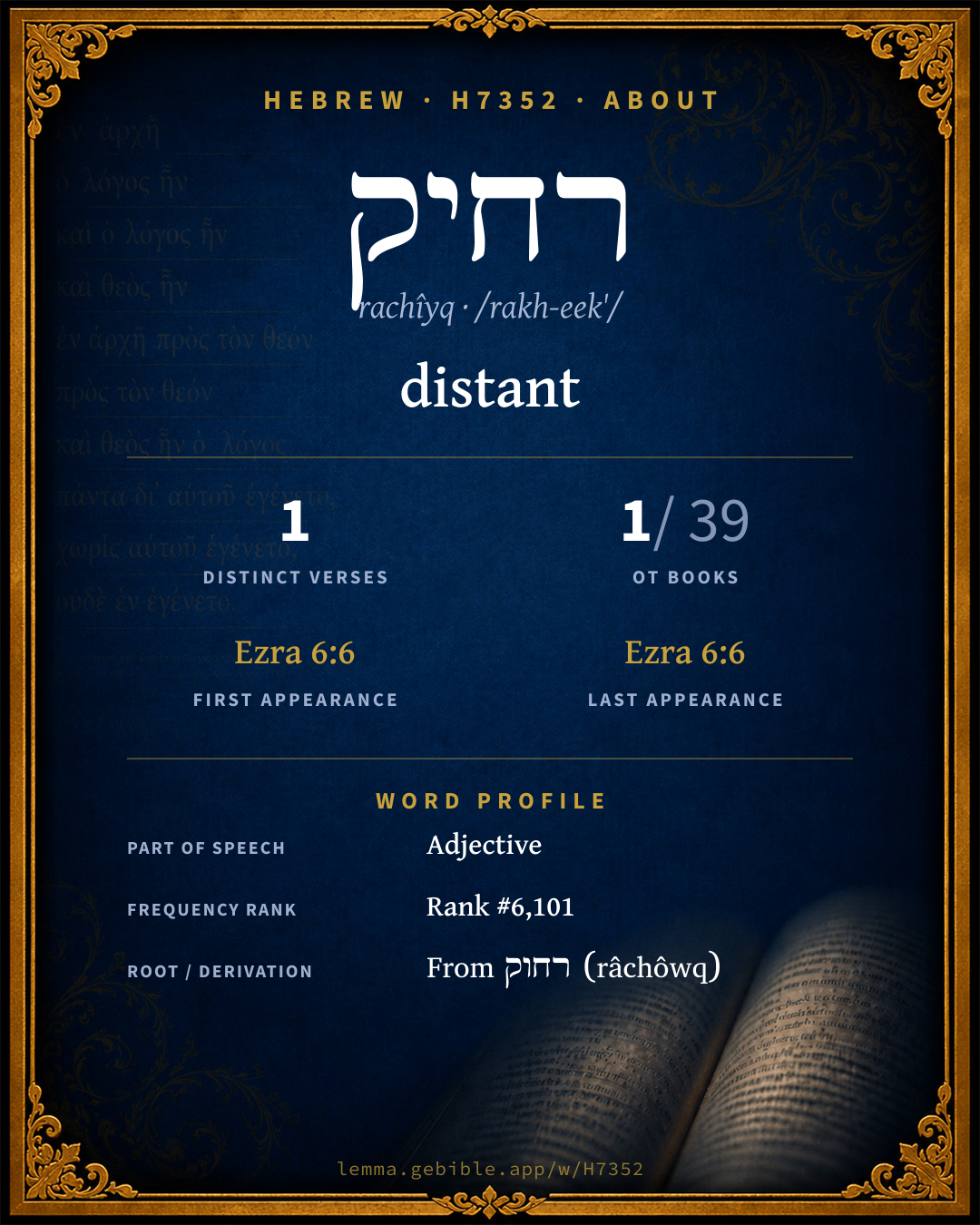
רְחִיק
distant
Full lexicon entry — Brown-Driver-Briggs (BDB)
From Brown-Driver-Briggs (BDB)
Where this word appears
Grammar key — what these labels mean
Part of speech
- Adjective
- A word that describes or qualifies a noun.
State
- Absolute
- The independent form of a noun, not bound to a following word.
Gender
- Masculine
- Grammatically masculine.
Number
- Plural
- More than one (in Hebrew, generally three or more).
Every verse where H7352 appears — 1 distinct verse across 1 book. Click any verse to open its interlinear word-by-word view. Verse text shown in the World English Bible for context — . Each verse’s Hebrew form is shown with its reference; the English is not keyword-highlighted, since the data carries no word-level English alignment. Use “Compare translations” on any verse to read it across multiple English versions. This concordance covers the Hebrew Bible; Septuagint (Greek Old Testament) occurrences are not indexed here.
Ezra 1 verse
About this entry
At a glance — auto-summarized from this page’s data, not written by a person. Every figure links to its source below. This summary describes the numbers; it doesn’t interpret them.
רחיק (rachîyq) is a Hebrew adjective most often rendered “distant.” A scarce word — 1 verse in all of the Hebrew Bible. Ezra dominates its distribution — 1 of 1 verses. Its lone occurrence is Ezra 6:6. For the data behind this summary, explore the sense tree and the renderings breakdown below.
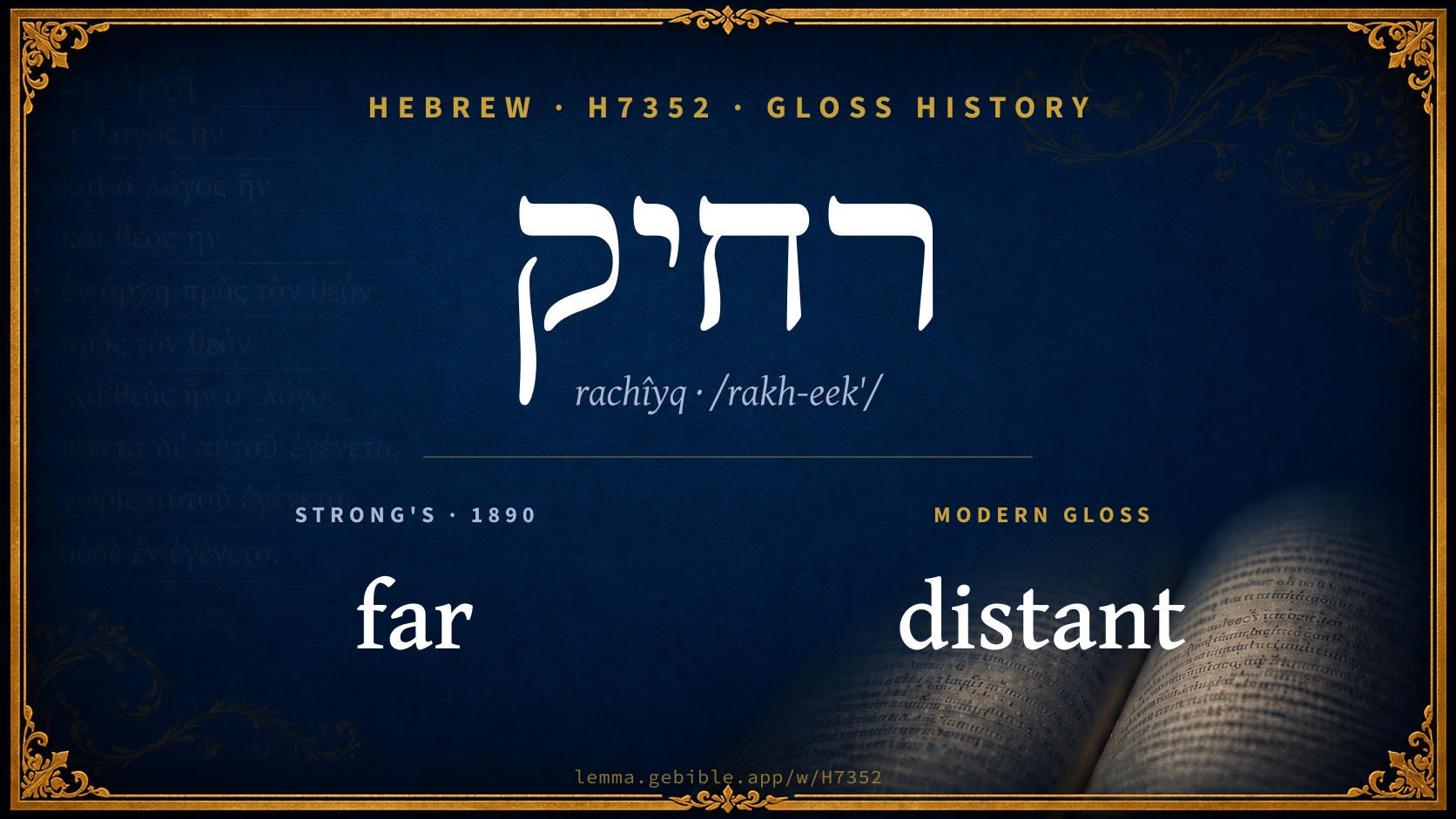
Gloss history
Strong's 1890 vs modern scholarship
About this word
Strong's H7352 catalogs a Hebrew word from the Hebrew Old Testament.
These counts are not copied from any lexicon or concordance. They are computed here, from the morphology-tagged Hebrew Old Testament. What Lemma adds →
- 1
- distinct verses
- The word appears in 1 distinct verse.
- 1 / 39
- OT books
- The word appears in 1 of 39 Old Testament books.
- #6,101
- by frequency
- Rank #6,101 (rank 6,101 of 8,640 Hebrew words by occurrence).
View all 1 occurrence in the concordance →
Most concentrated in
- Ezra 1 verse 100%
By section of the Old Testament
By traditional corpus
Conventional, traditional groupings — biblical authorship is debated, so this is a traditional corpus grouping, not an authorship claim. Each share is this word’s portion of its verses in that division of the Hebrew canon. Each figure is a share of the word’s 1 distinct verse.
- Writings (Ketuvim) 1 verse · 100%
How translations render this word
Counts come from each version’s own published word-to-Strong’s tagging or interlinear alignment — an approximate guide to how each version renders this word, not a word-level alignment the data otherwise carries. Because each total is that version’s own tagged count, the per-version totals vary from one another and need not match the appearance or distinct-verse counts above. These counts may also differ from a printed concordance because Lemma counts each distinctly tagged rendering and does not collapse phrase taggings into a single head-word total. This is a fixed set of word-tagged versions (KJV, ASV, BSB, ULT) and does not change with the reading translation you choose elsewhere. Each version’s license is shown beside its name below (and on Sources).
- King James Version: Far 1×
- American Standard Version: Far 1×
- Berean Standard Bible: Away 1×
- unfoldingWord Literal Text: Far away 1×
King James Version Public Domain
Renders H7352 across 1 tagged occurrence — most commonly:
American Standard Version Public Domain
Renders H7352 across 1 tagged occurrence — most commonly:
Berean Standard Bible Public Domain
Renders H7352 across 1 tagged occurrence — most commonly:
unfoldingWord Literal Text CC BY-SA 4.0
Renders H7352 across 1 tagged occurrence — most commonly:
Senses in BDB
The 1 sense BDB distinguishes for this word, in lexicon order (not ranked by frequency or importance). The full entry — with sub-senses — is in the Lexicon Entry tab.
- far, far off, distant
Word origin
[ רְחִיק ] adj. far;—pl. abs. Ezr 6:6
— Brown-Driver-Briggs (Oxford 1906, public domain), digitized via Sefaria, supplemented by the OpenScriptures HebrewLexicon (CC BY 4.0). See Sources.
Derived from רחוק (râchôwq) (H7350) — far.
Jastrow Dictionary
A second Hebrew/Aramaic lexicon for comparison, covering Aramaic and post-biblical (Talmudic, Targumic, Midrashic) usage that the biblical-Hebrew BDB does not. Matched by lemma rather than by Strong’s number, so a lemma may carry more than one Jastrow headword (shown separately below), and the entries cover usage well beyond the Bible.
רְחֵיק
- , v. רְחַק
רָחִיק I
- (preced.) distance. Targ. Ex. II, 4. Targ. Ps. X, 1. Targ. Prov. XXXI, 14 (Ms. רוֹחַק); a. fr.
רָחִיק II
- (preced.) far, distant, removed. Targ. Deut. XXIX, 21. Targ. Jer. XII, 2. Targ. Prov. XXV, 25; a. fr.—Succ. 52ᵃ; Yalk. Joel 535, v. צַוְותָּא. Y. Shebi. IX, 38ᵈ bot. לארעא דר׳ to a distant land; a. e.—Pl. רְחִיקִין; רְחִיקָן. Targ. Josh. IX, 22. Targ. Jud. XVIII, 7; a. fr.—Y. Ned. XI, end, 42ᵈ (expl. שמים ביני לבינך Mish. Ned. XI, 12) [read:] כמא דשמיא ר׳ … כן האי אתתא רחיקא וכ׳ as the heavens are remote from the earth, so is this woman (I) from this man (I cannot live with him); a. e.
רִחֵק
- Targ. Prov. XIX, 7. Targ. Ps. CIII, 12. Ib. LIII, 2. Targ. Job XXI, 16; a. fr.
- 1. to remove; to reject, loathe. Targ. Ps. CIII, 12. Targ. Ex. XXXIII, 7. Targ. Is. VI, 12. Targ. Job XXXIII, 20 (Ms. Pa.); a. fr.
- 2. to be removed. Gitt. 58ᵃ כמה מַרְחִיקְנָא וכ׳ how far am I (in my studies) from that place (the passage quoted)?
- to remove, keep off; to loathe, abominate; to make abominable. Targ. Job XI, 14. Targ. Am. VI, 3 מר׳ יום (ed. Lag. מיום, corr. acc.; h. text מנדים). Targ. Jer. II, 37 (h. text מאס). Targ. Deut. VII, 26 (h. text תעב). Targ. Job IX, 31; a. fr.—Part. pass. מְרָחַק. Targ. Mal. I, 7 (h. text מגאל).—Sabb. 128ᵇ טמאה לא מְרַחֲקָא וולדא ואי מרחקא וכ׳ an unclean animal (after giving birth) does not keep its young off, and if it does, it does not allow them to come near again (stimulation of the maternal instinct does not avail, v. רָחַם). Snh. 29ᵃ משום דמְרָחֲקָא דעתיה (an enemy cannot be witness,) because his mind is estranged (hostile), opp. מקרבא; Yalk. Num. 788; a. e.—V. מְרָחַק, מְרַחַקְתָּא.
A Dictionary of the Targumim, the Talmud Babli and Yerushalmi, and the Midrashic Literature (Marcus Jastrow; London, Luzac, 1903) — Public Domain. Digitized via Sefaria. Digitized via Sefaria. Full attribution on Sources.
Septuagint verse parallels
This word appears in 1 verse that also exists in the Greek Old Testament (Septuagint), out of the 1 Hebrew verse it occurs in. You can read those verses in Greek by switching the Old Testament edition to the Septuagint.
Read these verses in the Septuagint
This is a verse-level parallel only — the same verses exist in both the Hebrew and Greek Old Testaments. No word-level Hebrew↔Greek correspondence is claimed: the data carries no such alignment, so no Greek word is shown as this Hebrew word’s translation. Coverage is not total — the Septuagint omits the deuterocanon and renumbers the Psalms, so some Hebrew verses have no direct Greek parallel.