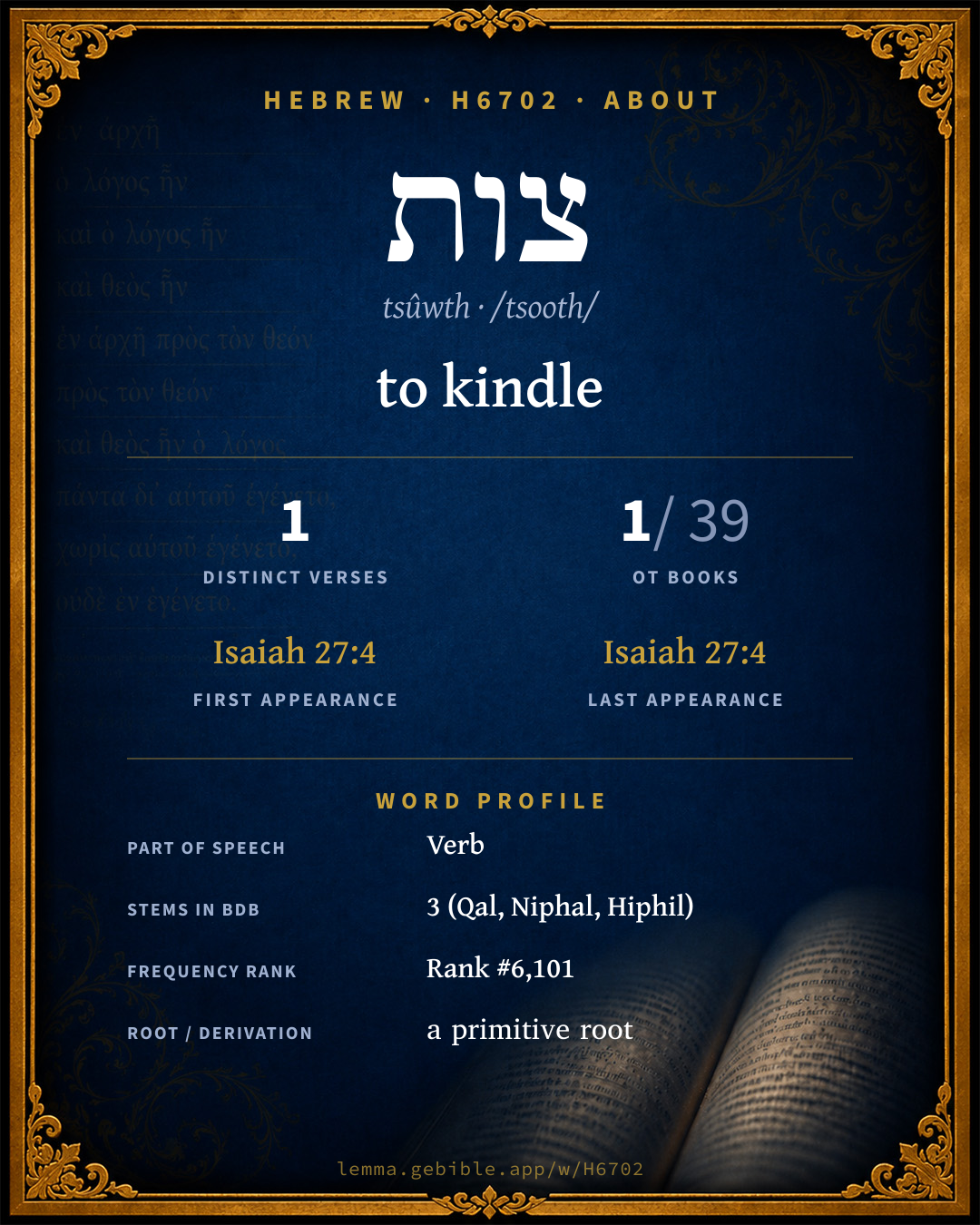
צוּת
to kindle
Full lexicon entry — Brown-Driver-Briggs (BDB)
From Brown-Driver-Briggs (BDB)
Where this word appears
Grammar key — what these labels mean
Part of speech
- Verb
- An action or state-of-being word.
Stem
- Hiphil
- The causative active stem (“he caused / brought about”).
Form
- Imperfect
- An incomplete, ongoing, or future action (“he will / would write”).
Person
- 1st Person
- The speaker (“I / we”).
Gender
- Common
- Either gender — not distinguished for this form.
Number
- Singular
- One.
Every verse where H6702 appears — 1 distinct verse across 1 book. Click any verse to open its interlinear word-by-word view. Verse text shown in the World English Bible for context — . Each verse’s Hebrew form is shown with its reference; the English is not keyword-highlighted, since the data carries no word-level English alignment. Use “Compare translations” on any verse to read it across multiple English versions. This concordance covers the Hebrew Bible; Septuagint (Greek Old Testament) occurrences are not indexed here.
Isaiah 1 verse
About this entry
At a glance — auto-summarized from this page’s data, not written by a person. Every figure links to its source below. This summary describes the numbers; it doesn’t interpret them.
צות — transliterated tsûwth — is a Hebrew verb carrying the sense “to kindle.” It occurs a mere 1 verse across Scripture. More than three-quarters of its appearances fall in Isaiah. Found nowhere else but Isaiah 27:4. As a verb its force shifts by stem, across 3 stems (Qal, Niphal, and more). See the sense tree, 1-verse concordance, and the renderings breakdown below.
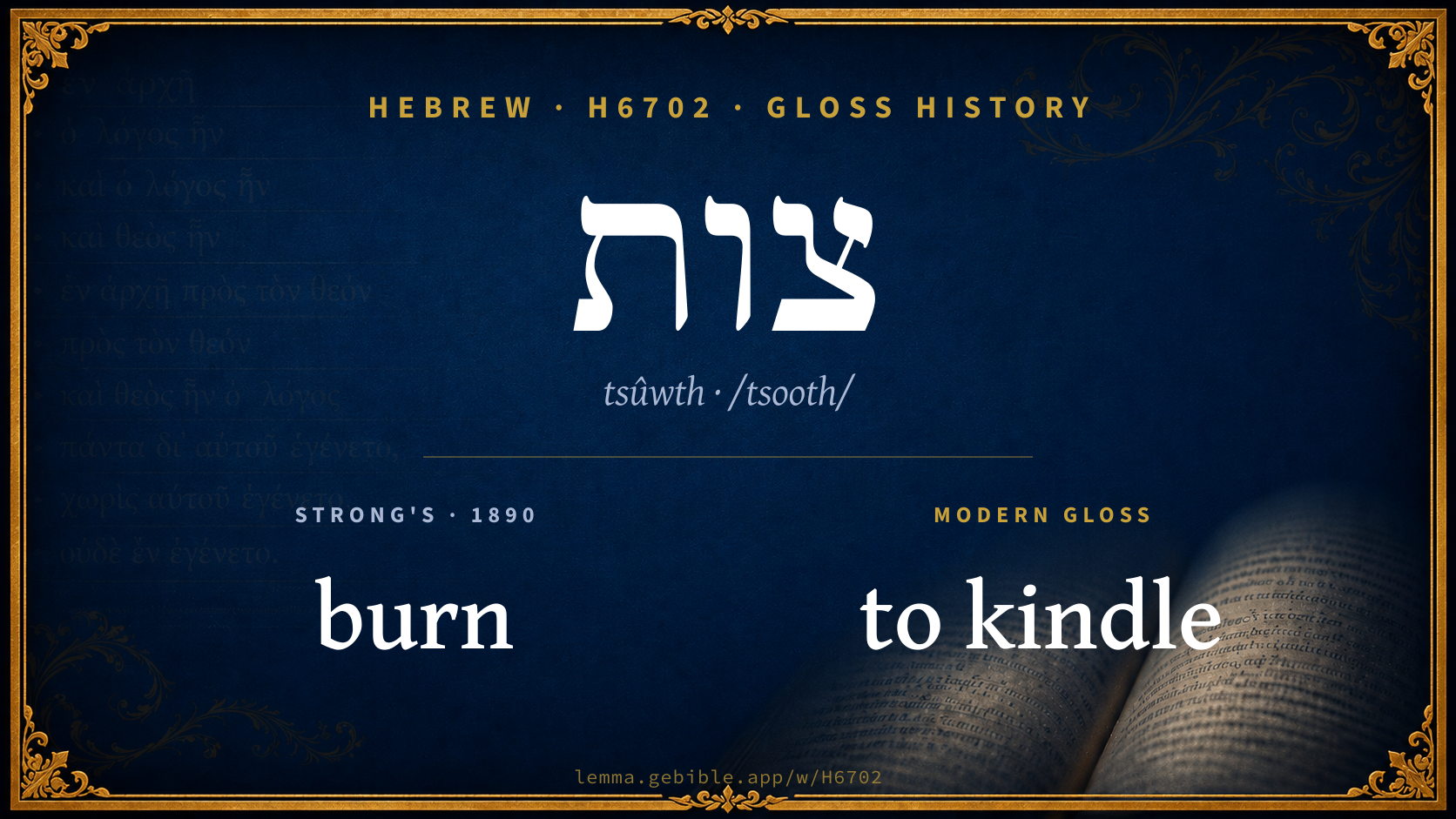
Gloss history
Strong's 1890 vs modern scholarship
About this word
Strong's H6702 catalogs a Hebrew word from the Hebrew Old Testament.
These counts are not copied from any lexicon or concordance. They are computed here, from the morphology-tagged Hebrew Old Testament. What Lemma adds →
- 1
- distinct verses
- The word appears in 1 distinct verse.
- 1 / 39
- OT books
- The word appears in 1 of 39 Old Testament books.
- #6,101
- by frequency
- Rank #6,101 (rank 6,101 of 8,640 Hebrew words by occurrence).
View all 1 occurrence in the concordance →
Most concentrated in
- Isaiah 1 verse 100%
By section of the Old Testament
By traditional corpus
Conventional, traditional groupings — biblical authorship is debated, so this is a traditional corpus grouping, not an authorship claim. Each share is this word’s portion of its verses in that division of the Hebrew canon. Each figure is a share of the word’s 1 distinct verse.
- Prophets (Nevi'im) 1 verse · 100%
How translations render this word
Counts come from each version’s own published word-to-Strong’s tagging or interlinear alignment — an approximate guide to how each version renders this word, not a word-level alignment the data otherwise carries. Because each total is that version’s own tagged count, the per-version totals vary from one another and need not match the appearance or distinct-verse counts above. These counts may also differ from a printed concordance because Lemma counts each distinctly tagged rendering and does not collapse phrase taggings into a single head-word total. This is a fixed set of word-tagged versions (KJV, ASV, BSB, ULT) and does not change with the reading translation you choose elsewhere. Each version’s license is shown beside its name below (and on Sources).
- King James Version: Through them i would burn 1×
- American Standard Version: Them 1×
- Berean Standard Bible: I would burn them 1×
- unfoldingWord Literal Text: Let me burn it 1×
King James Version Public Domain
Renders H6702 across 1 tagged occurrence — most commonly:
American Standard Version Public Domain
Renders H6702 across 1 tagged occurrence — most commonly:
Berean Standard Bible Public Domain
Renders H6702 across 1 tagged occurrence — most commonly:
unfoldingWord Literal Text CC BY-SA 4.0
Renders H6702 across 1 tagged occurrence — most commonly:
Senses in the full BDB
Hebrew verbs can shift meaning by stem (binyan): Qal is the basic action, Niphal is often passive or reflexive, Piel often intensifies or makes it factitive, and Hiphil is typically causative. The senses below are grouped under the stem BDB assigns to each.
What do BDB’s symbols mean?
BDB uses these scholarly abbreviations:
| Symbol | Meaning |
|---|---|
| 𝔊 | the Septuagint (the ancient Greek translation, LXX) |
| 𝔙 | the Vulgate (the Latin translation) |
| 𝔖 | the Syriac version (the Peshitta) |
| 𝔗 | the Targum (the Aramaic translation) |
| ψ | the Psalms |
| √ | root (the underlying root or stem) |
| ‖ | parallel passage (a synonymous or contrasted parallel) |
| † | the dagger: every passage where the word occurs is cited |
The 3 senses and sub-senses the full Brown-Driver-Briggs lexicon distinguishes for this word, in lexicon order (not ranked by frequency), with BDB’s own verbatim wording and sub-sense lettering. Shown in Hebrew script with BDB’s own scholarly abbreviations. The condensed entry is in the Lexicon Entry tab.
Qal
- kindle, intr., fig. of wickedness; sq. be kindled with fire (= set on fire)
Niphal
- . be kindled; be burned; = desolated
Hiphil
- . kindle, set on fire
Senses from the full Brown-Driver-Briggs lexicon (Brown, Driver, Briggs; Oxford 1906 — public domain), digitized via Sefaria, supplemented by the OpenScriptures HebrewLexicon (CC BY 4.0). Full attribution on Sources.
Word origin
[ יָצַת ] vb. kindle, burn (intr.)
— Brown-Driver-Briggs (Oxford 1906, public domain), digitized via Sefaria, supplemented by the OpenScriptures HebrewLexicon (CC BY 4.0). See Sources.
Origin: a primitive root
Jastrow Dictionary
A second Hebrew/Aramaic lexicon for comparison, covering Aramaic and post-biblical (Talmudic, Targumic, Midrashic) usage that the biblical-Hebrew BDB does not. Matched by lemma rather than by Strong’s number, so a lemma may carry more than one Jastrow headword (shown separately below), and the entries cover usage well beyond the Bible.
צוּת
- (cmp. צָבַת) to join, follow; to attend. Ber. 6ᵇ, Sabb. 30ᵇ, v. צָוָה.
- to incline (the ear,); to listen. Midr. Till. to Ps. XXX, end הקב"ה מֵצִית לדבריהם the Lord listens to their words (ref. to Mal. III, 16). e.g. Malachi 3:16
- (cmp. שָׁמַע Hif.) to proclaim. Y. Sot. IX, beg., 23ᵇ כי ימצא לא שתהא חוזר ומְצוֹתֵת עליו ‘if there be found’ (Deut. XXI, 1), this intimates, that thou need not go around and issue a proclamation about it (calling upon the people to inform the authorities of any slain body found). e.g. Deuteronomy 21:1
צוּת ²
- , to listen, obey. Targ. Jer. VI, 10 למֵיצַת. Targ. Ps. V, 3 צֵית (imperat.). Targ. Is. LIII, 5 וכדנָצֵית וכ׳ ed. Wil. (v. נְהֵי I) and when we listen &c.; a. fr.—Part. צָיֵית, צָיֵת, צָאִית. Targ. Prov. XVII, 4. Targ. Ps. CXXX, 2; a. fr.—Keth. 63ᵃ אי לדידי צ׳ if he heeded my advice. Ab. Zar. 28ᵇ מאן צ׳ ליהודה וכ׳ who heeds what Judah the Sabbath-breaker says? Yeb. 89ᵃ בתרי מאני צ׳ … לא צ׳ in the case of two vessels, if you tell him that he must give T’rumah from each, he will obey; in the case of one vessel, if you tell him that he must give T’rumah twice, he will not obey. B. Kam. 113ᵃ על דלא צ׳ לדינא a warrant issued because he did not heed the decision of the court; כיון דאמר צָיִיתְנָא וכ׳ (Ms. M. צָאִיתְנָא, v. Rabb. D. S. a. l. notes 5, 6) as soon as he says, I shall obey, we tear up the warrant (v. פְּתִיחָא); a. e.
- (with אודנא, or sub. אודנא) same. Targ. Y. Ex. VI, 28. Targ. Deut. I, 45; a. fr.—B. Bath. 74ᵃ אצית אי שמעת listen! what dost thou hear?; Snh. 110ᵃ bot. Ab. Zar. 38ᵇ לא תְצִיתוּ ליה heed him not. Keth. 60ᵃ, v. כְּלָלָא; a. fr.
- to cause to listen. Y. Taan. I, 64ᵃ bot. ובסופה את מְצַיֵּית ליה וכ׳ and finally thou madest him listen (to thee), and he said &c.
צְוַת
- , v. צְוַות
A Dictionary of the Targumim, the Talmud Babli and Yerushalmi, and the Midrashic Literature (Marcus Jastrow; London, Luzac, 1903) — Public Domain. Digitized via Sefaria. Digitized via Sefaria. Full attribution on Sources.
Septuagint verse parallels
This word appears in 1 verse that also exists in the Greek Old Testament (Septuagint), out of the 1 Hebrew verse it occurs in. You can read those verses in Greek by switching the Old Testament edition to the Septuagint.
Read these verses in the Septuagint
This is a verse-level parallel only — the same verses exist in both the Hebrew and Greek Old Testaments. No word-level Hebrew↔Greek correspondence is claimed: the data carries no such alignment, so no Greek word is shown as this Hebrew word’s translation. Coverage is not total — the Septuagint omits the deuterocanon and renumbers the Psalms, so some Hebrew verses have no direct Greek parallel.