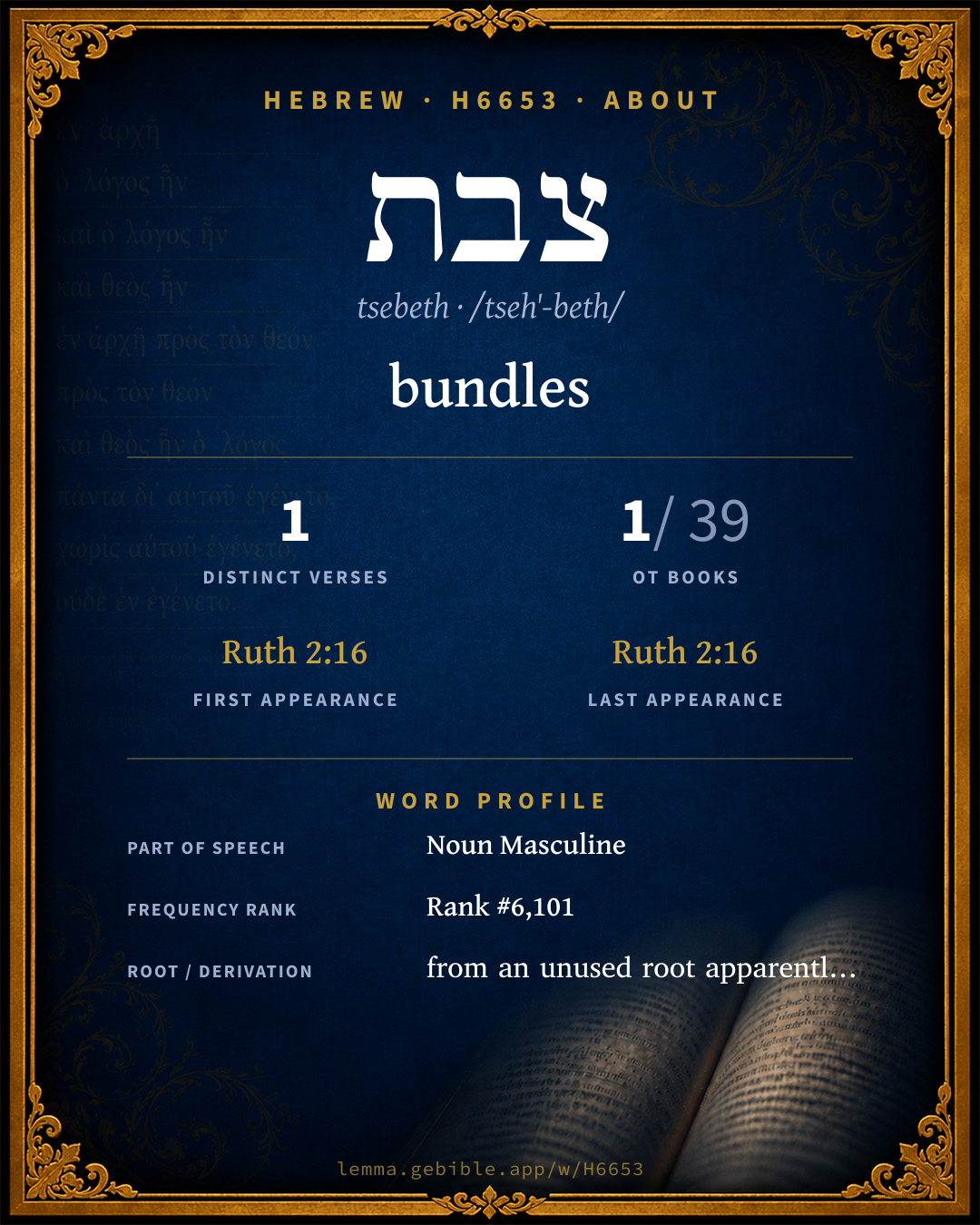
צְבָתִים
bundles
‘bundles’ is one of 2 main senses fuller range ↓
Full lexicon entry — Brown-Driver-Briggs (BDB)
From Brown-Driver-Briggs (BDB)
Where this word appears
Grammar key — what these labels mean
Noun type
- Common
- A common noun — a general class of person, place, or thing (“king,” “city,” “water”), not a specific name.
State
- Absolute
- The independent form of a noun, not bound to a following word.
Gender
- Masculine
- Grammatically masculine.
Number
- Plural
- More than one (in Hebrew, generally three or more).
Every verse where H6653 appears — 1 distinct verse across 1 book. Click any verse to open its interlinear word-by-word view. Verse text shown in the World English Bible for context — . Each verse’s Hebrew form is shown with its reference; the English is not keyword-highlighted, since the data carries no word-level English alignment. Use “Compare translations” on any verse to read it across multiple English versions. This concordance covers the Hebrew Bible; Septuagint (Greek Old Testament) occurrences are not indexed here.
Ruth 1 verse
About this entry
At a glance — auto-summarized from this page’s data, not written by a person. Every figure links to its source below. This summary describes the numbers; it doesn’t interpret them.
At its core, צבת (tsebeth) means “bundles.” The Hebrew Bible uses it only 1 verse. The word gravitates to Ruth (100%). Scripture uses it exactly once, at Ruth 2:16. Ranging over 2 senses, it is not a single-sense word. Dig into 1-verse concordance and the renderings breakdown below.
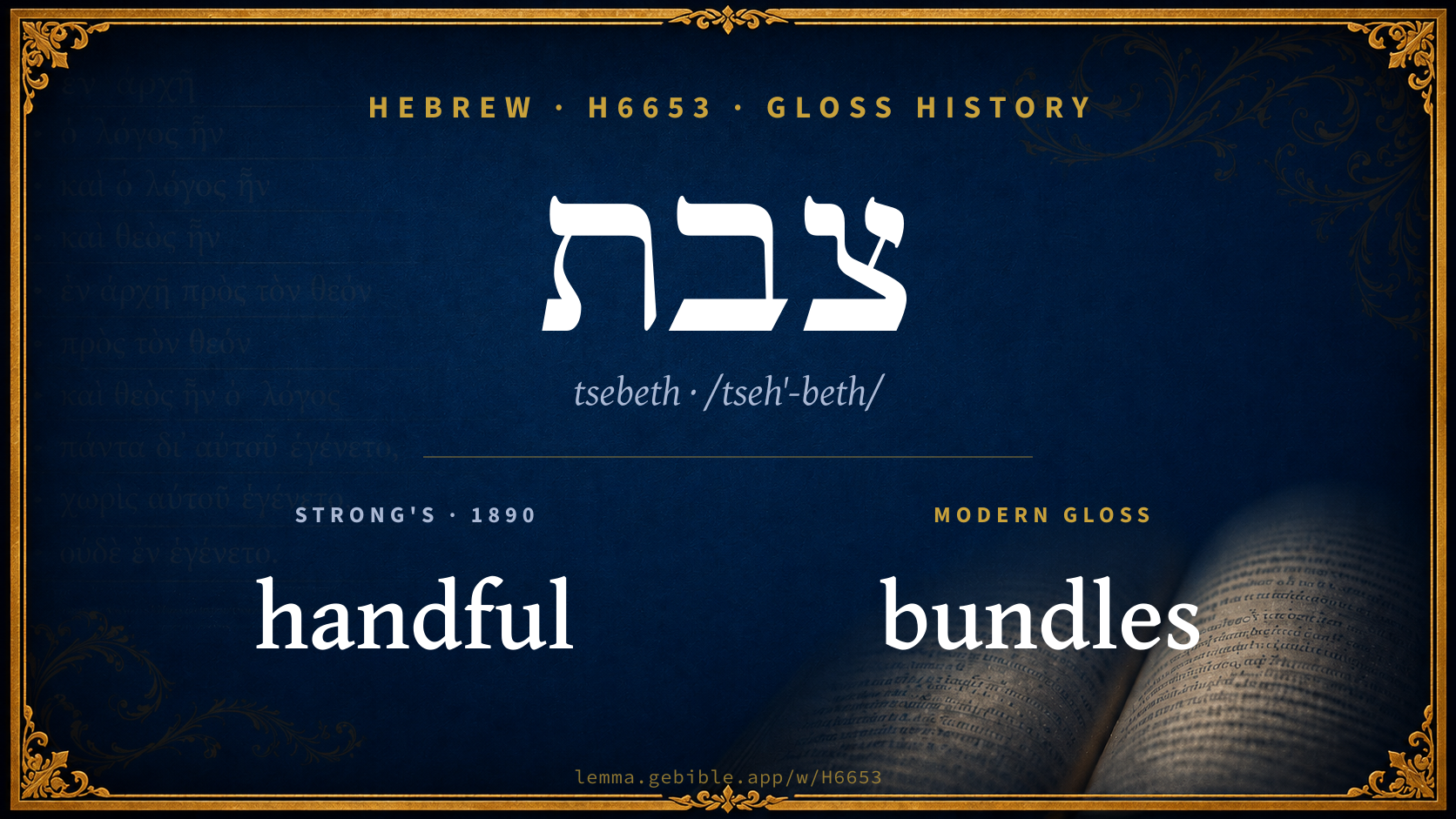
Gloss history
Strong's 1890 vs modern scholarship
About this word
Strong's H6653 catalogs a Hebrew word from the Hebrew Old Testament.
These counts are not copied from any lexicon or concordance. They are computed here, from the morphology-tagged Hebrew Old Testament. What Lemma adds →
- 1
- distinct verses
- The word appears in 1 distinct verse.
- 1 / 39
- OT books
- The word appears in 1 of 39 Old Testament books.
- #6,101
- by frequency
- Rank #6,101 (rank 6,101 of 8,640 Hebrew words by occurrence).
View all 1 occurrence in the concordance →
Most concentrated in
- Ruth 1 verse 100%
By section of the Old Testament
By traditional corpus
Conventional, traditional groupings — biblical authorship is debated, so this is a traditional corpus grouping, not an authorship claim. Each share is this word’s portion of its verses in that division of the Hebrew canon. Each figure is a share of the word’s 1 distinct verse.
- Writings (Ketuvim) 1 verse · 100%
How translations render this word
Counts come from each version’s own published word-to-Strong’s tagging or interlinear alignment — an approximate guide to how each version renders this word, not a word-level alignment the data otherwise carries. Because each total is that version’s own tagged count, the per-version totals vary from one another and need not match the appearance or distinct-verse counts above. These counts may also differ from a printed concordance because Lemma counts each distinctly tagged rendering and does not collapse phrase taggings into a single head-word total. This is a fixed set of word-tagged versions (KJV, ASV, BSB, ULT) and does not change with the reading translation you choose elsewhere. Each version’s license is shown beside its name below (and on Sources).
- King James Version: Some of the handfuls 1×
- American Standard Version: Bundles 1×
- Berean Standard Bible: Bundles 1×
- unfoldingWord Literal Text: Bundles 1×
King James Version Public Domain
Renders H6653 across 1 tagged occurrence — most commonly:
American Standard Version Public Domain
Renders H6653 across 1 tagged occurrence — most commonly:
Berean Standard Bible Public Domain
Renders H6653 across 1 tagged occurrence — most commonly:
unfoldingWord Literal Text CC BY-SA 4.0
Renders H6653 across 1 tagged occurrence — most commonly:
Senses in BDB
The 2 senses BDB distinguishes for this word, in lexicon order (not ranked by frequency or importance). The full entry — with sub-senses — is in the Lexicon Entry tab.
- bundles
- of grain
Word origin
צְבָתִים n.[m.]pl. bundles of grain Ru 2:16
— Brown-Driver-Briggs (Oxford 1906, public domain), digitized via Sefaria, supplemented by the OpenScriptures HebrewLexicon (CC BY 4.0). See Sources.
Origin: from an unused root apparently meaning to grip
Jastrow Dictionary
A second Hebrew/Aramaic lexicon for comparison, covering Aramaic and post-biblical (Talmudic, Targumic, Midrashic) usage that the biblical-Hebrew BDB does not. Matched by lemma rather than by Strong’s number, so a lemma may carry more than one Jastrow headword (shown separately below), and the entries cover usage well beyond the Bible.
צָבַת
- to join; to attend. Ber. 6ᵇ; Sabb. 30ᵇ כל העולם … אלא כל העולם … אלא לִצְבּוֹת לזה Ar. (ed. לִצְווֹת) the entire world has been created for naught but to attend (be subservient) to him (the God-fearing man), [perh. fr. צָבָה, cmp. צָבָא].—Part. pass. צָבוּת; pl. צְבוּתִים, צְבוּתִין coupled. Men. X, 9 (71ᵃ), v. צֶבֶת. [Lev. R. s. 17 צבותים, read: צביתים, v. צָבָה.]
צְבַת
- 1. same, to join, associate. [Targ. Prov. XXIII, 32 some ed., read נכת.]—Y. Keth. V, 30ᵃ bot. חכים אנא לנשייא דצַבְתָן עם וכ׳ (not דצבתין) I knew the women that kept my mother company (during her confinement), v. חֲכַם.
- 2. (cmp. זְוַד) to present, outfit. Ḥull. 60ᵃ בעינא דאִיצְבֵּית ליה נהמא וכ׳ I desire to offer bread (to sacrifice) to your God; פוק צְבִית לגידא וכ׳ go out and offer up at the banks (or landing) of the Rabitha where there is a wide plain. M. Kat. 27ᵇ צבית זוודתא לאודך ed. (read: צְבִיתִי; Ms. M. תימוש האי וכ׳) prepare a shroud for thy other son.
- to be attached. B. Bath. 80ᵃ Ar., v. צְוַות.
צֶבֶת
- preced.) couple, pair, set. Tosef. Ab. Zar. III (IV), 8 בצ׳ הראשון of the first pair (of T’fillin); Erub. 97ᵃ; a. e.—Pl. צְבָתִים. Ib. X, 1 מצאן צ׳ if he found the T’fillin arranged in sets; expl. ib. 97ᵃ, v. זָוָוא I. Men. X, 9 (71ᵃ) מניחן צ׳ (Talm. ed. צְבוּתִים, v. Rabb. D. S. a. l. note 3; Ms. M. צבצין, corr. acc.) he puts the sheaves down in sets (without tying them). Tosef. Ab. Zar. l. c.
צְבָת
- (preced.) a pair of tongs (cmp. זוּג). Ab. V, 6 (among the things created in the last moment before the Sabbath) אף צ׳ בצ׳ עשויה also tongs which (by human hands) can be made only by means of tongs; Pes. 54ᵃ אף הצ׳ also the (first) tongs; v. next w.—Snh. VII, 2 פותחין את פיו בצ׳ וכ׳ they force his mouth open with tongs; Tosef. Sot. II, 3 (v. כַּלְבּוּס). Erub. X, 15 צ׳ של עץ wooden tongs; a. e.
A Dictionary of the Targumim, the Talmud Babli and Yerushalmi, and the Midrashic Literature (Marcus Jastrow; London, Luzac, 1903) — Public Domain. Digitized via Sefaria. Digitized via Sefaria. Full attribution on Sources.
Septuagint verse parallels
This word appears in 1 verse that also exists in the Greek Old Testament (Septuagint), out of the 1 Hebrew verse it occurs in. You can read those verses in Greek by switching the Old Testament edition to the Septuagint.
Read these verses in the Septuagint
This is a verse-level parallel only — the same verses exist in both the Hebrew and Greek Old Testaments. No word-level Hebrew↔Greek correspondence is claimed: the data carries no such alignment, so no Greek word is shown as this Hebrew word’s translation. Coverage is not total — the Septuagint omits the deuterocanon and renumbers the Psalms, so some Hebrew verses have no direct Greek parallel.