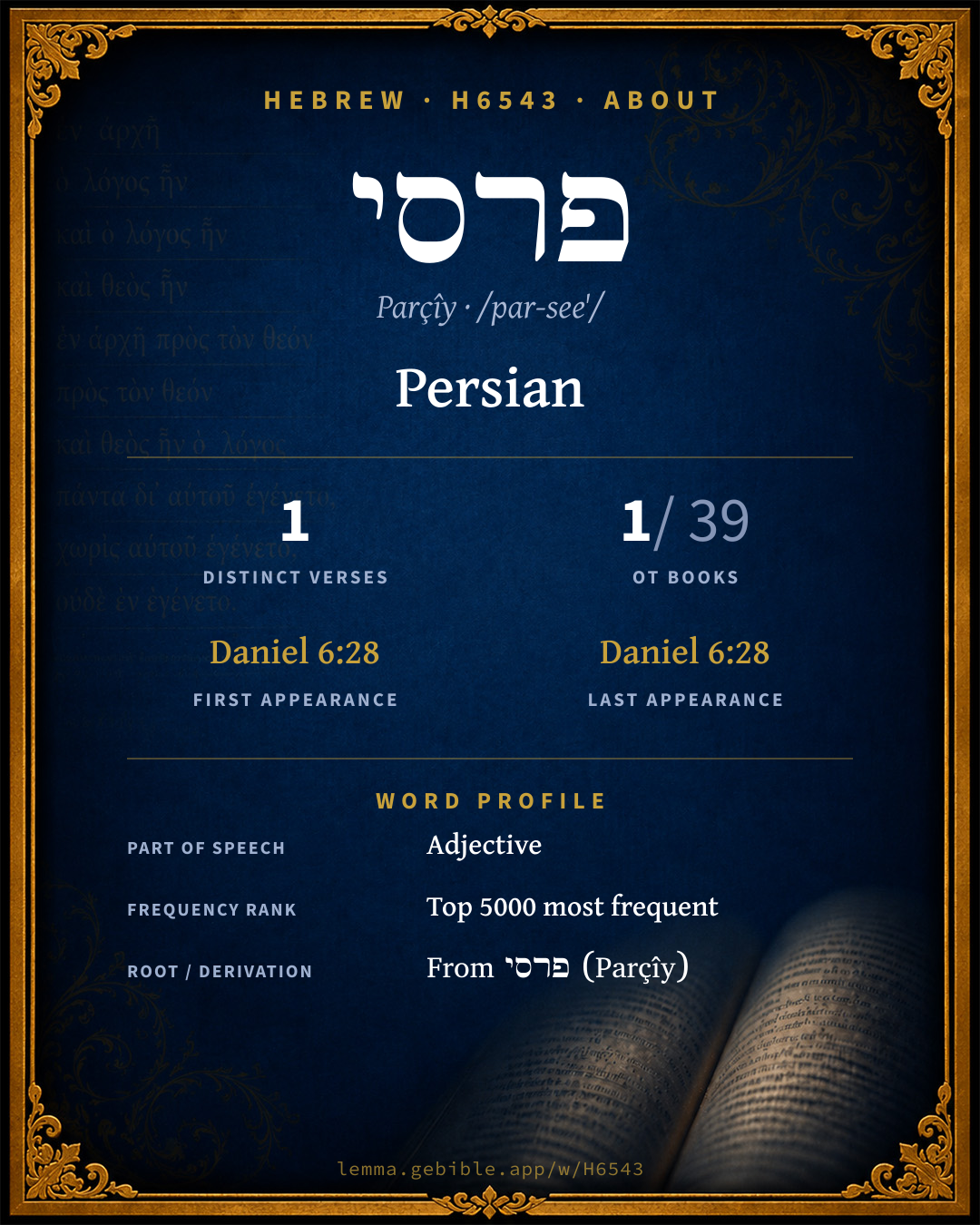
פָּרְסָאָה
Persian
BDB lists 2 entries for ‘Persian’ fuller range ↓
Full lexicon entry — Brown-Driver-Briggs (BDB)
From Brown-Driver-Briggs (BDB)
Where this word appears
Every verse where H6543 appears — 1 distinct verse across 1 book. Click any verse to open its interlinear word-by-word view. Verse text shown in the World English Bible for context — . Each verse’s Hebrew form is shown with its reference; the English is not keyword-highlighted, since the data carries no word-level English alignment. Use “Compare translations” on any verse to read it across multiple English versions. This concordance covers the Hebrew Bible; Septuagint (Greek Old Testament) occurrences are not indexed here.
Daniel 1 verse
About this entry
At a glance — auto-summarized from this page’s data, not written by a person. Every figure links to its source below. This summary describes the numbers; it doesn’t interpret them.
“Persian” is the headline sense of the Hebrew name פרסי (Parçîy). The Hebrew Bible uses it only 1 verse. More than three-quarters of its appearances fall in Daniel. Scripture uses it exactly once, at Daniel 6:28. The sections below give every occurrence and version rendering.
Gloss history
Strong's 1890 vs modern scholarship
About this word
Strong's H6543 catalogs a Hebrew word from the Hebrew Old Testament.
These counts are not copied from any lexicon or concordance. They are computed here, from the morphology-tagged Hebrew Old Testament. What Lemma adds →
- 1
- distinct verses
- The word appears in 1 distinct verse.
- 1 / 39
- OT books
- The word appears in 1 of 39 Old Testament books.
- #4,807
- by frequency
- Top 5000 most frequent Hebrew words (rank 4,807 of 8,640 Hebrew words by occurrence).
View all 1 occurrence in the concordance →
Most concentrated in
- Daniel 1 verse 100%
By section of the Old Testament
By traditional corpus
Conventional, traditional groupings — biblical authorship is debated, so this is a traditional corpus grouping, not an authorship claim. Each share is this word’s portion of its verses in that division of the Hebrew canon. Each figure is a share of the word’s 1 distinct verse.
- Writings (Ketuvim) 1 verse · 100%
How translations render this word
Counts come from each version’s own published word-to-Strong’s tagging or interlinear alignment — an approximate guide to how each version renders this word, not a word-level alignment the data otherwise carries. Because each total is that version’s own tagged count, the per-version totals vary from one another and need not match the appearance or distinct-verse counts above. These counts may also differ from a printed concordance because Lemma counts each distinctly tagged rendering and does not collapse phrase taggings into a single head-word total. This is a fixed set of word-tagged versions (KJV, ASV, BSB, ULT) and does not change with the reading translation you choose elsewhere. Each version’s license is shown beside its name below (and on Sources).
- King James Version: Persian 1×
- American Standard Version: Persian 1×
- Berean Standard Bible: Persian 1×
- unfoldingWord Literal Text: Persian 1×
King James Version Public Domain
Renders H6543 across 1 tagged occurrence — most commonly:
American Standard Version Public Domain
Renders H6543 across 1 tagged occurrence — most commonly:
Berean Standard Bible Public Domain
Renders H6543 across 1 tagged occurrence — most commonly:
unfoldingWord Literal Text CC BY-SA 4.0
Renders H6543 across 1 tagged occurrence — most commonly:
Senses in BDB
The 2 senses BDB distinguishes for this word, in lexicon order (not ranked by frequency or importance). The full entry — with sub-senses — is in the Lexicon Entry tab.
- Persian = see Persia " pure" or " splendid"
- an inhabitant of Persia
Word origin
[ פַּרְסַי ] adj.gent. Persian;—emph. Dn 6:29
— Brown-Driver-Briggs (Oxford 1906, public domain), digitized via Sefaria, supplemented by the OpenScriptures HebrewLexicon (CC BY 4.0). See Sources.
Derived from פרסי (Parçîy) (H6542) — Persian.
Jastrow Dictionary
A second Hebrew/Aramaic lexicon for comparison, covering Aramaic and post-biblical (Talmudic, Targumic, Midrashic) usage that the biblical-Hebrew BDB does not. Matched by lemma rather than by Strong’s number, so a lemma may carry more than one Jastrow headword (shown separately below), and the entries cover usage well beyond the Bible.
פְּרָסָא
- , curtain, cover. Targ. II Sam. XVII, 19 (h. text מסך). Targ. Num. III, 25, sq.; a. fr.—Ḥull. 8ᵇ, v. בְּלִיתָא. Meg. 26ᵇ האי פְּרִיסָא וכ׳ (Rashi פרסא) to make of an old curtain (covering the ark which contains the Torah scrolls) a cover for books; a. e.—Pl. פְּרָסֵי. Succ. 20ᵇ חזו לפ׳ ונפוותא are fit for covers and sieves (Ar.: for sifting nets and sieves).
פַּרְסָא
- 1. = h. פַּרְסָה I, Persian mile.—Pl. פַּרְסִין, פַּרְסֵי. Targ. Is. X, 32. Targ. Y. Num. XXI, 35; a. e.—Ḥull. 59ᵇ. Pes. 94ᵃ; a. e.
- 2. Persian. B. Kam. 55ᵃ גמלא פ׳ (Mss. H. a. R. פרסאה) a Persian camel, contrad. to an Arabian camel. Kidd. 72ᵃ, v. נוּד ch.
פַּרְסִי
- , Pali of פְּרַס; v. פְּרַס I.
פַּרְסִי ²
- Persian. Esth. R. to I, 22 פ׳ נושא … מדברת בלשון פ׳ when a Persian marries a Median woman, she must speak Persian. Ib. to I, 11 לא מדית ולא פ׳ אלא כשדית is neither a Median nor a Persian woman, but a Chaldean; a. e.—Pl. פַּרְסִים, פַּרְסִיִּים, פַּרְסִיִּין, פַּרְסִיּוֹת. Kidd. 72ᵃ. Ber. 8ᵇ בשלשה … אני אוהב את הפ׳ for the sake of three things I love the Persians. Esth. R. l. c.; a. e.—Shebi. V, 1 הפַּרְסָיוֹת Ms. M. (ed. הפַּרְסָאוֹת) Persian figs (or dates); Sifra B’har, Par. 1, ch. I; Tosef. Shebi. IV, 1 הפרסאות.
פַּרְסָי
- [Targ. II Esth. I, 8 פרסאה, read: פַּרְסָאֵי].—Y. Ber. VI, 10ᵇ bot. חד פרסי ed. Lehm. (oth. ed. פרסוי, read פרסיי) a Persian Jew. B. Kam. 59ᵃ דקלא פ׳, v. דִּקְלָא. Shebu. 34ᵇ ההוא דינא פ׳ הוא that is Persian law (arbitrariness); B. Kam. 58ᵇ דינא דפרסאה (Ms. R. דינא פרסאה; Rashi דינא דפַרְסָאֵי); a. e.—Pl. (פַּרְסֵי) פַּרְסָאֵי. Targ. II Esth. l. c. Targ. Esth. I, 14; a. e.—Ab. Zar. 24ᵇ כמאן קרו פ׳ לספרא דביר by what authority do the Persian Jews call a book d’bir? Ib. v. דִּיסְתָּנָא II. Yoma 77ᵃ, v. אִיסְרָא II; Yalk. Ez. 347. Ib. בשני דפ׳ (Yoma l. c. במלכותא דפרס, v. Rabb. D. S. a. l. note 3) during the years of the Persian rule; a. e.—Fem. פַּרְסָאִיתָא. Targ. II Esth. I, 16.—Pl. פַּרְסְיָאתָא, פַּרְסְיָיתָא. Ib. 12.—Ber. 44ᵇ, v. אוּפֵי. Sabb. 143ᵃ ודפרסייתא Rashi (ed. ודפַרְסְיָתָא) and the stones of Persian dates.
A Dictionary of the Targumim, the Talmud Babli and Yerushalmi, and the Midrashic Literature (Marcus Jastrow; London, Luzac, 1903) — Public Domain. Digitized via Sefaria. Digitized via Sefaria. Full attribution on Sources.
Forms in the corpus
The 2 distinct written forms H6543 takes in the Hebrew Bible, most frequent first — each parse links to that state’s occurrences in the concordance. Hebrew forms include their vowel points and cantillation, so a single lemma takes many written forms.
| Form | Parsing | Example | Uses |
|---|---|---|---|
| פָּרְסָאָֽ/ה | Particle, Definite Article | Daniel 6:28 | 1 |
| פרסי/א | Particle, Definite Article | Daniel 6:28 | 1 |
Septuagint verse parallels
This word appears in 1 verse that also exists in the Greek Old Testament (Septuagint), out of the 1 Hebrew verse it occurs in. You can read those verses in Greek by switching the Old Testament edition to the Septuagint.
Read these verses in the Septuagint
This is a verse-level parallel only — the same verses exist in both the Hebrew and Greek Old Testaments. No word-level Hebrew↔Greek correspondence is claimed: the data carries no such alignment, so no Greek word is shown as this Hebrew word’s translation. Coverage is not total — the Septuagint omits the deuterocanon and renumbers the Psalms, so some Hebrew verses have no direct Greek parallel.