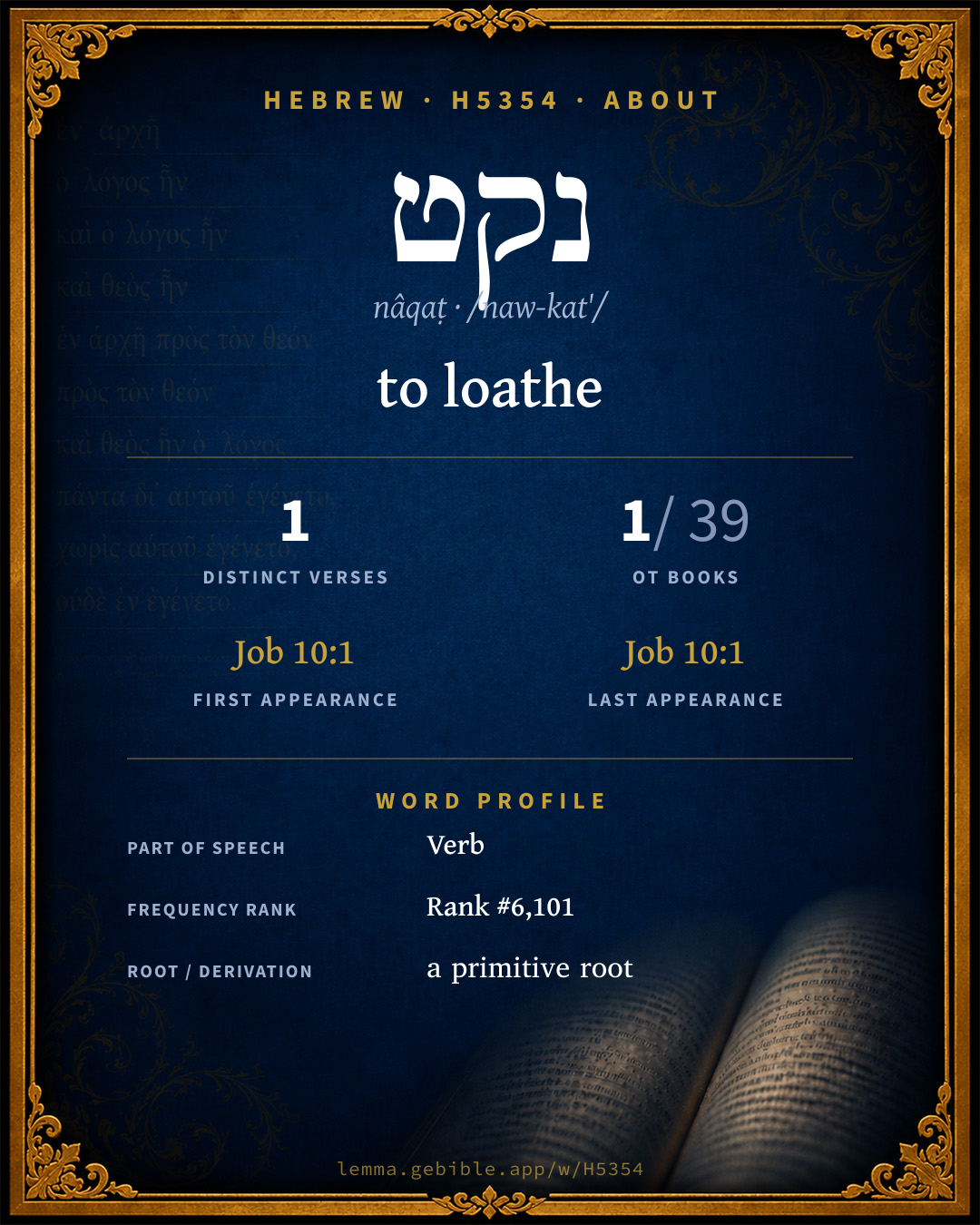
נָקַט
to loathe
also: be grieved, feel a loathing fuller range ↓
Full lexicon entry — Brown-Driver-Briggs (BDB)
From Brown-Driver-Briggs (BDB)
Where this word appears
Grammar key — what these labels mean
Part of speech
- Verb
- An action or state-of-being word.
Stem
- Niphal
- Usually the simple passive or reflexive of the Qal (“he was written”).
Form
- Perfect
- A completed action or state — Hebrew marks aspect (completeness) more than strict tense (“he wrote”).
Person
- 3rd Person
- The one spoken about (“he / she / it / they”).
Gender
- Feminine
- Grammatically feminine.
Number
- Singular
- One.
Every verse where H5354 appears — 1 distinct verse across 1 book. Click any verse to open its interlinear word-by-word view. Verse text shown in the World English Bible for context — . Each verse’s Hebrew form is shown with its reference; the English is not keyword-highlighted, since the data carries no word-level English alignment. Use “Compare translations” on any verse to read it across multiple English versions. This concordance covers the Hebrew Bible; Septuagint (Greek Old Testament) occurrences are not indexed here.
Job 1 verse
About this entry
At a glance — auto-summarized from this page’s data, not written by a person. Every figure links to its source below. This summary describes the numbers; it doesn’t interpret them.
נקט (nâqaṭ) is a Hebrew verb most often rendered “to loathe.” A scarce word — 1 verse in all of the Hebrew Bible. Job dominates its distribution — 1 of 1 verses. A true hapax — its single appearance is Job 10:1. The lexical range runs to 2 senses — “to loathe” plus “be grieved” and “feel a loathing”. For the data behind this summary, explore the sense tree and the renderings breakdown below.
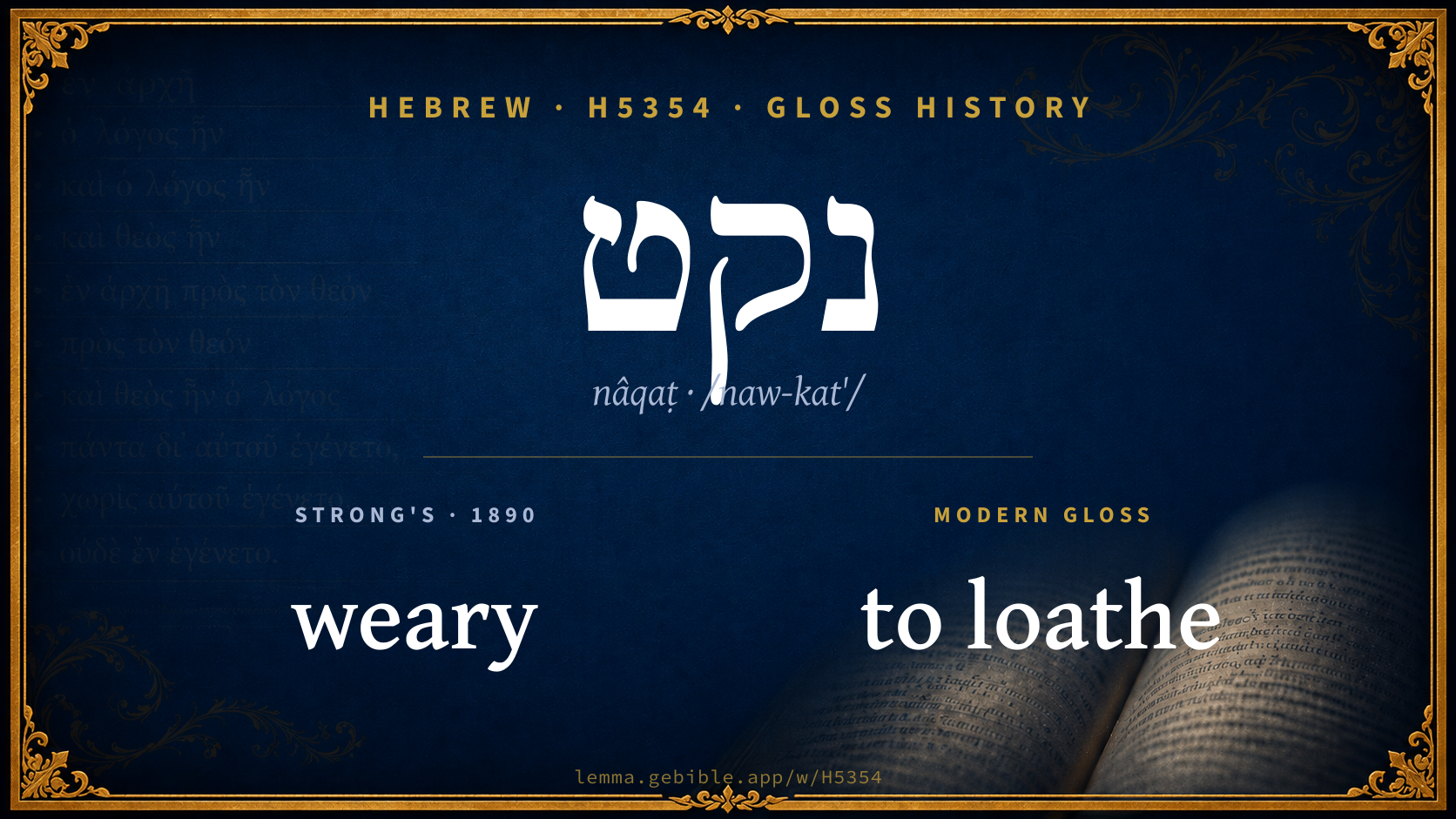
Gloss history
Strong's 1890 vs modern scholarship
About this word
Strong's H5354 catalogs a Hebrew word from the Hebrew Old Testament.
These counts are not copied from any lexicon or concordance. They are computed here, from the morphology-tagged Hebrew Old Testament. What Lemma adds →
- 1
- distinct verses
- The word appears in 1 distinct verse.
- 1 / 39
- OT books
- The word appears in 1 of 39 Old Testament books.
- #6,101
- by frequency
- Rank #6,101 (rank 6,101 of 8,640 Hebrew words by occurrence).
View all 1 occurrence in the concordance →
Most concentrated in
- Job 1 verse 100%
By section of the Old Testament
By traditional corpus
Conventional, traditional groupings — biblical authorship is debated, so this is a traditional corpus grouping, not an authorship claim. Each share is this word’s portion of its verses in that division of the Hebrew canon. Each figure is a share of the word’s 1 distinct verse.
- Writings (Ketuvim) 1 verse · 100%
How translations render this word
Counts come from each version’s own published word-to-Strong’s tagging or interlinear alignment — an approximate guide to how each version renders this word, not a word-level alignment the data otherwise carries. Because each total is that version’s own tagged count, the per-version totals vary from one another and need not match the appearance or distinct-verse counts above. These counts may also differ from a printed concordance because Lemma counts each distinctly tagged rendering and does not collapse phrase taggings into a single head-word total. This is a fixed set of word-tagged versions (KJV, ASV, BSB, ULT) and does not change with the reading translation you choose elsewhere. Each version’s license is shown beside its name below (and on Sources).
- King James Version: Is weary 1×
- American Standard Version: Is weary 1×
- Berean Standard Bible: I loathe 1×
- unfoldingWord Literal Text: Is weary 1×
King James Version Public Domain
Renders H5354 across 1 tagged occurrence — most commonly:
American Standard Version Public Domain
Renders H5354 across 1 tagged occurrence — most commonly:
Berean Standard Bible Public Domain
Renders H5354 across 1 tagged occurrence — most commonly:
unfoldingWord Literal Text CC BY-SA 4.0
Renders H5354 across 1 tagged occurrence — most commonly:
Senses in BDB
The 2 senses BDB distinguishes for this word, in lexicon order (not ranked by frequency or importance). The full entry — with sub-senses — is in the Lexicon Entry tab.
- to loathe, be grieved, feel a loathing
- (Qal) to feel a loathing
Word origin
Origin: a primitive root
Jastrow Dictionary
A second Hebrew/Aramaic lexicon for comparison, covering Aramaic and post-biblical (Talmudic, Targumic, Midrashic) usage that the biblical-Hebrew BDB does not. Matched by lemma rather than by Strong’s number, so a lemma may carry more than one Jastrow headword (shown separately below), and the entries cover usage well beyond the Bible.
נָקַט
- (cmp. לָקַט) to hold in hand, take, seize. [נקטה Pesik. B’shall., p. 81ᵇ; Yalk. Ex. 225, v. קוּט.]
- to cause to hold, to procure. Ex. R. s. 1 ומְנַקֵּט להם שני וכ׳ (some ed. ומלקט) and provided for them two balls (breast-shaped stones); (Sot. 11ᵇ ומלקט; Yalk. Ex. 164 ומלקט; Yalk. Ez. 354 ונותן).
נְקַט
- (corresp. to h. אָחַז). Targ. Esth. VI, 1; a. fr.—Part. act. נָקֵיט, pass. נְקִיט holding. Ib. VIII, 15; a. fr.—Shebu. 38ᵇ נ׳ חפצא וכ׳ he held an object in his hand (on being sworn). Ab. Zar. 30ᵃ הוה נקיט חמרא בהדיה was carrying wine with him. Ib. סירכא דגברא נְקִיטָה she holds fast (clings to) the habit of her (deceased) husband. Sanh. 5ᵃ נְקִיטְנָא רשותא I hold a license (to teach). M. Kat. 28ᵃ, a. e. נְקוֹט לך מיהא וכ׳ hold at least half of it in thy hand, i.e. admit as certain &c.; Snh. 90ᵇ נְקוֹטוּ (not נקוטי); a. v. fr.—Ḥull. 53ᵃ, a. fr. נַקְטִינָן, נְקִיטִינָן we hold a tradition.—Sabb. 116ᵇ top נקיט שמא וכ׳ quoted in Levy Talm. Dict. (ed. שקיל) had the reputation that &c. Gitt. 56ᵃ נְקוֹט נפשך בקצירי have thyself counted among the sick, i.e. have the report spread that thou art sick. Ḥull. 87ᵃ נקוט לי זימנא וכ׳ keep time for me &c., i.e. allow me three days’ time.—Trnsf. to contract a habit. B. Kam. 57ᵃ, v. נִיגְרָא.
- , Pa. נַקֵּיט
- 1. to cause to hold, to give, hand. Targ. II Esth. IV, 16.—Pes. 110ᵃ מְנַקְּטָא ליה אימיה וכ׳ (not מנקיט, v. Rabb. D. S. a. l. note) his mother was ready to hand him two cups. Ib. מַנְקֵיט ליה וכ׳ (or מְנַקֵּיט) his servant was ready to hand him &c. B. Kam. 85ᵇ לאַנְקוּטֵיה גוונא דבישריה to make him regain the natural color of flesh; a. e.—B. Bath. 22ᵃ נַקֵּיט ליה שוקא make him take the market, i.e. give him the monopoly of sale.
- 2. to pick up, gather. Ned. 50ᵃ וכ׳ (read הות … מְנַקְּטָא) הוה קא מנקיט she picked the straw out of his hair.
- 3. to cause to contract a habit, train. B. Kam. 118ᵇ; B. Bath. 88ᵃ אַנְקְטִינְהוּ וכ׳, v. נִיגְרָא.
- 4. *to carry. Targ. Y. Ex. XXI, 37 אַקְּטֵיה בגנבותיה he carried it (on his shoulder) when he stole it.
- to receive. Yeb. 42ᵇ מִנְּקִיט ואזיל הלכתא וכ׳ received instruction from him while walking.
A Dictionary of the Targumim, the Talmud Babli and Yerushalmi, and the Midrashic Literature (Marcus Jastrow; London, Luzac, 1903) — Public Domain. Digitized via Sefaria. Digitized via Sefaria. Full attribution on Sources.
Septuagint verse parallels
This word appears in 1 verse that also exists in the Greek Old Testament (Septuagint), out of the 1 Hebrew verse it occurs in. You can read those verses in Greek by switching the Old Testament edition to the Septuagint.
Read these verses in the Septuagint
This is a verse-level parallel only — the same verses exist in both the Hebrew and Greek Old Testaments. No word-level Hebrew↔Greek correspondence is claimed: the data carries no such alignment, so no Greek word is shown as this Hebrew word’s translation. Coverage is not total — the Septuagint omits the deuterocanon and renumbers the Psalms, so some Hebrew verses have no direct Greek parallel.