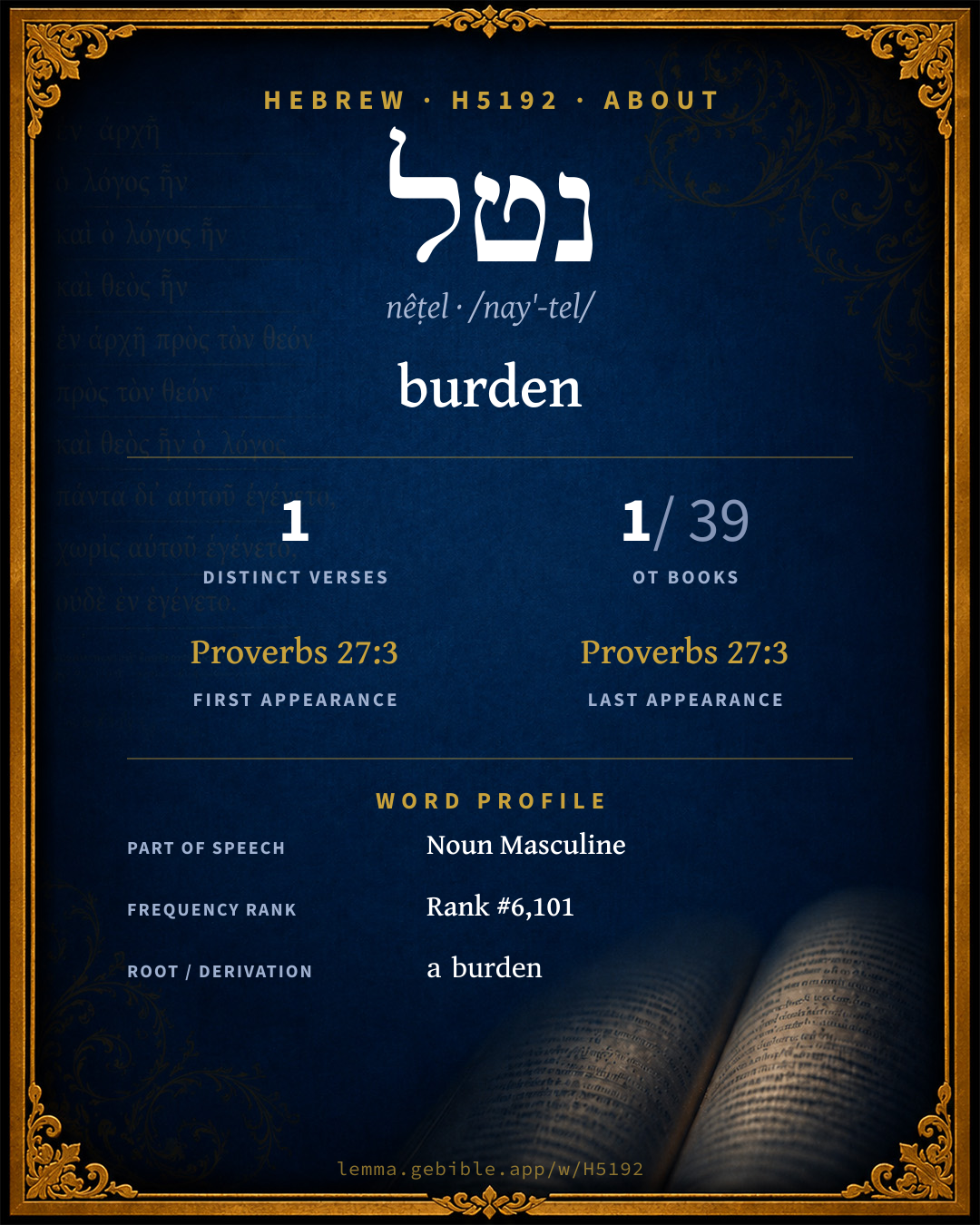
נֵ֫טֶל
burden
Full lexicon entry — Brown-Driver-Briggs (BDB)
From Brown-Driver-Briggs (BDB)
Where this word appears
Grammar key — what these labels mean
Noun type
- Common
- A common noun — a general class of person, place, or thing (“king,” “city,” “water”), not a specific name.
State
- Construct
- A noun bound to a following noun in a possessive / “of” relationship (the construct chain).
Gender
- Masculine
- Grammatically masculine.
Number
- Singular
- One.
Every verse where H5192 appears — 1 distinct verse across 1 book. Click any verse to open its interlinear word-by-word view. Verse text shown in the World English Bible for context — . Each verse’s Hebrew form is shown with its reference; the English is not keyword-highlighted, since the data carries no word-level English alignment. Use “Compare translations” on any verse to read it across multiple English versions. This concordance covers the Hebrew Bible; Septuagint (Greek Old Testament) occurrences are not indexed here.
Proverbs 1 verse
About this entry
At a glance — auto-summarized from this page’s data, not written by a person. Every figure links to its source below. This summary describes the numbers; it doesn’t interpret them.
At its core, נטל (nêṭel) means “burden.” It occurs a mere 1 verse across Scripture. Its uses cluster heavily in Proverbs (100% of all occurrences). Found nowhere else but Proverbs 27:3. Each statement above links to its evidence; the full detail follows below.
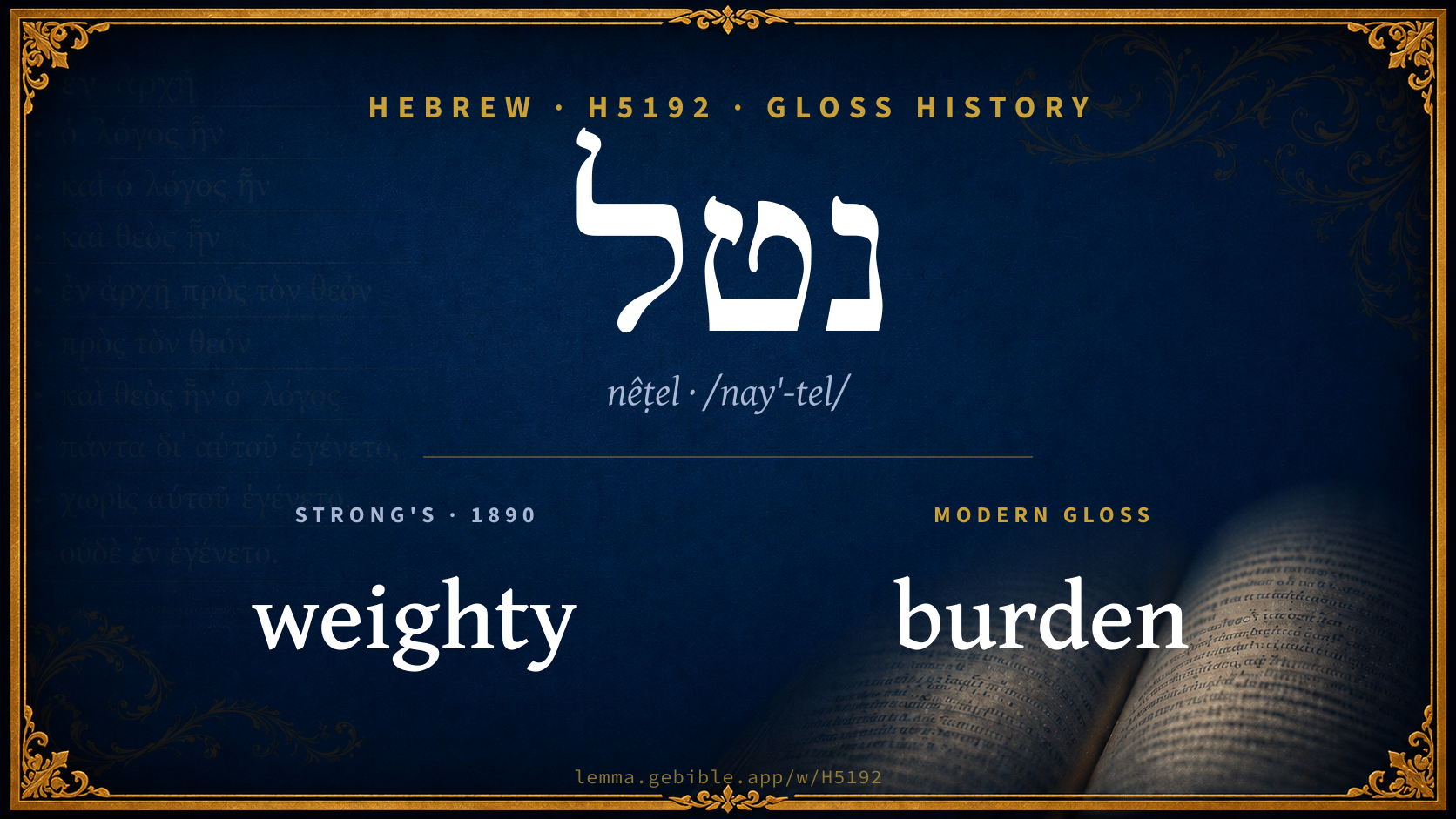
Gloss history
Strong's 1890 vs modern scholarship
About this word
Strong's H5192 catalogs a Hebrew word from the Hebrew Old Testament.
These counts are not copied from any lexicon or concordance. They are computed here, from the morphology-tagged Hebrew Old Testament. What Lemma adds →
- 1
- distinct verses
- The word appears in 1 distinct verse.
- 1 / 39
- OT books
- The word appears in 1 of 39 Old Testament books.
- #6,101
- by frequency
- Rank #6,101 (rank 6,101 of 8,640 Hebrew words by occurrence).
View all 1 occurrence in the concordance →
Most concentrated in
- Proverbs 1 verse 100%
By section of the Old Testament
By traditional corpus
Conventional, traditional groupings — biblical authorship is debated, so this is a traditional corpus grouping, not an authorship claim. Each share is this word’s portion of its verses in that division of the Hebrew canon. Each figure is a share of the word’s 1 distinct verse.
- Writings (Ketuvim) 1 verse · 100%
How translations render this word
Counts come from each version’s own published word-to-Strong’s tagging or interlinear alignment — an approximate guide to how each version renders this word, not a word-level alignment the data otherwise carries. Because each total is that version’s own tagged count, the per-version totals vary from one another and need not match the appearance or distinct-verse counts above. These counts may also differ from a printed concordance because Lemma counts each distinctly tagged rendering and does not collapse phrase taggings into a single head-word total. This is a fixed set of word-tagged versions (KJV, ASV, BSB, ULT) and does not change with the reading translation you choose elsewhere. Each version’s license is shown beside its name below (and on Sources).
- King James Version: Weighty 1×
- American Standard Version: Weighty 1×
- Berean Standard Bible: Burden 1×
- unfoldingWord Literal Text: Weightiness of 1×
King James Version Public Domain
Renders H5192 across 1 tagged occurrence — most commonly:
American Standard Version Public Domain
Renders H5192 across 1 tagged occurrence — most commonly:
Berean Standard Bible Public Domain
Renders H5192 across 1 tagged occurrence — most commonly:
unfoldingWord Literal Text CC BY-SA 4.0
Renders H5192 across 1 tagged occurrence — most commonly:
Senses in BDB
The 1 sense BDB distinguishes for this word, in lexicon order (not ranked by frequency or importance). The full entry — with sub-senses — is in the Lexicon Entry tab.
- burden, weight
Word origin
נֵ֫טֶל n.[m.] burden, weight;—cstr., of sand, Pr 27:3
— Brown-Driver-Briggs (Oxford 1906, public domain), digitized via Sefaria, supplemented by the OpenScriptures HebrewLexicon (CC BY 4.0). See Sources.
Origin: a burden
Jastrow Dictionary
A second Hebrew/Aramaic lexicon for comparison, covering Aramaic and post-biblical (Talmudic, Targumic, Midrashic) usage that the biblical-Hebrew BDB does not. Matched by lemma rather than by Strong’s number, so a lemma may carry more than one Jastrow headword (shown separately below), and the entries cover usage well beyond the Bible.
נָטַל
- 1. to move, carry off; to receive, take. B. Mets. I, 1 זה נוֹטֵל וכ׳ the one (of the claimants) gets three shares &c. Y. Sot. I, 16ᵈ bot., a. e. ומה שכר נָטְלוּ על כך what reward did they get for it?—Sifra Sh’mini, beg. מסיני נטלו להם they got (their punishment) from Sinai. Sabb. 151ᵇ טוֹל מה וכ׳ take away what thou hast put into me. Arakh. 16ᵇ; B. Bath. 15ᵇ טול קיסם מבין עיניך (Ag. Hatt. שיניך) remove the chip from between thy eyes (teeth); טול קורה וכ׳ remove the beam from &c. Gitt. VI, 1 אף האומרת טול לי גטי even if she says, get me my letter of divorce (instead of ‘receive for me’). Ib. 78ᵃ טְלִי גיטיך וכ׳ take up thy letter of divorce from the ground. Pesik. R. s. 26, end נָטַלְתִּי עיני I lifted up my eyes. Ber. II, 8 לא כל הרוצה לִיטּוֹל לו את השם יִטּוֹל Y. ed., not every one who desires to assume a name, may assume it, i.e. not every one has a right to consider himself superior to the masses (v. יוֹהֲרָא); a. v. fr.—Part. pass. נָטוּל; f. נְטוּלָה removed. Ned. XI, 12 (if a woman says) נ׳ אני מן היהודים I will be removed from (keep no company with) Jews; יפר … ותהא נ׳ וכ׳ the husband may forbid the vow as far as it concerns himself, and (for the rest) let her be isolated &c.—Snh. 21ᵇ נְטוּלֵי טחול persons who had their milt cut out (to make them fast runners).—V. נְטוּלָה.
- 2. (sub. מים) to pour water over one’s hands for purification; נ׳ לידים, (ellipt.) נ׳ ידים, or only נ׳ to wash the hands before and after meals, before prayer &c. Tosef. Yad. I, 1 מי רביעית נוֹטְלִין לידים וכ׳ (Var. ed. Zuck., a. Mish. ib. I, 1 נותנין) a quantity of one fourth of a Log of water may be used for pouring over the hands of one person &c. Ib. 13 הנוֹטֵל לידים הנוטל מתכוין והנותן וכ׳ if a person had his hands washed, himself having the intention (of purification), while he who poured it had not. Ib. 2; Mish. ib. II, 3 נ׳ את הראשונים if he began to use the water for washing before the meal (v. מַיִם). Ḥull. 107ᵃ נוטלין ממנו לידים you may use it for washing the hands; Tosef. l. c. 6. Ber. VIII, 2. Ib. 51ᵃ אל תִּטּוֹל ידיך ממי וכ׳ have not water poured over thy hands by one who has not washed his hands &c. Ḥull. 105ᵃ נוטלין … בכלי you must wash over a vessel (receiving the water); ע"ג קרקע on the floor; a. v. fr.
- 1. to be handled. Sabb. XVII, 1 (122ᵇ) כל הכלים נִיטְּלִין בשבת all vessels (implements, utensils &c.) may be handled on the Sabbath. Ib. 43ᵃ, a. e. אין כלי נ׳ אלא לדבר הנ׳ בשבת a utensil must not be handled on the Sabbath except for the protection of a thing which may be used on the Sabbath. Par. V, 9 והן יכולות להִנָּטֵל וכ׳ and they can be handled simultaneously; a. fr.
- 2. to be removed, be gone. Ḥull. III, 1; 2, v. כָּבֵר III. Ohol. II, 3 כדי שיִנָּטֵל מן כ׳ as much of it as, if cut out from the skull of a living being, would cause death; a. fr.
- 3. to be used for washing hands. Tosef. Yad. II, 7 לא נִטְּלוּ מן הכלי the water was not poured directly from the vessel; לא ניטלו מן הרביעית not poured from a vessel containing one fourth of a Log; a. fr.
- 1. to throw; to put; to hang on, attach. Gitt. V, 9 משתַּטִּיל המים from the time she pours water on the flour. Yoma III, 2 המַטִּיל מים who urinates. Men. 40ᵇ ה׳ לבעלת וכ׳ if he attached the fringe (תְּכֵלֶת) to a three-cornered garment. Sabb. 42ᵇ להַטִּיל ביצתה to lay her eggs; a. fr.
- 2. (of plants) to assume the shape of, to develop. Maasr. I, 2 משיַטִּילוּ שאור, v. שְׂאוֹר; ib. משיטילו גידין, v. גִּיד.
- to be thrown; to lie. Part. מוּטָּל, f. מוּטֶּלֶת; pl. מוּטָּלִים, מוּטָּלִין; מוּטָּלוֹת a) lying. Kidd. 82ᵇ מ׳ ברעב lies prostrated from starvation. Ber. III, 1 מי שמתו מ׳ לפניו he whose dead relative lies before him; ib. 18ᵃ כיון שמ׳ עליו לקוברו כמ׳ וכ׳ since the duty of burying rests upon him, it is the same as if the body were lying before him. Yeb. 37ᵇ, a. fr. ממון המ׳ בספק, v. סָפֵק; a. fr.—b) מוּטֶּלֶת a garment provided with show-fringes. Men. l. c. הטיל למ׳ if he attached additional fringes to a garment provided &c.; a. fr.
נְטַל
- 1. (corresp. to h. נָשָׂא) to take, lift, move, carry. Targ. Ex. X, 13. Targ. Ps. CXXXIV, 2 טוּלוּ (imperat.); a. fr.
- 2. (corresp. to h. נָסַע) to move. Targ. Gen. XX, 1. Targ. Ps. LV, 9 נָטְלָא (Bxt. נטילה; h. text סעה); a. fr.
- 3. to wash the hands. Y. Ber. VIII, 12ᵃ bot. הוה נ׳ ידיה is to be considered as if he had washed his hands.
- to lift, carry. Targ. O. Deut. XXXII, 11. Targ. Is. LXIII, 9; a. e.—Part. pass. מְנַטַּל, מְנַטְּלָא; f. מְנַטְּלָא; pl. מְנַטְּלִין, מְנַטְּלַיָּא; מְנַטְּלָתָא exalted, high. Targ. Y. Deut. XXVIII, 13 (opp. מאיסין). Targ. Y. I ib. IV, 7. Targ. Is. LVII, 15. Targ. II Esth. I, 2. Targ. Prov. XXX, 13. Targ. Y. Ex. XV, 1 (not מַנְטְלַ׳). Targ. Is. II, 14.
- 1. to cause to move, to pass. Targ. Ex. XV, 22. Targ. Ps. LXXVIII, 26. Targ. Y. Deut. XXVI, 9; a. fr.
- 2. to throw; א׳ (ב)אבנין to stone to death. Targ. Y. Deut. XIII, 11 תְאַנְטלוּן, תְאַטְּ׳ (!); a. fr.—[Targ. Y. II, Ex. XXXIII, 22, v. טְלַל.]
- ; Ithpe. אִתְנְטִיל, אִינְּ׳
- 1. to be lifted up; to be exalted. Targ. Ps. XC, 2. Targ. Y. Ex. XV, 1; a. e.
- 2. to lift one’s self up, be overbearing. Targ. Y. Num. XVII, 5.
- 3. to be taken away, removed. Targ. Job IV, 21. Targ. Esth. VIII, 10; a. e.—[Snh. 91ᵃ (quot. fr. Meg. Taan. ch. III) אתנטילו דימוסנאי, v. דִּימוֹסְנָאֵי.]
A Dictionary of the Targumim, the Talmud Babli and Yerushalmi, and the Midrashic Literature (Marcus Jastrow; London, Luzac, 1903) — Public Domain. Digitized via Sefaria. Digitized via Sefaria. Full attribution on Sources.
Septuagint verse parallels
This word appears in 1 verse that also exists in the Greek Old Testament (Septuagint), out of the 1 Hebrew verse it occurs in. You can read those verses in Greek by switching the Old Testament edition to the Septuagint.
Read these verses in the Septuagint
This is a verse-level parallel only — the same verses exist in both the Hebrew and Greek Old Testaments. No word-level Hebrew↔Greek correspondence is claimed: the data carries no such alignment, so no Greek word is shown as this Hebrew word’s translation. Coverage is not total — the Septuagint omits the deuterocanon and renumbers the Psalms, so some Hebrew verses have no direct Greek parallel.