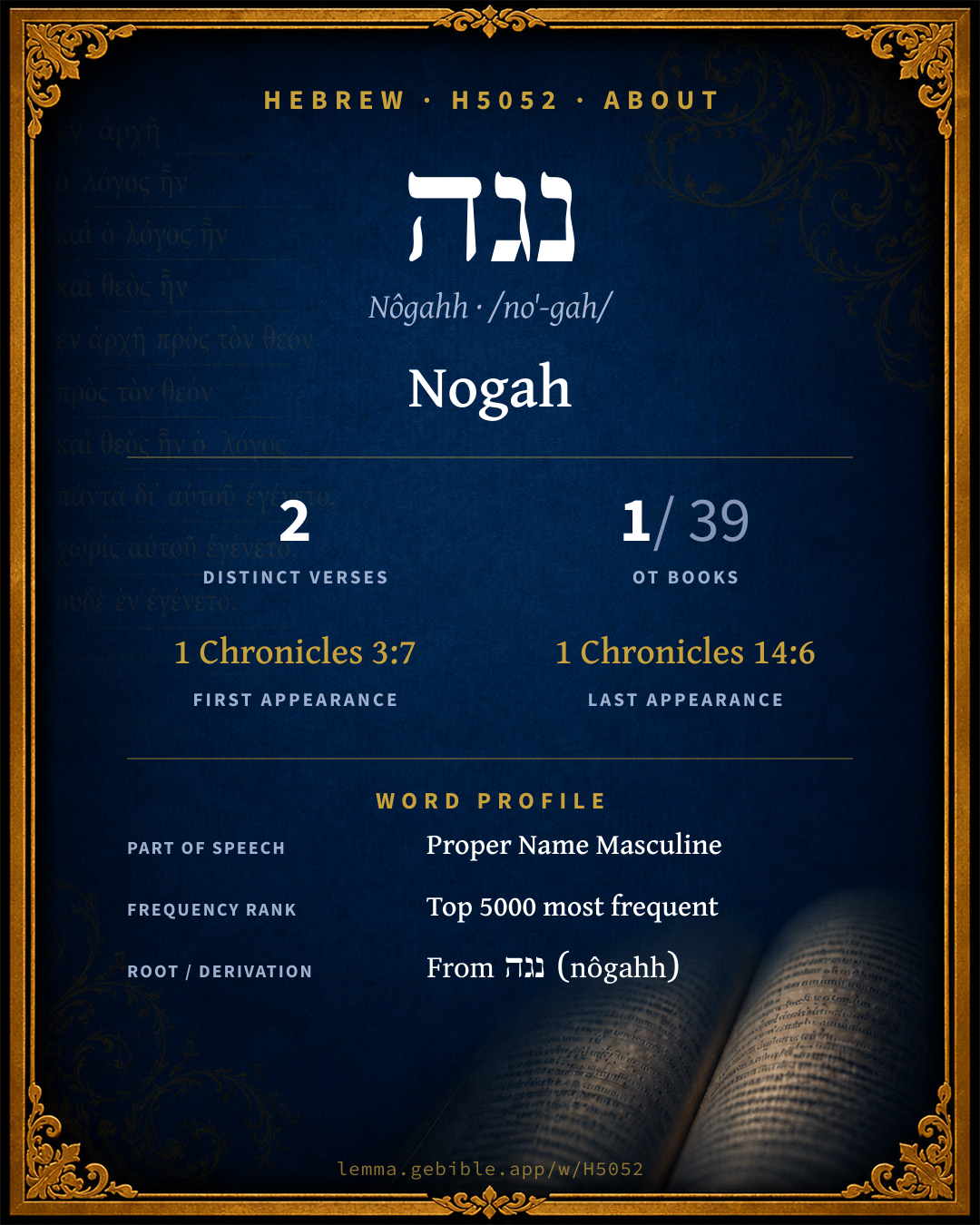
נֹ֫גַהּ
Nogah
BDB lists 2 entries for ‘Nogah’ fuller range ↓
Full lexicon entry — Brown-Driver-Briggs (BDB)
From Brown-Driver-Briggs (BDB)
Where this word appears
Grammar key — what these labels mean
Noun type
- Proper
- A name of a specific person, place, or people (e.g. Abraham, Zion, Israel).
Every verse where H5052 appears — 2 distinct verses across 1 book. Click any verse to open its interlinear word-by-word view. Verse text shown in the World English Bible for context — . Each verse’s Hebrew form is shown with its reference; the English is not keyword-highlighted, since the data carries no word-level English alignment. Use “Compare translations” on any verse to read it across multiple English versions. This concordance covers the Hebrew Bible; Septuagint (Greek Old Testament) occurrences are not indexed here.
1 Chronicles 2 verses
About this entry
At a glance — auto-summarized from this page’s data, not written by a person. Every figure links to its source below. This summary describes the numbers; it doesn’t interpret them.
“Nogah” is the headline sense of the Hebrew name נגה (Nôgahh). With only 2 verses it sits in the long tail of Hebrew Bible vocabulary. It clusters heavily in 1 Chronicles, which alone accounts for 100% of its uses. Scripture first uses it in 1 Chronicles 3:7. The sections below give every occurrence and version rendering.
Gloss history
Strong's 1890 vs modern scholarship
About this word
Strong's H5052 catalogs a Hebrew word from the Hebrew Old Testament.
These counts are not copied from any lexicon or concordance. They are computed here, from the morphology-tagged Hebrew Old Testament. What Lemma adds →
- 2
- distinct verses
- The word appears in 2 distinct verses.
- 1 / 39
- OT books
- The word appears in 1 of 39 Old Testament books.
- #4,807
- by frequency
- Top 5000 most frequent Hebrew words (rank 4,807 of 8,640 Hebrew words by occurrence).
View all 2 occurrences in the concordance →
Most concentrated in
- 1 Chronicles 2 verses 100%
By section of the Old Testament
By traditional corpus
Conventional, traditional groupings — biblical authorship is debated, so this is a traditional corpus grouping, not an authorship claim. Each share is this word’s portion of its verses in that division of the Hebrew canon. Each figure is a share of the word’s 2 distinct verses.
- Writings (Ketuvim) 2 verses · 100%
How translations render this word
Counts come from each version’s own published word-to-Strong’s tagging or interlinear alignment — an approximate guide to how each version renders this word, not a word-level alignment the data otherwise carries. Because each total is that version’s own tagged count, the per-version totals vary from one another and need not match the appearance or distinct-verse counts above. These counts may also differ from a printed concordance because Lemma counts each distinctly tagged rendering and does not collapse phrase taggings into a single head-word total. This is a fixed set of word-tagged versions (KJV, ASV, BSB, ULT) and does not change with the reading translation you choose elsewhere. Each version’s license is shown beside its name below (and on Sources).
BDB lists this Strong’s number as 2 distinct words (homographs). Each count above pools all of them and is not split by sense — see the Senses section below. A low-frequency rendering may belong to a different one of those words, not the primary meaning.
- King James Version†: Nogah 2×
- American Standard Version†: Nogah 2×
- Berean Standard Bible†: Nogah 2×
- unfoldingWord Literal Text†: Nogah 2×
King James Version Public Domain
Renders H5052 across 2† tagged occurrences — most commonly:
American Standard Version Public Domain
Renders H5052 across 2† tagged occurrences — most commonly:
Berean Standard Bible Public Domain
Renders H5052 across 2† tagged occurrences — most commonly:
unfoldingWord Literal Text CC BY-SA 4.0
Renders H5052 across 2† tagged occurrences — most commonly:
Senses in BDB
The 2 senses BDB distinguishes for this word, in lexicon order (not ranked by frequency or importance). The full entry — with sub-senses — is in the Lexicon Entry tab.
- Nogah = "brightness"
- one of the 13 sons of David born to him in Jerusalem
Word origin
I. n.f. Hb 3:4 (?) brightness;—נ׳ abs. Am. 5:20 +; cstr. Is 4:5 +; sf. נָגְהָם Jo 2:10; 4:15;—brightness of a (clear, sunshiny) day Am 5:20 (‖ אוֹר; opp. אָפֵל, חֹשֶׁךְ), 2 S 23:4 (מִמָּטָר after rain); so fig. of Zion’s dawning, נ׳ זַרְחֵךְ Is 60:3 (‖ אוֹר); of her righteousness כַּנֹּגַהּ 62:1 (c. art. only here and Ez 1:28), ‖ כְּלַפִּיד יִבְעָ֑ר; of moon Is 60:19, of stars Jo 2:10; 4:15; of theophany 2 S 22:13 = ψ 18:13 (in storm); cf. Ez 1:4, 27, 28, נ׳ כְּבוֹד י׳ 10:4; נ׳ כאור Hb 3:4; נ׳ לָאֵשׁ Ez 1:13, נ׳ אֵשׁ לֶהָבָה Is 4:5; נ׳ בְּרַק חֲנִיתֶ֑ךָ Hb 3:11 (of glitter of י׳’s spear; ‖ אוֹר חִצֶּיךָ); of individ., וְאֵין נ׳ לוֹ Is 50:10 (fig. of distress ‖ חֲשֵׁכִים); so וְאֹרַח צַדִּיקִים כְּאוֹר נ׳ Pr 4:18 the path of righteous men is like a light of brightness.
II. n.pr.m. a son of David according to 1 Ch 3:7; 14:6. 𝔊 Ναγαι, Ναγεθ, etc.
— Brown-Driver-Briggs (Oxford 1906, public domain), digitized via Sefaria, supplemented by the OpenScriptures HebrewLexicon (CC BY 4.0). See Sources.
Derived from נגה (nôgahh) (H5051) — brightness.
Jastrow Dictionary
A second Hebrew/Aramaic lexicon for comparison, covering Aramaic and post-biblical (Talmudic, Targumic, Midrashic) usage that the biblical-Hebrew BDB does not. Matched by lemma rather than by Strong’s number, so a lemma may carry more than one Jastrow headword (shown separately below), and the entries cover usage well beyond the Bible.
נָגַהּ
- (b. h.) to burst forth; to be bright, shine. V. גִּיהַּ a. גִּיחַ.
- 1. to shed light. Pirké d’R. El. ch. XXXVIII; Yalk. Josh. 18 [read:] היתה אבנו מַגִּיהָה את אורה its (the tribe’s) jewel shed its light; a. e.
- 2. (cmp. Hif. of נָבַט) to look over; to revise a manuscript, to correct, restore (when faded). Ber. 13ᵃ בקורא להַגִּיהַּ when he reads for the sake of revising. Y. Sabb. VII, 10ᵇ bot. (in a misplaced passage) אם להגיה כדי להגיה וכ׳ (not להגות) if (he carries ink) for the purpose of correcting, (he is guilty when carrying) enough to correct one letter. Keth. 106ᵃ מַגִּיהֵי ספרים וכ׳ the official revisers of Biblical manuscripts; Y. Shek. IV, 48ᵃ top מַגִּיהֵי ספר העזרה (Bab. ed. Var. עזרא, v. Rabb. D. S. a. l. note) the revisers of the Temple manuscript. M. Kat. III, 4 (18ᵇ) אין מַגִּיהִין אות אחת אפי׳ בספרי העזרה Ms. M. (ed. בספר עזרא, v. Rabb. D. S. a. l. note) we dare not (during the festive week) correct (restore) one letter even in the Temple books (ed. in the manuscript named after Ezra). Meg. II, 2 היה … ומַגִּיהָהּ if he recited the Book of Esther while he was writing or teaching or correcting it; a. fr.—Part. pass. מוּגָּהּ revised, correct. Pes. 112ᵃ כשאתה … למדהו בספר מ׳ when thou teachest thy son, teach him from a corrected book. Keth. 19ᵇ ספר שאינו מ׳ an unrevised Bible manuscript.
נְגַהּ
- 1. same, to be bright, shine. Yoma 28ᵇ אי הכי נ׳ ליה טובא (Ms. M. נַגְהָא, v. Rabb. D. S. a. l. note) if that is so (that it was the time for working men to go to their labors), it must have been bright day-light (sunrise). M. Kat. 16ᵇ לא נ׳ לך לישרי לי מר בתיגראי (or בתיגרי, not בתיגריה, v. Rabb. D. S. a. l. note; Ms. M. נהגא a. differ. version; ed. Ven. נגיחא, v. נְגַח) is it (the case you have been thinking of) not yet clear to you? Attend, sir, now to my case (differ. interpret. in Rashi).
- 2. (denom. of נַגְהֵי) to get dark, to be belated. Taan. 24ᵃ נ׳ להו וכ׳ night set in, and no food was brought to them. Ib. האי דנְגַהְנָא (differ. in Ms. M.) the reason why I am late. Sabb. 10ᵃ נ׳ לצלויי the time for the evening prayer arrived (Rashi: he delayed).—[Y. Dem. II, 22ᶜ נגיהין, read: נְהִיגִין.]
- to dwell until late. Nidd. 65ᵇ דמַגְּהֵי ביה טפי וכ׳ Var. (v. גִּיחַ) they protract their negotiations before they sign.
A Dictionary of the Targumim, the Talmud Babli and Yerushalmi, and the Midrashic Literature (Marcus Jastrow; London, Luzac, 1903) — Public Domain. Digitized via Sefaria. Digitized via Sefaria. Full attribution on Sources.
Same root — word family
Other BDB entries built from the same root as H5052, grouped by Strong’s listed origin. These share a root / origin per the lexicon — not necessarily a shared meaning. Each links to that word’s own entry.
Derives from
Shares the same root
Compare all same-root words → They share a root, not necessarily a meaning.
Bible dictionary
Public-domain dictionary articles matched to this entry by name (Nogah). A biblical name can be shared by more than one person or place, so an article may treat several.
Easton's Bible Dictionary · M. G. Easton, 1897
Splendour, one of David's sons, born at Jerusalem (1 Chr. 3:7).
Smith's Bible Dictionary · William Smith, 1863
(brightness), one of the thirteen sons of David who were born to him in Jerusalem, (1 Chronicles 3:7; 14:6) (B.C. 1050-1015.)
Hitchcock's Bible Names Dictionary · Roswell D. Hitchcock, 1869
brightness; clearness
Classic public-domain reference works; full attribution on Sources.
Septuagint verse parallels
This word appears in 2 verses that also exist in the Greek Old Testament (Septuagint), out of the 2 Hebrew verses it occurs in. You can read those verses in Greek by switching the Old Testament edition to the Septuagint.
Read these verses in the Septuagint
This is a verse-level parallel only — the same verses exist in both the Hebrew and Greek Old Testaments. No word-level Hebrew↔Greek correspondence is claimed: the data carries no such alignment, so no Greek word is shown as this Hebrew word’s translation. Coverage is not total — the Septuagint omits the deuterocanon and renumbers the Psalms, so some Hebrew verses have no direct Greek parallel.