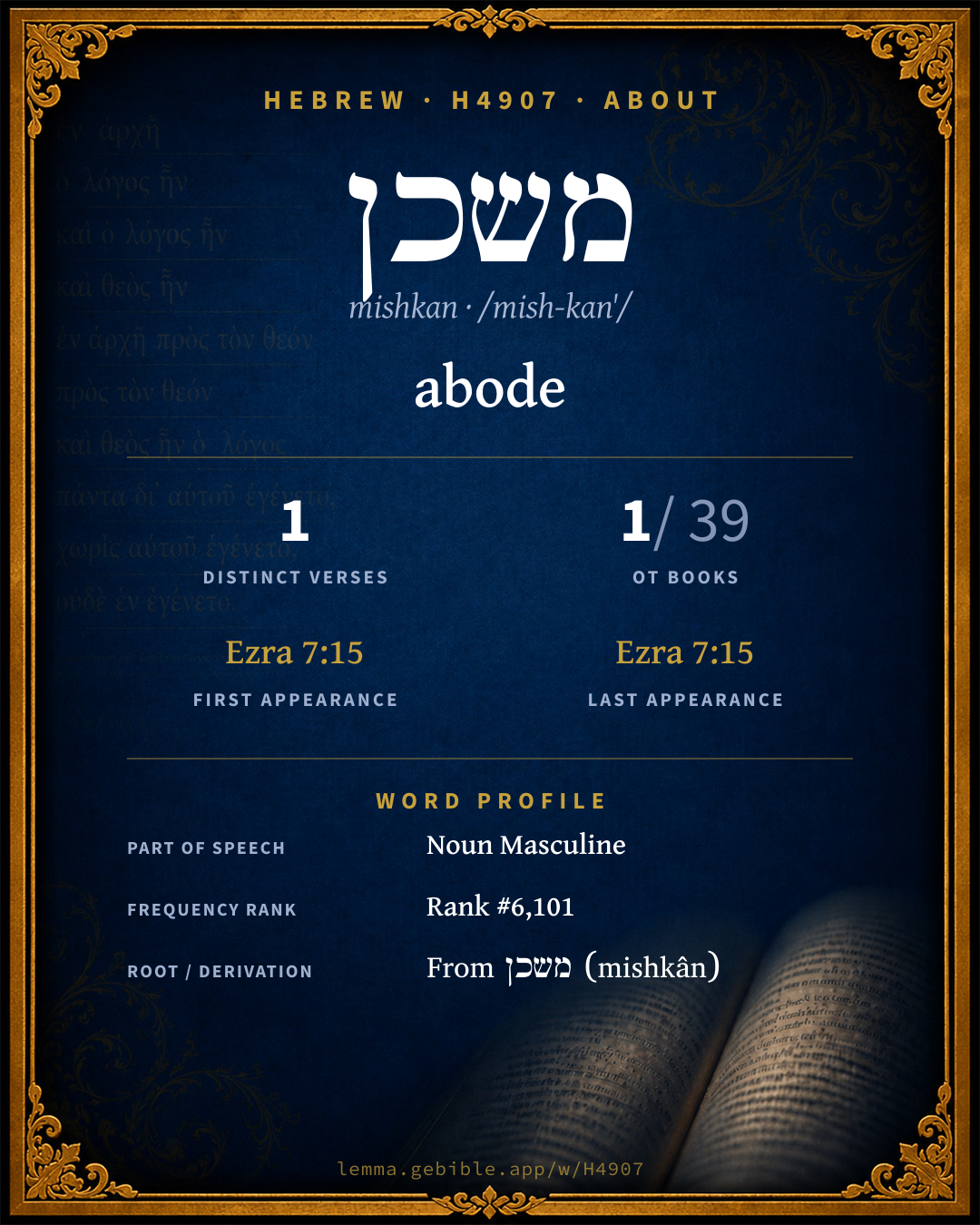
מִשְׁכַּן
abode
Full lexicon entry — Brown-Driver-Briggs (BDB)
From Brown-Driver-Briggs (BDB)
Where this word appears
Grammar key — what these labels mean
Part of speech
- Noun
- A naming word — a person, place, thing, or idea.
Noun type
- Common
- A common noun — a general class of person, place, or thing (“king,” “city,” “water”), not a specific name.
State
- Construct
- A noun bound to a following noun in a possessive / “of” relationship (the construct chain).
Gender
- Masculine
- Grammatically masculine.
Number
- Singular
- One.
Every verse where H4907 appears — 1 distinct verse across 1 book. Click any verse to open its interlinear word-by-word view. Verse text shown in the World English Bible for context — . Each verse’s Hebrew form is shown with its reference; the English is not keyword-highlighted, since the data carries no word-level English alignment. Use “Compare translations” on any verse to read it across multiple English versions. This concordance covers the Hebrew Bible; Septuagint (Greek Old Testament) occurrences are not indexed here.
Ezra 1 verse
About this entry
At a glance — auto-summarized from this page’s data, not written by a person. Every figure links to its source below. This summary describes the numbers; it doesn’t interpret them.
משכן (mishkan) is a Hebrew noun most often rendered “abode.” A scarce word — 1 verse in all of the Hebrew Bible. Ezra dominates its distribution — 1 of 1 verses. Scripture uses it exactly once, at Ezra 7:15. For the data behind this summary, explore the sense tree and the renderings breakdown below.
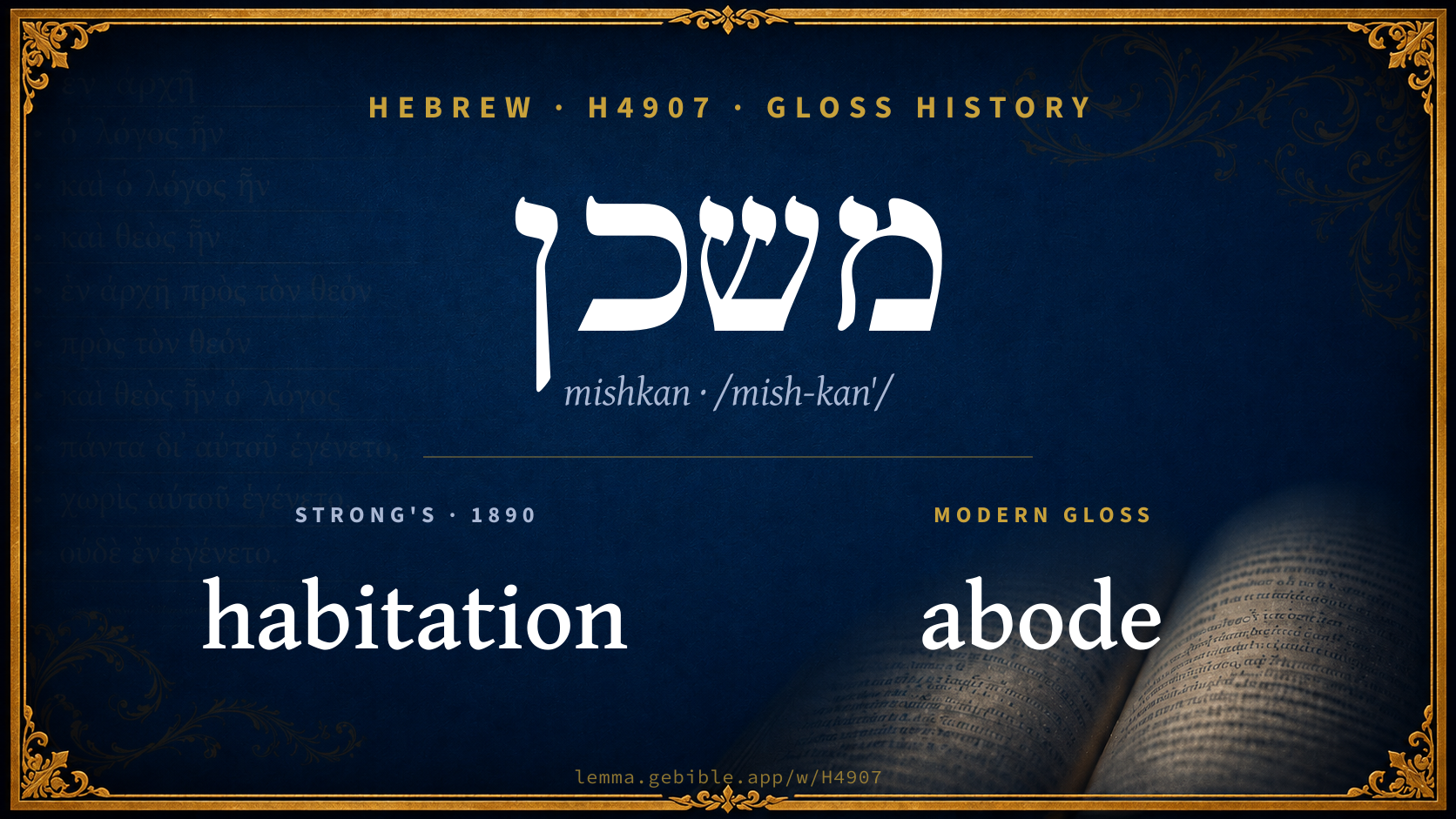
Gloss history
Strong's 1890 vs modern scholarship
About this word
Strong's H4907 catalogs a Hebrew word from the Hebrew Old Testament.
These counts are not copied from any lexicon or concordance. They are computed here, from the morphology-tagged Hebrew Old Testament. What Lemma adds →
- 1
- distinct verses
- The word appears in 1 distinct verse.
- 1 / 39
- OT books
- The word appears in 1 of 39 Old Testament books.
- #6,101
- by frequency
- Rank #6,101 (rank 6,101 of 8,640 Hebrew words by occurrence).
View all 1 occurrence in the concordance →
Most concentrated in
- Ezra 1 verse 100%
By section of the Old Testament
By traditional corpus
Conventional, traditional groupings — biblical authorship is debated, so this is a traditional corpus grouping, not an authorship claim. Each share is this word’s portion of its verses in that division of the Hebrew canon. Each figure is a share of the word’s 1 distinct verse.
- Writings (Ketuvim) 1 verse · 100%
How translations render this word
Counts come from each version’s own published word-to-Strong’s tagging or interlinear alignment — an approximate guide to how each version renders this word, not a word-level alignment the data otherwise carries. Because each total is that version’s own tagged count, the per-version totals vary from one another and need not match the appearance or distinct-verse counts above. These counts may also differ from a printed concordance because Lemma counts each distinctly tagged rendering and does not collapse phrase taggings into a single head-word total. This is a fixed set of word-tagged versions (KJV, ASV, BSB, ULT) and does not change with the reading translation you choose elsewhere. Each version’s license is shown beside its name below (and on Sources).
- King James Version: Habitation 1×
- American Standard Version: Habitation 1×
- Berean Standard Bible: Dwelling 1×
- unfoldingWord Literal Text: Dwelling 1×
King James Version Public Domain
Renders H4907 across 1 tagged occurrence — most commonly:
American Standard Version Public Domain
Renders H4907 across 1 tagged occurrence — most commonly:
Berean Standard Bible Public Domain
Renders H4907 across 1 tagged occurrence — most commonly:
unfoldingWord Literal Text CC BY-SA 4.0
Renders H4907 across 1 tagged occurrence — most commonly:
Senses in BDB
The 1 sense BDB distinguishes for this word, in lexicon order (not ranked by frequency or importance). The full entry — with sub-senses — is in the Lexicon Entry tab.
- abode (of God)
Word origin
[ מִשְׁכַּן ] n.[m.] abode, of God;—sf. Ezr 7:15, of Jerusalem.
— Brown-Driver-Briggs (Oxford 1906, public domain), digitized via Sefaria, supplemented by the OpenScriptures HebrewLexicon (CC BY 4.0). See Sources.
Derived from משכן (mishkân) (H4908) — dwelling place.
Jastrow Dictionary
A second Hebrew/Aramaic lexicon for comparison, covering Aramaic and post-biblical (Talmudic, Targumic, Midrashic) usage that the biblical-Hebrew BDB does not. Matched by lemma rather than by Strong’s number, so a lemma may carry more than one Jastrow headword (shown separately below), and the entries cover usage well beyond the Bible.
מַשְׁכָּן
- , v. מַשְׁכּוֹן
מִשְׁכֵּן
- (denom. of מַשְׁכּוֹן) to take a pledge; to seize, levy. B. Mets. 81ᵇ מִשְׁכְּנוֹ בשעת הלואתו he made him give a pledge at the time when the loan was transacted; מ׳ שלא בשעת וכ׳ he seized it (through court proceedings) after the transaction of the loan. Ib. 113ᵇ שליח ב"ד שבא למַשְׁכְּנוֹ when the court messenger comes to seize his goods. Shek. I, 3 את מי מְמַשְׁכְּנִין against whom was seizure (for the contribution of the half-Shekel) executed?—Y. ib. II, beg. 46ᶜ מכיון שב"ד ראויין למַשְכֵּן ולא מִישְׁכְּנוּ since the court had a right to seize and did not do so (because the claim was satisfied with another man’s money). Cant. R. to I, 4 (play on משכני, ib.) מַשְׁכֵּינְנִי אחריך נרוצה execute levy against me (take my sanctuary, v. מַשְׁכּוֹן), yet after thee we run. Ex. R. s. 35 אני נוטל … ומְמַשְׁכְּנוֹ בעדם I take a righteous man from them and seize him for their guilt; a. fr.—Part. pass. מְמוּשְׁכָּן; pl. מְמוּשְׁכָּנִים, מְמוּשְׁכָּנִין. Y. Shek. l. c. אין תורמין … ולא על הממ׳ in distributing the Temple contributions we do not take into account that which is being collected (and has not yet come in) or that which is to be obtained by seizure. Peah VIII, 8. B. Mets. 73ᵇ, v. next w.; a. e.
- to be seized. Ex. R. s. 51, beg. שנ׳ שתי פעמים וכ׳ it (the sanctuary) was twice seized for their sins, v. מַשְׁכּוֹן. Ex. R. s. 35; Tanḥ. Vayakh. 9 יהא המשכן מִתְמַשְׁכֵּן עליהם, v. מַשְׁכּוֹן. Ib. ויהיו מִתְמַשְׁכְּנִין וכ׳ and they (the righteous) will be seized &c. Num. R. s. 12 המשכן והמקדש יִתְמַשְׁכְּנוּ וכ׳ the Tabernacle and the Temple shall be seized &c.; a. fr.
מַשְׁכֵּן
- Targ. Y. Ex. XXII, 25. Targ. Job XXIV, 3; a. fr.—B. Mets. 68ᵃ מ׳ ליה פלניא וכ׳ (not משכון) A pledged his field to B, and then rented it from him. Ib. 73ᵇ top ר׳ מרי … מ׳ ליה וכ׳ a gentile gave his house (for occupation) as a pledge, and then sold it to &c. Ib. 113ᵃ אבל מַשְׁכּוּנֵי לא Ms. M. (ed. מַשְׁכְּנוֹ) but to take a pledge out of his house he (the messenger of the court) is not permitted; a. fr.—Part. pass. מְמַשְׁכַּן, f. מְמַשְׁכְּנָא. Koh. R. to III, 2, v. מְחַבַּלְתָּא. B. Mets. 73ᵇ אי הוה ידענא דממשכן וכ׳ Ms. F. (Ms. M. דמשכן, corr. acc.; ed. דהוה ממוּשְׁכָּן) if I had known that the house was pledged to you. Y. ib. VIII, end, 11ᵈ ביתיה הוות מְמַשְׁכְּנָה וכ׳ his house was pledged to &c.; a. e.
- to be given as a pledge; to be levied upon; to borrow on pledge. Targ. II Chr. XXV, 24 (h. text תערבות). Targ. Y. Deut. XV, 6; a. e.
מִשְׁכָּן
- dwelling, esp. the sanctuary of the desert, the Tabernacle. Erub. 2ᵃ, v. מִקְדָּשׁ. Num. R. s. 12; a. v. fr.—Pl. מִשְׁכָּנוֹת. Ib.; a. fr.
A Dictionary of the Targumim, the Talmud Babli and Yerushalmi, and the Midrashic Literature (Marcus Jastrow; London, Luzac, 1903) — Public Domain. Digitized via Sefaria. Digitized via Sefaria. Full attribution on Sources.
Septuagint verse parallels
This word appears in 1 verse that also exists in the Greek Old Testament (Septuagint), out of the 1 Hebrew verse it occurs in. You can read those verses in Greek by switching the Old Testament edition to the Septuagint.
Read these verses in the Septuagint
This is a verse-level parallel only — the same verses exist in both the Hebrew and Greek Old Testaments. No word-level Hebrew↔Greek correspondence is claimed: the data carries no such alignment, so no Greek word is shown as this Hebrew word’s translation. Coverage is not total — the Septuagint omits the deuterocanon and renumbers the Psalms, so some Hebrew verses have no direct Greek parallel.