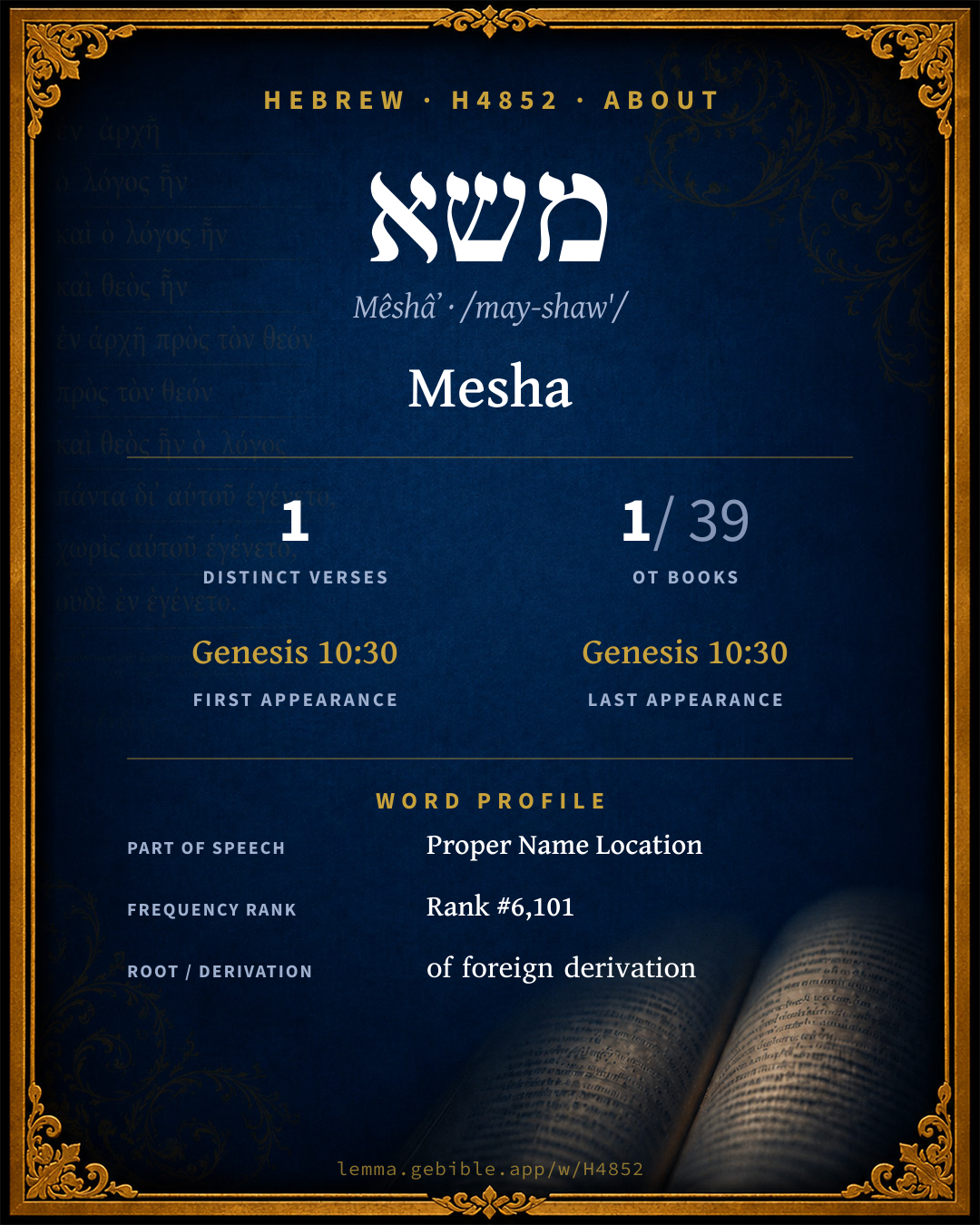
מֵשָׁא
Mesha
BDB lists 2 entries for ‘Mesha’ fuller range ↓
Full lexicon entry — Brown-Driver-Briggs (BDB)
From Brown-Driver-Briggs (BDB)
Where this word appears
Grammar key — what these labels mean
Noun type
- Proper
- A name of a specific person, place, or people (e.g. Abraham, Zion, Israel).
Every verse where H4852 appears — 1 distinct verse across 1 book. Click any verse to open its interlinear word-by-word view. Verse text shown in the World English Bible for context — . Each verse’s Hebrew form is shown with its reference; the English is not keyword-highlighted, since the data carries no word-level English alignment. Use “Compare translations” on any verse to read it across multiple English versions. This concordance covers the Hebrew Bible; Septuagint (Greek Old Testament) occurrences are not indexed here.
Genesis 1 verse
About this entry
At a glance — auto-summarized from this page’s data, not written by a person. Every figure links to its source below. This summary describes the numbers; it doesn’t interpret them.
“Mesha” is the headline sense of the Hebrew name משא (Mêshâʼ). It occurs a mere 1 verse across Scripture. More than three-quarters of its appearances fall in Genesis. Scripture uses it exactly once, at Genesis 10:30. The sections below give every occurrence and version rendering.
Gloss history
Strong's 1890 vs modern scholarship
About this word
Strong's H4852 catalogs a Hebrew word from the Hebrew Old Testament.
These counts are not copied from any lexicon or concordance. They are computed here, from the morphology-tagged Hebrew Old Testament. What Lemma adds →
- 1
- distinct verses
- The word appears in 1 distinct verse.
- 1 / 39
- OT books
- The word appears in 1 of 39 Old Testament books.
- #6,101
- by frequency
- Rank #6,101 (rank 6,101 of 8,640 Hebrew words by occurrence).
View all 1 occurrence in the concordance →
Most concentrated in
- Genesis 1 verse 100%
By section of the Old Testament
By traditional corpus
Conventional, traditional groupings — biblical authorship is debated, so this is a traditional corpus grouping, not an authorship claim. Each share is this word’s portion of its verses in that division of the Hebrew canon. Each figure is a share of the word’s 1 distinct verse.
- Torah (Pentateuch) 1 verse · 100%
How translations render this word
Counts come from each version’s own published word-to-Strong’s tagging or interlinear alignment — an approximate guide to how each version renders this word, not a word-level alignment the data otherwise carries. Because each total is that version’s own tagged count, the per-version totals vary from one another and need not match the appearance or distinct-verse counts above. These counts may also differ from a printed concordance because Lemma counts each distinctly tagged rendering and does not collapse phrase taggings into a single head-word total. This is a fixed set of word-tagged versions (KJV, ASV, BSB, ULT) and does not change with the reading translation you choose elsewhere. Each version’s license is shown beside its name below (and on Sources).
- King James Version: Was from mesha 1×
- American Standard Version: Was from mesha 1×
- Berean Standard Bible: Mesha 1×
- unfoldingWord Literal Text: Mesha 1×
King James Version Public Domain
Renders H4852 across 1 tagged occurrence — most commonly:
American Standard Version Public Domain
Renders H4852 across 1 tagged occurrence — most commonly:
Berean Standard Bible Public Domain
Renders H4852 across 1 tagged occurrence — most commonly:
unfoldingWord Literal Text CC BY-SA 4.0
Renders H4852 across 1 tagged occurrence — most commonly:
Senses in BDB
The 2 senses BDB distinguishes for this word, in lexicon order (not ranked by frequency or importance). The full entry — with sub-senses — is in the Lexicon Entry tab.
- Mesha = "freedom"
- a region marking one of the limits of the territory of the Joktanites when they first settled in Arabia
Word origin
מֵשָׁא n.pr.loc. limiting territory of Jokṭanites, Gn 10:30
— Brown-Driver-Briggs (Oxford 1906, public domain), digitized via Sefaria, supplemented by the OpenScriptures HebrewLexicon (CC BY 4.0). See Sources.
Origin: of foreign derivation
Jastrow Dictionary
A second Hebrew/Aramaic lexicon for comparison, covering Aramaic and post-biblical (Talmudic, Targumic, Midrashic) usage that the biblical-Hebrew BDB does not. Matched by lemma rather than by Strong’s number, so a lemma may carry more than one Jastrow headword (shown separately below), and the entries cover usage well beyond the Bible.
מְשָׁא
- , v. מְשֵׁי
מַשָּׂא
- m (b. h.;
- 1. carrying. Kel. I, 1 מטמאין במ׳ make the carrier unclean. Ib. 3 ששוה מַגָּעוֹ למַשָּׂאוֹ the touch of which has the same effect as the carrying of it; a. fr.
- 2. מ׳ ומַתָּן carrying and giving, business, dealings; worldly affairs; intercourse. Sabb. 120ᵃ במ׳ ומ׳ in worldly affairs, opp. בדברי תורה. Kidd. 35ᵃ איש דבר מ׳ ומ׳ a man (has the protection of the law) because he is engaged in business. Yoma 86ᵃ מַשָּׂאוֹ ומַתָּנוֹ וכ׳ his dealings with men; a. fr.—Kidd. 30ᵇ כל משאו ומתנו בך he (the tempter) will always be busy with thee.
- 3. burden. Tanḥ. B’midb. 2, v. מַשּׂוֹא.—Trnsf. burden of prophecy. Gen. R. s. 44 עשרה לשונות נקראת נבואה … מ׳ וכ׳ prophecy goes by ten names: ‘vision’ … ‘burden’ &c.; ib. רבנן אמרי מ׳ כמשמעו וכ׳ the Rabbis say, the severest of all is massa, as its name indicates (burden) &c.; Cant. R. to III, 4; a. e.—Pl. מַשָּׂאוֹת. Gitt. 71ᵃ מ׳ ומתנות business transactions.
מֵשָׁא
- , v. מֵישָׁא
משא
- , Pes. 111ᵇ כרו מ׳, v. כְּרוּמְשָׁא
A Dictionary of the Targumim, the Talmud Babli and Yerushalmi, and the Midrashic Literature (Marcus Jastrow; London, Luzac, 1903) — Public Domain. Digitized via Sefaria. Digitized via Sefaria. Full attribution on Sources.
Bible dictionary
Public-domain dictionary articles matched to this entry by name (Mesha). A biblical name can be shared by more than one person or place, so an article may treat several.
Easton's Bible Dictionary · M. G. Easton, 1897
Middle district, Vulgate, Messa. (1.) A plain in that part of the boundaries of Arabia inhabited by the descendants of Joktan (Gen. 10:30).
(2.) Heb. meysh'a, "deliverance," the eldest son of Caleb (1 Chr. 2:42), and brother of Jerahmeel.
(3.) Heb. id, a king of Moab, the son of Chemosh-Gad, a man of great wealth in flocks and herds (2 Kings 3:4). After the death of Ahab at Ramoth-Gilead, Mesha shook off the yoke of Israel; but on the ascension of Jehoram to the throne of Israel, that king sought the help of Jehoshaphat in an attempt to reduce the Moabites again to their former condition. The united armies of the two kings came unexpectedly on the army of the Moabites, and gained over them an easy victory. The whole land was devastated by the conquering armies, and Mesha sought refuge in his last stronghold, Kir-harasheth (q.v.). Reduced to despair, he ascended the wall of the city, and there, in the sight of the allied armies, offered his first-born son a sacrifice to Chemosh, the fire-god of the Moabites. This fearful spectacle filled the beholders with horror, and they retired from before the besieged city, and recrossed the Jordan laden with spoil (2 Kings 3:25-27).
The exploits of Mesha are recorded in the Phoenician inscription on a block of black basalt found at Dibon, in Moab, usually called the "Moabite stone" (q.v.).
Smith's Bible Dictionary · William Smith, 1863
(freedom).
+ The name of one of the geographical limits of the Joktanites when they first settled in Arabia. (Genesis 10:30) + The king of Moab who was tributary to Ahab, (2 Kings 3:4) but when Ahab fell at Ramoth-gilead, Mesha refused to pay tribute to his successor, Jehoram. When Jehoram succeeded to the throne of Israel, one of his first acts was to secure the assistance of Jehoshaphat, his father's ally, in reducing the Moabites to their former condition of tributaries. The Moabites were defeated, and the king took refuge in his last stronghold, and defended himself with the energy of despair. With 700 fighting men he made a vigorous attempt to cut his way through the beleaguering army, and when beaten back, he withdrew to the wall of his city, and there, in sight of the allied host, offered his first-born son, his successor in the kingdom, as a burnt offering to Chemosh, the ruthless fire-god of Moab. His bloody sacrifice had so far the desired effect that the besiegers retired from him to their own land. (At Dibon in Moab has lately been discovered the famous Moabite Stone, which contains inscriptions concerning King Mesha and his wars, and which confirms the Bible account.--ED.) + The eldest son of Caleb the son of Hezron by his wife Azubah, as Kimchi conjectures. (1 Chronicles 2:42) + A Benjamite, son of Shabaraim by his wife Hodesh, who bore him in the land of Moab. (1 Chronicles 8:9)
Hitchcock's Bible Names Dictionary · Roswell D. Hitchcock, 1869
burden; salvation
Classic public-domain reference works; full attribution on Sources.
Septuagint verse parallels
This word appears in 1 verse that also exists in the Greek Old Testament (Septuagint), out of the 1 Hebrew verse it occurs in. You can read those verses in Greek by switching the Old Testament edition to the Septuagint.
Read these verses in the Septuagint
This is a verse-level parallel only — the same verses exist in both the Hebrew and Greek Old Testaments. No word-level Hebrew↔Greek correspondence is claimed: the data carries no such alignment, so no Greek word is shown as this Hebrew word’s translation. Coverage is not total — the Septuagint omits the deuterocanon and renumbers the Psalms, so some Hebrew verses have no direct Greek parallel.