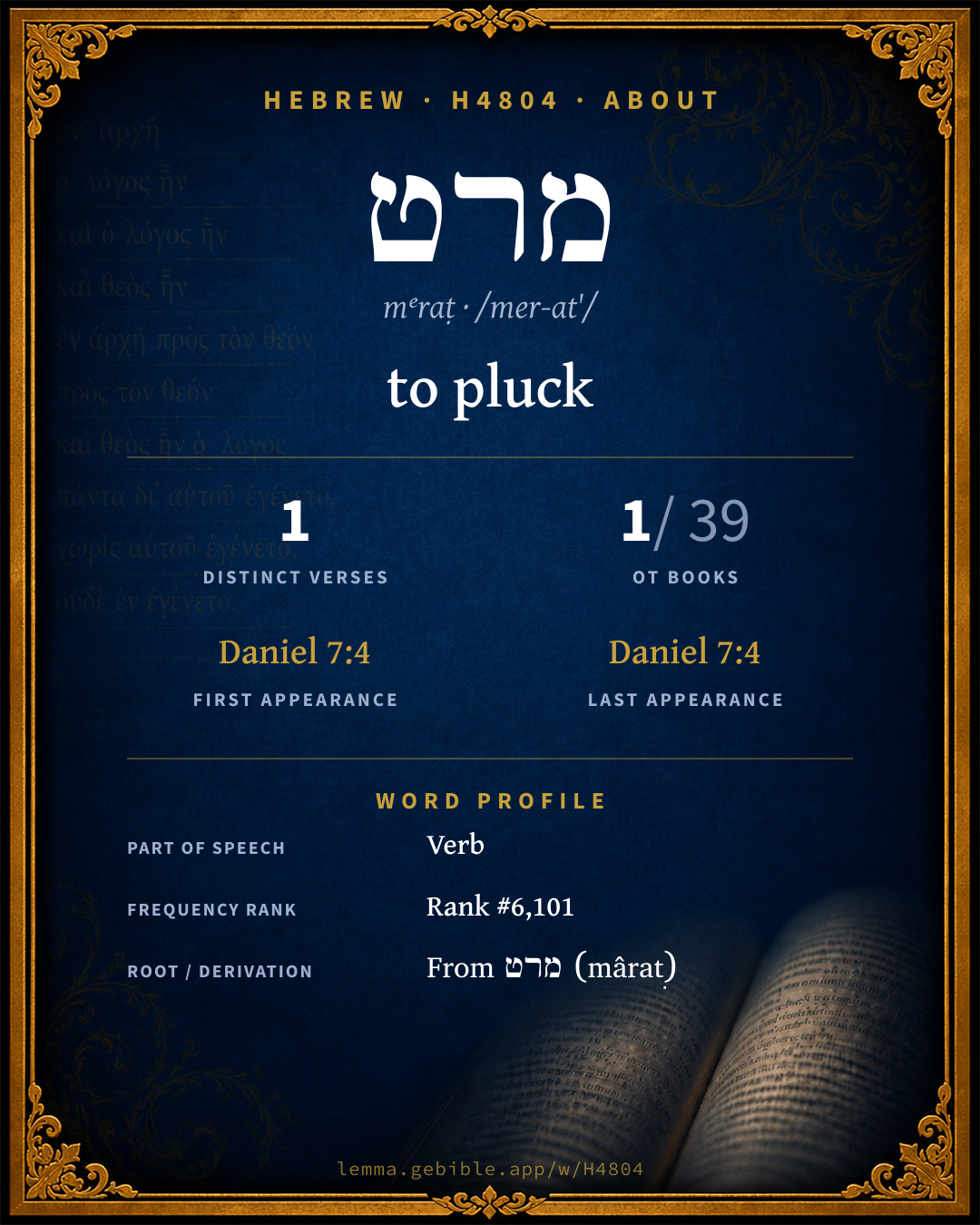
מְרַט
to pluck
‘to pluck’ is one of 2 main senses fuller range ↓
Full lexicon entry — Brown-Driver-Briggs (BDB)
From Brown-Driver-Briggs (BDB)
Where this word appears
Grammar key — what these labels mean
Part of speech
- Verb
- An action or state-of-being word.
Stem
- Qal Passive
- An archaic passive of the Qal, preserved in a few forms.
Form
- Perfect
- A completed action or state — Hebrew marks aspect (completeness) more than strict tense (“he wrote”).
Person
- 3rd Person
- The one spoken about (“he / she / it / they”).
Gender
- Masculine
- Grammatically masculine.
Number
- Plural
- More than one (in Hebrew, generally three or more).
Every verse where H4804 appears — 1 distinct verse across 1 book. Click any verse to open its interlinear word-by-word view. Verse text shown in the World English Bible for context — . Each verse’s Hebrew form is shown with its reference; the English is not keyword-highlighted, since the data carries no word-level English alignment. Use “Compare translations” on any verse to read it across multiple English versions. This concordance covers the Hebrew Bible; Septuagint (Greek Old Testament) occurrences are not indexed here.
Daniel 1 verse
About this entry
At a glance — auto-summarized from this page’s data, not written by a person. Every figure links to its source below. This summary describes the numbers; it doesn’t interpret them.
“to pluck” is the headline sense of the Hebrew verb מרט (mᵉraṭ). With only 1 verse it sits in the long tail of Hebrew Bible vocabulary. More than three-quarters of its appearances fall in Daniel. It occurs only once, in Daniel 7:4. Catalogued under 2 senses, its meaning is not single-sense. See the sense tree, 1-verse concordance, and the renderings breakdown below.
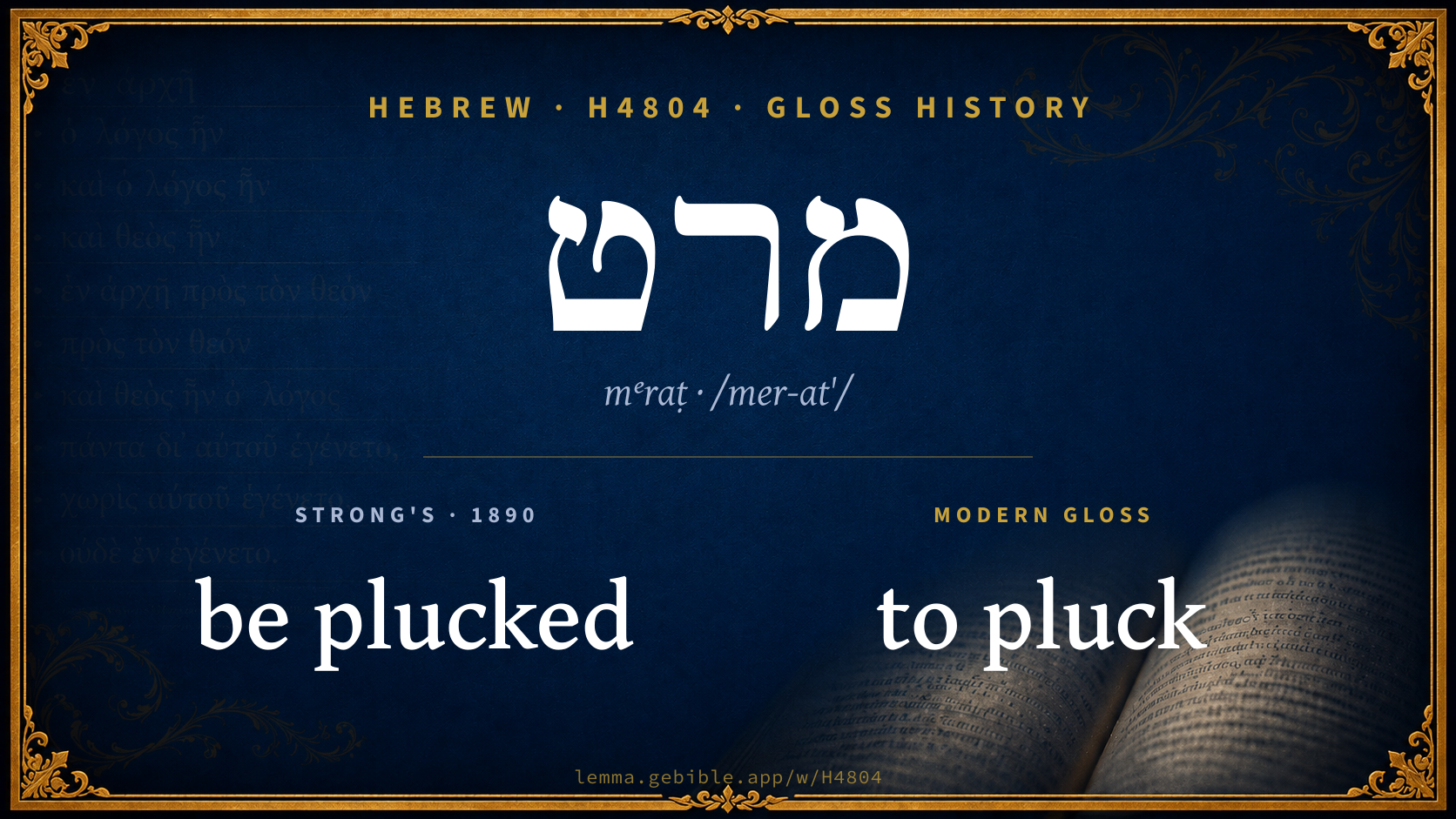
Gloss history
Strong's 1890 vs modern scholarship
About this word
Strong's H4804 catalogs a Hebrew word from the Hebrew Old Testament.
These counts are not copied from any lexicon or concordance. They are computed here, from the morphology-tagged Hebrew Old Testament. What Lemma adds →
- 1
- distinct verses
- The word appears in 1 distinct verse.
- 1 / 39
- OT books
- The word appears in 1 of 39 Old Testament books.
- #6,101
- by frequency
- Rank #6,101 (rank 6,101 of 8,640 Hebrew words by occurrence).
View all 1 occurrence in the concordance →
Most concentrated in
- Daniel 1 verse 100%
By section of the Old Testament
By traditional corpus
Conventional, traditional groupings — biblical authorship is debated, so this is a traditional corpus grouping, not an authorship claim. Each share is this word’s portion of its verses in that division of the Hebrew canon. Each figure is a share of the word’s 1 distinct verse.
- Writings (Ketuvim) 1 verse · 100%
How translations render this word
Counts come from each version’s own published word-to-Strong’s tagging or interlinear alignment — an approximate guide to how each version renders this word, not a word-level alignment the data otherwise carries. Because each total is that version’s own tagged count, the per-version totals vary from one another and need not match the appearance or distinct-verse counts above. These counts may also differ from a printed concordance because Lemma counts each distinctly tagged rendering and does not collapse phrase taggings into a single head-word total. This is a fixed set of word-tagged versions (KJV, ASV, BSB, ULT) and does not change with the reading translation you choose elsewhere. Each version’s license is shown beside its name below (and on Sources).
- King James Version: Thereof were plucked 1×
- American Standard Version: Thereof were plucked 1×
- Berean Standard Bible: Were torn off 1×
- unfoldingWord Literal Text: Were plucked off 1×
King James Version Public Domain
Renders H4804 across 1 tagged occurrence — most commonly:
American Standard Version Public Domain
Renders H4804 across 1 tagged occurrence — most commonly:
Berean Standard Bible Public Domain
Renders H4804 across 1 tagged occurrence — most commonly:
unfoldingWord Literal Text CC BY-SA 4.0
Renders H4804 across 1 tagged occurrence — most commonly:
Senses in BDB
The 2 senses BDB distinguishes for this word, in lexicon order (not ranked by frequency or importance). The full entry — with sub-senses — is in the Lexicon Entry tab.
- to pluck, pull off
- (Peil) to be plucked off
Word origin
[ מְרַט ] vb. pluck;— Pe‛îl Dn 7:4
— Brown-Driver-Briggs (Oxford 1906, public domain), digitized via Sefaria, supplemented by the OpenScriptures HebrewLexicon (CC BY 4.0). See Sources.
Derived from מרט (mâraṭ) (H4803) — to make bare.
Jastrow Dictionary
A second Hebrew/Aramaic lexicon for comparison, covering Aramaic and post-biblical (Talmudic, Targumic, Midrashic) usage that the biblical-Hebrew BDB does not. Matched by lemma rather than by Strong’s number, so a lemma may carry more than one Jastrow headword (shown separately below), and the entries cover usage well beyond the Bible.
מָרַט
- (b. h.) to pluck off (hair, wool &c.); to pull. Tosef. Sabb. IX (X), 20; Sabb. 74ᵇ והמוֹרְטוֹ and he who plucks the down off the large feather of the wing. B. Mets. 68ᵇ גוזזות ושוטפות ומוֹרְטוֹת (Ar. גזוזות) they yield wool by being shorn, by passing through water, and by being plucked (in passing bushes &c.; [prob. to be read גזוזות ושטופות ומְרוּטוֹת].
- 1. same. Naz. 39ᵇ תלש מ׳ סיפסף וכ׳ if he pinced his hair (near the root), plucked it off, or trimmed it &c.; (Ar. s. v. ספסף: ‘created a bald spot by using a depilatory’). Sabb. l. c. מְמָרֵט חייב משום ממחק he who plucks the down (v. supra) is guilty of an act coming under the head of scraping (leather).—Part. pass. מְמוֹרָט bald-headed. Naz. 46ᵇ; Yoma 61ᵇ נזיר ממ׳; Tosef. Naz. I, 6 המוֹרָט; Y. ib. VI, end, 55ᵈ נזיר ומירט (read: נזיר ממ׳ or מורט).
- 2. to smooth, polish. Num. R. s. 12 נחשת ממורט (prob. to be read: מְמוֹרֶטֶת) polished bronze.
- to be plucked, to be bald. Sifra Thazr., Par. 5, ch. X נ׳ ראשו וכ׳ if his head became bald through sickness.
מְרַט I
- Targ. O. Lev. XXI, 5. Targ. Jer. XVI, 6; a. e.—Part. מָרֵיט, pl. מָרְטִין. Targ. Is. L, 6 ed. Lag. (oth. ed. מָרְטָן; ed. Wil. מוֹרְטִין).
- to be laid bare, to have the shoulder uncovered (in mourning), v. חָלַץ. Targ. Ez. XXIX, 18 (ed. Wil. אִתְמְרט; h. text מְרוּטָה; Pesh. חליץ).
- , v. infra.
- to pull to pieces, to divide, plunder. Targ. Job XVI, 11 מְמַרְטֵט ed. Lag. (Ms. מרטיט, Var. מְמָרֵט Pa.; h. text ירטני). Targ. Ps. XXXIX, 3 כיבי ממרטיט he lacerates my wound (h. text נעכר).—Ḥull. 92ᵇ ממרטט ליה he pulled the fatty fibres out (going to the root).
- to be torn to pieces, dismembered. Ab. Zar. 69ᵃ אִימַּרְטוּטֵי אִימַּ׳ (the mouse in the liquid) was dismembered. Nidd. 56ᵇ אִמַּרְטוּטֵי אימרטיט it would have been dismembered.—[Koh. R. to X, 16 איתמרטת, read: איתמרעת, v. מְרַע I.]
מְרַט II
- (preced.)
- 1. baldness. Targ. O. Deut. XIV, 1. Targ. Is. XV, 2; a. fr.
- 2. plucked wool, tuft. Sabb. 49ᵃ ממ׳ דביני אטמי of wool plucked from between the flanks (of a living animal, which contains moisture).
A Dictionary of the Targumim, the Talmud Babli and Yerushalmi, and the Midrashic Literature (Marcus Jastrow; London, Luzac, 1903) — Public Domain. Digitized via Sefaria. Digitized via Sefaria. Full attribution on Sources.
Septuagint verse parallels
This word appears in 1 verse that also exists in the Greek Old Testament (Septuagint), out of the 1 Hebrew verse it occurs in. You can read those verses in Greek by switching the Old Testament edition to the Septuagint.
Read these verses in the Septuagint
This is a verse-level parallel only — the same verses exist in both the Hebrew and Greek Old Testaments. No word-level Hebrew↔Greek correspondence is claimed: the data carries no such alignment, so no Greek word is shown as this Hebrew word’s translation. Coverage is not total — the Septuagint omits the deuterocanon and renumbers the Psalms, so some Hebrew verses have no direct Greek parallel.