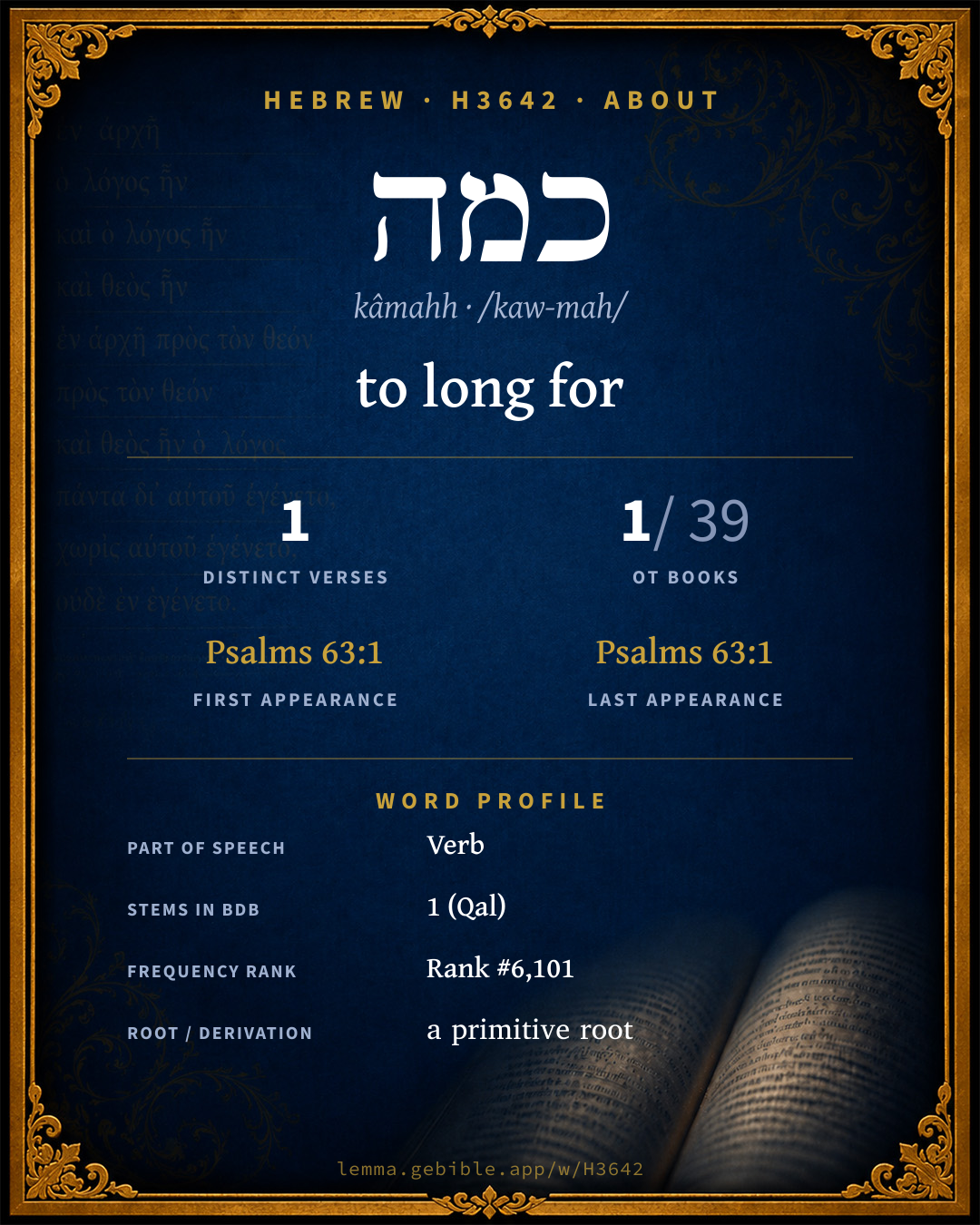
כָּמַהּ
to long for
Full lexicon entry — Brown-Driver-Briggs (BDB)
From Brown-Driver-Briggs (BDB)
Where this word appears
Grammar key — what these labels mean
Part of speech
- Verb
- An action or state-of-being word.
Stem
- Qal
- The basic, simple active stem — the plain form of the verb (“he wrote”).
Form
- Perfect
- A completed action or state — Hebrew marks aspect (completeness) more than strict tense (“he wrote”).
Person
- 3rd Person
- The one spoken about (“he / she / it / they”).
Gender
- Masculine
- Grammatically masculine.
Number
- Singular
- One.
Every verse where H3642 appears — 1 distinct verse across 1 book. Click any verse to open its interlinear word-by-word view. Verse text shown in the World English Bible for context — . Each verse’s Hebrew form is shown with its reference; the English is not keyword-highlighted, since the data carries no word-level English alignment. Use “Compare translations” on any verse to read it across multiple English versions. This concordance covers the Hebrew Bible; Septuagint (Greek Old Testament) occurrences are not indexed here.
Psalms 1 verse
About this entry
At a glance — auto-summarized from this page’s data, not written by a person. Every figure links to its source below. This summary describes the numbers; it doesn’t interpret them.
“to long for” is the headline sense of the Hebrew verb כמה (kâmahh). It is rare — just 1 verse in the entire Hebrew Bible. More than three-quarters of its appearances fall in Psalms. Its lone occurrence is Psalms 63:1. Related forms include כמהם. The sections below give every sense, occurrence, and version rendering.
Gloss history
Strong's 1890 vs modern scholarship
About this word
Strong's H3642 catalogs a Hebrew word from the Hebrew Old Testament.
These counts are not copied from any lexicon or concordance. They are computed here, from the morphology-tagged Hebrew Old Testament. What Lemma adds →
- 1
- distinct verses
- The word appears in 1 distinct verse.
- 1 / 39
- OT books
- The word appears in 1 of 39 Old Testament books.
- #6,101
- by frequency
- Rank #6,101 (rank 6,101 of 8,640 Hebrew words by occurrence).
View all 1 occurrence in the concordance →
Most concentrated in
- Psalms 1 verse 100%
By section of the Old Testament
By traditional corpus
Conventional, traditional groupings — biblical authorship is debated, so this is a traditional corpus grouping, not an authorship claim. Each share is this word’s portion of its verses in that division of the Hebrew canon. Each figure is a share of the word’s 1 distinct verse.
- Writings (Ketuvim) 1 verse · 100%
How translations render this word
Counts come from each version’s own published word-to-Strong’s tagging or interlinear alignment — an approximate guide to how each version renders this word, not a word-level alignment the data otherwise carries. Because each total is that version’s own tagged count, the per-version totals vary from one another and need not match the appearance or distinct-verse counts above. These counts may also differ from a printed concordance because Lemma counts each distinctly tagged rendering and does not collapse phrase taggings into a single head-word total. This is a fixed set of word-tagged versions (KJV, ASV, BSB, ULT) and does not change with the reading translation you choose elsewhere. Each version’s license is shown beside its name below (and on Sources).
- King James Version: Longeth 1×
- American Standard Version: Flesh longeth 1×
- Berean Standard Bible: Yearns for you 1×
- unfoldingWord Literal Text: Faints 1×
King James Version Public Domain
Renders H3642 across 1 tagged occurrence — most commonly:
American Standard Version Public Domain
Renders H3642 across 1 tagged occurrence — most commonly:
Berean Standard Bible Public Domain
Renders H3642 across 1 tagged occurrence — most commonly:
unfoldingWord Literal Text CC BY-SA 4.0
Renders H3642 across 1 tagged occurrence — most commonly:
Senses in the full BDB
What do BDB’s symbols mean?
BDB uses these scholarly abbreviations:
| Symbol | Meaning |
|---|---|
| 𝔊 | the Septuagint (the ancient Greek translation, LXX) |
| 𝔙 | the Vulgate (the Latin translation) |
| 𝔖 | the Syriac version (the Peshitta) |
| 𝔗 | the Targum (the Aramaic translation) |
| ψ | the Psalms |
| √ | root (the underlying root or stem) |
| ‖ | parallel passage (a synonymous or contrasted parallel) |
| † | the dagger: every passage where the word occurs is cited |
The 1 sense the full Brown-Driver-Briggs lexicon distinguishes for this word, in lexicon order (not ranked by frequency), with BDB’s own verbatim wording and sub-sense lettering. Shown in Hebrew script with BDB’s own scholarly abbreviations. The condensed entry is in the Lexicon Entry tab.
Qal
- Pf. 3 ms. כ׳ לְךָ בְשָׂרִי ψ 63:2 faint (with longing) for thee (‖ צָֽמְאָה לְךָ נַפְשִׁי). e.g. Psalms 63:2
Senses from the full Brown-Driver-Briggs lexicon (Brown, Driver, Briggs; Oxford 1906 — public domain), digitized via Sefaria, supplemented by the OpenScriptures HebrewLexicon (CC BY 4.0). Full attribution on Sources.
Word origin
vb. faint (Arabic كَمِهَ is be pale of face, gray (of daylight), weak-eyed, أَكْمَهُ blind from birth; Syriac ܟܡܰܗ be blind), only fig.—
— Brown-Driver-Briggs (Oxford 1906, public domain), digitized via Sefaria, supplemented by the OpenScriptures HebrewLexicon (CC BY 4.0). See Sources.
Origin: a primitive root
Jastrow Dictionary
A second Hebrew/Aramaic lexicon for comparison, covering Aramaic and post-biblical (Talmudic, Targumic, Midrashic) usage that the biblical-Hebrew BDB does not. Matched by lemma rather than by Strong’s number, so a lemma may carry more than one Jastrow headword (shown separately below), and the entries cover usage well beyond the Bible.
כְּמָא
- (v. כְּ־ a. מָא)
- 1. (followed by ד־) like that which. Targ. Jud. XI, 39 a. fr. [Usu.: הֵיךְ מָא, הֵיכְמָא.]—
- 2. (mostly כמה) how! how many!, how much!, how long!; (also interrog.) how much? &c. Targ. Ps. CXXXIX, 17. Ib. XXXV, 17; a. fr.—Gen. R. s. 6 כ׳ נפשיה וכ׳ how the soul of this man’s (my) brother is now chopping cedars and sawing &c. (is in the agony of death)! (Midr. Sam. ch. IX; Yalk. Ps. 743, only נפשיה וכ׳). Yoma 22ᵇ, v. חֲלִי. Ber. 14ᵇ כ׳ מעליא וכ׳ how excellent &c. B. Mets. 86ᵃ כ׳ ככרין וכ׳ how many cakes of nardus do we owe to &c.!—M. Kat. 16ᵇ כל כ׳ דהוה וכ׳ as long as &c.; a. fr.—Y. Ab. Zar. II, 41ᵃ top כְּמָן קטל how many of them did he kill?
כְּמָה
- , v. כְּמָא
כַּמֶּה
- (preced. wds.)
- 1. how much?, how many? Kidd. 9ᵇ ב׳ אתה נותן וכ׳ how much (dowry) wilt thou give &c.? Ber. 14ᵃ עד כ׳ up to how much? Ib. 30ᵇ כ׳ ישהה וכ׳ how long must he pause between &c.?; a. fr.
- 2. how!, how many!, how much! Sabb. 12ᵇ כ׳ גדולים דברי וכ׳ how grand are the words of &c.; a. fr.—על אחת כ׳ וכ׳, v. אֶחָד.
- 3. (I don’t know) how many, many. M. Kat. 16ᵇ איבדתי כ׳ דוד מפניו I should have destroyed many Davids for his sake. Y. Keth. V, 30ᵃ bot. לאחר כ׳ ימים after ever so many days. Ib. אפי כ׳ even much longer; a. fr.—[Y. Succ. I, 51ᵈ top גבוה מכמה, prob. to be read: מכ׳ אמה = מעשרים ib.]
מָה
- (b. h.)
- 1. something; anything. Num. R. s. 14; Tanḥ. Ḥayé 3, v. בְּלִימָה.
- 2. what? which? Ḥull. 89ᵃ (play on הא̇מ̇נ̇ם א̇ל̇ם̇, Ps. LVIII, 2) מה א̇ומ̇נ̇תו … כא̇ל̇ם̇ which is the best policy for man in this world? Let him act as if he were mute (keep silence). B. Mets. 63ᵃ, a. e. מה לו הן מה לי דמיהן what are they to me and what their equivalent, i.e. what difference does it make whether the purchased objects or their equivalent be delivered?; Y. Yoma V, 43ᵃ bot. מה ביניהן ומה בין דמיהן. B. Bath. 32ᵇ; 31ᵃ מה (לי) לו לשקר what motive could he have to tell a lie? Ib., a. e. מה לי לשקר במקום עדים וכ׳ we do not apply the principle that we believe a defendant because he has no motive to lie, where witnesses are on hand; a. v. fr.—מה … אף what …?, even so, i.e. as … so. Gitt. 23ᵇ מה אתם … אף וכ׳ as you (Num. XVIII, 28) refers to Israelites, so must your delegate be an Israelite. Sabb. 133ᵇ מה הוא … אף וכ׳ as He is gracious and merciful, so be thou &c.; a. fr.—מה … לא כל שכן, v. כָּל.—מה … אינו דין, v. דִּין II.—מה ל־ … שכן … תאמר what has this to do with …? In this case …, whereas &c., i.e. it is different with … because &c. Kidd. 4ᵇ מה ליבמה שכן … תאמר וכ׳ the case of a Y’bamah is different, because she can neither be acquired by means of a document, whereas this (an ordinary woman) &c.; a. fr.—מָה נַפְשְׁךָ (in Babli mostly: מִמָּה נפשך; abbr. ממ"נ) whatever be thy opinion (from whatever opinion thou start), i.e. whichever side you take, at all events. Y. Ber. I, 2ᵇ מ׳ נ׳ אם וכ׳ at all events (he has offended); if it was day-time when the first stars (on Friday evening) were visible, it was day-time when the first stars (on Sabbath evening) were visible &c.; Sabb. 35ᵇ חייכ חטאת ממ"נ must bring a sin-offering at all events (whether you consider twilight a part of the day or a part of the night). Ib. 34ᵃ (in Chald. dict.) מה נפשך אי וכ׳ whichever side you take, if twilight is day &c. Erub. 10ᵃ גדולה … למה לי ממ"נ אי וכ׳ what reason was there for saying ‘large …’? In either case (it is incorrect), if it be to permit the use of the larger court &c. Ḥull. 29ᵃ ממ"נ אי מחצה וכ׳ in either case (the slaughtering is ritually correct); if you adopt the opinion that an exact half is to be considered as if it were the larger portion &c.; a. v. fr.—Ib. 78ᵇ מה אם נפשך, v. נֶפֶשׁ.—בַּמֶּה a) wherewith? B. Bath. 10ᵇ במה תרום וכ׳ whereby can the horn of Israel be lifted up? Sabb. II, 1; a. fr.—b) in what case? במה דברים אמורים (abbr. בד"א), v. אָמַר I.—לָמָּה wherefore? Ber. 3ᵃ תחלת … סימנא למה לי what need is there for a sign for the beginning of the first watch? M. Kat. 28ᵃ ל׳ נסמכה וכ׳ why is the account of the death of Miriam attached to &c.?; a. fr.—לַמֶּה to what?, whereto? Kidd. 40ᵇ ל׳ צדיקים נמשלים what are the righteous to be compared to?—ל׳ הדבר דומה, v. דָּמָה; a. fr.—V. לָמָה. e.g. Psalms 58:2
- 3. (relat.) which, what. Pes. 88ᵇ מה שקנה עבד וכ׳ whatever the slave acquires belongs to the master. Ber. I, 1 כל מה שאמרו וכ׳ for whatever act the scholars designated the time ‘up to midnight’ &c.; a. v. fr.
מָה ²
- ch. same (v. מָא). Targ. II Sam. XVIII, 23. Targ. Ex. XXXIII, 21; a. v. fr.—Snh. 65ᵇ; Gen. R. s. 11, v. גּוּבְרָא. Y. Ned. VI, end, 40ᵃ מה שבקית תמן what (prominent men) I left there (in Palestine); Y. Snh. I, 19ᵃ top (corr. acc.) [Ib. מה מודע לי, read מאן.]—Y. Gitt. I, 43ᵈ מה אנן קיימין what do we stand at, i.e. what is the case before us? Y. Dem. I, 21ᵈ bot. מה אפשר דר׳ וכ׳ what? is it possible that &c.? i.e. it is impossible that &c.; ib. מה ר׳ ז׳ מיכול וכ׳ it is impossible that R. Z. should eat &c. Y. Sabb. XIV, 14ᶜ מה ביניהון wherein do they differ?, v. בֵּין. Ḥull. 34ᵃ, a. e. מה נפשך, v. preced.; a. v. fr.—מָהִיא = מה היא, how is it? Y. Sabb. l. c.
A Dictionary of the Targumim, the Talmud Babli and Yerushalmi, and the Midrashic Literature (Marcus Jastrow; London, Luzac, 1903) — Public Domain. Digitized via Sefaria. Digitized via Sefaria. Full attribution on Sources.
Same root — word family
Other BDB entries built from the same root as H3642, grouped by Strong’s listed origin. These share a root / origin per the lexicon — not necessarily a shared meaning. Each links to that word’s own entry.
Proper names from this root
People and places named from this root — a name, not an additional meaning of the word.
Compare all same-root words → 1 of the same-root words is a proper name (a person or place). They share a root, not necessarily a meaning.
Septuagint verse parallels
This word appears in 1 verse that also exists in the Greek Old Testament (Septuagint), out of the 1 Hebrew verse it occurs in. You can read those verses in Greek by switching the Old Testament edition to the Septuagint.
Read these verses in the Septuagint
This is a verse-level parallel only — the same verses exist in both the Hebrew and Greek Old Testaments. No word-level Hebrew↔Greek correspondence is claimed: the data carries no such alignment, so no Greek word is shown as this Hebrew word’s translation. Coverage is not total — the Septuagint omits the deuterocanon and renumbers the Psalms, so some Hebrew verses have no direct Greek parallel.