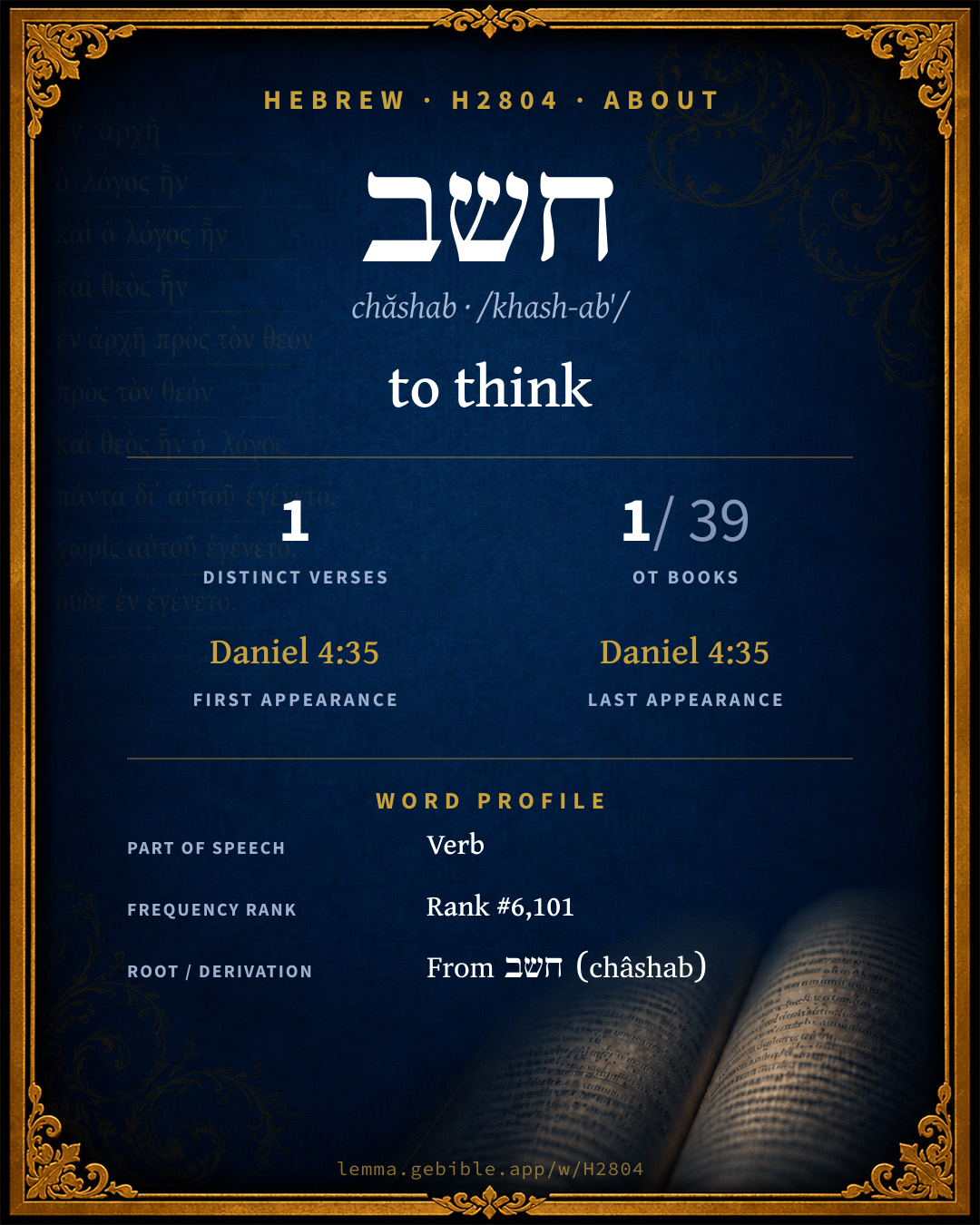
חֲשַׁב
to think
Full lexicon entry — Brown-Driver-Briggs (BDB)
From Brown-Driver-Briggs (BDB)
Where this word appears
Grammar key — what these labels mean
Part of speech
- Verb
- An action or state-of-being word.
Stem
- Qal Passive
- An archaic passive of the Qal, preserved in a few forms.
Form
- Participle Passive
- A verbal adjective expressing action received (“written”).
State
- Absolute
- The independent form of a noun, not bound to a following word.
Gender
- Masculine
- Grammatically masculine.
Number
- Plural
- More than one (in Hebrew, generally three or more).
Every verse where H2804 appears — 1 distinct verse across 1 book. Click any verse to open its interlinear word-by-word view. Verse text shown in the World English Bible for context — . Each verse’s Hebrew form is shown with its reference; the English is not keyword-highlighted, since the data carries no word-level English alignment. Use “Compare translations” on any verse to read it across multiple English versions. This concordance covers the Hebrew Bible; Septuagint (Greek Old Testament) occurrences are not indexed here.
Daniel 1 verse
About this entry
At a glance — auto-summarized from this page’s data, not written by a person. Every figure links to its source below. This summary describes the numbers; it doesn’t interpret them.
חשב — transliterated chăshab — is a Hebrew verb carrying the sense “to think.” A scarce word — 1 verse in all of the Hebrew Bible. More than three-quarters of its appearances fall in Daniel. Its lone occurrence is Daniel 4:35. Related forms include חשב, חשב and חשבון. Each statement above links to its evidence; the full detail follows below.
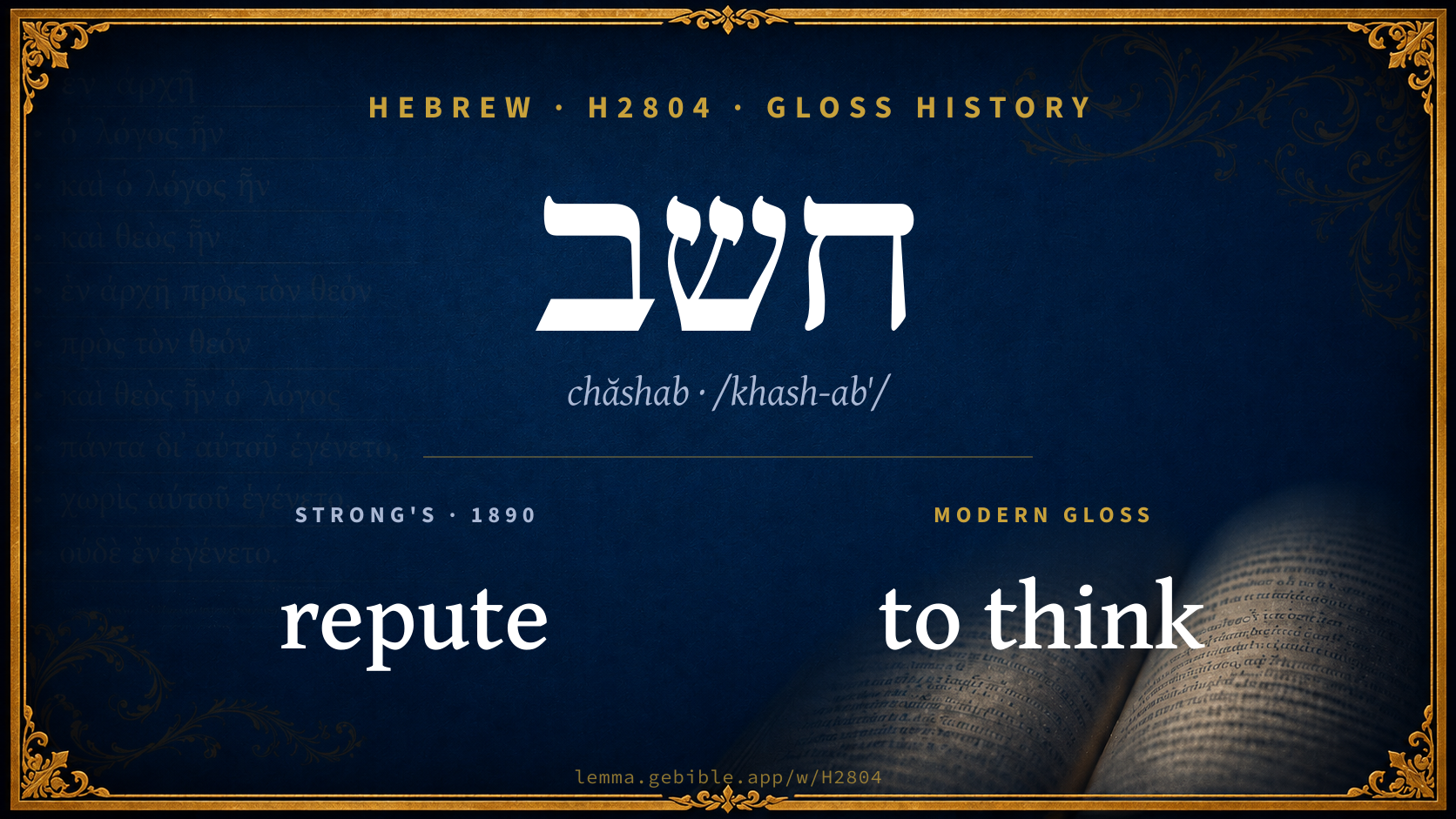
Gloss history
Strong's 1890 vs modern scholarship
About this word
Strong's H2804 catalogs a Hebrew word from the Hebrew Old Testament.
These counts are not copied from any lexicon or concordance. They are computed here, from the morphology-tagged Hebrew Old Testament. What Lemma adds →
- 1
- distinct verses
- The word appears in 1 distinct verse.
- 1 / 39
- OT books
- The word appears in 1 of 39 Old Testament books.
- #6,101
- by frequency
- Rank #6,101 (rank 6,101 of 8,640 Hebrew words by occurrence).
View all 1 occurrence in the concordance →
Most concentrated in
- Daniel 1 verse 100%
By section of the Old Testament
By traditional corpus
Conventional, traditional groupings — biblical authorship is debated, so this is a traditional corpus grouping, not an authorship claim. Each share is this word’s portion of its verses in that division of the Hebrew canon. Each figure is a share of the word’s 1 distinct verse.
- Writings (Ketuvim) 1 verse · 100%
How translations render this word
Counts come from each version’s own published word-to-Strong’s tagging or interlinear alignment — an approximate guide to how each version renders this word, not a word-level alignment the data otherwise carries. Because each total is that version’s own tagged count, the per-version totals vary from one another and need not match the appearance or distinct-verse counts above. These counts may also differ from a printed concordance because Lemma counts each distinctly tagged rendering and does not collapse phrase taggings into a single head-word total. This is a fixed set of word-tagged versions (KJV, ASV, BSB, ULT) and does not change with the reading translation you choose elsewhere. Each version’s license is shown beside its name below (and on Sources).
- King James Version: Are reputed 1×
- American Standard Version: Are reputed 1×
- Berean Standard Bible: Are counted 1×
- unfoldingWord Literal Text: Are regarded 1×
King James Version Public Domain
Renders H2804 across 1 tagged occurrence — most commonly:
American Standard Version Public Domain
Renders H2804 across 1 tagged occurrence — most commonly:
Berean Standard Bible Public Domain
Renders H2804 across 1 tagged occurrence — most commonly:
unfoldingWord Literal Text CC BY-SA 4.0
Renders H2804 across 1 tagged occurrence — most commonly:
Senses in BDB
The 1 sense BDB distinguishes for this word, in lexicon order (not ranked by frequency or importance). The full entry — with sub-senses — is in the Lexicon Entry tab.
- (Peal) to think, account
Word origin
[ חֲשַׁב ] vb. think, account;— Pe. Dn 4:32
— Brown-Driver-Briggs (Oxford 1906, public domain), digitized via Sefaria, supplemented by the OpenScriptures HebrewLexicon (CC BY 4.0). See Sources.
Derived from חשב (châshab) (H2803) — to think.
Jastrow Dictionary
A second Hebrew/Aramaic lexicon for comparison, covering Aramaic and post-biblical (Talmudic, Targumic, Midrashic) usage that the biblical-Hebrew BDB does not. Matched by lemma rather than by Strong’s number, so a lemma may carry more than one Jastrow headword (shown separately below), and the entries cover usage well beyond the Bible.
חָשַׁב
- 1. to think, intend, plan. Ber. 6ᵃ; Kidd. 40ᵃ (ref. to Mal. III, 16) אפי׳ ח׳ אדם וכ׳ even if one only had the intention of doing etc.; Sabb. 63ᵃ חִישֵּׁב (Pi.).—Tanḥ. P’kudé 11 וכשהן חוֹשְׁבִין להעמידו וכ׳ and when they thought they had put it up, it fell apart again. Sot. 35ᵃ אני חֲשַׁבְתִּיהָ … והם חָשְׁבוּ וכ׳ I planned it for their good, but they considered it an evil; a. fr. e.g. Malachi 3:16
- 2. to consider, regard; to count. Ber. 14ᵃ (ref. to Is. II, 22) במה חֲשַׁבְתּוֹ לזה ולא לאלוה with what right didst thou pay thy regard to him and not to God?—Sot. l. c., v. supra. Pesik. R. s. 21, v. סוֹפִיסְטָא; a. fr. e.g. Isaiah 2:22
- 3. to design, trace. Yoma 72ᵇ (ref. to חשב a. רקם, Ex. XXVI, 31ᵃ 36) רוקמין במקום שחוֹשְׁבִין they embroidered over what they had traced.—Part. pass. חָשׁוּב fem. חֲשׁוּבָה a) counted, regarded; ח׳ כ־ equal to. Lam. R. to I, 5 לא … מדינה ח׳ כלום the country towns were of no account. Ned. 64ᵇ ח׳ כמת is like dead; ib. חֲשׁוּבִין כמת; Gen. R. s. 71 חֲשׁוּבִים כמתים; a. fr.—b) valuable; important; respectable, of high standing. Bets. 3ᵇ ביצה ח׳ an egg is a valuable object. Ber. 19ᵃ, a. fr. אדם ח׳ שאני with a man of high standing it is different. Pes. 108ᵃ אשה ח׳ a woman of rank. Tanḥ. Shmini 9 איש ח׳ שמחשבים וכ׳ a man of standing whom they respected in his place; a. fr. e.g. Exodus 26:31
- same,
- 1. to consider, regard; to respect, v. supra.
- 2. to account, calculate, figure. B. Bath. 78ᵇ המְחַשְּׁבִים the thoughtful. Sabb. 150ᵃ. חשבונות … לחַשְּׁבָן וכ׳ accounts of a religious nature may be figured out on the Sabbath. Ab. II, 1 הוי מְחַשְּׁב וכ׳ count what you sacrifice in doing good, against what you gain thereby. Snh. 65ᵇ המח׳ עתים וכ׳ he who calculates seasons and hours (which are auspicious and which are not). Ib. 97ᵇ מְחַשְּׁבֵי קיצין those who make calculations (from Biblical verses) as to when the Messiah will come; a. fr.—[Sabb. 150ᵇ top מותר לחוֹשְׁבָן (Kal), Ms. M. לחַשְּׁ׳.]—V. חֶשְׁבּוֹן.
- 3. (sub. מחשבה זרה) to have in mind an undue intention in the performance of a sacrificial ceremony. Yoma 48ᵃ חי׳ בחפינת וכ׳ if he had an undue intention when grasping the frankincense (e.g. to offer it tomorrow). Ib.ᵇ; a. fr.
- 1. to be counted. Ohol. I, 3 אין האהל מִתְחַשֵּׁב the tent is not counted (as a special item). Yalk. Num. 768 מתח׳ לנו will be counted against us (be deducted from our share). Mikv. III, 3 עד שיִתְחַשֵּׁב וכ׳ until it is calculated that all the original water has run off. Pesik. R. s. 44 the former sins אינן מִתְחַשְּׁבוֹת לו וכ׳ are not counted or remembered to him.
- 2. to be considered, believed to be. Tanḥ. Masé 5, v. כַּזְבָּן.
- 3. to occupy a high position. Shebi. VIII, 11 אם מתחשב הוא (Ms. M. כמ׳, v. Rabb. D. S. a. l. note) if he (is like one who) holds a high position.
- 4. to conspire (with the Romans). Tosef. Ab. Zar. II, 7 ואם מתחשב וכ׳ but when he (the Israelite besieging a city) does it as an ally (in the Roman interest), he is forbidden (to conduct the siege); Ab. Zar. 18ᵇ ובלבד שלא יִתְחַשֵּׁב עמהם provided he does not conspire with them; ואם נתח׳ וכ׳ (Ms. M. יתח׳); Y. ib. I, 40ᵃ מתחשד (corr. acc.).
חֲשֵׁב
- Targ. Gen. L, 20. Targ. Esth. VIII, 3; a. fr.—Pesik. B’shall., p. 82ᵃ (translating Ex. XVIII, 11ᵇ) במחשבה דחַשְׁבוּן איתחשב להון what they had planned (against Israel) was planned against them. Sabb. 3ᵃ קא חֲשִׁיב he counts in; a. fr.—Part. pass. חָשִׁיב, pl. חֲשִׁיבִין = h. חָשׁוּב, v. preced. Targ. Y. Ex. IV, 19; a. fr.—Keth. 8ᵇ ח׳ את וכ׳ thou hast been found worthy to be seized (to suffer) for etc. Gitt. 56ᵇ מאן ח׳ וכ׳ who is highly esteemed in that world (the hereafter)?; a. fr.
- same, to plan, to count, calculate. Targ. Jer. XXI, 11.—Targ. O. Lev. XXV, 27; a. fr.—Meg. 11ᵇ חַשִּׁיב ועייל וכ׳ count, and include in their place &c. Pes. 94ᵃ דקא חַשְּׁבֵי דקדמא וכ׳ because they also counted the distances which one walks before dawn and after sunset. Sabb. 74ᵃ וליחַשֵּׁב וכ׳ let him also count the act of pounding; ib. 6ᵇ; a. e. ולִחְשׁוֹב (Pe.); a. fr. [Y. Pes. IV, end, 31ᶜ מחשבנא v. חֲשַׂךְ.]
- אִיחֲשַׁב
- 1. to be planned. Targ. O. Gen. L, 20.—Pesik. l. c., v. supra.
- 2. to be considered, valued. Targ. Lev. XVII, 4. Targ. Ps. L, 23; a. fr.—[Targ. Prov. XXIX, 11 מֵיחֲשַׁב Ms. (ed. Lag. מחשב, Var. מאשב) is respected (v. Pesh. a. l.; ed. Wil. מאכה v. מְאַךְ).]
A Dictionary of the Targumim, the Talmud Babli and Yerushalmi, and the Midrashic Literature (Marcus Jastrow; London, Luzac, 1903) — Public Domain. Digitized via Sefaria. Digitized via Sefaria. Full attribution on Sources.
Same root — word family
Other BDB entries built from the same root as H2804, grouped by Strong’s listed origin. These share a root / origin per the lexicon — not necessarily a shared meaning. Each links to that word’s own entry.
Derives from
Shares the same root
- חשב chêsheb H2805 girdle
- חשבון cheshbôwn H2808 reckoning
- חשבון chishshâbôwn H2810 device
- מחשבה machăshâbâh H4284 thought
Proper names from this root
People and places named from this root — a name, not an additional meaning of the word.
- חשבדנה Chashbaddânâh H2806 Hashbadana
- חשבה Chăshubâh H2807 Hashubah
- חשביה Chăshabyâh H2811 Hashabiah
- חשוב Chashshûwb H2815 Hashub
Compare all same-root words → Showing 4 of 10 — not the complete family. 4 of the same-root words are proper names (people or places). They share a root, not necessarily a meaning.