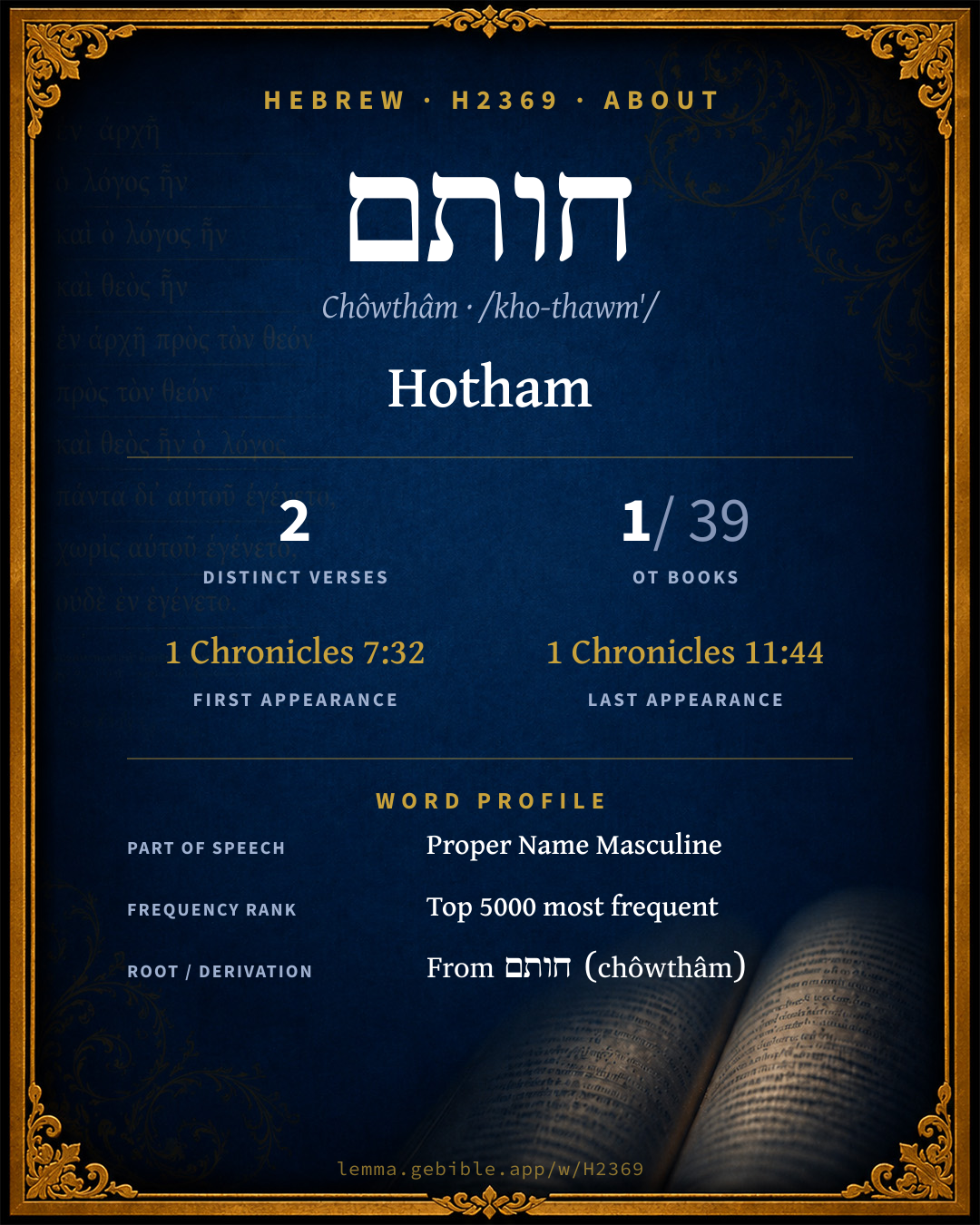
חוֹתָם
Hotham
BDB lists 3 entries for ‘Hotham’ fuller range ↓
Full lexicon entry — Brown-Driver-Briggs (BDB)
From Brown-Driver-Briggs (BDB)
Where this word appears
Grammar key — what these labels mean
Part of speech
- Noun
- A naming word — a person, place, thing, or idea.
Noun type
- Proper
- A name of a specific person, place, or people (e.g. Abraham, Zion, Israel).
Every verse where H2369 appears — 2 distinct verses across 1 book. Click any verse to open its interlinear word-by-word view. Verse text shown in the World English Bible for context — . Each verse’s Hebrew form is shown with its reference; the English is not keyword-highlighted, since the data carries no word-level English alignment. Use “Compare translations” on any verse to read it across multiple English versions. This concordance covers the Hebrew Bible; Septuagint (Greek Old Testament) occurrences are not indexed here.
1 Chronicles 2 verses
About this entry
At a glance — auto-summarized from this page’s data, not written by a person. Every figure links to its source below. This summary describes the numbers; it doesn’t interpret them.
At its core, חותם (Chôwthâm) means “Hotham.” The Hebrew Bible uses it only 2 verses. Its uses cluster heavily in 1 Chronicles (100% of all occurrences). It first appears in 1 Chronicles 7:32. Dig into 2-verse concordance and the renderings breakdown below.
Gloss history
Strong's 1890 vs modern scholarship
About this word
Strong's H2369 catalogs a Hebrew word from the Hebrew Old Testament.
These counts are not copied from any lexicon or concordance. They are computed here, from the morphology-tagged Hebrew Old Testament. What Lemma adds →
- 2
- distinct verses
- The word appears in 2 distinct verses.
- 1 / 39
- OT books
- The word appears in 1 of 39 Old Testament books.
- #4,807
- by frequency
- Top 5000 most frequent Hebrew words (rank 4,807 of 8,640 Hebrew words by occurrence).
View all 2 occurrences in the concordance →
Most concentrated in
- 1 Chronicles 2 verses 100%
By section of the Old Testament
By traditional corpus
Conventional, traditional groupings — biblical authorship is debated, so this is a traditional corpus grouping, not an authorship claim. Each share is this word’s portion of its verses in that division of the Hebrew canon. Each figure is a share of the word’s 2 distinct verses.
- Writings (Ketuvim) 2 verses · 100%
How translations render this word
Counts come from each version’s own published word-to-Strong’s tagging or interlinear alignment — an approximate guide to how each version renders this word, not a word-level alignment the data otherwise carries. Because each total is that version’s own tagged count, the per-version totals vary from one another and need not match the appearance or distinct-verse counts above. These counts may also differ from a printed concordance because Lemma counts each distinctly tagged rendering and does not collapse phrase taggings into a single head-word total. This is a fixed set of word-tagged versions (KJV, ASV, BSB, ULT) and does not change with the reading translation you choose elsewhere. Each version’s license is shown beside its name below (and on Sources).
BDB lists this Strong’s number as 3 distinct words (homographs). Each count above pools all of them and is not split by sense — see the Senses section below. A low-frequency rendering may belong to a different one of those words, not the primary meaning.
- King James Version†: Hotham 1×, Hothan 1×
- American Standard Version†: Hotham 2×
- Berean Standard Bible†: Hotham 2×
- unfoldingWord Literal Text†: Hotham 2×
King James Version Public Domain
Renders H2369 across 2† tagged occurrences — most commonly:
American Standard Version Public Domain
Renders H2369 across 2† tagged occurrences — most commonly:
Berean Standard Bible Public Domain
Renders H2369 across 2† tagged occurrences — most commonly:
unfoldingWord Literal Text CC BY-SA 4.0
Renders H2369 across 2† tagged occurrences — most commonly:
Senses in the full BDB
What do BDB’s symbols mean?
BDB uses these scholarly abbreviations:
| Symbol | Meaning |
|---|---|
| 𝔊 | the Septuagint (the ancient Greek translation, LXX) |
| 𝔙 | the Vulgate (the Latin translation) |
| 𝔖 | the Syriac version (the Peshitta) |
| 𝔗 | the Targum (the Aramaic translation) |
| ψ | the Psalms |
| √ | root (the underlying root or stem) |
| ‖ | parallel passage (a synonymous or contrasted parallel) |
| † | the dagger: every passage where the word occurs is cited |
The 2 senses and sub-senses the full Brown-Driver-Briggs lexicon distinguishes for this word, in lexicon order (not ranked by frequency), with BDB’s own verbatim wording and sub-sense lettering. Shown in Hebrew script with BDB’s own scholarly abbreviations. The condensed entry is in the Lexicon Entry tab. See also the Forms in the corpus table below.
- 1. man of Asher 1 Ch 7:32 𝔊 Χωθαν(μ) (= הֶלֶם v 35; A Ελαμ, 𝔊L Ιασουλ). e.g. 1 Chronicles 7:32
- 2. father of two of David’s heroes 1 Ch 11:44, 𝔊 Κωθαν, 𝔊L Χωθαν. e.g. 1 Chronicles 11:44
Senses from the full Brown-Driver-Briggs lexicon (Brown, Driver, Briggs; Oxford 1906 — public domain), digitized via Sefaria, supplemented by the OpenScriptures HebrewLexicon (CC BY 4.0). Full attribution on Sources.
Word origin
n.m. Jb 41:7 seal, signet-ring (Aramaic ܚܳܬܡܳܐ; Ethiopic ማኅተም —v. LagBN 116)—abs. חֹתָם Ex 28:11 + 2 times; חוֹתָם Je 22:24 + 8 times; sf. חֹתָֽמְךָ Gn 38:18, חֹתָמוֹ 1 K 21:8;—on supposed cstr. חוֹתַם v. foregoing;—seal, signet-ring, hung by a cord (פָּתִיל) about the neck Gn 38:18 (J; = חֹתֶמֶת v 25), or (later?) worn on (finger of) right hand Je 22:24, (BenzArchäol. 106); the two customsappar. combined Ct 8:6 (עַל־לִבֶּ֗ךָ, עַל־זְרוֹעֶךָ); used to attest a royal missive 1 K 21:8 (instr. of vb. חתם); a precious article Hg 2:23 (sim. of Zerubbabel); פִּתּוּחֵי ח׳ engravings of a seal, as model for cutting names and inscr. on precious stones and gold plate Ex 28:11, 21, 26; 39:6, 14, 30 (all P; v. Benz258 ff.); חֹמֶר ח׳ Jb 38:14 = clay of (under) a signet; ח׳ צָ֑ר 41:7 a close signet, i.e. one that is closely pressed down, sim. of closely joined (סָגוּר) scales of crocodile.
— Brown-Driver-Briggs (Oxford 1906, public domain), digitized via Sefaria, supplemented by the OpenScriptures HebrewLexicon (CC BY 4.0). See Sources.
Derived from חותם (chôwthâm) (H2368) — seal.
Jastrow Dictionary
A second Hebrew/Aramaic lexicon for comparison, covering Aramaic and post-biblical (Talmudic, Targumic, Midrashic) usage that the biblical-Hebrew BDB does not. Matched by lemma rather than by Strong’s number, so a lemma may carry more than one Jastrow headword (shown separately below), and the entries cover usage well beyond the Bible.
חוֹתָם
- 1. seal, stamp, die; enclosure locked up with a mark. Sabb. VIII, 5 כח׳ המרצופין as much sealing clay as required for a seal on bags. Ib. ח׳ האיגרות seal on letters. Snh. IV, 5 אדם טובע … בח׳ אחד a human being prints many coins from one die &c., but the Lord טבע … בחוֹתָמוֹ של וכ׳ stamped every human being with the die of Adam, and yet not one is like the other; Y. ib. IV, 22ᵇ bot. מח׳ וכ׳. Sabb. 58ᵃ העבד בח׳ שבצוארו the slave with the mark hanging down from his neck, בח׳ שבכסותו with the mark tied to his garment; a. fr.—Trnsf. sexual innocence; purity. Yalk. Num. 766, v. infra.—Pl. חוֹתָמוֹת, חוֹתָמִים. Y. Snh. l. c.—Bets. 31ᵇ ח׳ שבקרקע וכ׳ knots which serve as marks on doors of subterranean stores, may be untied &c.; a. e.—Tan. d’be El. ch. XX, בחוֹתָמֵיהֶן in their innocence.
- 2. [lock,] the oblate side of a berry to which the stalk is attached. Y. Ab. Zar. V, 44ᵈ top. Toh. X, 5 גרגר … ח׳ a single berry, if its oblate part with the stalk is intact; Tosef. ib. XI, 10. Ib. מקום ח׳ the place where the stalk (now torn out) was seated (and where now juice is oozing out).
- 3. the membraneous enclosure separating the stone of a date from its flesh, pericarp (as far as not eatable). Tosef. Ḥull. I, 23 הח׳ טמא ביבשה quot. by R. S. to Ukts. II, 2 (ed. Zuck. הח׳ omitted; oth. ed. הזיתים in place of the preceding העמים) the pericarp is counted in with the unclean matter in dry dates; Ukts. l. c. ח׳ של יבשה R. S. (ed. a. Maim. חותל).
- 4. concluding formula of prayers.—Pl. as ab. Taan. II, 3 חוֹתָמֵיהֶן. Y. Ber. I, 3ᵈ bot. חוֹתְמוֹתֵיהֶן, v. חִיתּוּם.
A Dictionary of the Targumim, the Talmud Babli and Yerushalmi, and the Midrashic Literature (Marcus Jastrow; London, Luzac, 1903) — Public Domain. Digitized via Sefaria. Digitized via Sefaria. Full attribution on Sources.
Forms in the corpus
The 2 distinct written forms H2369 takes in the Hebrew Bible, most frequent first — each parse links to that state’s occurrences in the concordance. Hebrew forms include their vowel points and cantillation, so a single lemma takes many written forms.
| Form | Parsing | Example | Uses |
|---|---|---|---|
| חוֹתָ֑ם | Noun, Proper | 1 Chronicles 7:32 | 1 |
| חוֹתָ֥ם | Noun, Proper | 1 Chronicles 11:44 | 1 |
Bible dictionary
Public-domain dictionary articles matched to this entry by name (Hotham). A biblical name can be shared by more than one person or place, so an article may treat several.
Smith's Bible Dictionary · William Smith, 1863
(signet ring), a man of Asher, son of Heber, of the family Of Beriah. (1 Chronicles 7:32) (B.C. 1490.)
Hitchcock's Bible Names Dictionary · Roswell D. Hitchcock, 1869
a seal
Classic public-domain reference works; full attribution on Sources.
Septuagint verse parallels
This word appears in 2 verses that also exist in the Greek Old Testament (Septuagint), out of the 2 Hebrew verses it occurs in. You can read those verses in Greek by switching the Old Testament edition to the Septuagint.
Read these verses in the Septuagint
This is a verse-level parallel only — the same verses exist in both the Hebrew and Greek Old Testaments. No word-level Hebrew↔Greek correspondence is claimed: the data carries no such alignment, so no Greek word is shown as this Hebrew word’s translation. Coverage is not total — the Septuagint omits the deuterocanon and renumbers the Psalms, so some Hebrew verses have no direct Greek parallel.