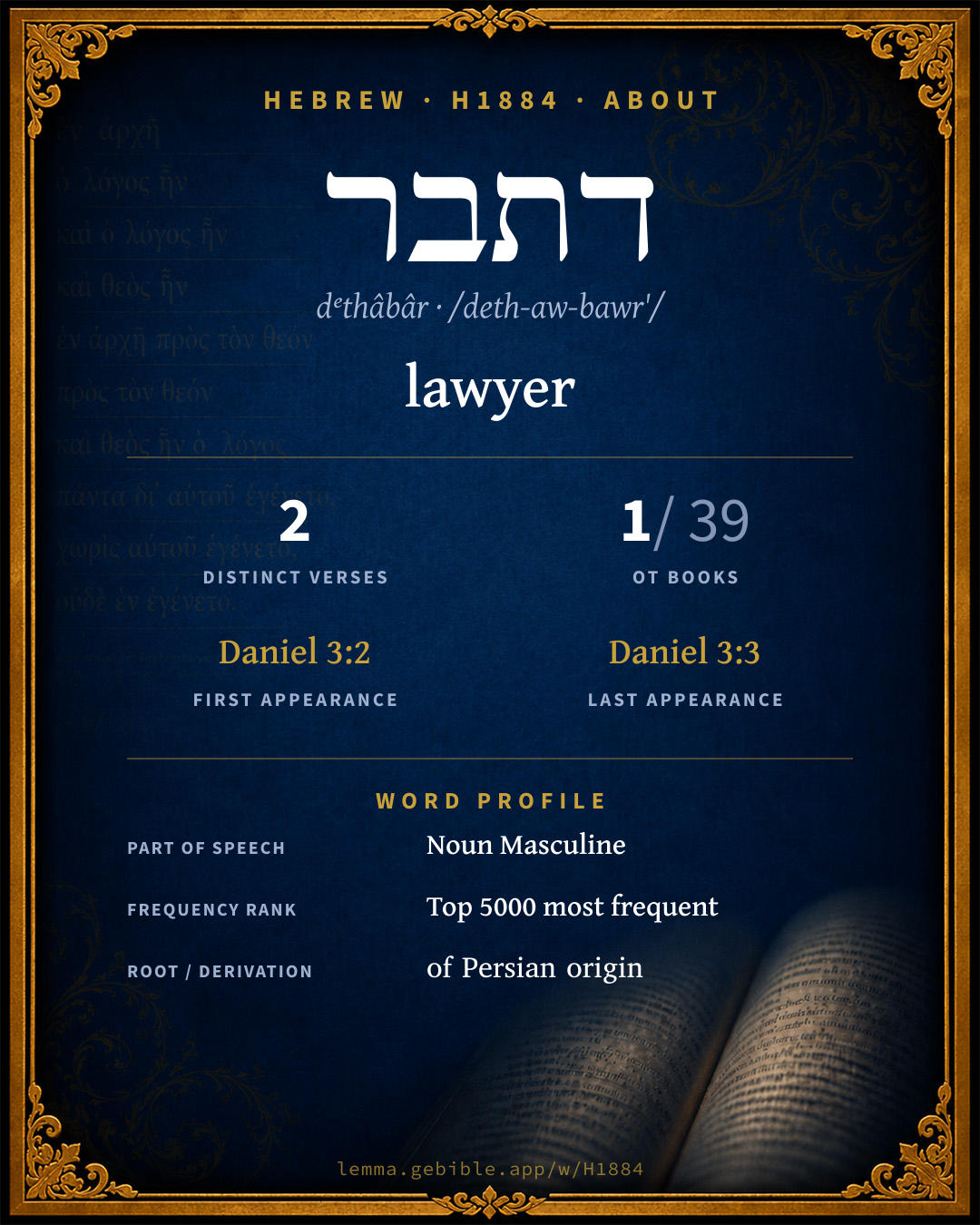
דְּתָבָר
lawyer
Full lexicon entry — Brown-Driver-Briggs (BDB)
From Brown-Driver-Briggs (BDB)
Where this word appears
Every verse where H1884 appears — 2 distinct verses across 1 book. Click any verse to open its interlinear word-by-word view. Verse text shown in the World English Bible for context — . Each verse’s Hebrew form is shown with its reference; the English is not keyword-highlighted, since the data carries no word-level English alignment. Use “Compare translations” on any verse to read it across multiple English versions. This concordance covers the Hebrew Bible; Septuagint (Greek Old Testament) occurrences are not indexed here.
Daniel 2 verses
- Daniel 3:2 דְּתָבְרַיָּ/א֙ n c mp det + ptcl def.art Then Nebuchadnezzar the king sent to gather together the satraps, the deputies, and the governors, the judges, the treasurers, the counselors, the sheriffs, and all the rulers of the provinces, to come to the dedication of the image which Nebuchadnezzar the king had set up.
- Daniel 3:3 דְּתָ֨בְרַיָּ֜/א n c mp det + ptcl def.art Then the satraps, the deputies, and the governors, the judges, the treasurers, the counselors, the sheriffs, and all the rulers of the provinces, were gathered together to the dedication of the image that Nebuchadnezzar the king had set up; and they stood before the image that Nebuchadnezzar had set up.
About this entry
At a glance — auto-summarized from this page’s data, not written by a person. Every figure links to its source below. This summary describes the numbers; it doesn’t interpret them.
The Hebrew noun דתבר centers on the idea of “lawyer.” It is rare — just 2 verses in the entire Hebrew Bible. The word gravitates to Daniel (100%). Debuting at Daniel 3:2, it then recurs through the corpus. Dig into 2-verse concordance and the renderings breakdown below.
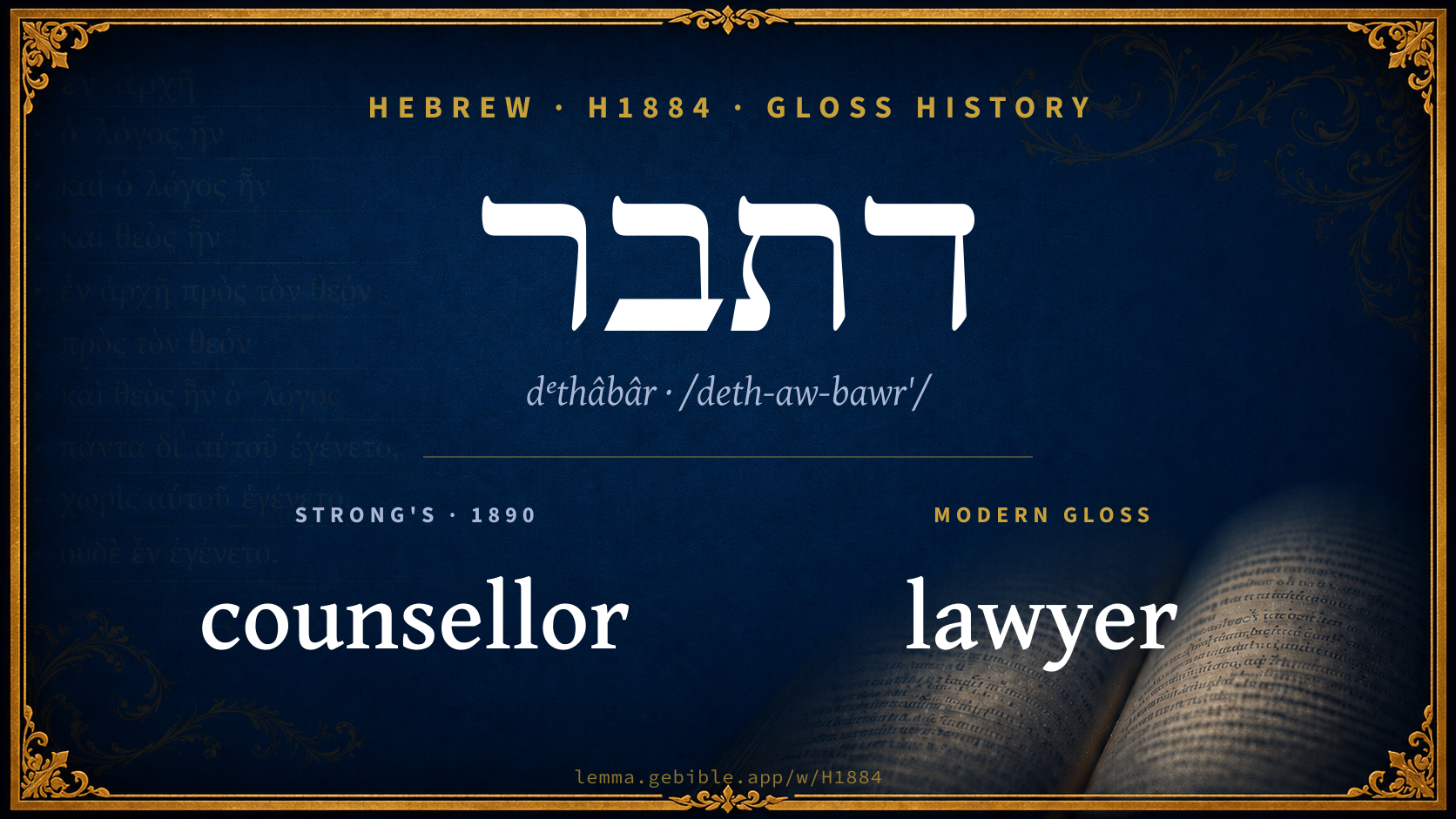
Gloss history
Strong's 1890 vs modern scholarship
About this word
Strong's H1884 catalogs a Hebrew word from the Hebrew Old Testament.
These counts are not copied from any lexicon or concordance. They are computed here, from the morphology-tagged Hebrew Old Testament. What Lemma adds →
- 2
- distinct verses
- The word appears in 2 distinct verses.
- 1 / 39
- OT books
- The word appears in 1 of 39 Old Testament books.
- #4,807
- by frequency
- Top 5000 most frequent Hebrew words (rank 4,807 of 8,640 Hebrew words by occurrence).
View all 2 occurrences in the concordance →
Most concentrated in
- Daniel 2 verses 100%
By section of the Old Testament
By traditional corpus
Conventional, traditional groupings — biblical authorship is debated, so this is a traditional corpus grouping, not an authorship claim. Each share is this word’s portion of its verses in that division of the Hebrew canon. Each figure is a share of the word’s 2 distinct verses.
- Writings (Ketuvim) 2 verses · 100%
How translations render this word
Counts come from each version’s own published word-to-Strong’s tagging or interlinear alignment — an approximate guide to how each version renders this word, not a word-level alignment the data otherwise carries. Because each total is that version’s own tagged count, the per-version totals vary from one another and need not match the appearance or distinct-verse counts above. These counts may also differ from a printed concordance because Lemma counts each distinctly tagged rendering and does not collapse phrase taggings into a single head-word total. This is a fixed set of word-tagged versions (KJV, ASV, BSB, ULT) and does not change with the reading translation you choose elsewhere. Each version’s license is shown beside its name below (and on Sources).
- King James Version: Counsellors 2×
- American Standard Version: Counsellors 2×
- Berean Standard Bible: Judges 2×
- unfoldingWord Literal Text: Judges 2×
King James Version Public Domain
Renders H1884 across 2 tagged occurrences — most commonly:
American Standard Version Public Domain
Renders H1884 across 2 tagged occurrences — most commonly:
Berean Standard Bible Public Domain
Renders H1884 across 2 tagged occurrences — most commonly:
unfoldingWord Literal Text CC BY-SA 4.0
Renders H1884 across 2 tagged occurrences — most commonly:
Senses in BDB
The 1 sense BDB distinguishes for this word, in lexicon order (not ranked by frequency or importance). The full entry — with sub-senses — is in the Lexicon Entry tab.
- lawyer, interpreter of decrees, judge
Word origin
[ דְּתָבָר ] n.m. judge (loan-word fr. Pers. dâtabara, law-bearer, judge )
— Brown-Driver-Briggs (Oxford 1906, public domain), digitized via Sefaria, supplemented by the OpenScriptures HebrewLexicon (CC BY 4.0). See Sources.
Origin: of Persian origin
Jastrow Dictionary
A second Hebrew/Aramaic lexicon for comparison, covering Aramaic and post-biblical (Talmudic, Targumic, Midrashic) usage that the biblical-Hebrew BDB does not. Matched by lemma rather than by Strong’s number, so a lemma may carry more than one Jastrow headword (shown separately below), and the entries cover usage well beyond the Bible.
מִתְבְּרָא
- , pl. (תְּבַר) מִתְבְּרִין = b. h. מִשְׁבָּרִים, breakers, waves. Targ. Ps. XLII, 8.
תָּבַר
- , v. תָּפַר
תְּבַר
- = h. שָׁבַר, to break. Targ. Gen. XIX, 9. Targ. Jer. XIX, 10; a. fr.—Part. pass. תְּבִיר; f. תְּבִירָא; pl. תְּבִירִין; תְֹּבִירָן. Targ. Ps. XXXI, 13. Targ. Jer. II, 13; a. fr.; v. תְּבִירָא II.—B. Kam. 10ᵇ בהדי דסמיך בהו ת׳ (not דסמוך) while he leaned on them, he broke (the bench).
- same. Targ. Ex. IX, 25 (ed. Vien. תְּבַר; Y. תְּבִיר). Targ. Ps. XXIX, 5 Ms. (ed. מַתְבַּר Af.). Targ. Ex. XXIII, 24. Targ. Jer. I, 17; a. fr.—Yoma 78ᵇ תַּבּוּרֵי מאני breaking of vessels (as a child’s pleasure). Ib. זבין … ומְתַבְּרֵי להו (v. Rabb. D. S. a. l. note 100) bought defective vessels for his children, and they broke them, v. גְּזַז; a. e.—[Y. Sabb. VII, 10ᵃ bot. מתברא בצדדיא, read: מבחרא בצרריא, v. צְרָרָא II.]
- ; Ithpe. אִתְתְּבַר, אִתְּבַר (אִתְבַּר) to be broken. Targ. Jon. I, 4. Targ. Ex. XXII, 9 (Y. ed. Vien. אִיתְבִיר). Ib. 12 (h. text יטרף). Targ. Jer. XXIII, 9. Targ. Prov. XIV, 28 (h. text מחתת); a. fr.—Ber. 22ᵃ, v. חַצְבָּא. B. Kam. l. c. דבלאו איהו לא א׳ if without him (sitting on it), it would not have been broken. Ib. בלאו איהו הוה מִיתְּבַר וכ׳ without him, it would have broken down after two hours; a. e.
תְּבַר ²
- (preced.)
- 1. break, fracture; breach, misfortune. Targ. Lev. XXIV, 20. Targ. O. ib. XXI, 19, v. תְּבִיר. Targ. Job VI, 21; a. fr.—Taan. 31ᵃ וקרי ליה יום ת׳ מגל and it is called the day of breaking the axe; Lam. R. introd. (R. Z’ʿera).
- 2. contradiction. Gen. R. s. 30 אף היא לא ת׳ this, too, is no contradiction of the rule; Esth. R. to II, 5 תַּבְרָה. Sabb. 92ᵇ; B. Kam. 47ᵇ, a. fr. ת׳ מי ששנה זו וכ׳ there is a contradiction (between the two clauses of the Mishnah); he that taught the one &c., v. שָׁנָה I; [R. Ḥănanel: excommunication (v. infra), meant as an imprecation].
- 3. refutation, answer. Kidd. 74ᵇ (in Hebr. dict.) א"כ מצידה תַּבְרָהּ (Var. in Ar. s. v. צד: מצמדה) if this be so, its refutation is taken from what is next to it.
- 4. = h. שׁוֹבֵר, receipt. B. Bath. 173ᵃ ונחזי ת׳ … דכתיב let us see in whose name the receipt is written.
- 5. pl. תַּבְרֵי = h. שְׁבָרִים (v. שֶׁבֶר) the broken sounds of the Shofar on proclaiming the excommunication of a person. M. Kat. 17ᵇ מאי ת׳ … תברי וכ׳ Rashi (ed. incorr. תברא) why is the blowing of the Shofar at excommunications called tabré (breaks)?… They break down high houses.
A Dictionary of the Targumim, the Talmud Babli and Yerushalmi, and the Midrashic Literature (Marcus Jastrow; London, Luzac, 1903) — Public Domain. Digitized via Sefaria. Digitized via Sefaria. Full attribution on Sources.
Forms in the corpus
The 2 distinct written forms H1884 takes in the Hebrew Bible, most frequent first — each parse links to that state’s occurrences in the concordance. Hebrew forms include their vowel points and cantillation, so a single lemma takes many written forms.
| Form | Parsing | Example | Uses |
|---|---|---|---|
| דְּתָ֨בְרַיָּ֜/א | Particle, Definite Article | Daniel 3:3 | 1 |
| דְּתָבְרַיָּ/א֙ | Particle, Definite Article | Daniel 3:2 | 1 |
Septuagint verse parallels
This word appears in 2 verses that also exist in the Greek Old Testament (Septuagint), out of the 2 Hebrew verses it occurs in. You can read those verses in Greek by switching the Old Testament edition to the Septuagint.
Read these verses in the Septuagint
This is a verse-level parallel only — the same verses exist in both the Hebrew and Greek Old Testaments. No word-level Hebrew↔Greek correspondence is claimed: the data carries no such alignment, so no Greek word is shown as this Hebrew word’s translation. Coverage is not total — the Septuagint omits the deuterocanon and renumbers the Psalms, so some Hebrew verses have no direct Greek parallel.