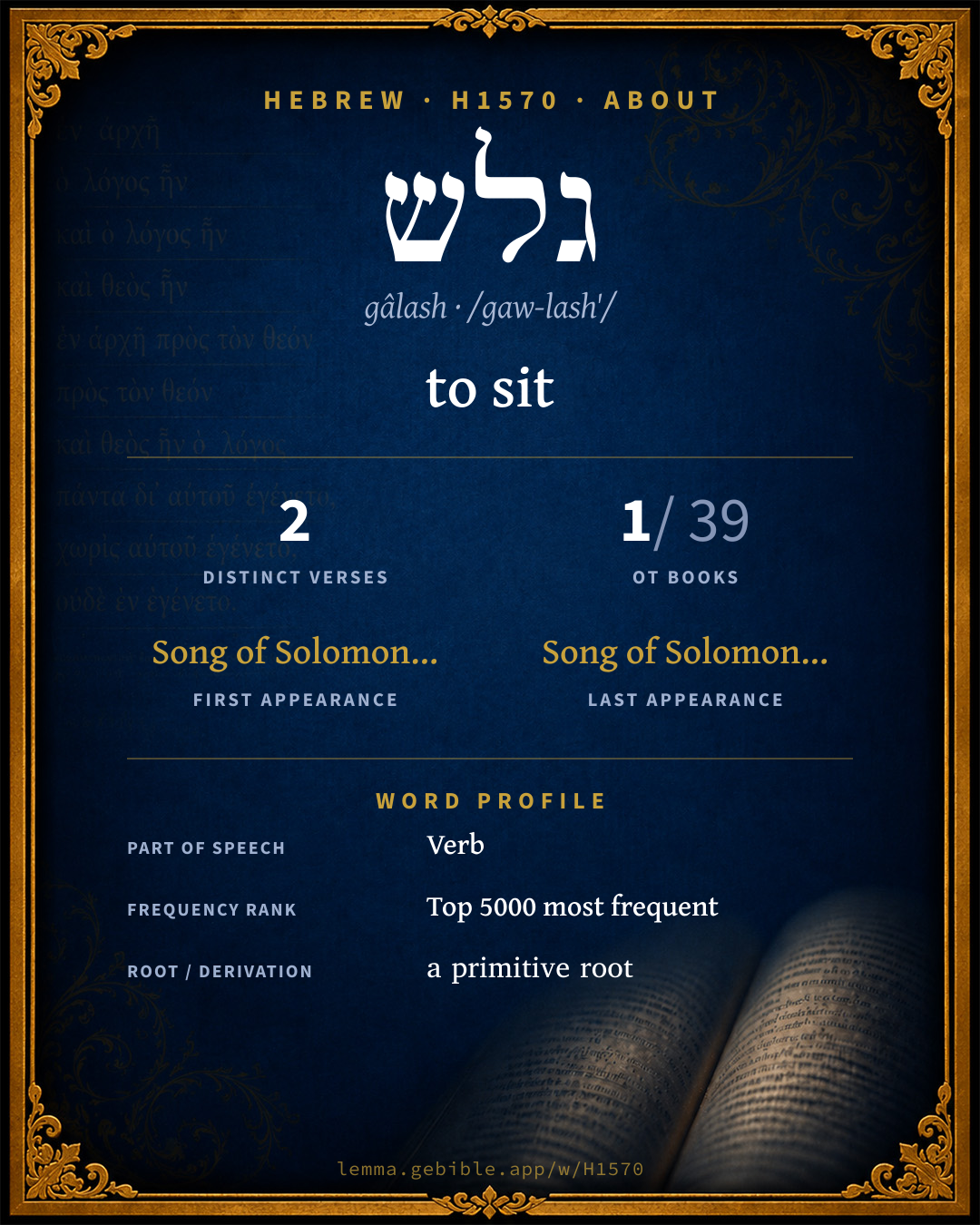
גָּלַשׁ
to sit
also: sit up, recline fuller range ↓
Full lexicon entry — Brown-Driver-Briggs (BDB)
From Brown-Driver-Briggs (BDB)
Where this word appears
Grammar key — what these labels mean
Stem
- Qal
- The basic, simple active stem — the plain form of the verb (“he wrote”).
Form
- Perfect
- A completed action or state — Hebrew marks aspect (completeness) more than strict tense (“he wrote”).
Person
- 3rd Person
- The one spoken about (“he / she / it / they”).
Gender
- Common
- Either gender — not distinguished for this form.
Number
- Plural
- More than one (in Hebrew, generally three or more).
Every verse where H1570 appears — 2 distinct verses across 1 book. Click any verse to open its interlinear word-by-word view. Verse text shown in the World English Bible for context — . Each verse’s Hebrew form is shown with its reference; the English is not keyword-highlighted, since the data carries no word-level English alignment. Use “Compare translations” on any verse to read it across multiple English versions. This concordance covers the Hebrew Bible; Septuagint (Greek Old Testament) occurrences are not indexed here.
Song of Solomon 2 verses
- Song of Solomon 4:1 שֶׁ/גָּלְשׁ֖וּ ptcl rel + Qal pf 3cp Behold, you are beautiful, my love. Behold, you are beautiful. Your eyes are doves behind your veil. Your hair is as a flock of goats, That descend from Mount Gilead.
- Song of Solomon 6:5 שֶׁ/גָּלְשׁ֖וּ ptcl rel + Qal pf 3cp Turn away your eyes from me, For they have overcome me. Your hair is like a flock of goats, That lie along the side of Gilead.
About this entry
At a glance — auto-summarized from this page’s data, not written by a person. Every figure links to its source below. This summary describes the numbers; it doesn’t interpret them.
The Hebrew verb גלש centers on the idea of “to sit.” The Hebrew Bible uses it only 2 verses. The word gravitates to Song of Solomon (100%). Debuting at Song of Solomon 4:1, it then recurs through the corpus. BDB distinguishes 3 senses; alongside “to sit” it spans “sit up” and “recline”. Dig into 2-verse concordance and the renderings breakdown below.
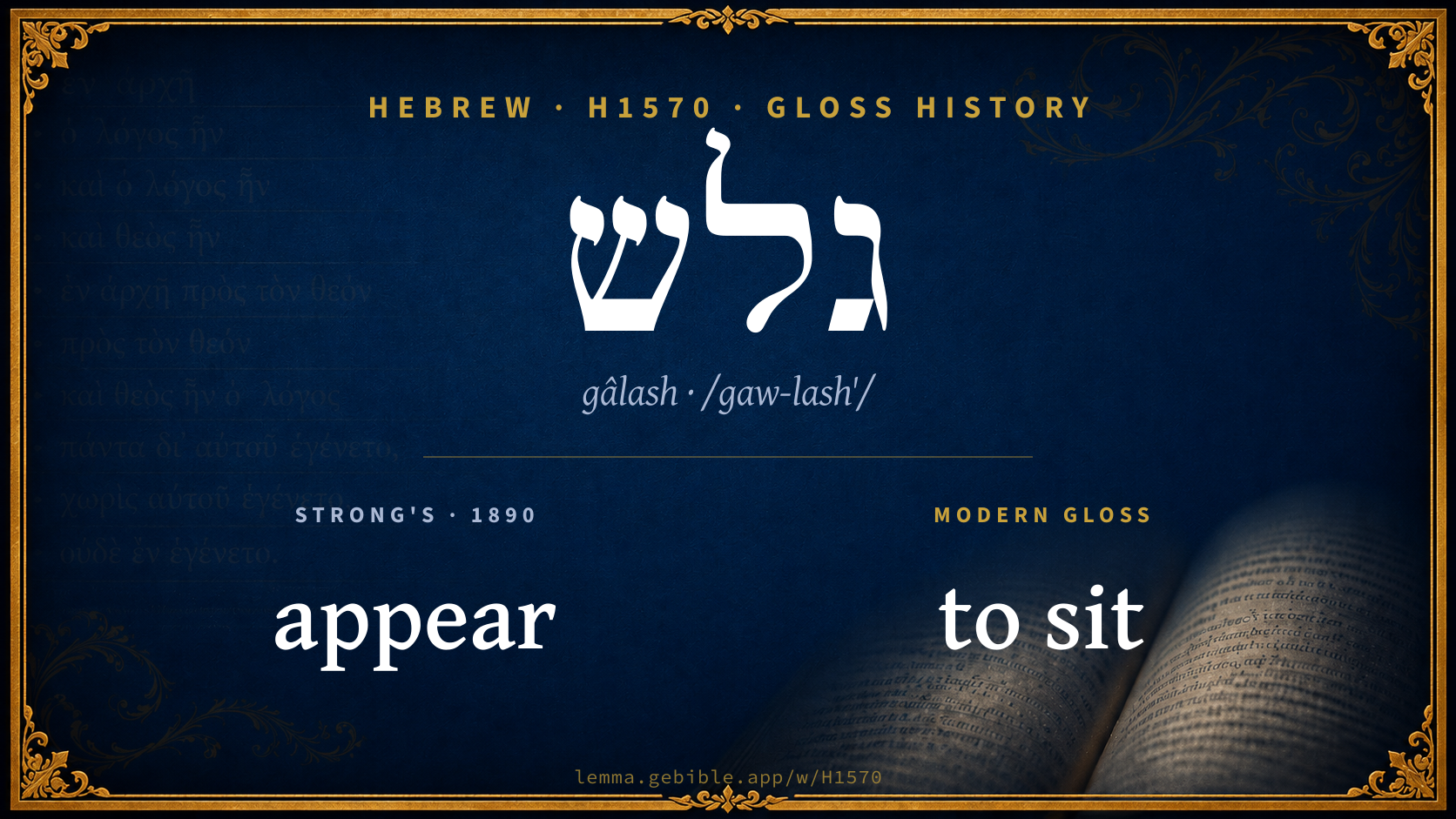
Gloss history
Strong's 1890 vs modern scholarship
About this word
Strong's H1570 catalogs a Hebrew word from the Hebrew Old Testament.
These counts are not copied from any lexicon or concordance. They are computed here, from the morphology-tagged Hebrew Old Testament. What Lemma adds →
- 2
- distinct verses
- The word appears in 2 distinct verses.
- 1 / 39
- OT books
- The word appears in 1 of 39 Old Testament books.
- #4,807
- by frequency
- Top 5000 most frequent Hebrew words (rank 4,807 of 8,640 Hebrew words by occurrence).
View all 2 occurrences in the concordance →
Most concentrated in
- Song of Solomon 2 verses 100%
By section of the Old Testament
By traditional corpus
Conventional, traditional groupings — biblical authorship is debated, so this is a traditional corpus grouping, not an authorship claim. Each share is this word’s portion of its verses in that division of the Hebrew canon. Each figure is a share of the word’s 2 distinct verses.
- Writings (Ketuvim) 2 verses · 100%
How translations render this word
Counts come from each version’s own published word-to-Strong’s tagging or interlinear alignment — an approximate guide to how each version renders this word, not a word-level alignment the data otherwise carries. Because each total is that version’s own tagged count, the per-version totals vary from one another and need not match the appearance or distinct-verse counts above. These counts may also differ from a printed concordance because Lemma counts each distinctly tagged rendering and does not collapse phrase taggings into a single head-word total. This is a fixed set of word-tagged versions (KJV, ASV, BSB, ULT) and does not change with the reading translation you choose elsewhere. Each version’s license is shown beside its name below (and on Sources).
- King James Version: Appear 2×
- American Standard Version: Lie 2×
- Berean Standard Bible: Streaming down 2×
- unfoldingWord Literal Text: Hop down 2×
King James Version Public Domain
Renders H1570 across 2 tagged occurrences — most commonly:
American Standard Version Public Domain
Renders H1570 across 2 tagged occurrences — most commonly:
Berean Standard Bible Public Domain
Renders H1570 across 2 tagged occurrences — most commonly:
unfoldingWord Literal Text CC BY-SA 4.0
Renders H1570 across 2 tagged occurrences — most commonly:
Senses in BDB
The 3 senses BDB distinguishes for this word, in lexicon order (not ranked by frequency or importance). The full entry — with sub-senses — is in the Lexicon Entry tab.
- to sit, sit up, (possibly also) recline
(Qal)
- of flocks of goats
- of a woman's hair (simile)
Word origin
[ גָּלַשׁ ] vb. sit, sit up, possibly also recline
— Brown-Driver-Briggs (Oxford 1906, public domain), digitized via Sefaria, supplemented by the OpenScriptures HebrewLexicon (CC BY 4.0). See Sources.
Origin: a primitive root
Jastrow Dictionary
A second Hebrew/Aramaic lexicon for comparison, covering Aramaic and post-biblical (Talmudic, Targumic, Midrashic) usage that the biblical-Hebrew BDB does not. Matched by lemma rather than by Strong’s number, so a lemma may carry more than one Jastrow headword (shown separately below), and the entries cover usage well beyond the Bible.
גָּלַשׁ
- 1. to come in sight, to come forth. Cant. R. to IV, 1 (ref. to שגלשו מהר וכ׳ ib.) הר שגלשתן מתוכה עשיתיו גלעד לאו"ה (not … תי) the mountain (of trouble) out of which ye came in sight again (ye escaped), I (the Lord) made it a hill of witness (a warning) to the nations; אי זה זה ים סוף what is this? It is the Red Sea [which R. Joshua … translated into Chaldean: טורא דאתנהרתון מן גווה]; ib. to IV, 4 הר שג׳ … הר סיני I made your escape memorable to the nations, it is Mount Sinai (by the giving of the Law); ib. repeatedly (referring to various escapes from dangers).
- to bring to light, to publish. Ib. to IV, 1 ומה הגלשה הִגְלַשְׁתִּי וכ׳ (Ar. ed. Koh. גלשה) and what publication (institution or law) have I (the Lord) brought to light out of that event?
- (denom. of גֶּלֶשׁ baldness) to be made hot enough for scalding the hair or feathers of an animal’s skin. Part. מוּגְלָשׁ, pl. מוּגְלָשִׁין seething water. Pes. 37ᵇ (Rabad to Eduy. V, 2 quotes a version מַגְלוֹשִׁין scalding water, Ar. מֵי גְלָשִׁים, fr. גֶּלֶשׁ; Y. Ḥall. I, 58ᵃ top חַמִּין).
גְּלַשׁ
- ; to shine, be bald; v. גְּלוֹשׁ, גְּלוֹשׁוּתָא &c.—Part. pass. גְּלִישׁ = h. מוּגְלָשׁ (v. preced.) brought to scalding heat, boiling over. Koh. R. to VIII, 9, v. גִּיסָא III.
*גֶּלֶשׁ
- (preced.) baldness. Pl. גְּלָשִׁים. מֵי גְ׳ scalding water, v. גָּלַשׁ Hof.
A Dictionary of the Targumim, the Talmud Babli and Yerushalmi, and the Midrashic Literature (Marcus Jastrow; London, Luzac, 1903) — Public Domain. Digitized via Sefaria. Digitized via Sefaria. Full attribution on Sources.
Septuagint verse parallels
This word appears in 2 verses that also exist in the Greek Old Testament (Septuagint), out of the 2 Hebrew verses it occurs in. You can read those verses in Greek by switching the Old Testament edition to the Septuagint.
Read these verses in the Septuagint
This is a verse-level parallel only — the same verses exist in both the Hebrew and Greek Old Testaments. No word-level Hebrew↔Greek correspondence is claimed: the data carries no such alignment, so no Greek word is shown as this Hebrew word’s translation. Coverage is not total — the Septuagint omits the deuterocanon and renumbers the Psalms, so some Hebrew verses have no direct Greek parallel.