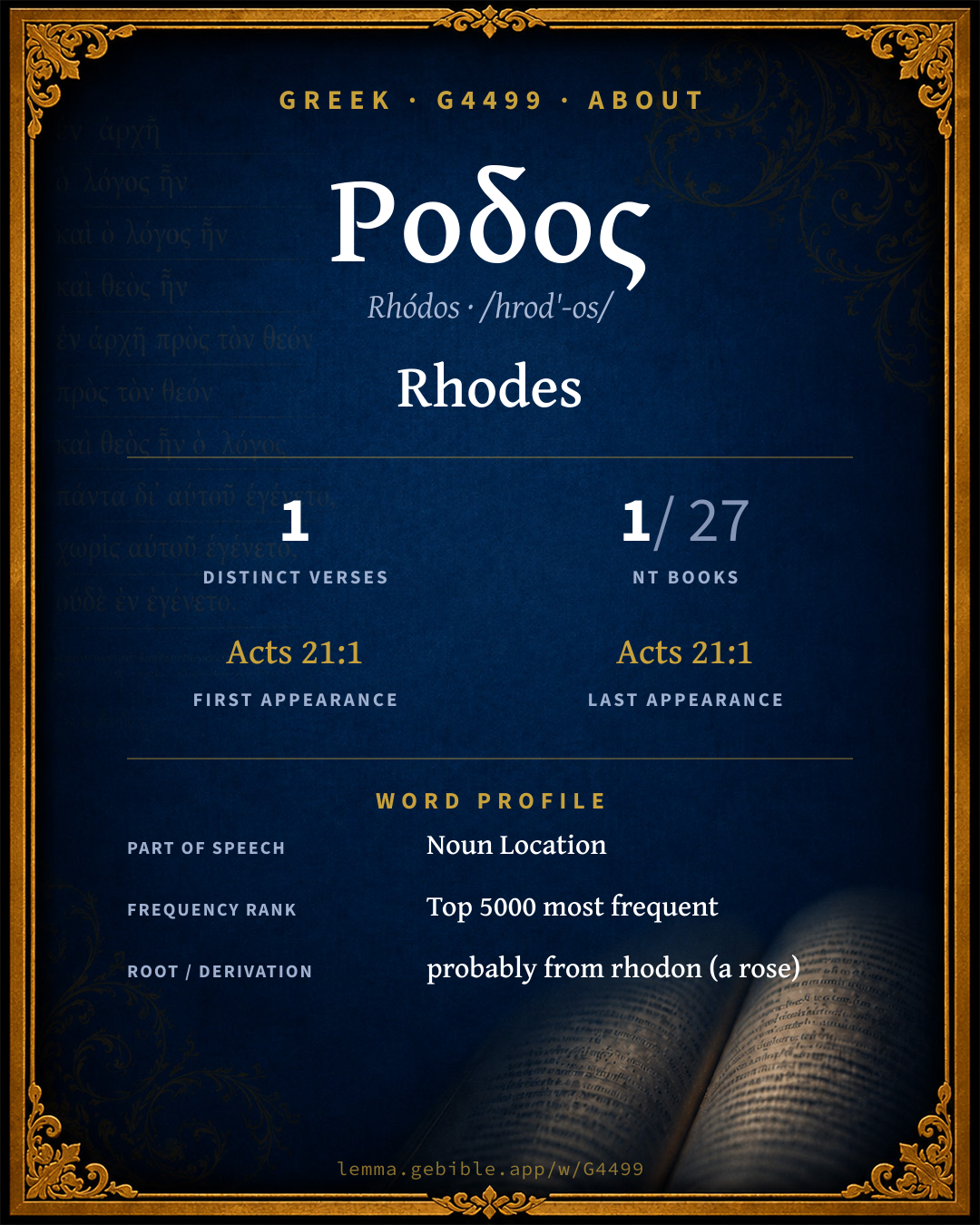
Ῥόδος
Rhodes
Thayer's lists 2 entries for ‘Rhodes’ fuller range ↓
Full lexicon entry — Thayer's Greek Lexicon
From Thayer's Greek Lexicon
Where this word appears
Grammar key — what these labels mean
Part of speech
- Noun
- A naming word — a person, place, thing, or idea.
Case
- Accusative
- The case of the direct object and of extent.
Gender
- Feminine
- Grammatically feminine.
Number
- Singular
- One.
Every verse where G4499 appears — 1 distinct verse across 1 book. Click any verse to open its interlinear word-by-word view. Verse text shown in the World English Bible for context — . Each verse’s Greek form is shown with its reference; the English is not keyword-highlighted, since the data carries no word-level English alignment. Use “Compare translations” on any verse to read it across multiple English versions. This concordance covers the Greek New Testament; Septuagint (Greek Old Testament) occurrences of this word are not indexed here.
Acts 1 verse
About this entry
At a glance — auto-summarized from this page’s data, not written by a person. Every figure links to its source below. This summary describes the numbers; it doesn’t interpret them.
The Greek name Ροδος centers on the idea of “Rhodes.” It occurs a mere 1 verse across Scripture. Acts dominates its distribution — 1 of 1 verses. A true hapax — its single appearance is Acts 21:1. For the data behind this summary, explore 1-verse concordance and the renderings breakdown below.
Gloss history
Strong's 1890 vs modern scholarship
About this word
Strong's G4499 catalogs a Greek word from the Greek New Testament.
These counts are not copied from any lexicon or concordance. They are computed here, from the morphology-tagged Greek New Testament. What Lemma adds →
- 1
- distinct verses
- The word appears in 1 distinct verse.
- 1 / 27
- NT books
- The word appears in 1 of 27 New Testament books.
- #3,503
- by frequency
- Top 5000 most frequent Greek words (rank 3,503 of 5,347 Greek words by occurrence).
View all 1 occurrence in the concordance →
Most concentrated in
- Acts 1 verse 100%
By section of the New Testament
By traditional corpus
Conventional, traditional groupings — biblical authorship is debated, so this is a traditional corpus grouping, not an authorship claim. Some books belong to more than one corpus (Luke is in both the Gospels and the Lukan corpus, and so on), so these shares overlap and need not total 100%. Each figure is a share of the word’s 1 distinct verse.
- Lukan (Luke–Acts) 1 verse · 100%
How translations render this word
Counts come from each version’s own published word-to-Strong’s tagging or interlinear alignment — an approximate guide to how each version renders this word, not a word-level alignment the data otherwise carries. Because each total is that version’s own tagged count, the per-version totals vary from one another and need not match the appearance or distinct-verse counts above. These counts may also differ from a printed concordance because Lemma counts each distinctly tagged rendering and does not collapse phrase taggings into a single head-word total. This is a fixed set of word-tagged versions (KJV, ASV, BSB, ULT) and does not change with the reading translation you choose elsewhere. Each version’s license is shown beside its name below (and on Sources).
- King James Version: Rhodes 1×
- American Standard Version: Rhodes 1×
- Berean Standard Bible: Rhodes 1×
- unfoldingWord Literal Text: Rhodes 1×
King James Version Public Domain
Renders G4499 across 1 tagged occurrence — most commonly:
American Standard Version Public Domain
Renders G4499 across 1 tagged occurrence — most commonly:
Berean Standard Bible Public Domain
Renders G4499 across 1 tagged occurrence — most commonly:
unfoldingWord Literal Text CC BY-SA 4.0
Renders G4499 across 1 tagged occurrence — most commonly:
Senses in Thayer's
The 2 senses Thayer's distinguishes for this word, in lexicon order (not ranked by frequency or importance). The full entry — with sub-senses — is in the Lexicon Entry tab.
- Rhodes = "rosy"
- a well known island of the Cyclades opposite Caria and Lycia, with a Rhodes as the capital city
Word origin
Origin: probably from rhodon (a rose)
Probably from ῥόδον rhodon (a rose ); Rhodus an island of the mediterranean : - Rhodes.
— Strong’s Exhaustive Concordance (1890), public domain.
Bible dictionary
Public-domain dictionary articles matched to this entry by name (Rhodes). A biblical name can be shared by more than one person or place, so an article may treat several.
Easton's Bible Dictionary · M. G. Easton, 1897
A rose, an island to the south of the western extremity of Asia Minor, between Coos and Patara, about 46 miles long and 18 miles broad. Here the apostle probably landed on his way from Greece to Syria (Acts 21:1), on returning from his third missionary journey.
Smith's Bible Dictionary · William Smith, 1863
(rosy), a celebrated island in the Mediterranean Sea. (It is triangular in form, 60 miles long from north to south, and about 18 wide. It is noted now, as in ancient times, for its delightful climate and the fertility of its soil. The city of Rhodes, its capital, was famous for its huge brazen statue of Apollo called the Colossus of Rhodes. It stood at the entrance of the harbor, and was so large that ships in full sail could pass between its legs. ED.) Rhodes is immediately opposite the high Carian and Lycian headlands at the southwest extremity of the peninsula of Asia Minor. Its position had much to do with its history. Its real eminence began about 400 B.C. with the founding of the city of Rhodes, at the northeast extremity of the island, which still continues to be the capital. After Alexander's death it entered on a glorious period, its material prosperity being largely developed, and its institutions deserving and obtaining general esteem. We have notice of the Jewish residents in Rhodes in 1 Macc. 15:23. The Romans, after the defeat of Antiochus, assigned, during some time, to Rhodes certain districts on the mainland. Its Byzantine, history is again eminent. Under Constantine If was the metropolis of the "Province of the Islands," It was the last place where the Christians of the East held out against the advancing Seracens; and subsequently it was once more famous as the home and fortress of the Knights of St. John. (It is now reduced to abject poverty. There are two cities--Rhodes the capital and Lindus--and forty or fifty villages. The population, according to Turner is 20,000, of whom 6000 are Turks and the rest Greeks, together with a few Jews.)
Hitchcock's Bible Names Dictionary · Roswell D. Hitchcock, 1869
same as Rhoda
Classic public-domain reference works; full attribution on Sources.